
TL;DR
In December 2025, Belarusian state media continued their systematic coverage of Poland and the Baltic states, all within the context of persistent propaganda narratives. This report presents the results of automated monitoring and AI analysis of 6,678 unique materials published by the main Belarusian state media between December 1 and December 31, 2025.
Of the total dataset, 664 materials underwent in-depth AI analysis and disinformation risk assessment. The average classifier confidence was 80.7%, demonstrating the sufficient reliability of the automatic categorization.
Methodology
The study is based on monitoring the main sources of Belarusian state media: the BelTA news agency, SB.BY “Belarus Today,” and the YouTube channels of state television companies—STV, ONT, BelTA, SB TV, and NEWS.BY. For each piece, the relevance of mentions of neighboring countries was determined, the threat score was assessed, and algorithms for identifying publication coordination were applied.
An in-depth analysis was conducted using machine learning models to classify disinformation risks into three levels: LOW, MEDIUM, and HIGH. Each piece was assessed for factual distortions, emotional manipulation, logical errors, and other disinformation techniques. The study utilizes a Retrieval-Augmented Generation (RAG) architecture, combining pgvector semantic search across 750,000+ Belarusian media documents (2019-2026) with Hypothetical Document Embedding, source balancing, and LLM verification. Data collection is performed using the Oxylabs web scraper provided as part of the program.Project 4βFor research projects. Video content is transcribed via AssemblyAI, allowing YouTube to be included in the analysis alongside text sources.
Key results
Distribution of disinformation risks
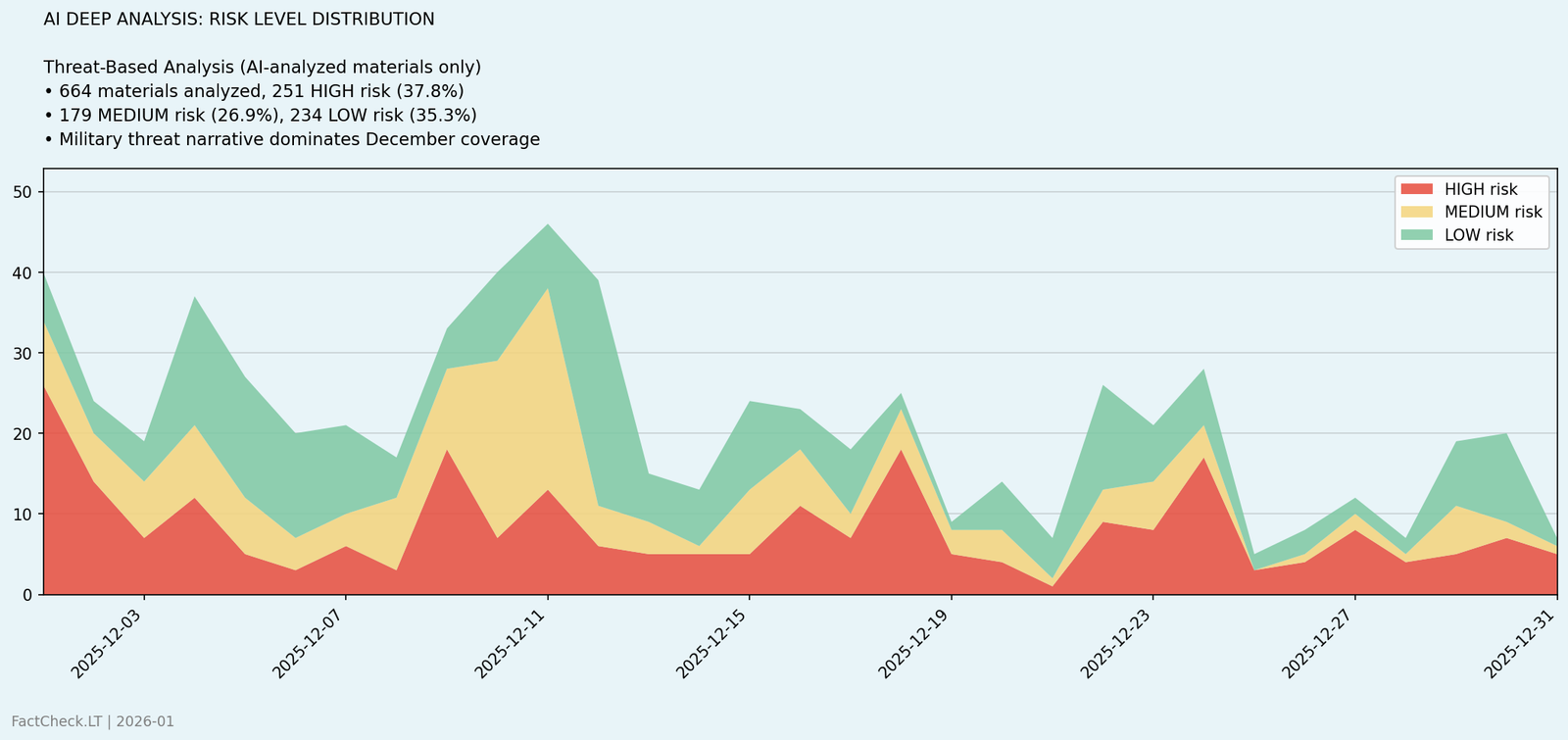
Of the 664 materials analyzed:
- HIGH risk: 251 materials (37.8%)
- MEDIUM risk: 179 materials (26.9%)
- LOW risk: 234 materials (35.3%)
Thus, more than a third of Belarusian state media coverage of neighboring countries contains signs of a high risk of disinformation—significant factual distortions, emotional manipulation, or deliberate misleading of the audience.
Average
Short
Medium risk
Low risk
Threat from Lithuania
Polish aggression
EU crisis
Provocations on the border
Degradation of the Baltics
Mining of bridges
Euroscepticism in Poland
Ukrainian crime
Economic crisis
NATO on the borders
Drones
Nuclear threat
Russophobia
Smuggling
Weather balloons
Border closures
The collapse of medicine
Unemployment
Types of manipulations identified
The analysis identified the following information manipulation techniques:
- Factual distortions: 433 cases (38.9%) – exaggeration, taking out of context, distortion of statistics
- Emotional manipulation: 345 cases (31.0%) – fear-mongering, alarmism, appeal to negative emotions
- Logical errors: 210 cases (18.9%) – false dilemmas, substitution of thesis, erroneous generalizations
- Dehumanization: 75 cases (6.7%) – offensive characteristics of peoples or politicians
- Whataboutism: 42 cases (3.8%) – distraction of attention to the “sins” of the criticized party
- Conspiracy: 7 cases (0.6%) – promotion of conspiracy theories
Coordination of publications
Fifty coordinated information events were recorded over 29 days, with an average of 7.4 materials per event. This indicates centralized planning and synchronization of information campaigns across various state media outlets.
The most active participants in the coordination were:
- BelTA: 47 coordinated publications
- SB. Belarus Today: 40 publications
- STV YouTube channel: 19 publications
- SB TV YouTube channel: 15 publications
- ONT YouTube channel: 13 publications
A peak coordination event has occurred.December 11, 2025 — 38 synchronized materials on the topic of “military threat” from neighboring countries.
Timing: text vs video
An analysis of 83 pairs of publications (text media and YouTube) revealed:
- Text one (📰→📺): 38 cases (45.8%)
- At the same time (⚡): 32 cases (38.6%)
- Video one (📺→📰): 13 cases (15.7%)
Textual sources (BelTA, SB) often act as the primary disseminators of narratives, while YouTube channels amplify and emotionally package these narratives for a mass audience.
Fact check: verification of key statements
1. Mining of bridges in Lithuania
Claim by Belarusian media: “Lithuania is equipping bridges along the border with Belarus with structures for attaching explosives.”
AI Rating: ❌ LIKELY FALSE
Verification: THE STATEMENT IS FACTUALLY TRUE, but presented without context.
Indeed, the Lithuanian Ministry of Defense has confirmed that bridges are being prepared for possible detonation. According to an official statement from the Lithuanian Armed Forces to the LRT portal on December 30, 2025, the bridges are being equipped with “engineering structures for attaching explosive materials” to ensure the rapid destruction of crossings in the event of a military conflict.
External sources:
- LRT: Lithuania preps bridges for demolition on Belarus, Russia borders(December 30, 2025)
- Newsweek: Map Shows NATO Nation Turning Border With Russia Ally into a Minefield(06.01.2026)
- Defense News: Lithuania to lay antitank mines along its borders with Belarus, Russia(06.05.2025)
- Army Recognition: Poland and Baltic States to start mining borders(20.03.2025)
- The Defense Post: Lithuania to Spend $1.2B to Fortify Russia, Belarus Border(05.05.2025)
- Charter97: Lithuania Prepares Bridges On The Border With Belarus To Be Blown Up(December 30, 2025)
Context omitted by Belarusian media:
- The measures are part of the Baltic Defence Line project, a joint defence initiative between Lithuania, Latvia and Estonia, approved in January 2024.
- Preparations are also underway on the border with Russia’s Kaliningrad region.
- Work is being carried out at more than 20 infrastructure facilities
- Lithuania to invest €1.2 billion in border strengthening, including €800 million in anti-tank mines
- Explosives are not used and will not be used in peacetime.
Conclusion:
Belarusian media portray NATO’s actual defensive measures as “aggression” without explaining the context of the Russian threat and its use of Belarus as a springboard for an invasion of Ukraine in 2022.
2. Military expenditures of Poland
Claim by Belarusian media: “Poland’s defense spending accounts for almost 5% of GDP.”
AI Rating:❓ CHECK (requires verification)
Verification: EXAGGERATION
According to NATO and the Wilson Center, Poland’s defense spending in 2025 will amount to4.7% of GDP (186.6 billion zlotys, approximately $45 billion). This is indeed a record figure among NATO countries in terms of GDP share, but the claim of “almost 5%” is an exaggeration.
External sources:
- Wilson Center: Poland’s Rise as NATO’s Defense Spending Leader
- Euronews: Poland’s president vows to spend 4.7% of GDP on defense(05.02.2025)
- Notes from Poland: Poland largest relative defense spender in NATO(02.09.2025)
- Statista: NATO defense spending by country 2025
- Atlantic Council: Poland doesn’t have to choose between defense spending and growth(12/15/2025)
Context of army size plans:
- Current strength (January 2025): ~215,000 troops
- Plan for the end of 2025: 230,000
- Medium-term target: 300,000 (announced by President Nawrocki in August 2025)
- Long-term goal by 2039: 500,000 (Armed Forces Development Program, including 200,000 reservists)
Additional sources on army size:
- Euronews: Poland says it plans to give every adult male military training(08.03.2025)
- Kyiv Independent: Poland to introduce large-scale military training(08.03.2025)
- Militarnyi: Poland Plans to Formally Increase Its Army to 500,000 by 2039
Conclusion:
Belarusian media tend to round up figures to create the impression of greater “aggressiveness” on the part of their neighbor.
3. Lithuania’s defense budget
Claim by Belarusian media: “Lithuania spends 5.38% of its GDP on defense”
AI Rating:❓ CHECK
Verification: CONFIRMED
On December 11, 2025, the Lithuanian Seimas approved the state budget for 2026, with defense spending set at5.38% of GDP (€4.79 billion). This truly is a record figure, making Lithuania the leader among NATO countries in terms of the share of GDP allocated to defense.
External sources:
- LRT: Seimas passes 2026 budget with record defense spending(11.12.2025)
- Liga.net: Lithuania and Estonia adopted record defense budgets(11.12.2025)
- European Pravda: Lithuania’s Seimas approved the 2026 state budget.(11.12.2025)
- Defense News: Lithuania to lay antitank mines along its borders(06.05.2025)
Context omitted by Belarusian media:
- The decision is due to the deployment of the German brigade until 2027.
- The formation of a Lithuanian division is planned for 2030.
- In 2025, spending was 3.03% of GDP (€2.5 billion) – an increase of €2.29 billion
- Lithuania also supports Ukraine at the level of 0.25% of GDP.
- 60% of the budget is allocated to the modernization and development of the armed forces
Conclusion:
The fact is true, but Belarusian media portray defensive measures in response to Russian aggression as “preparations for war against Belarus.”
4. Farmers’ protests in Poland
The narrative of the Belarusian media: Internal instability in Poland, farmers’ protests against the EU-Mercosur agreement
Verification: FACTS CONFIRMED, context distorted
On December 30, 2025, Polish farmers did indeed hold nationwide protests in over 160 locations against the planned EU-Mercosur trade agreement.
External sources:
- Notes from Poland: Polish farmers protest against EU’s planned Mercosur deal(December 30, 2025)
- Anadolu Agency: Polish farmers stage national protests(December 30, 2025)
- Al Jazeera: EU delays Mercosur trade deal amid farmer protests(19.12.2025)
Manipulation of Belarusian media:
- The protests are being presented as a sign of “internal destabilization” and the “collapse” of Poland.
- It is ignored that similar protests took place in France, Belgium, Spain, and Germany.
- There is no mention that the Tusk government itself opposed the agreement.
- It seems that Poland is experiencing exceptional instability, while the protests are a pan-European phenomenon.
5. Smuggled balloons from Belarus
The narrative of the Belarusian media: “Lithuania is escalating the situation around contraband cigarette balloons.”
AI Rating: ❌ LIKELY FALSE
Verification: COMPLETE Distortion of the Facts
Belarusian media portray Lithuania as a provocateur, while in reality:
- Weather balloons carrying contraband cigarettes are being launched from Belarus to Lithuania.
- In 2025, 623 balls were intercepted (compared to 226 in 2024 and 3 in 2023)
- Vilnius Airport closed more than 15 times from October to December 2025.
- More than 350 flights and 51,000 passengers were affected.
- Lithuania declared a state of emergency on December 9, 2025.
External sources:
- NPR: Belarus weather balloons force repeated closures of Lithuania’s main airport(03.12.2025)
- CBC News: Lithuania declares national emergency over balloons(09.12.2025)
- Euronews: Lithuania arrests 21 in alleged cigarette smuggling ring(16.12.2025)
- LRT: Chronology of contraband balloon ‘hybrid attack’(11.12.2025)
- RFE/RL: Are Balloons From Belarus A Smuggling Operation? A Hybrid Attack? Or Both?(11/12/2025)
- Al Jazeera: Lithuania to shoot down smuggler balloons, shut Belarus border crossings(October 27, 2025)
- CNN: Balloons carrying smuggled cigarettes over Lithuania closed Vilnius Airport(05.10.2025)
- Euromaidan Press: Belarus balloons cost Lithuania €800,000, disrupt 51,000 passengers(December 26, 2025)
Chronology:
- October 2025: Lithuania closed its border with Belarus
- In response, Belarus detained more than 1,000 Lithuanian trucks.
- December 16: A group of 21 people who organized smuggling was arrested
- Damage to Lithuanian airports: more than €800,000
Conclusion: Belarusian media employ the technique of “role reversal,” presenting the victim of a hybrid attack as the aggressor.
6. Lithuania suffers “colossal losses” from border closure
Claim by Belarusian media:“Lithuania suffered colossal losses due to the border closure”
AI Rating: ❌ LIKELY FALSE
Verification: EXAGGERATION AND DISTORTION OF CAUSALITY
Lithuania is indeed suffering losses, but:
- Border closure is a response to a hybrid attack with balloons from Belarus.
- Belarus has effectively seized Lithuanian trucks, demanding €120/day for each
- The main losses are the result of the actions of the Belarusian side
Conclusion: Classic manipulation: the consequences of one’s own actions are attributed to the victim.
Key Narratives of December 2025
1. “Military threat from neighbors” (military_threat)
The dominant narrative of the month, present in most coordinated events, is that the defensive measures of the Baltic states and Poland under the Baltic Defense Line are systematically presented as “preparations for aggression against Belarus.”
Examples of HIGH-risk materials:
- “🔴 Lithuania wants to mine the borders! Is Europe preparing for war?” (90%)
- “The Baltics have chosen WAR! | The price of joining the EU | Russophobia” (90%)
- “🔴An anti-drone wall in Poland, combat duty of the NUT in Belarus” (90%)
- “Belarus is increasing defense investments: ‘Oreshnik’ as a new shield” (90%)
2. “Internal problems of neighbors” (internal_problems)
Farmer protests in Poland are being presented as a systemic crisis rather than a normal manifestation of democracy.
3. “Economic sanctions as self-harm” (economic_threat)
Claims of “colossal losses” to neighbors from their own decisions—without mentioning the context of sanctions against Russia and Belarus.
4. “Russophobia in the Baltics”
A systematic characterization of the Baltic states’ policies as “state-sponsored Russophobia.”
High-risk materials by country
Lithuania: 215 HIGH-risk materials
Main focus: border mining, defense budget, “hysteria” surrounding smuggled balloons
Poland: 179 HIGH-risk materials
Main focus: militarization, farmers’ protests, “war preparations”
Latvia: 89 HIGH-risk materials
Main focus: Baltic Defense Line, night flights, “Russophobia”
Estonia: 31 HIGH-risk materials
The least focused of the four countries; mentioned primarily in materials about the Baltics as a whole.
Conclusions
December 2025 demonstrated the sustained coordination of Belarusian state media in promoting narratives about a “military threat” from neighboring countries. Moreover:
- 37.8% of materials contain a high risk of disinformation
- Factual distortions — dominant manipulation technique (38.9%)
- Coordination between sources confirms the centralized nature of the information policy
- Verification of claims demonstrates the systematic application of techniques:
- Taking facts out of context
- Exaggeration of figures
- Role reversal (the victim is portrayed as the aggressor)
- Ignoring cause and effect relationships
Belarusian state media continue to function as an instrument of information warfare, systematically distorting coverage of NATO countries’ defensive measures and democratic processes in neighboring states.
Appendix:
Interactive dashboard