
How Disinformation Led to a Coup Attempt (2022–2023)
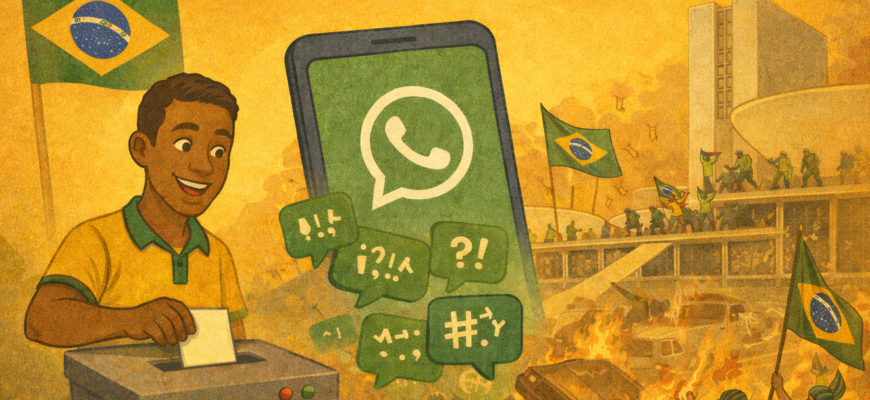
On January 8, 2023, thousands of supporters of former President Jair Bolsonaro stormed Brazil’s Congress, Supreme Court, and Presidential Palace in an attempt to overturn the election results. The insurrection didn’t emerge from nowhere — it was the culmination of years of disinformation that spread primarily through encrypted messaging apps.
The “WhatsApp Election” of 2018
Brazil is the second-largest market for WhatsApp in the world, after India. According to a 2019 study commissioned by the Brazilian Congress, 79 percent of Brazilians receive their news primarily through WhatsApp. Six out of ten Brazilians use the messaging app daily.
Bolsonaro successfully exploited this in his 2018 campaign. Journalist Patricia Campos Mello called the 2018 contest “the WhatsApp election” after revealing that businesses aligned with Bolsonaro had financed campaigns of mass messaging to discredit opponents. A year after Bolsonaro’s victory, WhatsApp conceded that some companies had violated its terms of service by using fake numbers to mass message political content.
In 2021, Brazil’s Federal Police accused Bolsonaro and top advisors of coordinating a “hate cabinet” that played a “direct and relevant” role in spreading falsehoods about the electoral process. The investigation found that the cabinet targeted opponents and disseminated disinformation on Facebook, Twitter, YouTube, and especially WhatsApp and Telegram.
The 2022 Election and “The Big Lie”
For the 2022 election, the primary theme of disinformation campaigns shifted. As Campos Mello told NPR: “In 2022, the main theme of disinformation campaigns is our version of ‘the big lie'” — baseless accusations that Brazil’s electronic voting machines were susceptible to fraud.
The Getulio Vargas Foundation, a Brazilian think tank, tracked social media from November 2020 to January 2022 and flagged almost 400,000 Facebook posts related to electronic voting machines across approximately 28,000 accounts, attracting 111 million interactions.
In an attempt to counter disinformation, major platforms signed agreements with Brazil’s Electoral Court. In February 2022, Google, Facebook, Twitter, WhatsApp, Instagram, YouTube, TikTok, and Kwai committed to help tackle the spread of fake news. In June 2022, Telegram — Bolsonaro’s preferred platform, where his official channel had 1.4 million subscribers — signed an agreement only after the Supreme Court threatened to suspend the platform in Brazil.
Between September 1 and November 15, 2022, the Electoral Court’s WhatsApp fact-checking feature received 223,621 queries about election-related content.
Despite predictions that Bolsonaro would lose decisively, false claims about electoral fraud reached millions. According to research from the Federal University of Rio de Janeiro, false allegations about Lula’s supposed anti-Christian crusade reached 142 million Twitter accounts.
Lula narrowly won the October 30, 2022 runoff with 50.9% of the vote. Bolsonaro did not concede.
January 8, 2023: The Insurrection
One week after Lula’s inauguration, on January 8, 2023, more than 100 buses arrived in Brasília from across Brazil, bringing radical Bolsonaro supporters to join protesters camped in front of Army Headquarters.
By mid-afternoon, the mob had stormed the Praça dos Três Poderes (Three Powers Square), attacking the Congress building, the Supreme Court, and the Planalto Presidential Palace. Rioters smashed windows and furniture, flooded Congress with the sprinkler system, ransacked ceremonial rooms in the Supreme Court, and spray-painted graffiti on the walls. At least 12 journalists were attacked during the invasion.
It took more than three hours for security forces to clear all three buildings. Senator Randolfe Rodrigues told CNN Brasil that five grenades were found after the attack — three at the Supreme Court and two at the Congress complex.
By January 9, more than 1,500 people had been arrested, according to Justice Minister Flávio Dino. President Lula declared a federal state of emergency in Brasília. The governor of the Federal District, Ibaneis Rocha, was suspended for 90 days by the Supreme Court. By March 2023, more than 2,000 people had been arrested for participation or connection to the attack.
As of January 2025, 371 people had been convicted by Brazil’s Supreme Court, with sentences ranging from 3 to 17.5 years in prison. At least 122 people were considered fugitives.
The Coup Plot Revealed
Investigations following the January 8 attacks revealed a broader conspiracy. The Federal Police found a draft announcement of a coup in a search of former justice minister Anderson Torres’s home. The document outlined a plan to implement a “state of defense” that would annul the 2022 election results.
On November 19, 2024, the Federal Police launched “Operation Counterattack,” investigating a plan called “Green and Yellow Dagger” drawn up in 2022 to prevent Lula’s inauguration. The plan included the assassination of Lula, Vice President-elect Geraldo Alckmin, and Supreme Court Justice Alexandre de Moraes.
On November 21, 2024, the Federal Police formally accused Bolsonaro and 36 people of attempting to overthrow Brazil’s democratic institutions. On December 14, 2024, Bolsonaro’s running mate, former general Walter Braga Netto, was arrested.
The Historic Conviction
On September 11, 2025, a panel of Brazil’s Supreme Court convicted Bolsonaro on five counts: attempting a coup, participating in an armed criminal organization, attempted violent abolition of the democratic rule of law, and two counts related to property damage. Four of five justices voted to convict.
Bolsonaro was sentenced to 27 years and 3 months in prison. As TIME noted, he became the first former Brazilian president to be convicted of attempting a coup — despite the country having experienced at least 15 coups and coup attempts since the end of its monarchy in 1889.
The Lesson
The Brazilian case demonstrates how years of disinformation — spread through encrypted messaging apps that are difficult to monitor — can erode trust in democratic institutions and ultimately lead to political violence. From “the WhatsApp election” of 2018 to the January 8 insurrection, disinformation was the through-line connecting false claims to real-world consequences.
Sources:
- NPR. Brazilians are about to vote. And they’re dealing with familiar viral election lies. September 27, 2022.
- France 24. The scourge of fake news in Brazil’s presidential election. September 18, 2022.
- Reuters Institute. Despite efforts to fight falsehoods, Brazil’s tight election is threatened by dangerous lies.
- Foreign Policy. Bolsonaro Is Already Undermining Brazil’s Presidential Election. May 4, 2022.
- Al Jazeera. Bolsonaro supporters storm key government buildings in Brazil. January 8, 2023.
- PBS NewsHour. What to know after Brazil’s Bolsonaro is convicted. September 12, 2025.
- TIME. Former Brazilian President Jair Bolsonaro Convicted and Sentenced to Prison. September 12, 2025.