
How Belarusian state media construct an alternative reality of war. An analysis of 488,635 publications over four years.
February 24, 2026, marks the fourth anniversary of Russia’s full-scale invasion of Ukraine. For Belarusian audiences, this war exists in two parallel realities: one created by the state-run news agency BELTA, the other by independent media in exile.
We analyzed488,635 publicationsFive Belarusian media outlets—state-owned BelTA and four independent publications (Zerkalo, Nasha Niva, Reform, and Euroradio)—were analyzed over four full years of the war. Using a corpus of 285 search terms in 26 thematic categories, LLM sentiment classification, and statistical analysis, we identified three systemic mechanisms by which state media construct an alternative picture of the war.
This isn’t an expert assessment—it’smeasurementEach conclusion is supported by quantitative data, and each relationship is verifiable.
Silence
The simplest and most effective tool: what isn’t written about doesn’t exist. We compared how many times BELTA and Zerkalo mentioned key war topics over four years.
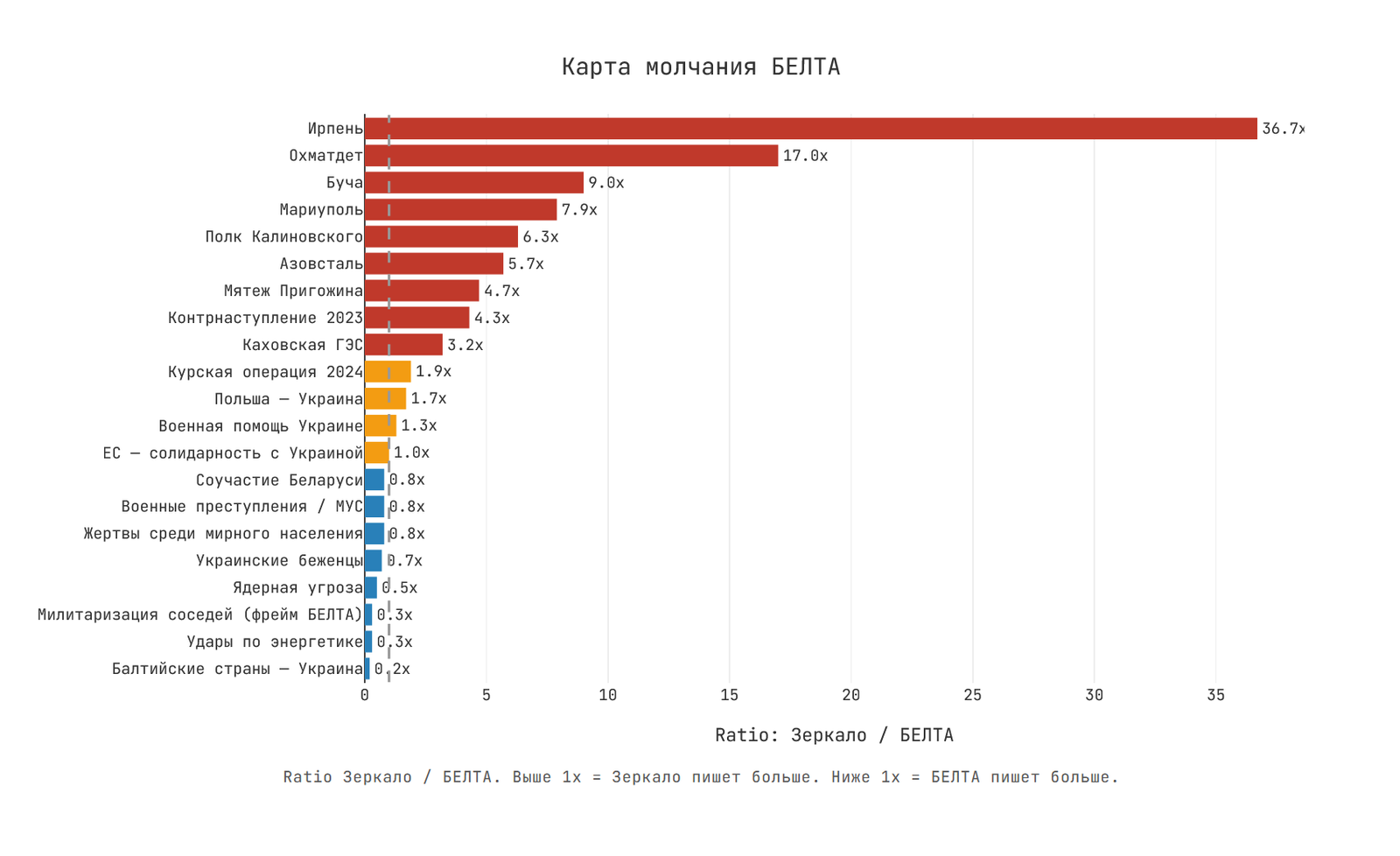
BELTA mentioned Irpin6 timesin four years. Mirror –220 timesThe difference is in36.7 times.
The Okhmatdet Children’s Hospital, destroyed by a Russian missile in July 2024 —3 mentionsBELTA has 51 versus Zerkalo (a 17-fold difference). Bucha, Mariupol, Azovstal—all of these exist in one information space and are practically absent from the other.
But the silence isn’t absolute. There are threads where BELTA writesmoreIndependents: the nuclear threat (0.5x – BELTA, twice as active) and attacks on the energy sector (0.3x – three times more active). This is no coincidence – these are tools: nuclear rhetoric is used to intimidate, energy rhetoric – to demonstrate Ukraine’s vulnerability.
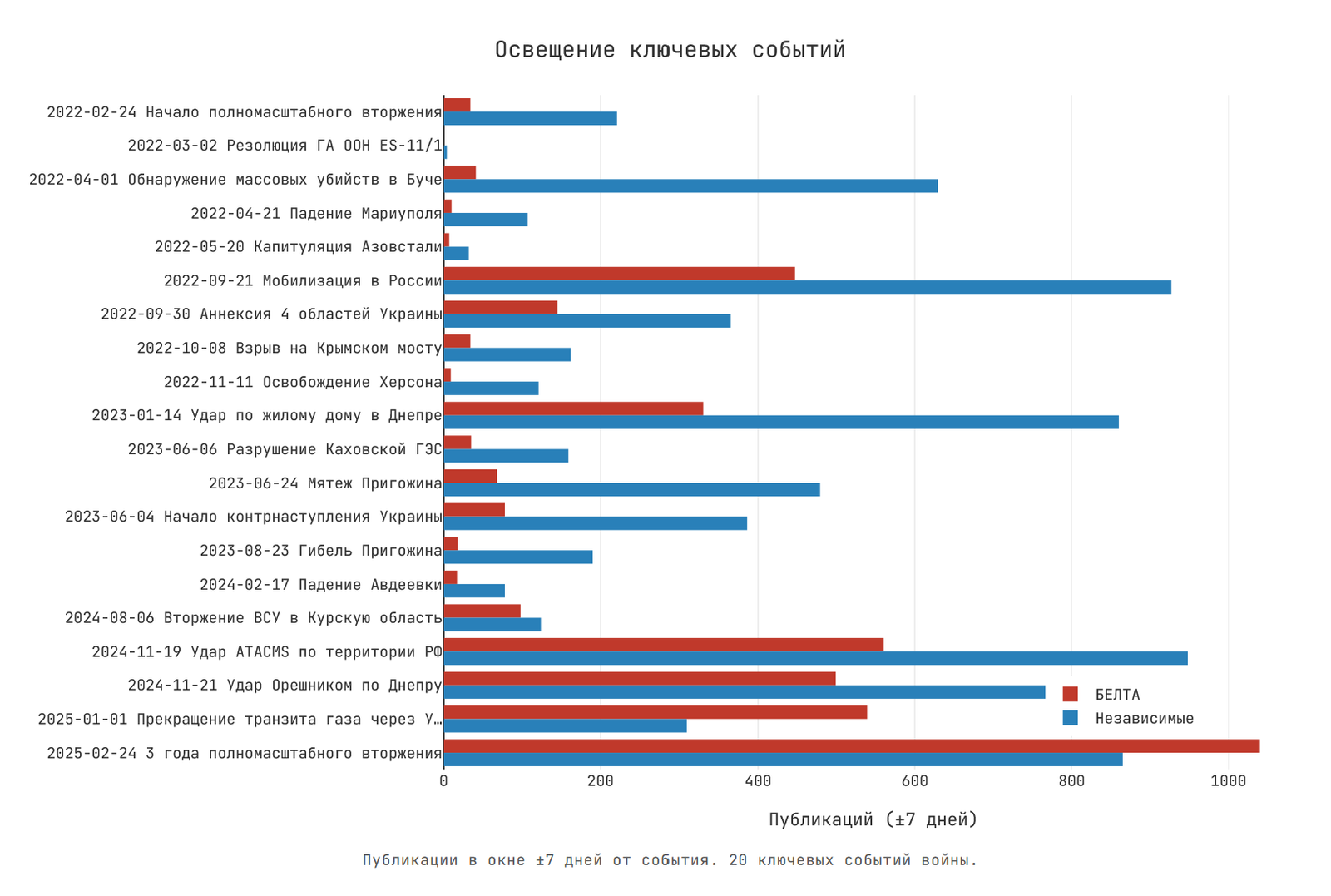
The graph of key events reveals a pattern of selectivity: BELTA covers the mobilization in Russia (447 publications), but almost completely ignores the liberation of Kherson (9 versus 121). The cessation of gas transit (539 publications) is the only event where BELTA leads: this is an economic narrative that can be controlled.
Lexical sterilization
If an event cannot be kept silent, one can choose words that soften, neutralize, or reverse its meaning. We calculated the frequency of key terms, normalized to 10,000 documents from each source.
“Invasion” BELTA / 10K
“Invasion” Mirror / 10K
difference
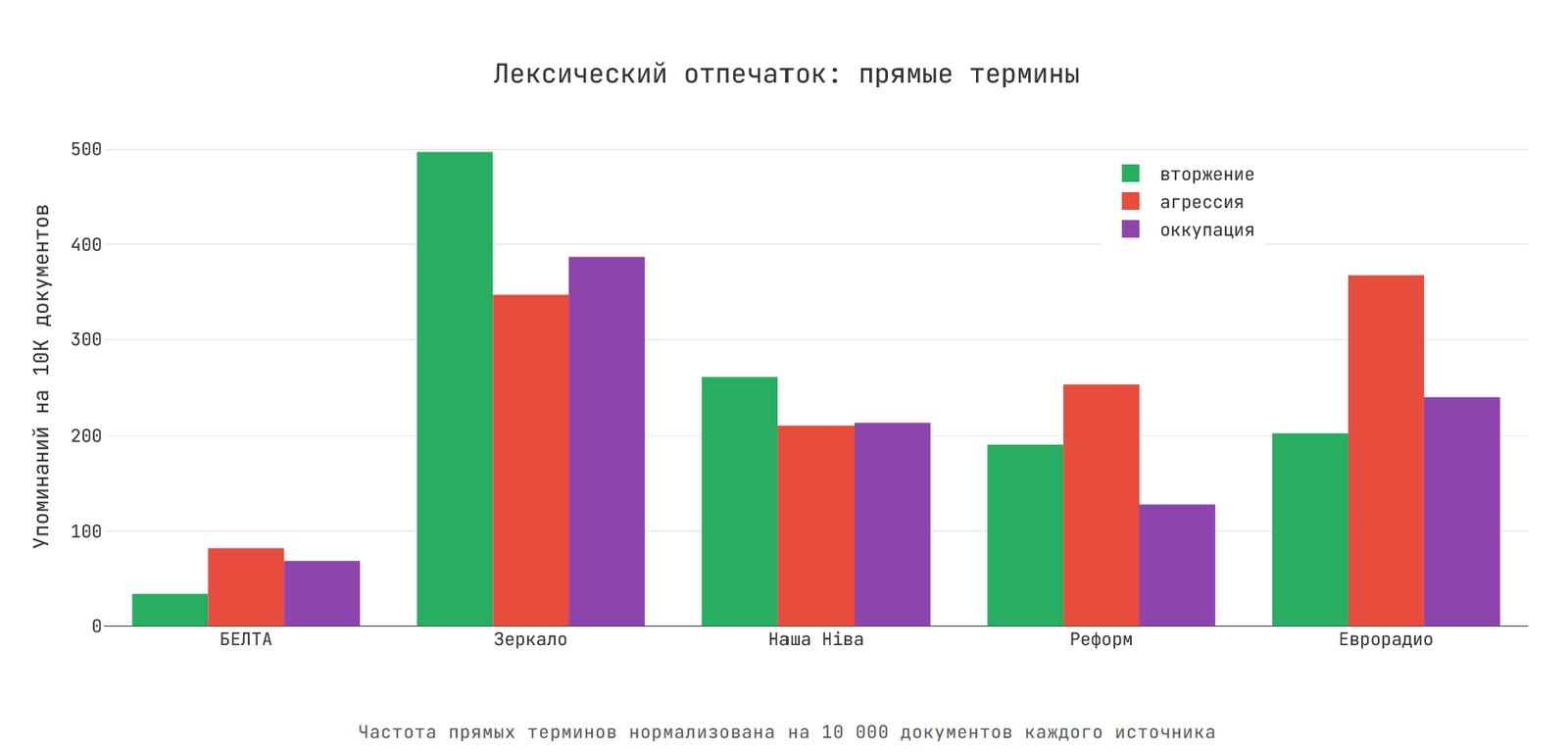
BELTA hardly uses the words “invasion” (34 per 10,000), “aggression” (82), and “occupation” (69). Zerkalo uses 497, 348, and 387, respectively. All four independent publications form a cluster with a high frequency of direct terms, while BELTA is an isolated outlier.
Evolution of BELTA vocabulary
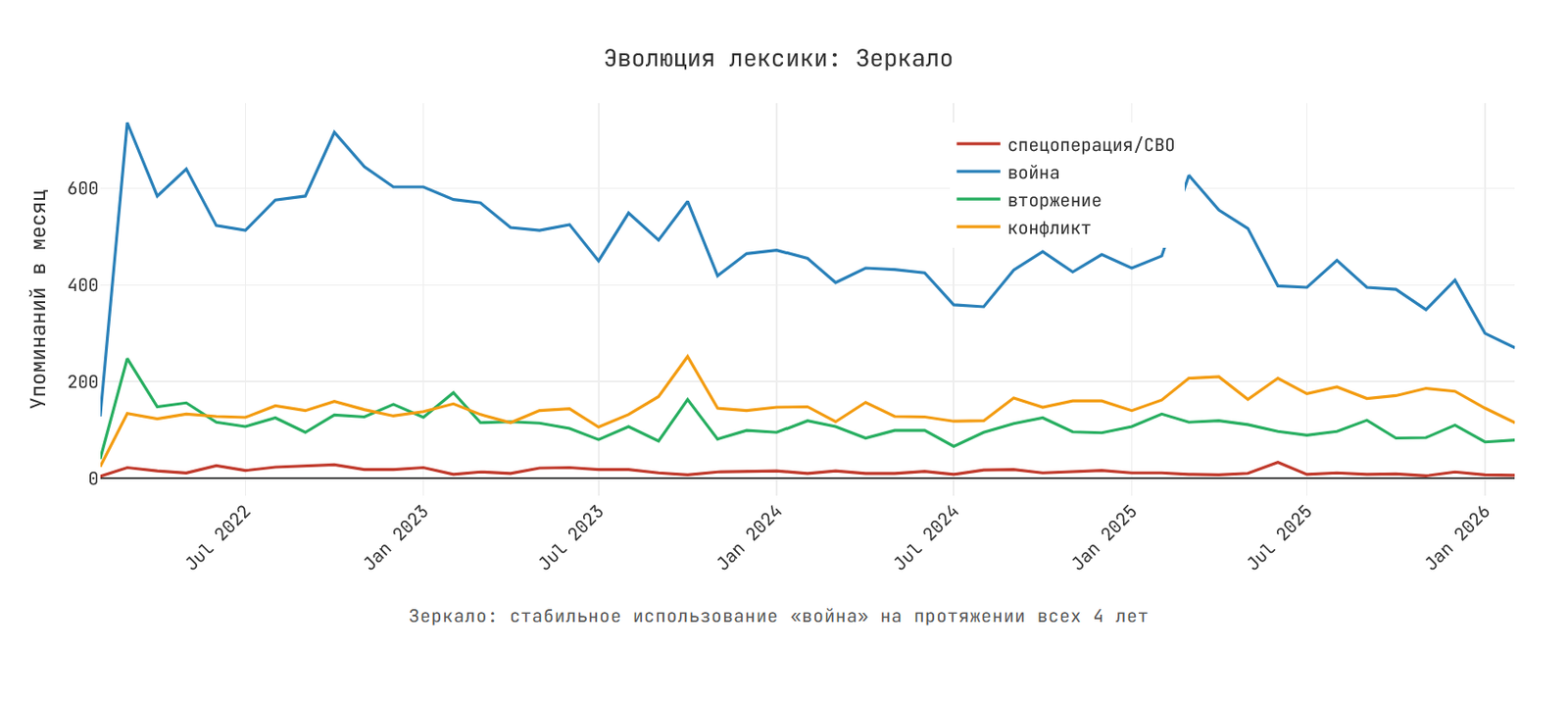
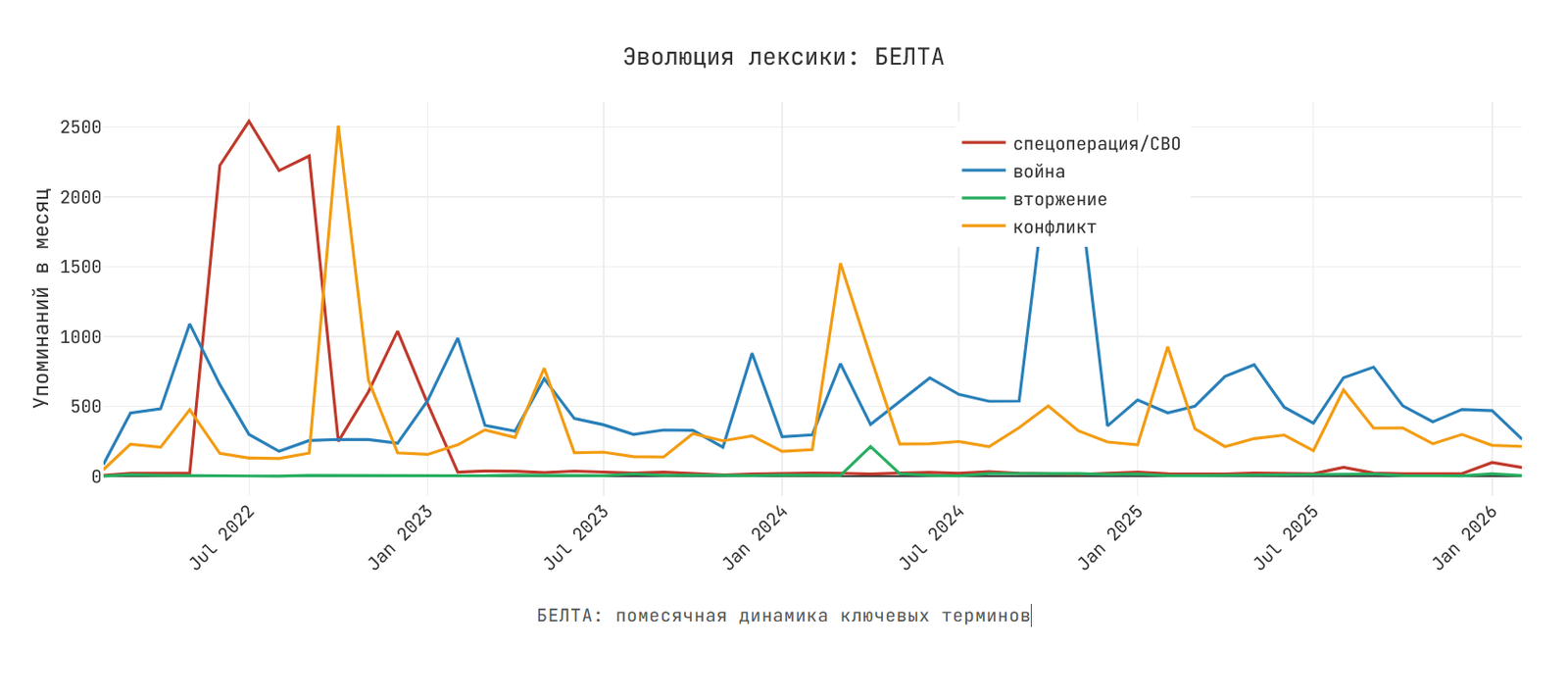
The dynamics of terms over time reveals the mechanics of lexical substitutions. In the first months of the war, BELTA actively used the term “special operation” (up to 2,500 mentions per month). By the end of 2022, this term was replaced by “conflict.” By 2024, even BELTA was forced to switch to the word “war”—but “invasion” remains almost taboo.
Inversion of meaning
The most sophisticated mechanism: write about the same event, but reverse its interpretation. We used LLM classification to analyze the sentiment and framing of over 200 publications on three key topics.
Bucha: denial and indifference
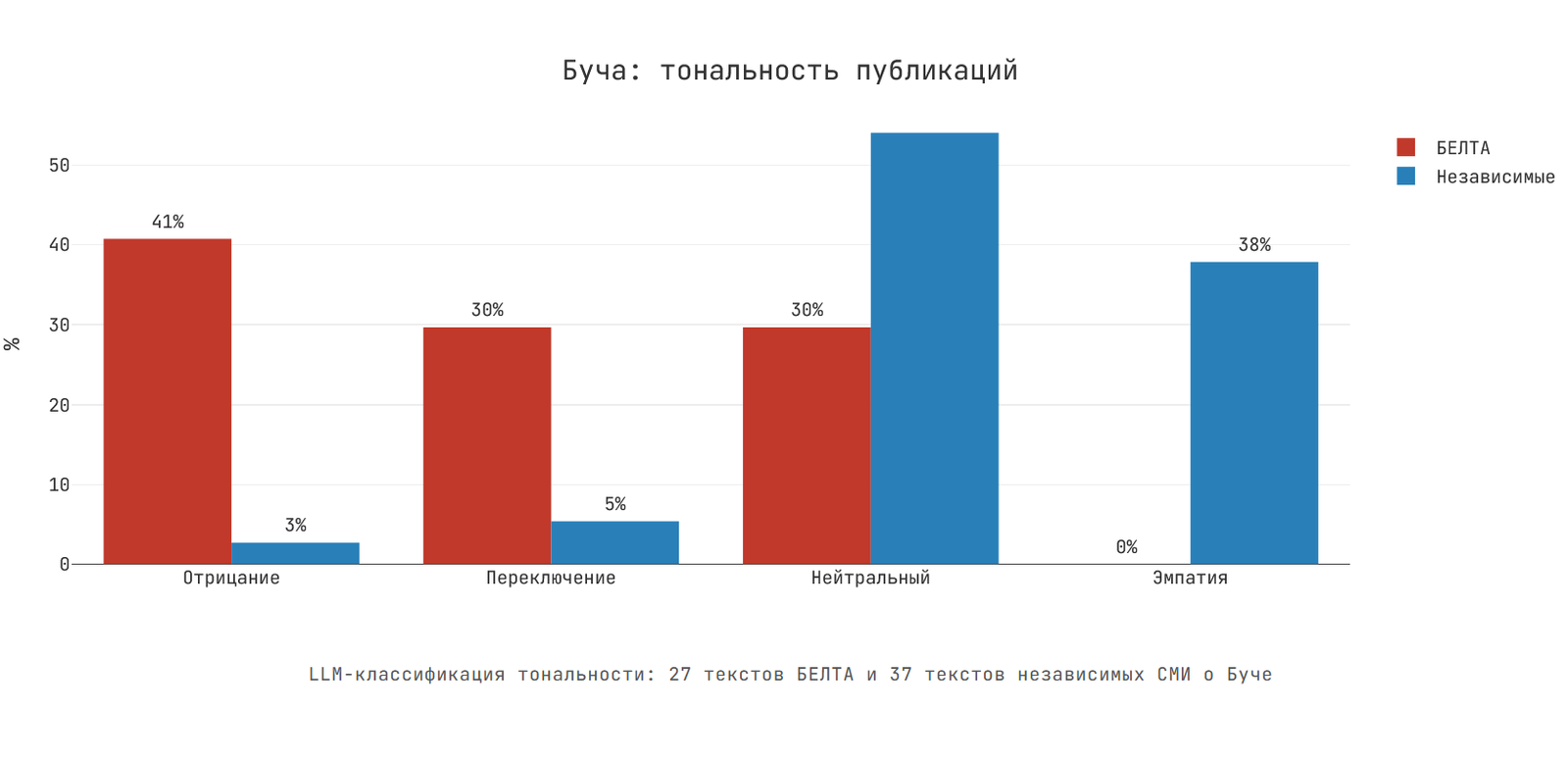
LLM Tonality Classification: 27 BELTA and 37 independent media reports on Bucha
41%BELTA texts about Bucha are a denial.0%– empathy for the victims.
71% of BELTA publications about Bucha employ a tone of denial (41%) or deflection (30%). Not a single publication expresses sympathy for the victims. 67% use the “propaganda statement” frame. Independent sources present a mirror image: 38% express empathy, while 35% qualify it as a war crime.
Baltic States: Solidarity or Threat?
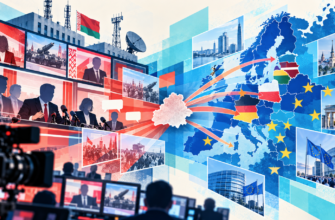
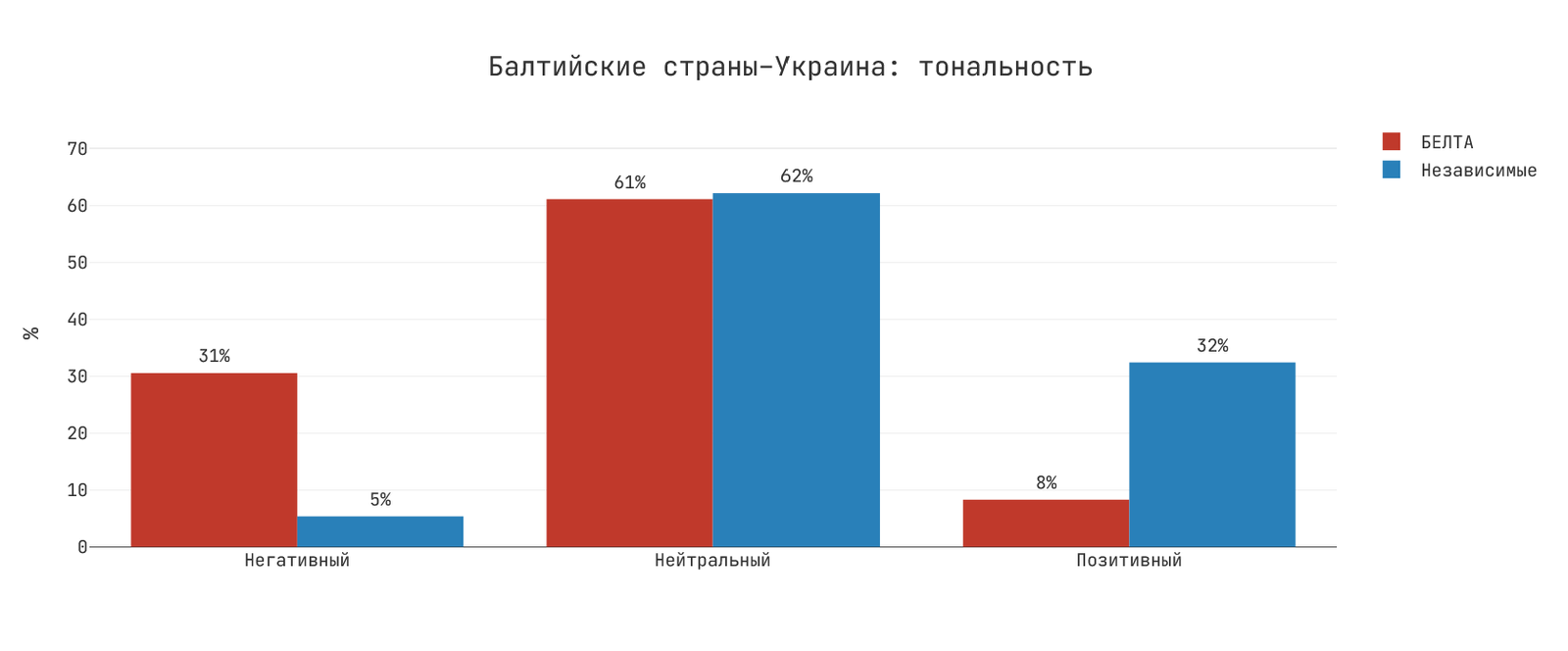
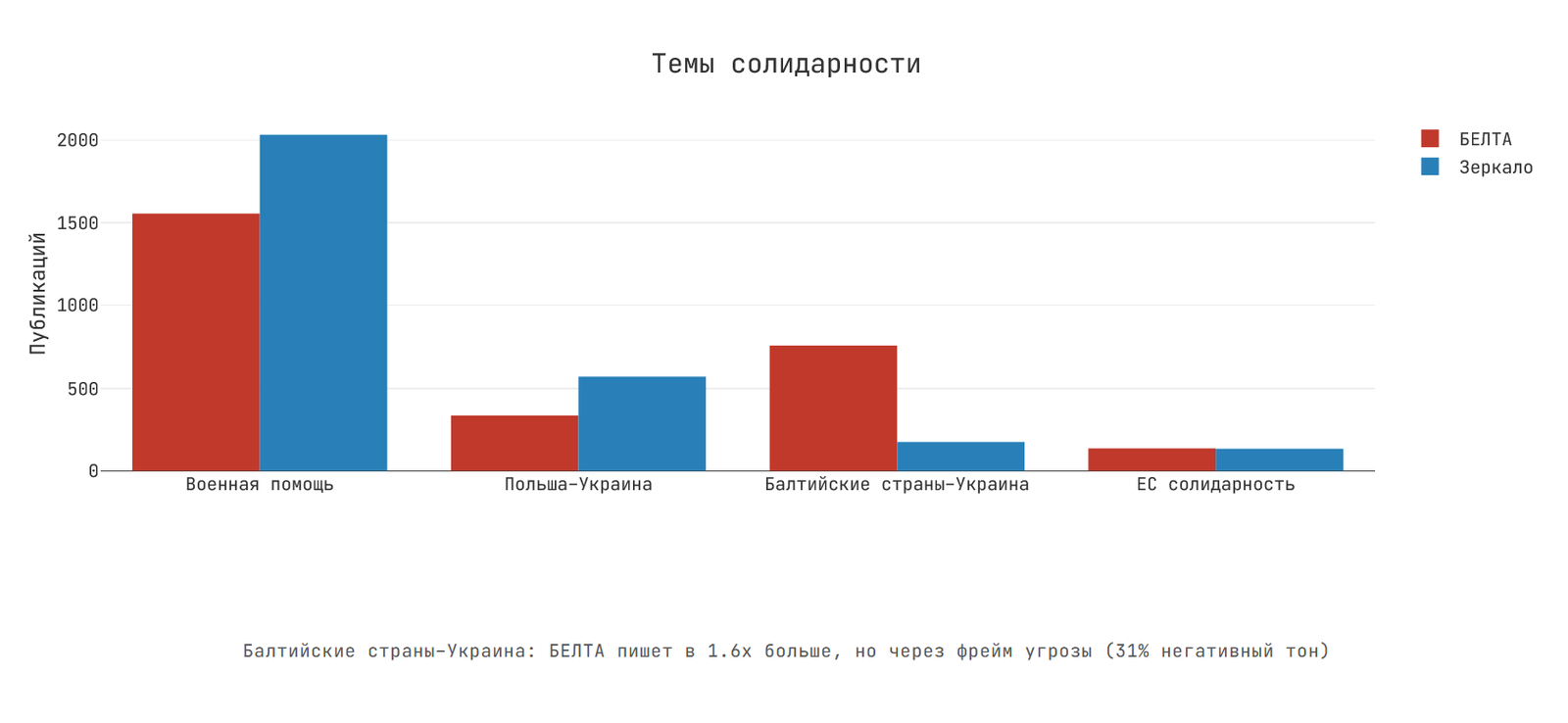
BELTA writes about the ties between the Baltic states and Ukraine 1.6 times more than all independent media combined (756 vs. 486). However, LLM analysis shows that the tone of these texts is fundamentally different: 31% are negative (compared to 5% for independent media). The “proxy war” frame is used only by BELTA (8%) and is completely absent from independent media.
Nuclear threat: who is to blame?
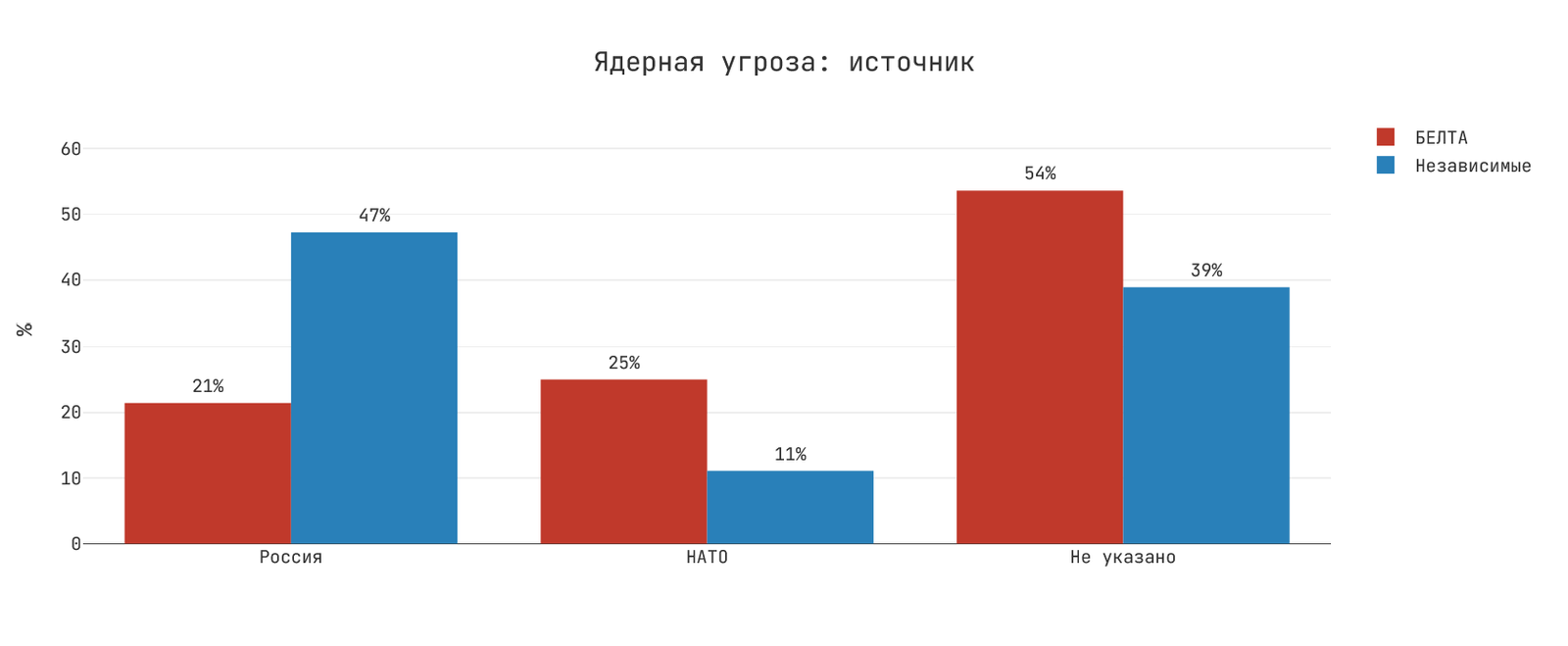
In its coverage of the nuclear threat, BELTA blurs the source: 54% of the reports don’t specify who is making the threat, and 25% directly shift responsibility to NATO. Independent sources explicitly identify Russia as the source in 47% of cases.
Four years – four phases
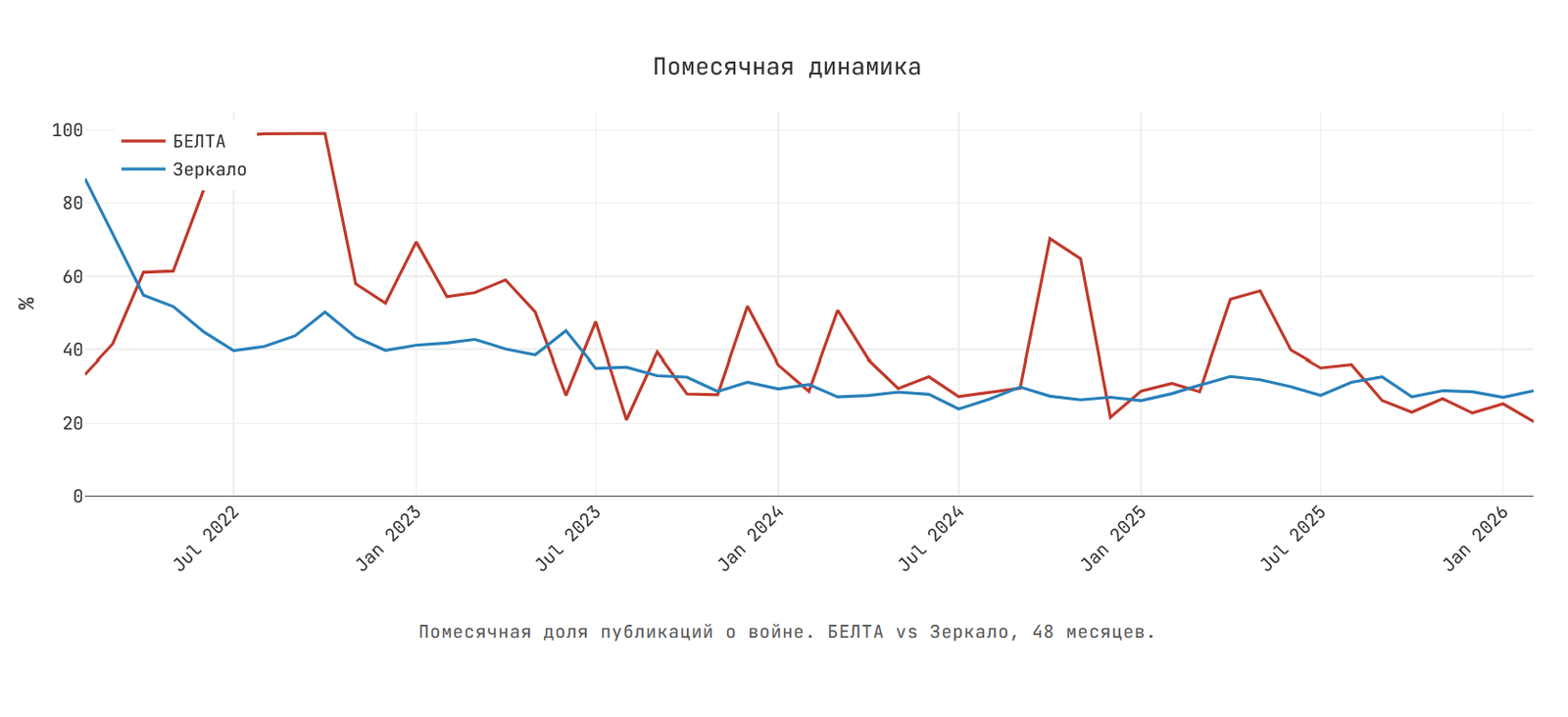
The dynamics of war coverage are not linear. Over the past four years, we have observed four distinct phases—from shock to convergence.
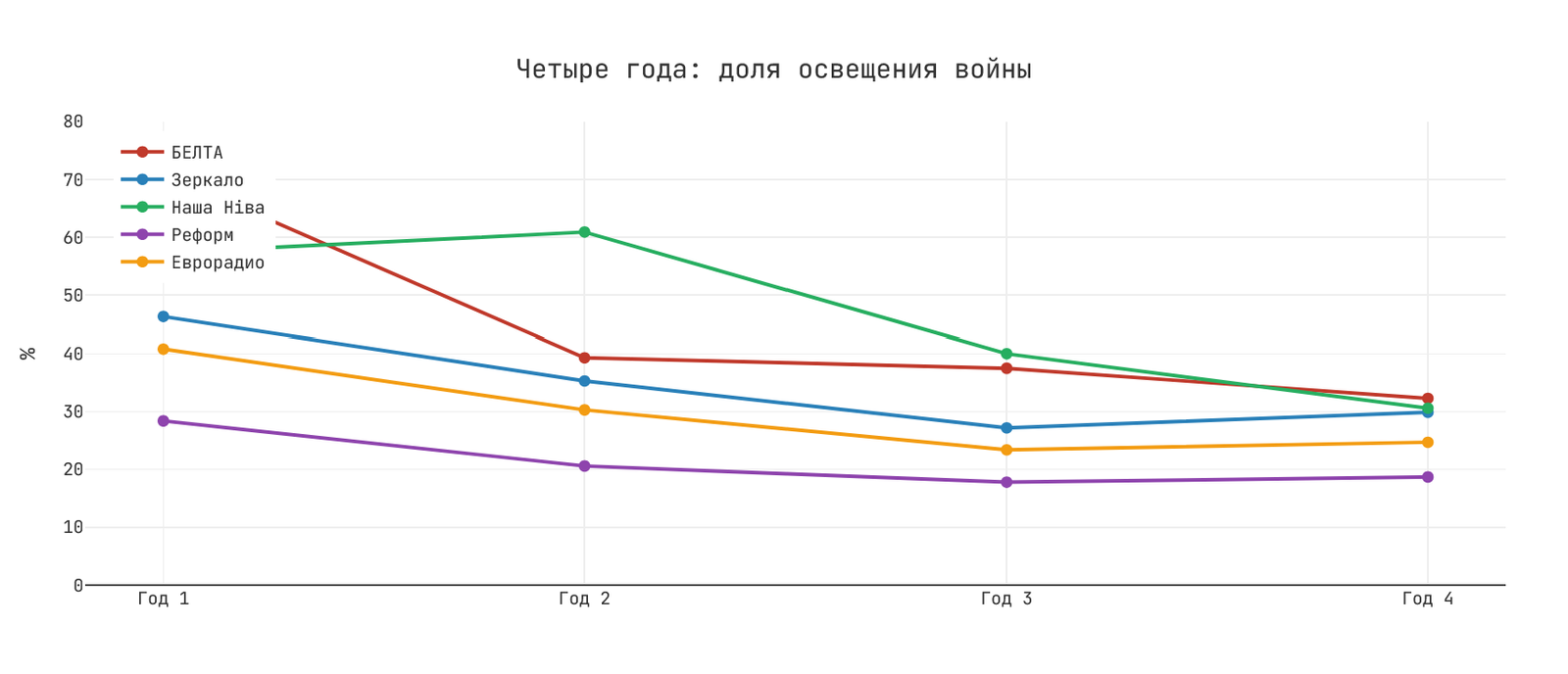
Year 1 – Shock (71%):BELTA devotes the maximum share of its coverage to the war, actively exploiting the “special operation.” All sources are receiving the full attention.
Year 2 – Normalization (39%):BELTA’s sharp decline. Lexical shift from “special operation” to “conflict.”
Year 3 – Routinization (38%):War is becoming a backdrop. Independent media are also reducing their coverage.
Year 4 – Convergence (32%):BELTA and Zerkalo arrive at the same figure of ~30%. But behind these identical figures lies fundamentally different meanings—this is precisely what mechanisms 1–3 reveal.
Belarusian context
This war isn’t just about Ukraine. For Belarusians, it has direct implications: Belarusian territory was used for the invasion, Belarusian volunteers are fighting on Ukraine’s side, and the Lukashenko regime is positioning itself as a peacemaker.
BELTA on Kalinovsky
Independents on Kalinovsky
difference
The Kalinovsky Regiment—Belarusian volunteers fighting for Ukraine—is practically taboo for BelTA: 241 mentions versus 4,550 for independent media outlets. Belarus’s complicity in the aggression is covered in varying ways: BelTA covers it more (4,574 versus 3,534 for Zerkalo), but through the frame of “peace mediation” rather than “complicity.”
Case: Zelensky’s interview with Zerkalo
On February 23, 2026—the eve of the fourth anniversary—Ukrainian President Volodymyr Zelenskyy gave an exclusive interview to the Belarusian independent publication Zerkalo. It was the first interview with a Belarusian media outlet since the war.
The media’s response confirmed all three mechanisms in real time:
Mirror— published the full text of the interview.
Nasha Niva, Reform, Euroradio— reprinted key quotes with a link to the source.
BELTA— didn’t mention the interview. Meanwhile, Zelensky’s quotes from other contexts were published that day, but without mentioning that he was addressing a Belarusian audience directly. A classic mechanism of selective silence: statements are taken out of context, and the very fact of the interview is glossed over.
sb.by (Belarus Today)— a similar silence.
Three mechanisms as a system
Silence, the sterilization of language, and the inversion of meaning are not three separate tactics. They are a unified system for constructing an alternative reality.
When an event is inconvenient, it is hushed up (Irpen, Okhmatdet). When silencing is impossible, the language is changed (invasion → conflict, war → special operation). When language fails, the interpretation is reversed (Bucha → “provocation,” the nuclear threat → “NATO’s fault,” the assistance of the Baltic states → “militarization”).
These mechanisms operate simultaneously, creating a holistic alternative picture of the war for BELTA’s Belarusian audience, one in which there are no war crimes, no one responsible for the aggression, and no solidarity between neighbors and the victims.
Over the course of four years, we have analyzed488,635 documents, using285 search terms,LLM classification And statistical analysisThe result is not an opinion, but a measurement.
Methodology
Data sources
Period:February 24, 2022 – February 23, 2026 (4 full years).
Sources:BELTA (belta.by) is the state news agency; Zerkalo (zerkalo.io) is the largest independent publication; Nasha Niva (nashaniva.com) is the oldest Belarusian media outlet; Reform (reform.news); Euroradio (euroradio.fm).
Volume:488,635 documents. BELTA — 170,049; Zerkalo — 108,921; Nasha Niva — 94,097; Reform — 73,882; Euroradio — 41,686.
Term corpus and tagging
Frame:285 search terms in 26 thematic categories.
Definition of war-related:Two-stage. Step 1 (core): REPLACE-chain + 14 LIKE patterns. Step 2 (tag expansion): documents with tags from 26 categories.
Processing Our Niva:HTML parsing includes a navigation bar within the body of the text (median 10,519 characters vs. 2,016 for Zerkalo). Solution: the first 4,000 characters. is_war decreases from 82.7% to 46.8%.
LLM classification
Model:Claude Sonnet (Anthropic), JSON response format.
Sample:3 topics x ~70 texts ≈ 200 texts. Topics: Bucha, Baltic states–Ukraine, nuclear threat.
Restrictions:The sample is not exhaustive. With effect sizes of 30–40 percentage points, the current volumes provide statistical significance (p<0.01).
Restrictions
1. Keyword-based detection has limited accuracy. Borderline matches are 14% for BELTA and 48% for Zerkal.
2. Nasha Niva: residual navigation noise can overestimate is_war by ~15-20% in Years 1-2.
3. LLM classification: inter-coder reliability has not been tested.
4. The silence map compares BELTA with Zerkal, not with all independent datasets.
© 2026 FactCheck.LT · Research conducted using the FORESIGHT platform