

On 19 April, Bulgaria holds its eighth snap parliamentary elections since 2021. On 14 April, the Brussels-based Balkan Free Media Initiative (BFMI) and the analytics platform Sensika published the second issue of their TikTokcracy Tracker monitoring report, documenting coordinated inauthentic activity around three of the eleven political forces contesting the election: DPS-New Beginning, Progressive Bulgaria, and There Is Such a People. In relation to two further forces, GERB-SDS and Revival (Vazrazhdane), the researchers recorded anomalous patterns warranting further scrutiny.
The BFMI-Sensika method relies on engagement ratios deviating from organic norms. These include metrics such as interaction-to-followers ratios reaching 83,899 percent for accounts with only a few hundred followers, asymmetric reposting schemes between accounts, and the appropriation of Russian-language hashtags. This is a measurement of what happens at the level of content that the platform shows to the user.
FactCheck.LT, as part of the FORESIGHT MAS project, conducted an independent algorithmic analysis of twenty Bulgarian TikTok accounts using a different method: a network of commenter-audience overlaps. We did not look for anomalies in what the platform shows. We looked for structural patterns in who exactly writes comments under the videos of different accounts, and which audience layers overlap above the expected baseline level.
The two methods measure different layers of the same phenomenon. Our results do not replace or contradict BFMI’s conclusions, but complement them. Below we present three concrete findings, two of which align with the conclusions of Tracker #2 and one that stands on its own.
Methodological framework
Source data: twenty-one TikTok accounts, 7,186 videos, 128,453 comments, approximately 54,500 unique commenters, collected over the period from 1 January to 18 April 2026 (108 days). Collection was conducted via the Exolyt platform. Account clustering is performed by political alignment and type (state media, private mainstream media, political parties, political figures, unofficial reach amplifiers, political commentary).
The key metric is the Jaccard coefficient for sets of unique commenters between a pair of accounts, normalized against the mainstream-media baseline level with a size-aware correction through binning. Large audiences are classified above 1,000 commenters, medium between 100 and 1,000, and small under 100.
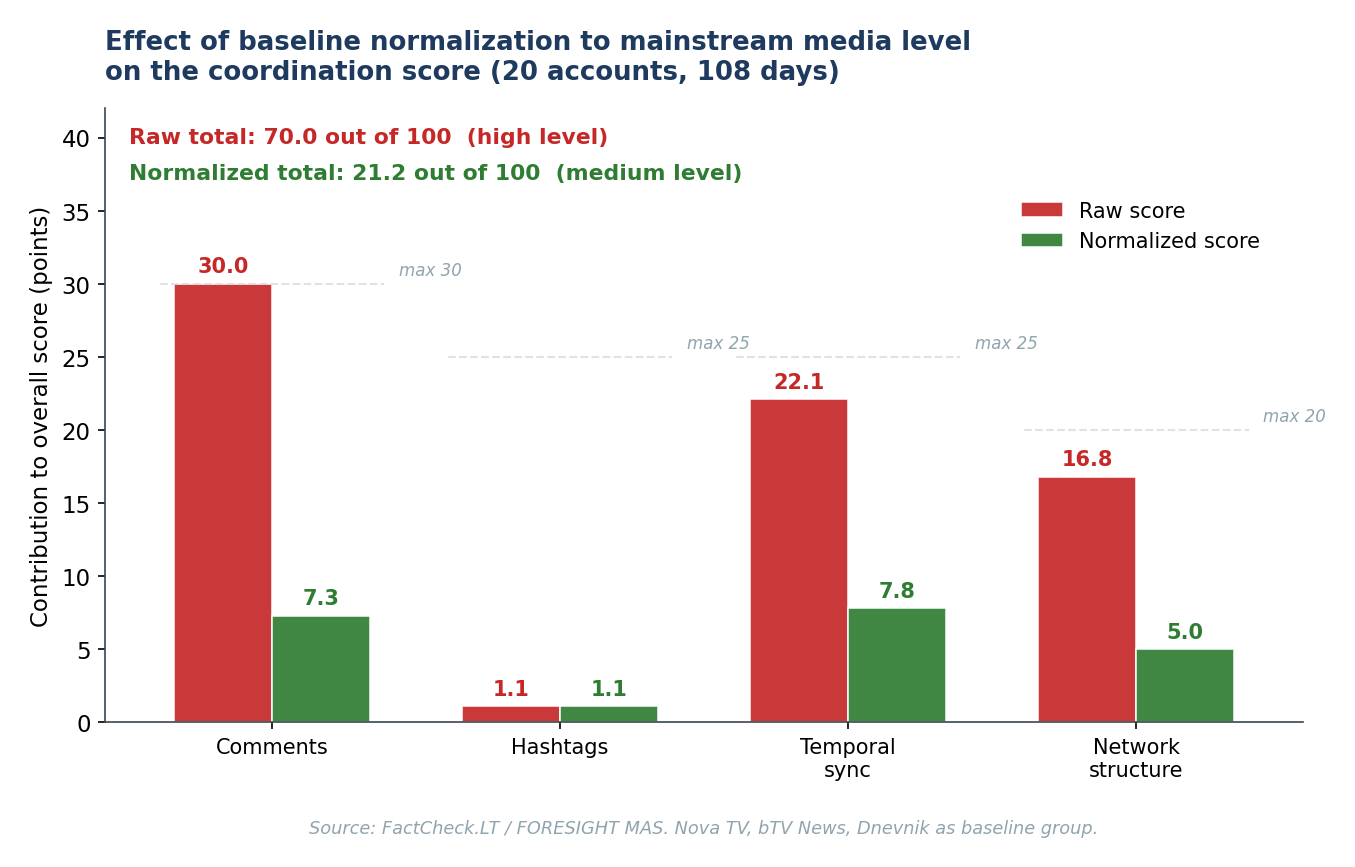
The necessity of normalization is explained as follows. Nova TV and bTV News, the two largest competing commercial television channels in Bulgaria, share 3,625 common commenters with a Jaccard coefficient of 0.1287. Any raw coordination score computed on a standard fifteen-to-twenty-account sample will automatically produce a high-alarm signal solely from this overlap of two mainstream audiences. On our sample, the raw score is 70.0 out of 100 (high level), the normalized score is 21.2 out of 100 (medium level). The difference between the two figures quantitatively reflects the contribution of the mainstream-television audience-hub effect to the raw coordination score.
This is the first methodological finding: any coordination assessment on Bulgarian TikTok data without accounting for the Nova+bTV baseline systematically overstates the signal. This is not a specific property of coordination methodologies, but a consequence of the structure of the Bulgarian television market.
Finding one: independent confirmation of the BFMI smoking gun
The central documentary finding of BFMI Tracker #2 is that the official Progresivna Bulgaria TikTok account @progresivna.bg uses the hashtag #рекомендации, a transliteration of the Russian-language #рекомендации (349.3 million publications, predominantly in entertainment content from Russian-speaking countries), in 83 of its 84 videos, together with the variant #рекомендаци in 30 videos. BFMI also documented that the same hashtag package appears in 16 of 17 videos of the associated unofficial account @onlytruth.bulgari.
Our independent data collection for the period from 1 January to 18 April 2026 shows the following picture across a corpus of 97 videos of @progresivna.bg. The hashtag #рекомендации appears in 66 videos (68 percent), the hashtag #рекомендаци appears in 30 videos (31 percent), at least one of the two variants is present in 96 out of 97 videos (99 percent), and only one video is published without any hashtags at all. The difference in absolute figures (66 versus 83) is explained by differences in the sampling window and collection instrument. The structural pattern is preserved: Russian-language entertainment hashtags are systematically used by the official account of a Bulgarian political party with near-total coverage.
This is an independent verification of the BFMI finding through a different collection instrument (Exolyt instead of Sensika) and a different time window. The significance of moving beyond simple replication lies in the following: if the tactic of applying Russian-language algorithmic targeting by the official account of a political party is sustained throughout the entire collection period of two independent research groups, it is not a local episode but a continuous promotion strategy.
We also included in our dataset the unofficial account @onlytruth.bulgari, named by BFMI as part of the coordinated pro-Radev network. Our method produces a result on this account that deserves a separate comment. @onlytruth.bulgari accumulated 22 videos, 727,357 views, 1,060 unique commenters during our collection period. Its hashtag signature matches what BFMI described: 99 uses of 12 unique hashtags across 22 videos, only 2 videos without hashtags. At the same time, the audience-overlap coefficient of @onlytruth.bulgari with @progresivna.bg stands at 0.61 relative to baseline, that is, below baseline, despite 407 common commenters in absolute terms. Similarly, the overlap with Andrey Gyurov yields 0.26, with other large pro-EU accounts between 0.26 and 0.35.
In other words, the three accounts of the pro-Radev cluster (the official party, the caretaker prime minister, the unofficial amplifier), each taken separately with significant political reach, do not circulate a common commenter pool. This contrasts sharply with the result for Vazrazhdane (detailed in Finding two), where three accounts of a single cluster show excess ratios above baseline by a factor of 4-6.
The substantive interpretation of this difference is as follows. Coordinated activity on contemporary TikTok can take two fundamentally different forms. The first, which we will call algorithmic amplification, consists of the systematic application of hashtags optimized for distribution in a particular linguistic or cultural segment of the TikTok algorithm (#рекомендации in the Russian-language entertainment space), without the need to form a unified audience. The second, audience-overlap coordination, consists of forming a compact shared audience of politically engaged users who circulate between linked accounts.
@progresivna.bg and @onlytruth.bulgari demonstrate the first type: identical hashtag strategy with absent audience overlap. Vazrazhdane (Finding two) demonstrates the second type: dense audience overlap with a hub structure. Our method is capable of detecting the second type, but the first type requires hashtag-level and engagement-ratio analysis, which is precisely the BFMI methodology.
This is consistent with how BFMI describe the technical differences between the pro-Radev and Vazrazhdane networks in Tracker #2 itself: the former is described as “strategically using hashtag piggybacking” for algorithmic distribution, the latter as having “publicly attributable named figures”. Our numerical results provide numerical confirmation of this qualitative distinction.
Finding two: the structural role of Tsoncho Ganev in the Vazrazhdane cluster
BFMI classified Vazrazhdane as a force with “publicly attributable named figures” that does not apply the algorithmic amplification tactics documented for DPS-NN and Progresivna Bulgaria. At the same time, the researchers recorded anomalous engagement ratios for several Vazrazhdane-linked accounts, including a single MP candidate at 83,899 percent, and concluded that this structural anomaly warrants further study.
Our network analysis reveals an additional layer that is not visible through engagement-ratio analysis. Within the Vazrazhdane cluster, consisting of the official party account @vazrazhdane.bg, the account of party leader Kostadin Kostadinov, and the account of deputy chair Tsoncho Ganev, the following above-baseline coefficients of audience overlap are observed.
The official Vazrazhdane party account with Ganev’s account yields a coefficient of 5.88 relative to baseline (48 common commenters). Party leader Kostadinov with Ganev shows a coefficient of 4.37 (64 common commenters). At the same time, the direct connection between the official party and its leader, Vazrazhdane ↔ Kostadinov, yields a coefficient of 0.53 (231 common commenters). Despite a substantially larger number of common commenters in absolute terms, the density of audience overlap between the party and its leader turns out to be below the mainstream-media baseline.
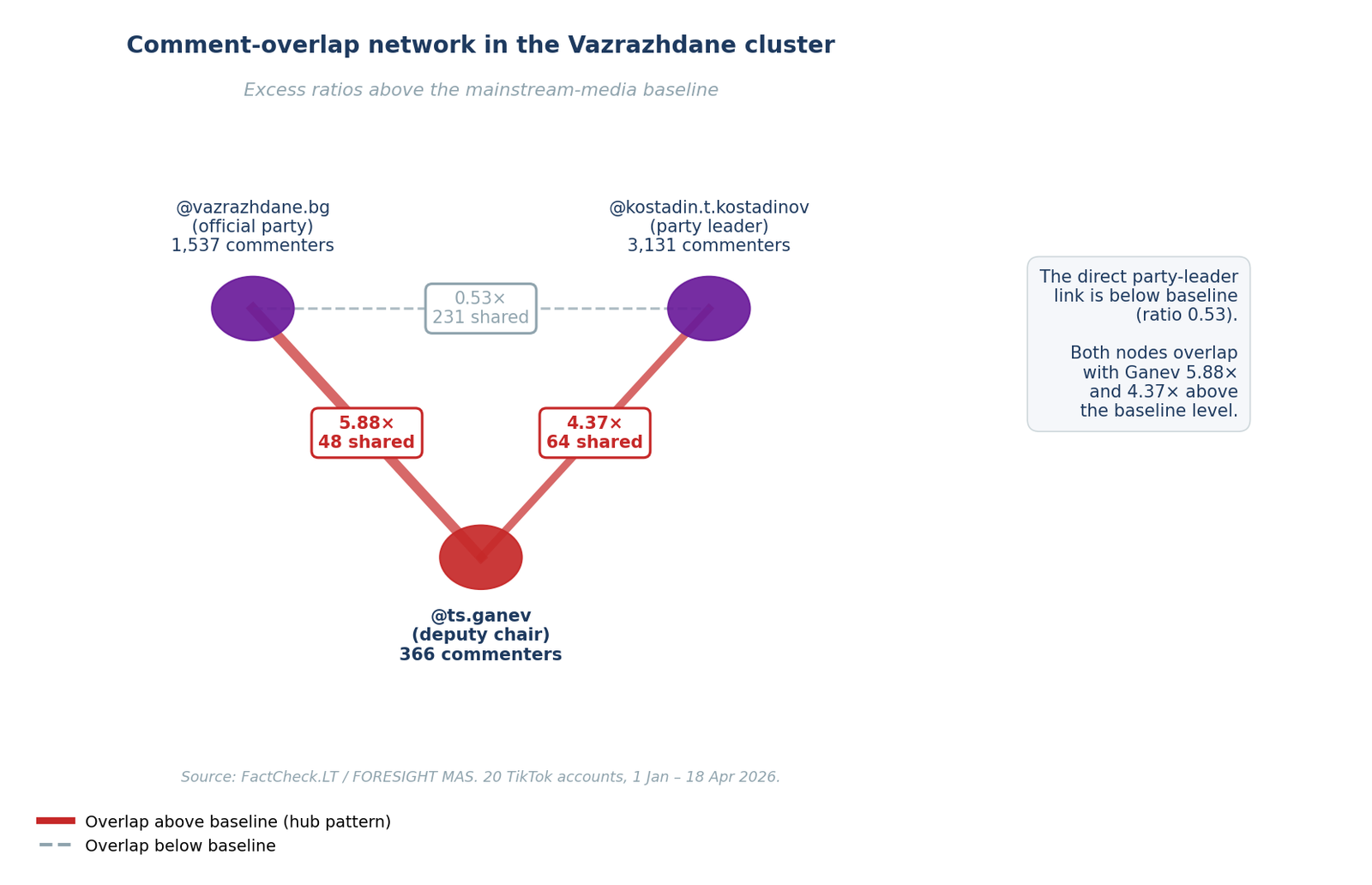
The substantive meaning of this configuration is as follows. In a typical political party with organic digital activity, the maximum audience overlap is expected precisely between the party account and the leader’s account. His voters read party publications, party subscribers follow the leader. In Vazrazhdane, the opposite picture is observed. The direct party-leader link is weaker than baseline, and both of these nodes are connected through an intermediate figure, Ganev, which shows above-baseline overlap at five and four times respectively.
In network science, such a configuration is called a hub pattern. It is characteristic of centralized message-distribution systems, in which a message does not travel horizontally between nodes of comparable status but passes through a coordinating node. Ganev is a member of the 51st National Assembly from the 23rd multi-member constituency of Sofia and holds the position of deputy chair of the party. He is a publicly known, in no way anonymous figure. The finding does not consist in uncovering a hidden network: the documented hub pattern belongs to the publicly identifiable political system.
For control we checked the analogous intra-cluster structure for the pro-European opposition. Within the PP-DB cluster, consisting of the accounts of Asen Vasilev and caretaker prime minister Andrey Gyurov, the pairs show the following. Vasilev with Gyurov yields a coefficient of 0.47 (281 common commenters), Vasilev with Progresivna Bulgaria shows 0.47 (427 commenters), Gyurov with Progresivna Bulgaria stands at 0.34 (269 commenters). All three intra-cluster pairs are below baseline, consistent with the BFMI characterization that PP-DB operationally “looks organic”.
The median of above-baseline coefficients within the Vazrazhdane cluster equals 4.37, the median within the PP-DB cluster equals 0.47. A nine-fold difference. This is not a claim of the existence of “trolls” or of hidden infrastructure. It is an observation that the structure of message distribution within the pro-Russian nationalist Vazrazhdane cluster is fundamentally different from the structure within the pro-European liberal PP-DB cluster.
An additional observation concerns the expansion of the hub pattern beyond Vazrazhdane. Ganev with the Velichie party (the world’s only parliamentary party fully built on TikTok and YouTube without a television campaign, owned by Blazhenstvo EOOD) shows an above-baseline coefficient of 2.49. This is four times above the baseline level, despite these being two formally separate parties. Ganev functions not only as a coordinating figure within his own party, but also as a point of audience connection between pro-Russian nationalist forces.
Finding three: the dual signature of the public broadcaster
Our dataset contains two official accounts of Bulgarian National Television: @bntnews.bg (the news channel, 1,056 unique commenters) and @bnt.bg (the general programming channel, 5,811 commenters). This is the same public broadcaster publishing content in different formats through different TikTok accounts. The theoretical expectation is that two accounts of the same editorial entity should exhibit similar or at least comparable patterns of audience overlap with the rest of the media environment.
The result contradicts this expectation. The news account @bntnews.bg shows an above-baseline coefficient ranging from 4.63 to 6.91 with every other account in the dataset: with 24 Chasa 6.91, with retvhd (an unidentified large mainstream-type account with 21,036 commenters) 5.78, with bTV News 5.31, with Otvetna Reakciya (political commentary) 5.22, with GERB 5.10, with Gyurov 4.97, with Vasilev 4.78, with Velichie 4.63. Regardless of the political orientation or type of partner, the news BNT is in dense audience overlap with all major participants in the political-information space.
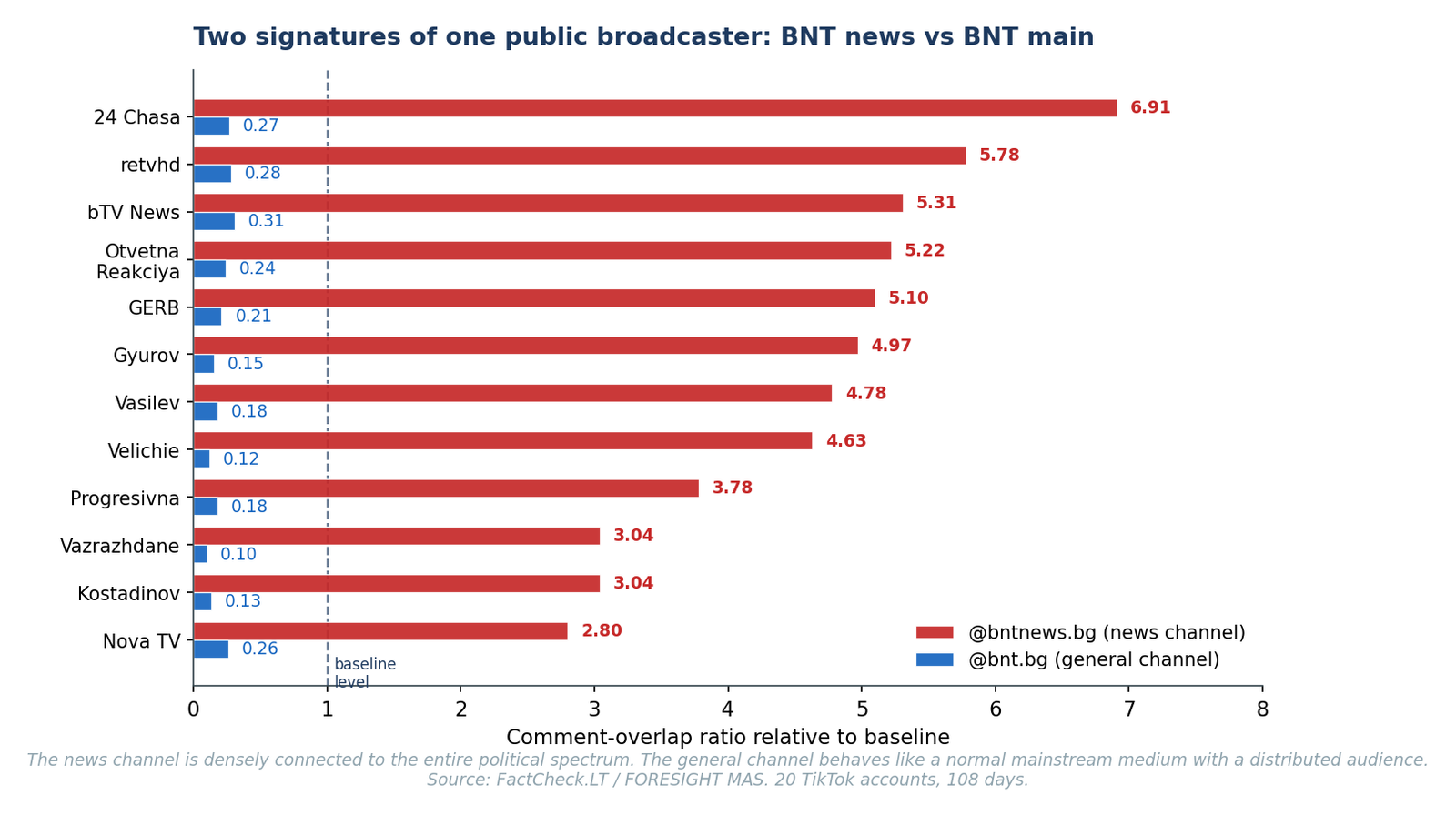
The general programming account @bnt.bg, belonging to the same editorial entity, shows the opposite picture. Its coefficients with the same partners: with bTV News 0.31, with Nova TV 0.26, with 24 Chasa 0.27, with GERB 0.21, with Progresivna 0.18, with Velichie 0.12, with Vazrazhdane-party 0.10, with Asen Vasilev 0.18. All indicators are radically below baseline and their behavior corresponds to a normal mainstream-media account with a naturally distributed audience.
The substantive explanation is as follows. BNT in the general programming format addresses a mass audience: entertainment formats, sport, cultural programs, children’s content. Its subscribers represent a broad cross-section of Bulgarian society and are distributed across many other mainstream media roughly as statistically expected. BNT in the news format addresses a much narrower audience of politically active citizens. This audience is concentrated: the same viewer who comments on BNT news, with high probability, also comments on bTV news, and on GERB content, and on Vazrazhdane content, and on PP-DB content, because this narrow group represents the politically engaged subset of TikTok users actively following the entire political spectrum simultaneously.
The significance of this finding extends beyond the specific BNT case. It shows that in the Bulgarian TikTok space, the public broadcaster does not serve a single public space. It serves two parallel information bubbles: a mass entertainment space, in which politically interested audience is dissolved in the general flow, and a narrow niche of politicized attention, in which several hundred active commenters circulate between all political camps simultaneously. These two bubbles have radically different audience mathematics, despite a common editorial subject.
For public policy this observation is important for assessing the real effect of public broadcasting in the digital environment. The reach of BNT news content on TikTok turns out to be structurally limited to a narrow politicized segment. This does not mean editorial failure. It means that the mass audience of the public broadcaster in 2026 is formed not through news formats.
What the findings mean together
The three findings presented above answer three different questions.
The first finding confirms that the BFMI-documented tactic of applying Russian-language hashtags by Radev’s official party was consistently observed throughout the entire period of our data collection. This is a verification through an independent channel of measurement, strengthening the evidence base of BFMI.
The second finding shows that within the publicly attributable Vazrazhdane cluster, there exists a structural asymmetry of message distribution, in which the deputy chair of the party, Tsoncho Ganev, functions as a coordinating node connecting the official party account and the leader’s account, bypassing the direct link between them. In the control group of the pro-European opposition PP-DB, such asymmetry is absent.
The third finding demonstrates that even the state public broadcaster in the Bulgarian TikTok space generates two radically different audience traces depending on the content format, which raises the question of the real structure of information reach in the platform environment.
We deliberately refrain from attribution and from predictions regarding the results of the 19 April vote. Our method does not establish who exactly stands behind the discovered patterns, does not measure whether they influenced electoral choice, and does not attempt to quantify the intentionality of coordination. We assert only that these patterns are statistically present in the data and that their structural explanation warrants further study.
Limitations of the method and directions for further work
Our analysis does not capture several important categories of information-environment distortion documented by BFMI. We do not measure the repurposing of Facebook pages, because we work only with TikTok data. We do not detect AI-generated profiles, because our input signal consists of comments by real users. We do not catch paid views without interactions (the DPS-NN pattern documented by BFMI), because views without comments do not enter our metric. We do not test paid political advertising through Meta Ad Library.
A large part of the politically neutral pairs available to us for baseline calibration falls in the medium audience group (100 to 1,000 commenters), while the large audience group calibration relies mainly on the Nova↔bTV pair with a Jaccard coefficient of 0.1287. This imposes a limitation: assertions that some large pair is “below baseline” should be read as “below the level of the two largest competing commercial television channels”, not as an absolute assertion.
The cluster @ppvelichie (the Velichie party) is represented in our dataset by a single account, which does not permit testing the hypothesis of internal coordination of a single content pipeline documented by Mediapool (2024) through the structure of Blazhenstvo EOOD. Expanding this direction requires adding to the analysis additional accounts linked to the party’s infrastructure.
Two new accounts in our dataset, otvetnareakciq (political commentary with the slogan “Politics and analysis without censorship”) and retvhd (an unidentified large account with 3,179 videos and 21,036 commenters), exhibit patterns warranting separate study. Otvetna Reakciya shows a coefficient of 5.22 with the news BNT and 2.62 with Ganev, but does not cluster with any of the partisan camps. Retvhd in its behavior acts as a second large mainstream-media hub with coefficient values close to baseline (1.04 with Nova, 1.09 with bTV). Identifying the nature of these accounts and their role in the Bulgarian TikTok ecosystem represents an independent research interest.
Conclusion
The Bulgarian parliamentary elections on 19 April 2026 take place in an information environment that BFMI and Sensika have compellingly characterized as a distributed system of coordinated inauthentic activity affecting a large part of the political spectrum. Our independent complementary analysis through the network of audience overlaps adds to their picture three concrete observations: a sustained confirmation of the systematic application of Russian-language hashtags by Radev’s party, the structural detection of Tsoncho Ganev’s role as a coordinating node within the Vazrazhdane cluster, and the documented difference between two audience bubbles of one and the same public broadcaster across different content formats.
The central methodological conclusion of our work is that coordination on TikTok has several structural layers, and different methodologies measure different layers. The BFMI engagement-ratio analysis captures what the platform shows to the user. The FORESIGHT MAS comment-overlap analysis captures how the audience that sees it is structured. For a complete picture, both lenses are needed in parallel.
The election will be held on 19 April. We make no predictions about the result. We assert only that the electorate will vote in an information environment in which quantitative signs of structural asymmetry in the distribution of political messages are statistically present and lend themselves to independent verification through more than one analytical instrument.
Methodology and data: reproducible pipeline available at github.com/Infopolicy-DH/foresight-mas. Data collection performed via the Exolyt platform. Collection period: 1 January to 18 April 2026. 21 accounts, 7,186 videos, 128,453 comments, approximately 54,500 unique commenters. The BFMI/Sensika “TikTokcracy Tracker #2” report is available at balkanfreemedia.org.