

Two parallel campaigns unfolded in the Belarusian media field around the 40th anniversary of Chernobyl: a state campaign and an independent one. They worked with the same topic but were organized fundamentally differently. This is a brief summary of our research for January–April 2026.
What we studied
The analysis is built around three control points. 20 January — a Russian strike on Ukrainian energy infrastructure that disconnected ChNPP from external power: an unforeseen event, chosen by neither campaign. 16 April — the distribution of the Single Day of Information (EDI) methodological brief and a synchronous publication wave in pro-government Telegram channels: a governing impulse. 26 April — the anniversary of the disaster: the calendar peak at which both campaigns operate at full capacity.
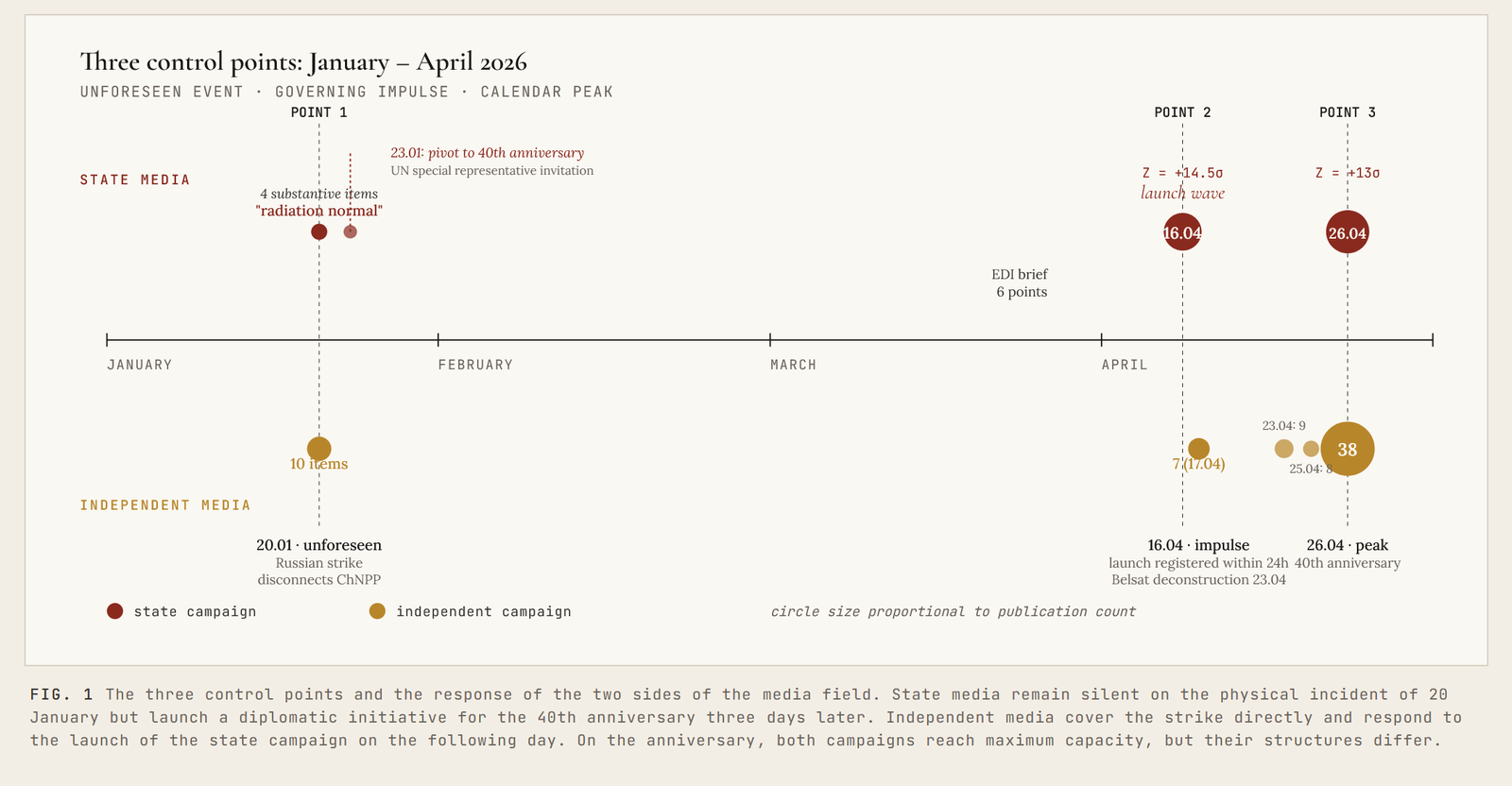
The base of the study is the FactCheck.LT FORESIGHT corpus (over 1.7 million documents). After double cleaning, 121 materials from 14 independent newsrooms entered the analytical sample. State media were analyzed in two modes: substantively for 20 January, and through synchronization signals in pro-government Telegram channels for 16 and 26 April (+14.5σ and +13σ from background).
Two campaigns in different logics
The state campaign operates in the mode of political logic: topics and emphases are set externally, and channels synchronously transmit approved formulations. Its framework — the six points of the EDI brief of 16 April: the scale of damage, the leading role of Lukashenka, 1,657 restored localities, six state programs, controlled population health, the Belarusian Nuclear Power Plant as a natural continuation. The framework is monological, has a single mode of address, and is replicated through a synchronized network of channels.
The independent campaign operates in the mode of media logic: each newsroom makes its own decisions. It has no single defining document, and its internal structure is derived from the materials themselves through clustering by semantic similarity. In these 121 materials, four stable registers of writing about Chernobyl are reproduced: affective, analytical, political, ritual.
Five narratives
| “Overcoming” state |
Catastrophe overcome, programs implemented, BelNPP as natural conclusion. A closed story with a single mode of address. |
| “Echo” independent · affective |
Catastrophe continues as experience. Witness testimony, literary canon, Alexievich’s formula of the “echo.” |
| “Verification” independent · analytical |
A gap exists between official claims and data. The only narrative that directly responds to “Overcoming”: Belsat’s deconstruction of the brief on 23 April. |
| “Political Biography” independent · political |
Chernobyl as a continuous plotline in the political history of Belarus: court cases, strikes, state decisions, relief funds. |
| “Action” independent · ritual |
A response through the “Charnobylski Shliakh” march, the slogan “For an Independent Nuclear-Free Belarus,” and the Ekodom offline program across 17 locations in 13 countries. |
Three cross-cutting observations
The parallel existence of narratives. The state campaign does not engage in polemic with independent media; independent media, although they register the launch of the state campaign and deconstruct its framework, do not produce a unified response. Between the five narratives there arises not direct competition but parallel coexistence.
The gap in engagement with the present. The state narrative builds Chernobyl along the past–future axis, effectively bypassing the present. Independent media engage with the present in part — through data, political context, public action — but the January nuclear incident does not receive a clear interpretation from them either.
The absence of a counter-narrative. A holistic alternative story is present on neither side. The four independent narratives challenge “Overcoming” in parts: “Verification” deconstructs its claims, “Political Biography” registers the practices from which it grows, “Echo” and “Action” operate in other coordinates. But a single alternative story does not take shape. The reason is structural: such a counter-narrative would require alternative data (departmental reporting, medical statistics), a single subject, a programmatic modality — conditions absent in the current media field.
📖 The full report with five visualizations (the timeline of control points, the four registers, the framework of “Overcoming,” the map of the Ekodom program, the summary characterization of the five narratives), a methodological appendix, and a sidebar on comparable research cases: FactCheck.LT · Narrative Intelligence Brief №01