

TL;DR
We analyzed nearly 12,000 posts in Belarusian Telegram channels from 2025 to determine which termfake or “disinformation”It’s more often used to describe false information, what topics dominate, who Belarusian media accuse of creating false information, and what role toxic propaganda channels play.
Methodology
Data source:Belarusian Telegram channels.
Period:January 1 – December 23, 2025
Volume:8,912 “fake” publications + 2,942 “disinformation” = 11,854
Methods:Frequency analysis, thematic classification, contextual analysis of sources, temporal analysis, identification of toxic channels
Restrictions:Doesn’t automatically distinguish between channel ideologies; doesn’t take sarcasm and quotations into account.
Part 1. Quantitative Analysis
The first thing that strikes one when analyzing nearly twelve thousand Belarusian Telegram posts for 2025 is the radical disparity between the two terms. The word “fake” appears three times more often than “disinformation”: 8,912 posts versus 2,942. This ratio remains stable throughout the year, fluctuating between 2.5 and 4 times depending on the month.
Term frequency by month in 2025:
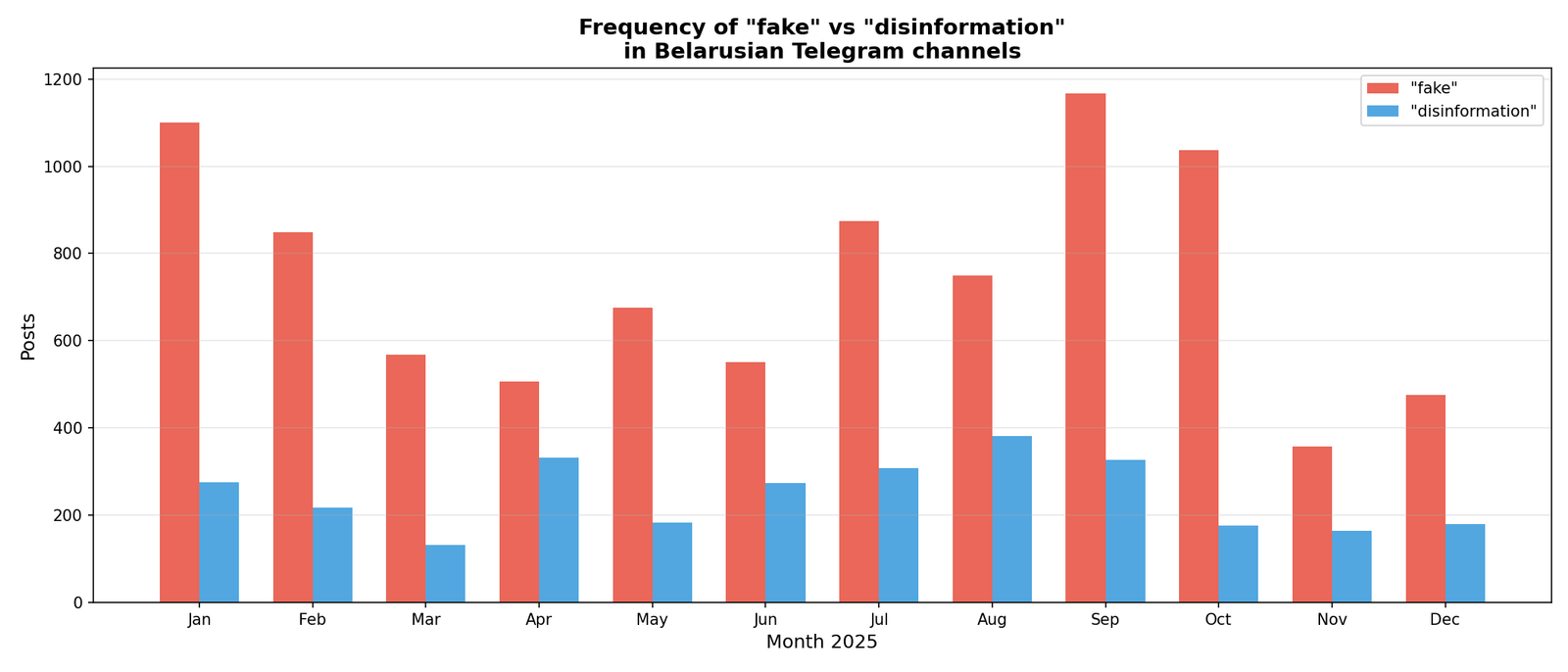
The reason for this imbalance lies in the nature of the words themselves. “Fake” is a borrowing from English that has become firmly entrenched in colloquial speech. It’s short, emotionally charged, and requires no intellectual effort from the reader. When a channel writes, “Beware, fake!”, the audience instantly understands the message: they’re trying to deceive you. “Disinformation,” by contrast, sounds bureaucratic and detached. It’s a word from the lexicon of official documents, press releases, and analytical reports.
Distribution of publications and reach by term:
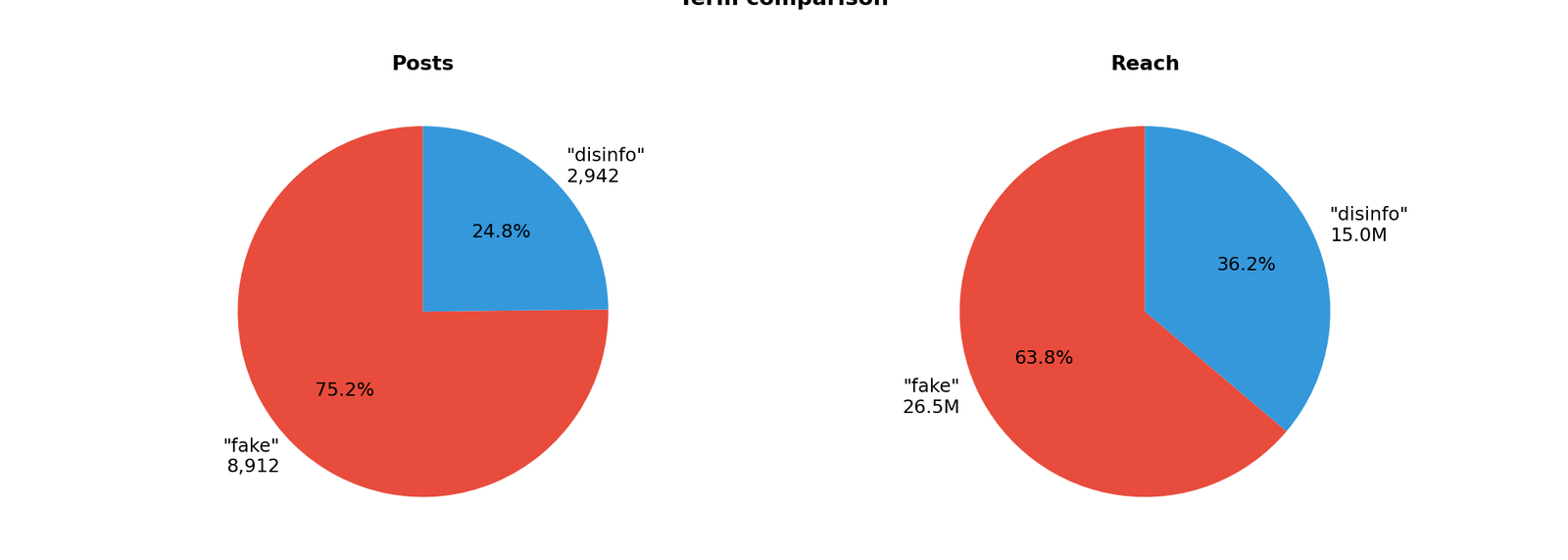
| Indicator | fake | “disinformation” |
|---|---|---|
| Total coverage | 26.5 million | 15.0 million |
| Average reach | 2,974 | 5,103 |
| Median reach | 433 | 447 |
| Unique channels | 1158 | 659 |
Term ratio dynamics by month:
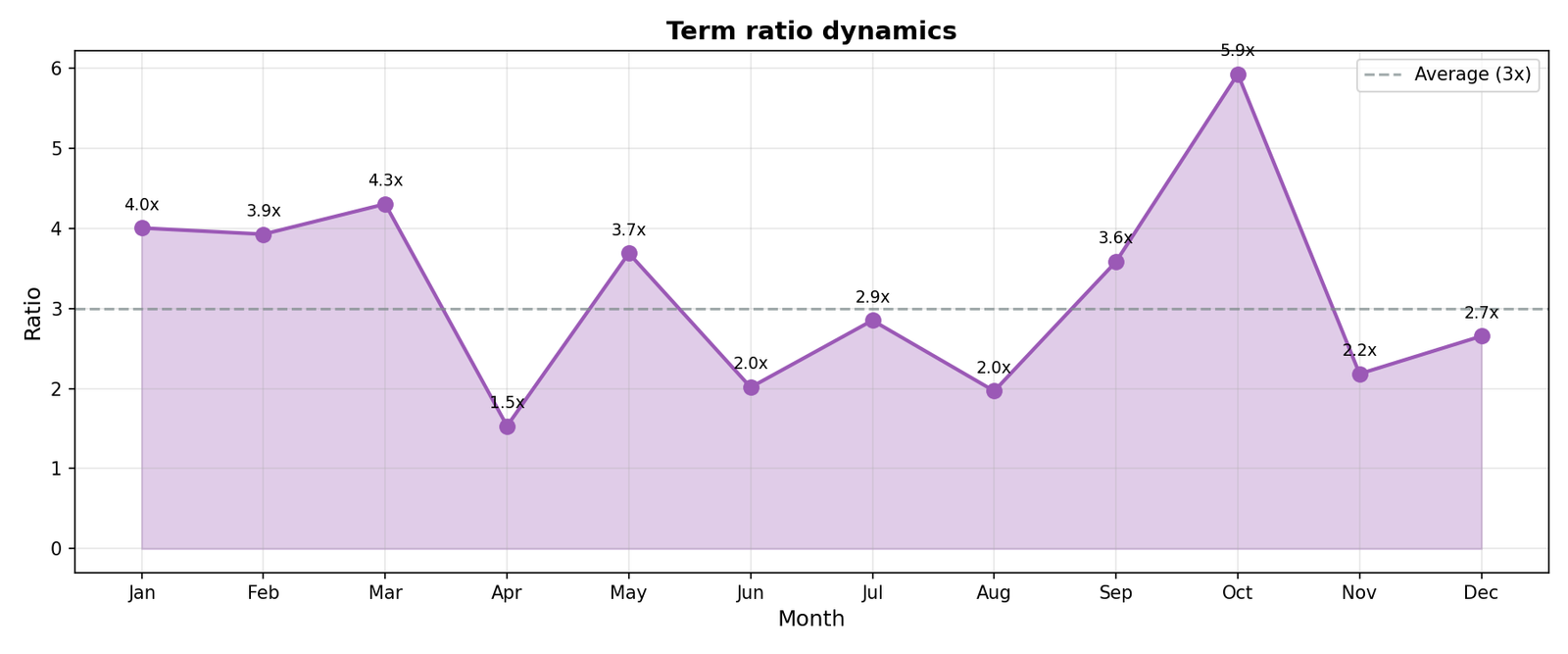
Interestingly, despite a smaller number of posts, the term “disinformation” demonstrates a higher average reach—5,103 views per post versus 2,974 for “fake.” This is explained by the fact that “disinformation” is more frequently used by large news channels with large audiences, while “fake” is evenly distributed among hundreds of small and medium-sized channels. A total of 1,256 unique channels used at least one of the terms, with 561 channels using both words, indicating a deliberate choice of terminology based on context.
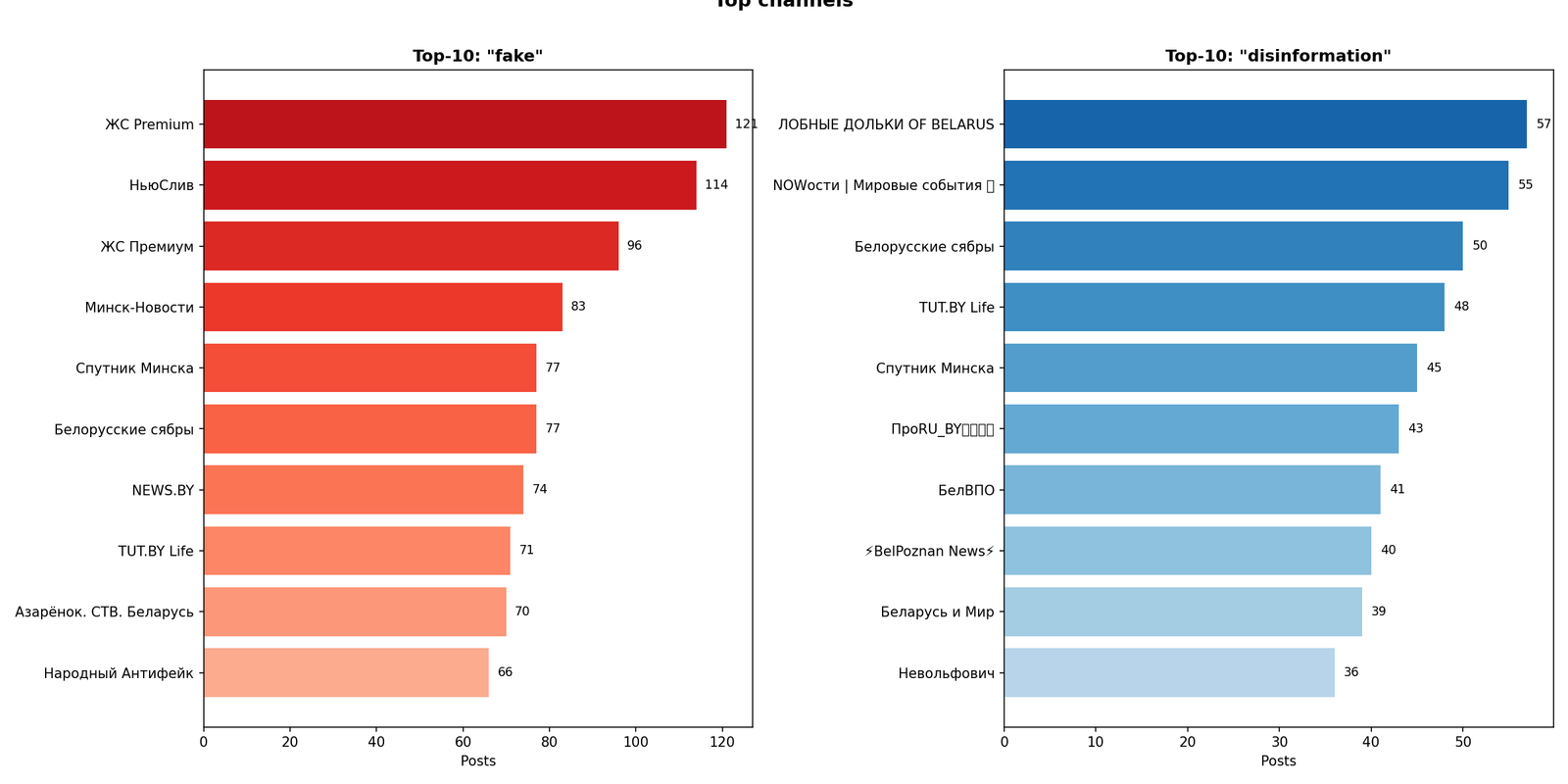
Top 10 channels by use of each term:
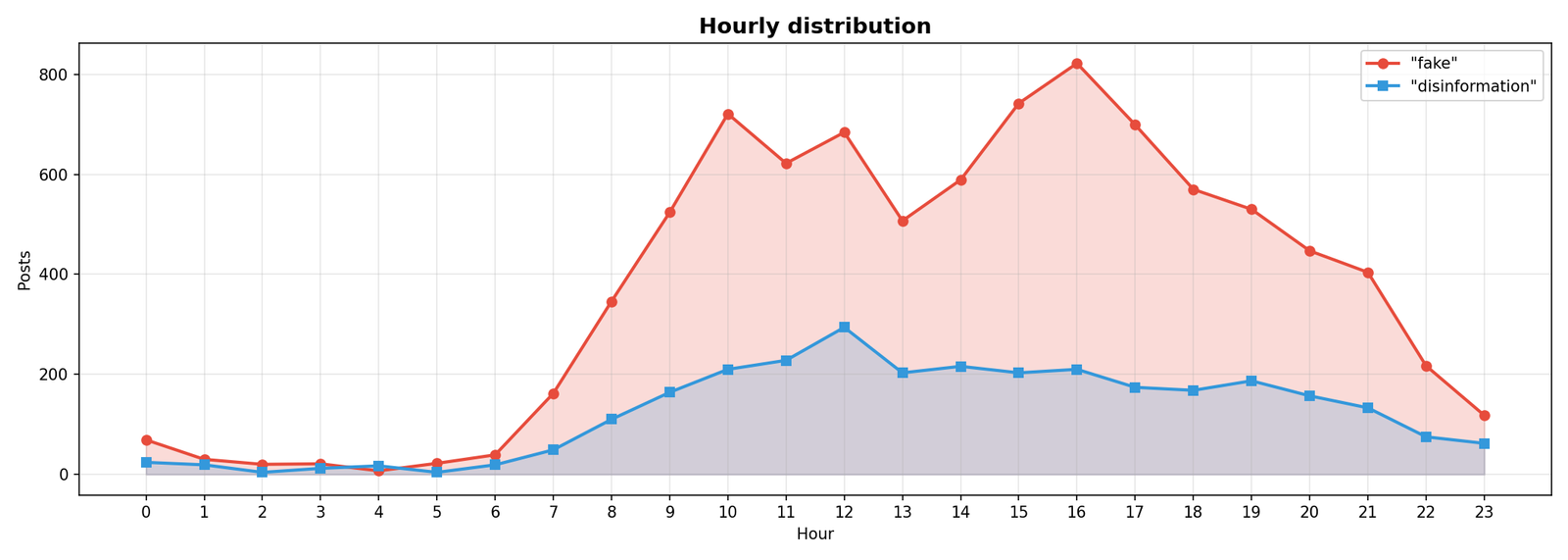
Distribution of publications by time of day
Distribution of publications by day of the week
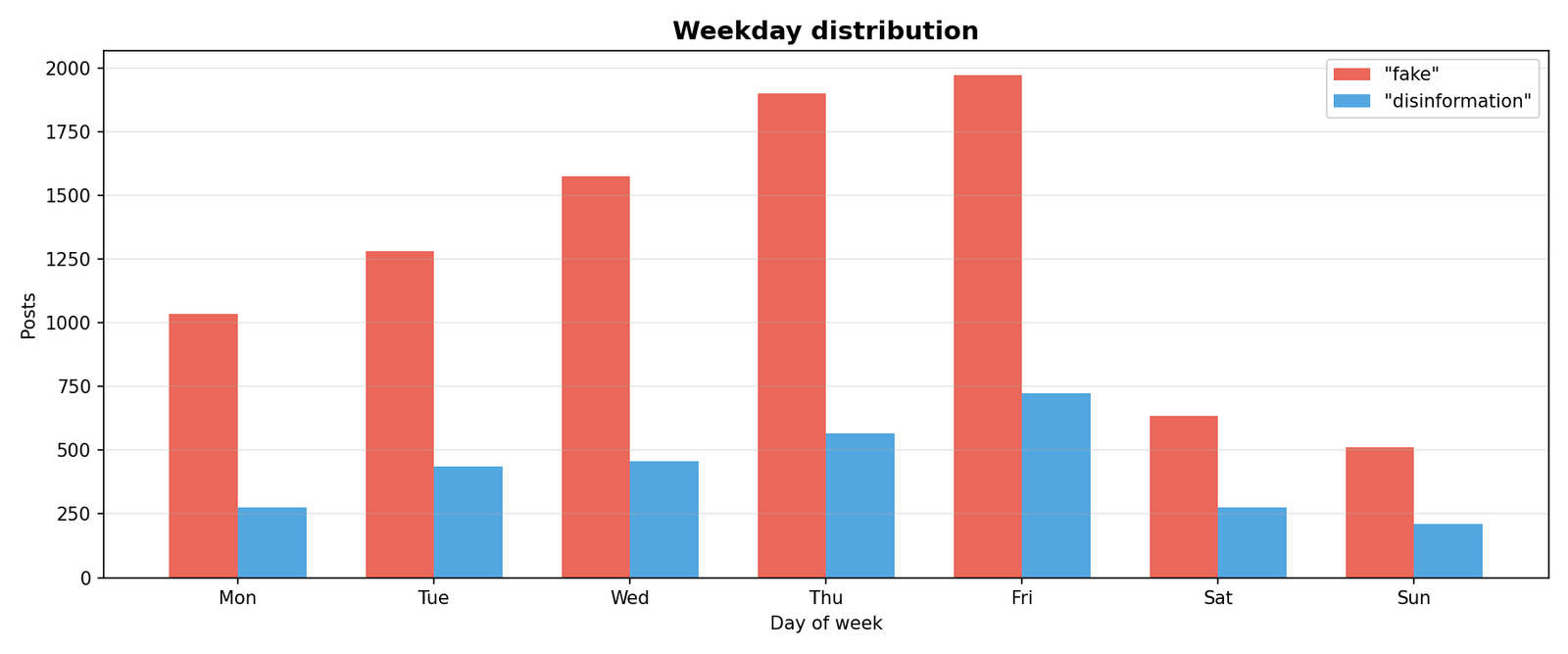
A time analysis of publications reveals a characteristic work rhythm: activity peaks between 10:00 AM and 6:00 PM, with a noticeable decline on weekends. This is not a pattern of spontaneous information dissemination. A particularly characteristic time lapse during the lunch period is observed for publications containing the term “fake.”
Publications about “fakes” and “disinformation” are created by professionals during work hours, which in itself indicates the organized nature of information campaigns.
Part 2. Thematic analysis
If quantitative analysis answers the question “how much,” then thematic analysis reveals “what.” And here, the differences between the two terms become truly revealing.
Thematic distribution of publications:
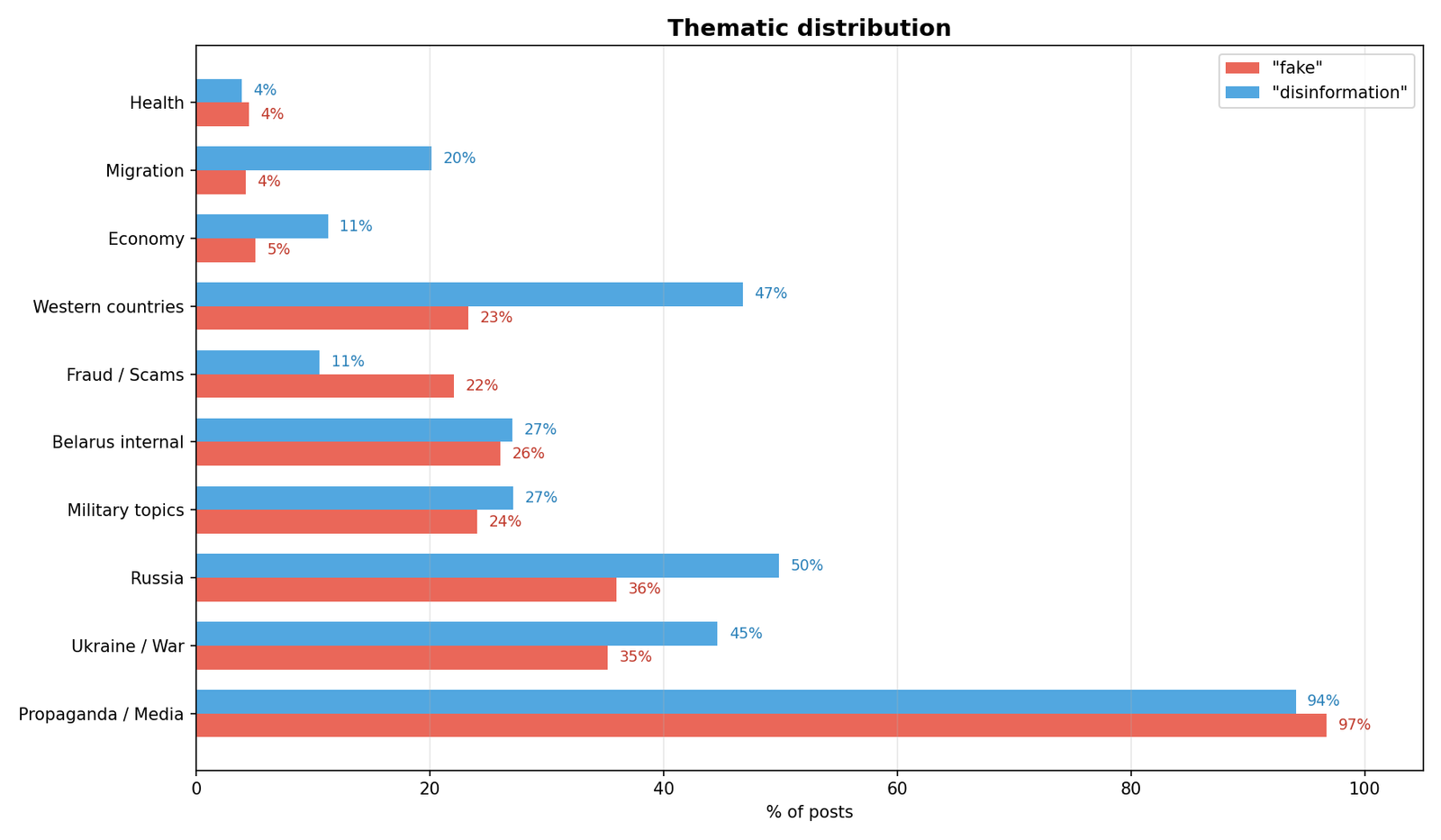
“Fake” is strongly associated with everyday deception. More than a quarter of all publications containing this word are related to fraud: phishing emails, fake sweepstakes, cryptocurrency schemes, false bank notifications. This is a practical, understandable threat. When a state-run channel warns about a “fake mailing on behalf of the tax authorities,” it acts as a protector who cares about citizens. Such content is legitimate and useful—no one will argue that people need to be protected from scammers.
What are they discussing?
| Topic | fake | “disinformation” | Interpretation |
|---|---|---|---|
| Propaganda/Media | 97% | 95% | Both terms are about media |
| Russia | 37% | 51% | “Disinformation” is more often about the Russian Federation |
| Western countries | 24% | 49% | “Disinformation” = “Western threat” |
| Fraud | 27% | 14% | “Fake” = everyday deception |
| Migration/Borders | 11% | 30% | “Disinformation” about borders |
“Disinformation” exists in a completely different semantic field. Almost half of the publications using this term mention Western countries, NATO, or the United States. A third are related to migration and borders. It’s a word from the arsenal of geopolitical rhetoric, a tool for describing external threats. When the channel writes about“Western disinformation”, it appeals not to the reader’s personal experience, but to their political identity.
The difference is especially noticeable in the context of military topics. “Fake news” about the army is usually a refutation of specific rumors: there will be no mobilization, exercises are proceeding as planned, a video of “Belarusian tanks on the border” was filmed in another country. “Disinformation” in a military context is a narrative about information warfare, about the enemy’s systematic attempts to undermine the country’s defenses.
It could be said that “fake news” operates at the micro level: an individual post, a specific message, a single instance of deception. “Disinformation” is presented at the macro level, a concept of organized hostile activity. The choice of term signals to the reader at what level they should perceive the information: as an isolated incident or as part of a global confrontation.
Part 3. Who creates the “fakes”?
An analysis of the publications’ context allows us to answer the key question: who are the Belarusian media accusing of creating false information? The answer turns out to be unexpectedly asymmetrical.
Who creates fakes and disinformation (according to the publications’ authors):
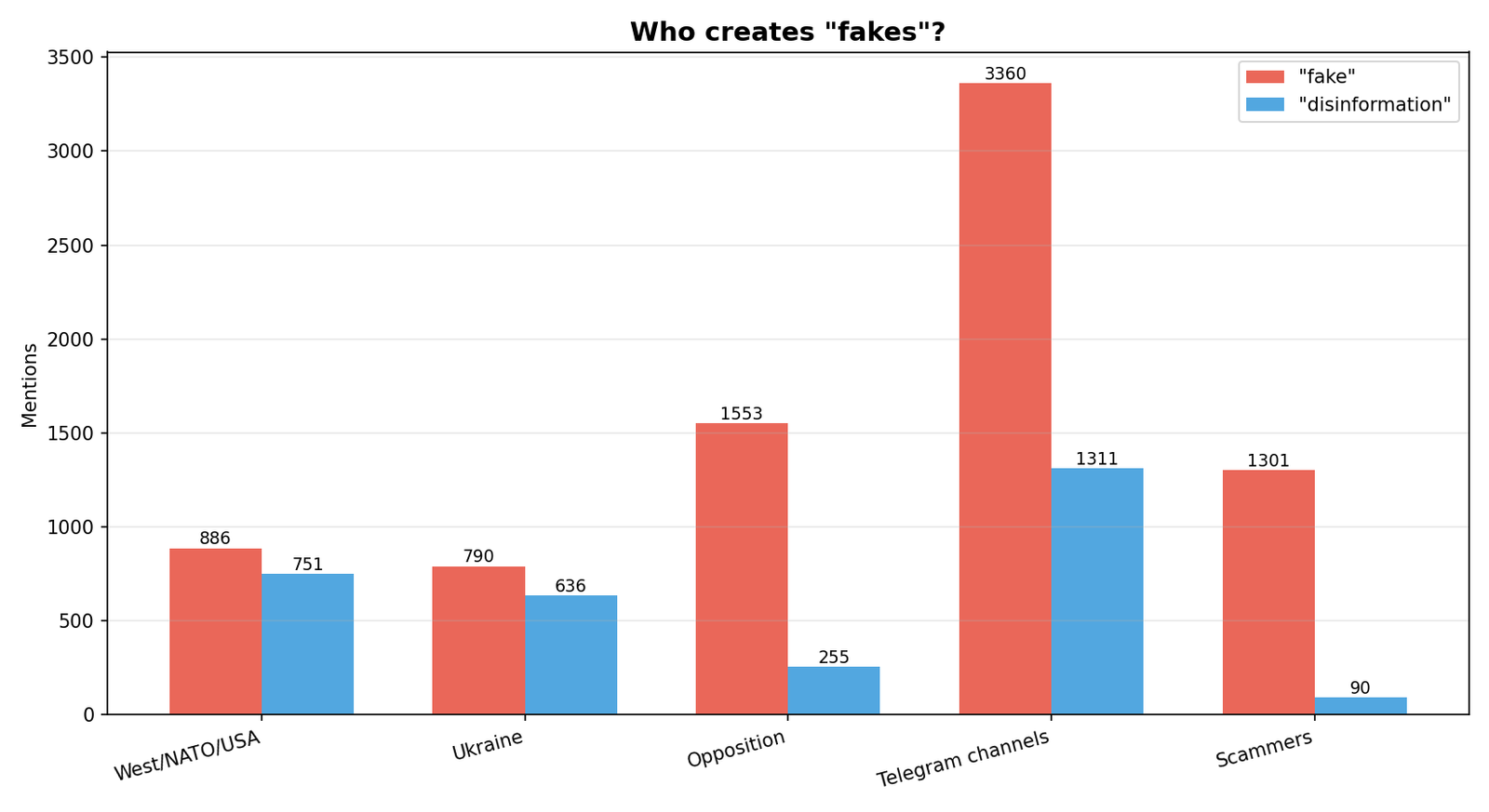
The main culprit:In both cases, they are in the leadTelegram channelsas a source of false information. But there are important differences:
- “Fake”more often associated withopposition(1593 vs 273) andscammers(1301 vs 90)
- “Disinformation”evenly distributed between the West, Ukraine and the opposition
| Source | fake | “disinformation” |
|---|---|---|
| Opposition / “fugitives” | 1,593 | 273 |
| Fraudsters | 1 301 | 90 |
| West / NATO / USA | 889 | 753 |
| Ukraine | 790 | 636 |
| Telegram channels | 3,360 | 1,311 |
Telegram channels, as an abstract category, lead in both cases—naturally, given that we’re analyzing Telegram specifically. But this general category conceals fundamentally different defendants.
The opposition and so-called “fugitives” are accused of creating “fakes” almost six times more often than of spreading “disinformation”: 1,593 mentions versus 273. This is the clearest indicator of the functional difference between the terms. When discrediting a domestic opponent, “fake” is the preferred term. This word, with a contemptuous connotation, implies petty deception, fraud, and forgery. Calling an opposition blogger a distributor of “fakes” equates them with online fraudsters.
The West and NATO, on the other hand, are almost equally accused of both: 889 mentions of “fakes” and 753 mentions of “disinformation.” But the quality of the accusations varies. “Western fakes” are usually specific materials that can be “exposed.” “Western disinformation” is a strategy, a long-term hostile activity, part of a hybrid war.
Fraudsters as a category are practically disappearing from the disinformation discourse: 1,301 mentions in the context of “fakes” and only 90 in the context of “disinformation.” This is logical: fraud is a crime for profit, not an ideological activity. But it is telling that state-run channels actively conflate these categories, creating a connection in the audience’s mind between online fraudsters and political opponents.
Part 4. Key Events of 2025
The 2025 topics demonstrate how terminology adapts to the news story.
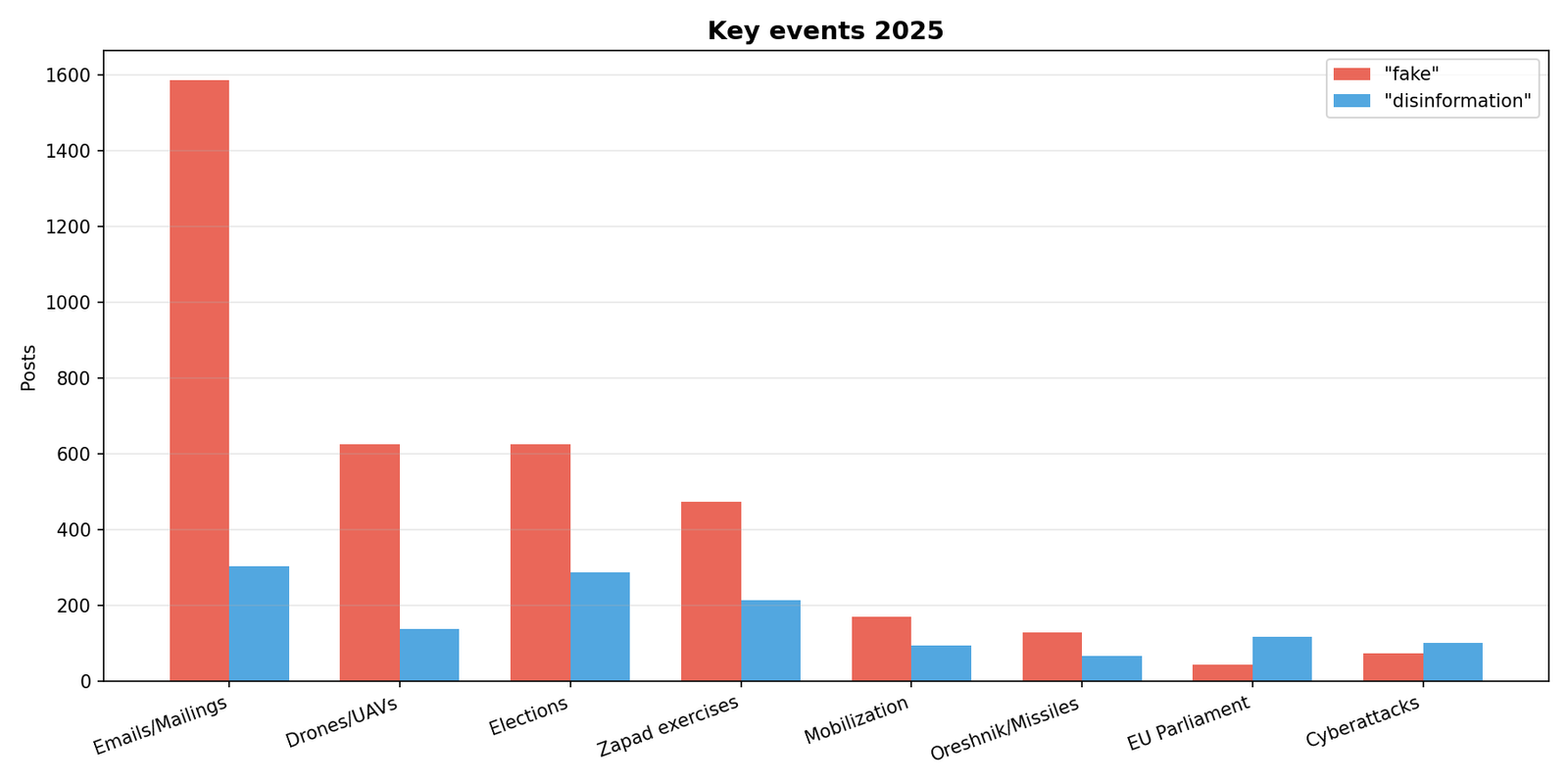
| Event/Topic | fake | “disinformation” |
|---|---|---|
| 📧 Fake emails/mailings | 1,586 | 302 |
| 🗳️ Elections | 625 | 288 |
| 🛸 Drones/UAVs | 624 | 138 |
| ⚔️ Exercises “Zapad” | 474 | 214 |
| 📋 Mobilization | 402 | 250 |
| 🚀 Hazelnut/Rockets | 129 | 67 |
| 🇪🇺 European Parliament | 43 | 116 |
| 💻 Cyberattacks | 74 | 100 |
European Parliament resolutions are the only topic where “disinformation” radically dominates over “fake news” by a ratio of almost three to one. In January, the European Parliament adopted a resolution not recognizing the Belarusian elections by a vote of 567 to 25. In October 2025, a resolution commemorating the fifth anniversary of the events of 2020 was adopted. In December 2025, a condemnation of hybrid attacks against Lithuania was adopted. Each resolution generated a wave of publications, and almost all of them used the term“disinformation”.
The reason is obvious: the European Parliament is an institutional adversary, the official organ of a hostile bloc. Calling its statements “fakes” would be stylistically inappropriate and lacking in weight. “Disinformation” sounds like a state-level accusation, like an institution’s response to another institution.
Cyberattacks demonstrate the most balanced use of terms. Belarus ranked second in the CIS for the number of successful cyberattacks in 2025, and the CyberPartizan attack on Aeroflot in July was the largest incident of the year. Interestingly, major news channels preferred the term “disinformation,” describing cyberattacks as an element of hybrid warfare, while specialized information security channels used “fake” to describe specific leaks and false reports of attacks.
The possible deployment of the Oreshnik missile system in December 2025 is a new topic in our dataset. Here, the ratio of terms is close to the average for the entire sample, which may indicate a narrative that has not yet formed. Characteristically, pro-government channels like “Nevolfovich” and “BelVPO” prefer the term “disinformation,” positioning any criticism of the missile deployment as part of the West’s information war.
Part 5. Analysis of toxic channels
Of the more than a thousand channels in our sample, we identified fifteen that systematically use aggressive rhetoric, dehumanizing language toward the opposition, and manipulative information delivery techniques. These channels account for less than seven percent of the total publication volume, but their influence is disproportionately large: the average reach of their posts is 35-40 percent higher than that of other channels.
Toxic Channel Ratings
| Channel | fake | “disinformation” | Coverage | Ratio |
|---|---|---|---|---|
| STV | 168 | 66 | 652K | 2.5x |
| ZhS Premium | 121 | 31 | 1.2M | 3.9x |
| Nevol’fovich | 35 | 36 | 415K | 1.0x |
| BelVPO | 28 | 41 | 716K | 0.7x |
| SB.BY | 43 | 20 | 77K | 2.1x |
| Sputnik Belarus | 31 | 16 | 411K | 1.9x |
| BELTA | 23 | 5 | 271K | 4.6x |
Who are the toxic channels to blame?
| Target of the attack | fake | “disinformation” | Difference |
|---|---|---|---|
| Opposition/”fugitives” | 29% | 20% | +9% |
| West/NATO/USA | 31% | 68% | -37% |
| Ukraine | 16% | 30% | -13% |
Toxicity markers
| Marker | Target | fake | “disinformation” |
|---|---|---|---|
| throw-in | Accusations of manipulation | 124 | 41 |
| extremist | Criminalization of dissent | 107 | 27 |
| provocat* | Accusations of provocation | 48 | 11 |
| zmagar | Derogatory designation | 46 | 18 |
| fugitives | Negative labeling | 25 | 11 |
Profiles of key toxic channels
🔴 ЖС Premium — maximum toxicity
Ratio:3.9x in favor of “fake” |Coverage:1.2 million
Style:Aggressive, mocking, uses emojis and sarcasm
🔵 BelVPO — geopolitical focus
Ratio:0.7x (the only one with a bias towards “disinformation”) |Coverage:716K
Style:Military analytical, pseudo-expert
Subject:Information warfare, hybrid threats, military exercises
⚖️ Nevolfovich is a balanced propagandist
Ratio:1.0x (equal usage) |Coverage:415K
Style:Official, associated with the Security Council
Subject:Domestic politics, security forces, “revelations”
The leader in publication volume is the STV channel, with 234 posts containing the terms analyzed this year. STV’s “fake” to “disinformation” ratio is 2.5 to 1, close to average. It’s a state-owned television channel with a professional editorial staff that balances between everyday warnings about fraud and political attacks.
“ZhS Premium” demonstrates the highest bias toward “fake”—a ratio of 3.9 to 1. This channel is distinguished by an aggressive, mocking style. A typical post: “‘Go away! Go away! Go away!’ It’s like that in all the Zmagar publics now. And they said it was fake. 😃.” The word “fake” is used here not to inform, but to troll opponents.
The only major channel with the opposite ratio is “BelVPO” (Belarusian Military-Political Observer). Here, “disinformation” is used more often than “fake” by a ratio of 0.7 to 1. The channel positions itself as a military-analytical outlet and prefers the language of the expert community. When BelVPO writes about “Western disinformation,” it appeals to an audience that perceives itself as thinking people capable of analyzing geopolitics.
An analysis of lexical markers of toxicity confirms the functional difference between the terms. The word “vbrak” (fake news) appears three times more often next to “fake” than next to “disinformation.” “Extremist” appears four times more often. “Zmagar” is used two and a half times more often. These markers point to the same pattern: “fake” is a term for a domestic audience, used to attack compatriots, who are portrayed as petty crooks and traitors.
Part 6. Analysis of publication coordination
The most technically challenging, but also most compelling, section of the study is devoted to identifying coordinated behavior.
Results for the term“fake”with a minute window:
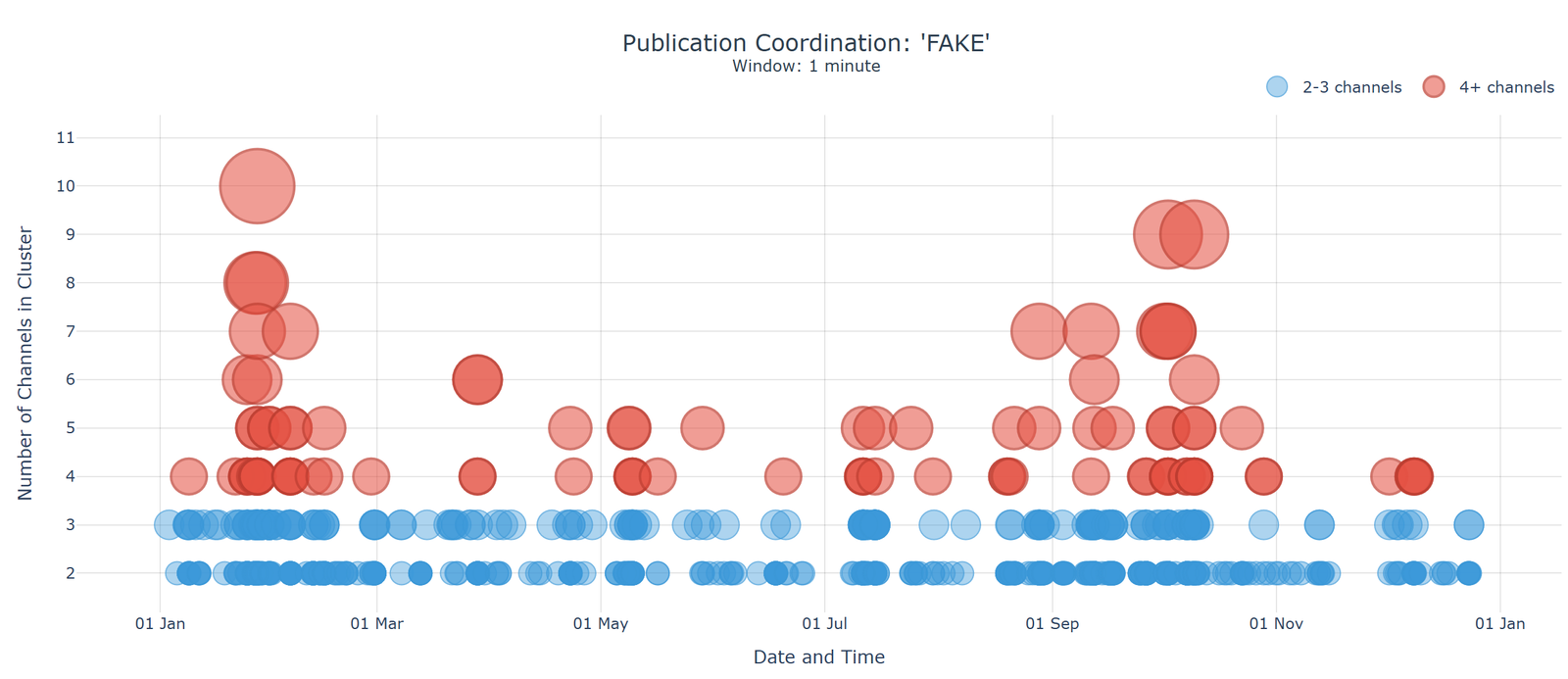
Full interactive chart here.
Results for the term“disinformation”with a minute window:
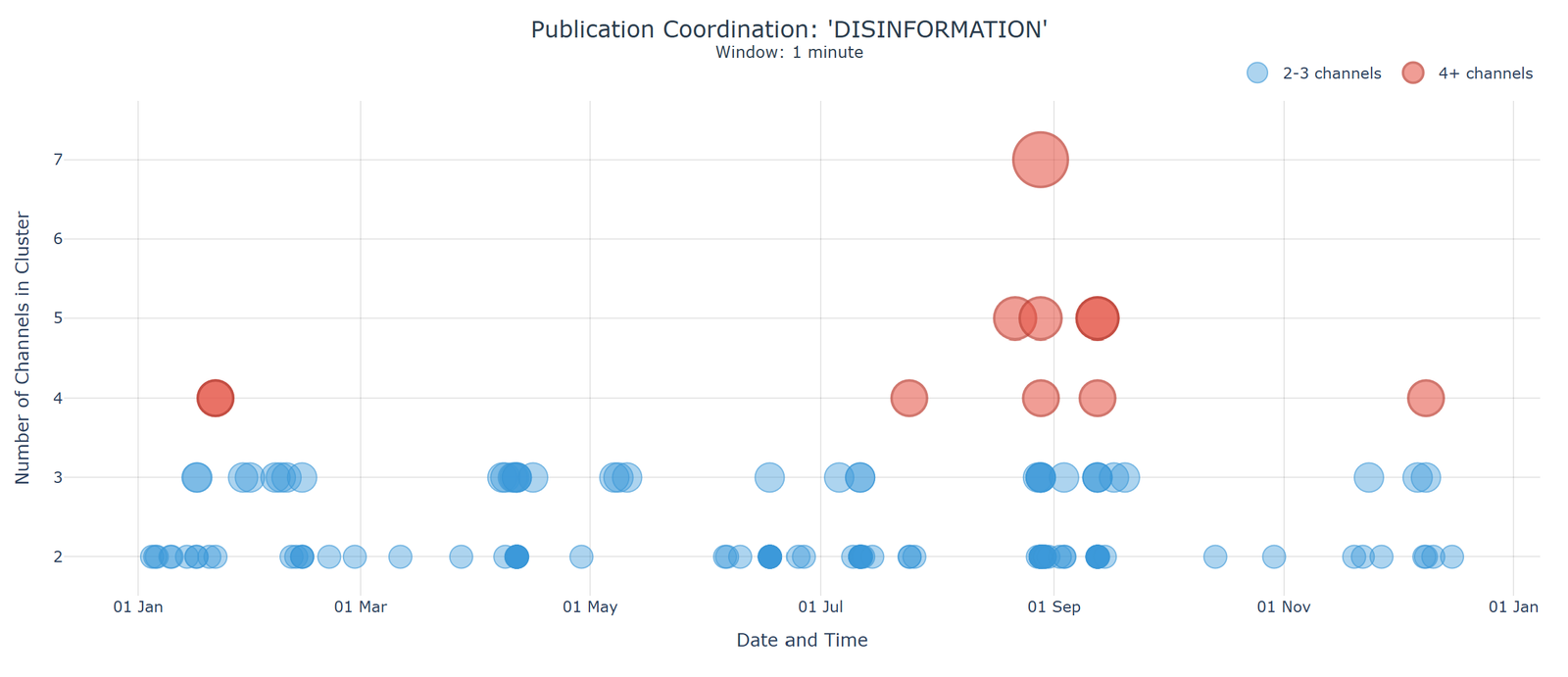
Full interactive chart here.
We defined coordination as a situation where multiple channels publish content with the same term within a fifteen-minute time window.
Comparison of coordination
| Indicator | fake | “disinformation” |
|---|---|---|
| Total clusters (2+ channels) | 1447 | 397 |
| 6+ channel clusters | 218 | 36 |
| Clusters of 10+ channels | 85 | 11 |
| Maximum channels | 50 | 19 |
Coordination network core
Channels most frequently involved in coordinated publications (clusters of 6+ channels):
🔴 The “FAKE” core
- ZhS Premium– 40 clusters
- ZhS Premium – 38 clusters
- People’s Antifake – 36 clusters
- NewSliv – 35 clusters
- Bragin region officially has 31 clusters
- New life – 23 clusters
- Reverse side – 22 clusters
- Current and Important – 22 clusters
- Mogilev Regional Water Utility – Cluster 21
- OZAA Info – 21 cluster
🔵 Core “DISINFORMATION”
- MOGILEVNEWS– 7 clusters
- Azarenok. STV. Belarus – 6 clusters
- People’s Antifake – 6 clusters
- ZhS Premium – 6 clusters
- ZhS Premium – 6 clusters
- PUL Korelichi – 5 clusters
- Reverse side – 5 clusters
- Bykhov Today – 5 clusters
- Korelichi Online – 5 clusters
- Belarus 4 Mogilev – 4 clusters
ZhS Premium, ZhS Premium, Narodny Antifake, NewSliv, Azarenok, The Other Side, Relevant and Important, Belarus 4 Mogilev, Bykhov Today, Glavny.Tour, PUL Korelichi, Mogilev Regional Hospital
Top 5 Largest Clusters
| Date and time | Channels | Channel examples |
|---|---|---|
| January 27, 2025, 10:30 AM | 50 | Belarus 4 Mogilev, Nevolfovich, POSUSEKAM, Newspaper Dzyannica… |
| October 2, 2025, 12:30 PM | 36 | Slonim Bulletin, New Life, VOLKOVYSK NEWS, Ashmyanski Vesnik… |
| October 9, 2025, 4:00 PM | 35 | Main. Tour, Belorusneft, Belarus 4 Mogilev, Chausy Iskra… |
| January 26, 2025, 8:30 PM | 34 | Grodno Pool, New Live, Your Homel, New Life, Premium… |
| March 28, 2025, 10:30 AM | 29 | Vitebsk DSK, what’s going on? Mogilev, Mogilevoblvodokanal… |
The results exceeded expectations. For the term “fake,” we found 1,447 coordination clusters, of which 218 included six or more channels, and 85 included ten or more. The all-time high was reached on January 27, 2025, at 10:30 AM, when fifty channels published content containing the word “fake” in a 15-minute window. The content was a refutation of TikTok videos about a “press conference attack.” Apparently, a command had been given, and the network acted as a single organism.
For “disinformation,” the picture is more modest: 397 clusters, of which only 36 included six or more channels. The largest cluster size was 19 channels. This 3.6-to-1 ratio in favor of “fake” once again confirms that this term is a working tool for coordinated campaigns.
Analysis of the coordination network core revealed a stable group of channels that regularly engage in synchronized publications. The leaders are predictable: “ZhS Premium” participated in 40 clusters, “Narodny Antifake” in 36, and “NewsLive” in 35. The presence of channels from state-owned enterprises and institutions (Mogilevoblvodokanal, Mogilev Regional Clinical Hospital, and Belorusneft) on this list is significant. This indicates the systematic involvement of the public sector in information campaigns.
Twelve channels are present in the coordination core of both terms, indicating the existence of a stable distribution infrastructure. These channels function as network nodes through which content is relayed to a wider audience. Identifying this structure is a practical result that can be used to monitor future information operations.
Conclusions
- “Fake” = a common termAssociated with fraud, phishing, and opposition. Used to discredit internal opponents.
- “Disinformation” is a political term.associated with the West, geopolitics, official discourse.
- Telegram channelsthe main “enemy” as a source of false information.
- Oppositionis accused of “fakes” six times more often than of “disinformation.”
- Toxic channelsmake up 6–9% of publications, but have a reach 35–40% higher than average.
- Toxicity markers:“stuffing”, “extremist”, “zmagar”, “provocation”.
- Mass coordination:Up to 50 channels are published simultaneously. JS Premium is the coordination leader (40 clusters).
- Key events in 2025:fake mailings, European Parliament resolutions, “Oreshnik”.
The choice between “fake” and “disinformation” isn’t a stylistic preference, but a strategic one. “Fake” operates on an emotional level; it’s understandable, dismissive, and aimed primarily at domestic opponents. “Disinformation” appeals to rationality, sounds expert, and addresses external threats.
State propaganda uses both tools deliberately. When it comes to discrediting an opposition blogger, they choose “fake.” When it comes to responding to the European Parliament, they choose “disinformation.” When it comes to warning about fraudsters, they choose “fake” again because it creates the image of a caring state.
The coordination of publications proves that this isn’t a spontaneous choice by individual editors, but a centralized system. Dozens of Telegram channels can’t all decide to use the same word at the same time—it requires a team.