
Region: 🇸🇩 Sudan / East Africa
In February 2022, a Sudanese customs inspector discovered something unusual in a Russian cargo plane at Khartoum International Airport. The manifest declared cookies – an item Sudan rarely exports. Inside the hold, behind the colorful boxes, inspectors found one ton of gold.
This was not an isolated incident. Between February 2022 and February 2023, at least 16 Russian flights smuggled an estimated 32.7 tons of Sudanese gold worth approximately $1.9 billion out of the country. The cargo was sometimes flown to a Russian-controlled airbase in Syria, sometimes to the UAE for laundering before reaching Moscow. All of it bypassed Sudan’s treasury.1
The discovery illuminates Russia’s strategy in Sudan – and reveals why Moscow has worked to ensure that no matter who wins the country’s devastating civil war, Russia profits.
Two Generals, One Patron
The war that erupted in April 2023 pits two men who once ruled together: General Abdel Fattah al-Burhan, commander of the Sudanese Armed Forces (SAF), and General Mohamed Hamdan Dagalo – known as Hemeti – who leads the paramilitary Rapid Support Forces (RSF).
Both have blood on their hands. The RSF emerged from the Janjaweed militias accused of genocide in Darfur. The SAF has conducted indiscriminate bombings of civilian areas. Together, they orchestrated the October 2021 coup that ended Sudan’s fragile transition to democracy.
And both have been cultivated by Russia.
Wagner Group first arrived in Sudan in 2017, shortly after a meeting between Putin and then-President Omar al-Bashir in Sochi. Bashir told Putin that Sudan could be Russia’s “key to Africa.” Within months, Russian “instructors” numbered between 100 and 500, deployed to secure gold mining operations and train security forces.2
When pro-democracy protests threatened al-Bashir in 2018-2019, Wagner advised the regime on media campaigns to discredit demonstrators. After his overthrow in April 2019, Russia quickly pivoted to back the military generals against civilians who were hostile to Moscow’s influence.3
Gold for Guns
At the heart of Russia’s Sudan operation is gold – Africa’s third-largest reserves.
Sudan’s gold sector is dominated by Hemeti’s family. The RSF leader controls mining operations in Darfur, where an estimated 50-80% of gold production is smuggled out of the country rather than passing through official channels.4
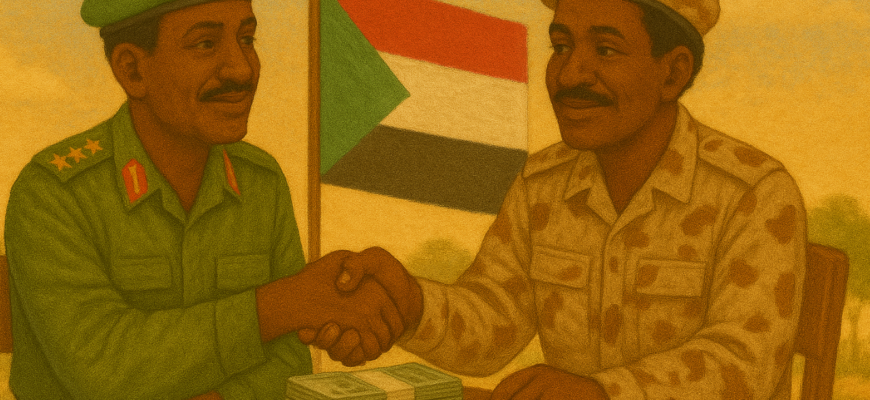
Russia’s main vehicle was Meroe Gold, a subsidiary of Prigozhin-owned M-Invest, which began operating in 2017. In exchange for gold access, Wagner provided weapons, training, and political support to both the SAF and RSF. Meroe Gold imported riot shields, helmets, and batons to RSF-linked companies – including 13 tons of equipment just two days after the June 2019 massacre that killed at least 128 pro-democracy protesters.5
The arrangement was formalized in secret deals. M-Invest paid millions to Sudanese military intelligence in exchange for permission to land military planes in Khartoum and use “the signal code of the air force” – effectively a license to fly weapons in and gold out without detection.6
A CNN investigation estimated that up to $13.4 billion worth of gold was missing from Sudan’s official accounts, with Bloomberg putting the figure at $4 billion. Either way, the sums are enormous – representing wealth that never reached Sudan’s impoverished population.7
“Sudan has lost a lot of its wealth,” said Abdul Moniem Sidig of the Sudanese Gold Exporters Association. “Gold hasn’t contributed remarkably to improving the Sudanese economy.”8
The Switch
When war erupted in April 2023, Russia initially continued its dual-track approach – the Kremlin maintaining ties with Burhan while Wagner supported Hemeti and the RSF.
As one analyst put it: “The Kremlin backs Burhan and the Wagner Group, which is an arm of Russian foreign policy, backs the RSF. That way they have a horse in the race no matter how this shakes out.”9
Wagner supplied the RSF with surface-to-air missiles from bases in Libya and Central African Republic, enabling them to shoot down SAF fighter jets. Flights from Wagner’s al-Jufra base in Libya and facilities in Syria landed at RSF-controlled airports in Sudan.10
But by mid-2024, Russia began shifting its primary support toward the SAF. Several factors drove the change.
First, Ukraine. Ukrainian special forces had begun operating in Sudan, conducting operations against Russian mercenaries and their RSF allies. Reports indicate that during Deputy Foreign Minister Bogdanov’s April 2024 visit to Port Sudan, Sudan pledged to abandon military cooperation with Ukrainians in exchange for Russia halting assistance to the RSF.11
Second, the naval base. Russia has pursued a Red Sea naval facility at Port Sudan since a 2019 agreement with al-Bashir. With the Assad regime’s fall in Syria threatening Russian bases at Tartus and Khmeimim, a Sudanese port became more valuable. Burhan controls Port Sudan; Hemeti does not.12
Third, changing fortunes. The SAF launched successful offensives in late 2024, recapturing Omdurman and much of Khartoum by early 2025. Russia prefers backing winners.
In November 2024, Russia vetoed a UN Security Council resolution aimed at guaranteeing humanitarian access and enforcing the arms embargo throughout Sudan – its support for the SAF now crystallized into blocking international action against both sides.13
The Veto Power
Russia’s UN veto exemplifies how it weaponizes institutional positions to protect client regimes and extend conflicts.
The vetoed resolution, drafted by the UK and Sierra Leone, demanded implementation of the Jeddah Declaration, condemned RSF atrocities, and called for an immediate ceasefire. Russia was the only member of the 15-member Council to reject it – following five previous abstentions on Sudan throughout 2024.14
Russia’s representative justified the veto by arguing that only the Sudanese government (meaning the SAF-aligned Sovereignty Council) should regulate border control and civilian protection. This framing treats the warring party Russia backs as the sole legitimate authority while dismissing international humanitarian concerns.
The result: continued impunity for both sides. As researchers have noted, Russia’s participation in Security Council votes “validates that voice as legitimate” and “ensures perpetuation of the war as long as all sides continue to profit.”15
The Human Cost
While Moscow calculates geopolitical advantage, Sudan burns.
By late 2025, the war had created one of the world’s worst humanitarian crises. Over 30 million people – including 16 million children – need humanitarian assistance. Famine, floods, and cholera outbreaks compound the violence.16
In Darfur, the RSF has conducted what the UN High Commissioner for Refugees warned is reminiscent of the 2003-2005 genocide that killed an estimated 300,000 people. In November 2023, RSF forces killed over 800 people in a multi-day rampage in Ardamata, West Darfur. UN reports indicate 10,000-15,000 people were killed in ethnic violence by the RSF and allies in West Darfur in 2023 alone.17
In October 2025, El-Fasher – North Darfur’s capital – fell to the RSF after 18 months under siege. The capture triggered house-to-house searches, arbitrary detentions, and summary executions. At the Saudi Maternity Hospital, nearly 500 people were killed. At least 62,000 fled the area within days.18
Women and girls as young as fourteen have been victims of systematic sexual violence. Over 235 villages were burned across Sudan, with the majority set by militias in Darfur.19
The Information War
Russia’s information operations in Sudan predate the current war.
Wagner’s disinformation experts “continue to support the claims of the military establishment in Sudan by creating manipulated news platforms on social media,” according to Sudan researcher Suliman Baldo. These have been repeatedly blocked by Facebook for representing unlawful foreign interference.20
The playbook mirrors other African operations: discrediting international actors (particularly the UN), amplifying regime narratives, and muddying waters around atrocities to prevent accountability.
When civilian investigators were preparing to publish a report on military corruption before the 2021 coup, one of Burhan’s first acts after seizing power was to raid their offices and confiscate the documents.21
Forever War Economics
Russia’s strategy in Sudan represents a cynical calculation: instability serves Moscow’s interests as long as gold keeps flowing and rivals remain excluded.
A civilian government “would likely prosecute these crimes more vigorously,” as one analyst noted. The military junta’s survival depends on Russian support; Russian resource extraction depends on junta survival.22
The arrangement proves mutually reinforcing – and mutually destructive for Sudanese civilians.
Between April and October 2024, Russia supplied 2.8 million barrels of diesel and gasoline to Sudan, accounting for nearly half of the country’s fuel imports. The war machine runs on Russian fuel even as Russia profits from the chaos it helps perpetuate.23
Iran has also entered the picture, supplying the SAF with Mohajer drones and seeking its own naval base on the Red Sea. China is building infrastructure at Port Sudan. The country’s strategic location – gateway to the Red Sea, Africa’s third-largest gold producer – ensures that external actors will continue treating Sudan as a prize rather than a people.24
The monuments in Central African Republic celebrate Russian “protectors.” In Sudan, there are only graves – unmarked, uncounted, multiplying – monuments to a partnership that enriches Moscow while impoverishing everyone else.
Sources
Additional Reading
- Al Jazeera, “Russian mercenaries in Sudan: What is the Wagner Group’s role?”, April 2023
- CSIS, “How Does the Conflict in Sudan Affect Russia and the Wagner Group?”, 2023
- DW/AllAfrica, “Sudan: Russia’s Wagner Group and the Grab for Power and Gold”, April 2023
-
CNN, “Russia is plundering gold in Sudan to boost Putin’s war effort in Ukraine”, July 2022. ↩
-
Security in Context, “Emerging Stage for Great Power Competition: Russia’s Influence in Sudan”, 2024. ↩
-
Security in Context, “Russia’s Influence in Sudan amid Political Turmoil”, 2024. ↩
-
Africa Defense Forum, “Russia Uses Wagner to Plunder Sudan’s Gold”, December 2022. ↩
-
Middle East Eye, “Russia’s Wagner Group ‘getting rich in Sudan’ from gold mines”, 2022. ↩
-
UnHerd, “How Wagner plundered Sudan’s gold”, April 2023. ↩
-
UnHerd, “How Wagner plundered Sudan’s gold”, April 2023. ↩
-
Africa Defense Forum, “Russia Uses Wagner to Plunder Sudan’s Gold”, December 2022. ↩
-
Middle East Eye, “Sudan war: Russia hedges bets by aiding both sides”, May 2024. ↩
-
Africa Defense Forum, “With Weapons and Gold Mining, Wagner Cashes In on Sudan Chaos”, May 2023. ↩
-
Jamestown Foundation, “Russia Switches Sides in Sudan War”, 2024. ↩
-
Africa Defense Forum, “Sudan’s Proxy War”, August 2025. ↩
-
EU Institute for Security Studies, “The fall of El-Fasher: Sudan’s war outpaces truce plan”, 2025. ↩
-
Syracuse Journal of International Law, “Russia’s Motivations for Vetoing UN Security Council Resolution”, January 2025. ↩
-
Columbia Political Review, “Russian Intervention on Dual Sides of Terror”, 2025. ↩
-
EU Institute for Security Studies, “The fall of El-Fasher”, 2025. ↩
-
Council on Foreign Relations, “Civil War in Sudan”, Global Conflict Tracker. ↩
-
EU Institute for Security Studies, “The fall of El-Fasher”, 2025. ↩
-
Council on Foreign Relations, “Civil War in Sudan”. ↩
-
Middle East Eye, “Russian mercenaries near Sudan accused of killing hundreds”, 2022. ↩
-
Africa Defense Forum, “With Weapons and Gold Mining, Wagner Cashes In”, May 2023. ↩
-
Africa Defense Forum, “With Weapons and Gold Mining, Wagner Cashes In”, May 2023. ↩
-
Africa Defense Forum, “Sudan’s Proxy War”, August 2025. ↩
-
Africa Defense Forum, “Sudan’s Proxy War”, August 2025