

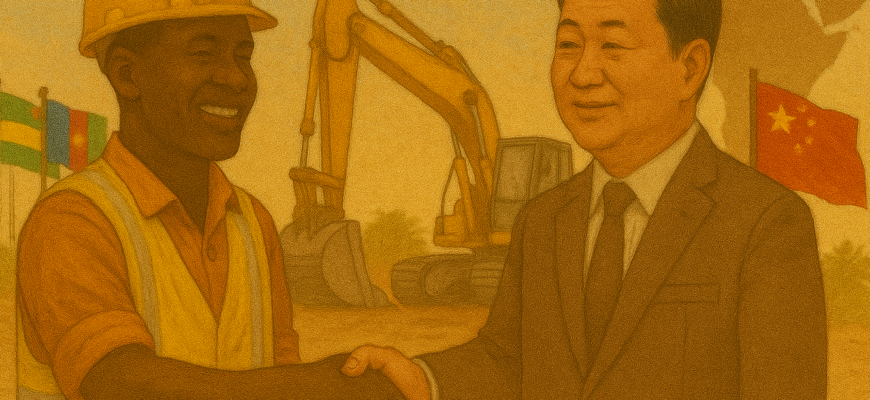
Region: 🇨🇳 China’s Operations Across Africa
In the village of Limuru, Kenya, a shoe repairman named Nganga lives in a home without running water, its walls made from corrugated metal. Yet outside, where chickens roam the yard, a large Chinese-built satellite dish connects his old television to hundreds of channels – many beamed directly from Beijing.1
Nganga is one of 10 million Africans whose homes now receive Chinese digital television through StarTimes, Beijing’s primary contractor for the “Access to Satellite TV for 10,000 African Villages” project. The cheapest packages offer just two international news channels: Al Jazeera and CGTN – China’s state-owned broadcaster tasked with “telling the China story well.”2
This is influence at scale, delivered not through military intervention or mercenary deployment, but through infrastructure, investment, and the slow rewiring of information ecosystems.
Two Models, One Continent
Russia and China are both expanding influence across Africa. But their approaches could hardly be more different.
Trade between China and Africa reached $295 billion in 2024, making China the continent’s largest trading partner by an enormous margin. Russia’s African trade that same year: $24.5 billion.3
China has embassies in all 54 African countries. Russia operates 39, and even where both maintain diplomatic presence, the disparity is striking – an American official in Kenya noted that China has three defense attachés posted there while Russia has none.4
But the contrast runs deeper than numbers. As one researcher put it: China prioritizes “subtle influence and maintaining stability in areas of investment to ensure that it gets good returns.” Russia, by contrast, has focused on security partnerships in countries experiencing “widespread insecurity and instability.”5
It is not coincidence that Mali, Central African Republic, and Sudan – all experiencing widespread violence – are hotspots of Russian influence. Wagner thrives in chaos. China needs order for its investments to mature.
The Belt and Road
The Belt and Road Initiative (BRI), launched by Xi Jinping in 2013, represents the most ambitious infrastructure program in history. All but two African countries have now signed BRI agreements. Chinese companies have signed contracts worth more than $700 billion in Africa between 2013 and 2023.6
At the Forum on China-Africa Cooperation (FOCAC) summit in September 2024, Xi announced more than $50 billion in additional financing over three years. At least 46 African ports have been built, financed, or are currently operated by Chinese state-owned shipping companies.7
The results are visible across the continent: the $5 billion Mombasa-Nairobi railway in Kenya, cutting travel time from ten hours to four. The Addis Ababa-Djibouti railway in Ethiopia. Highways, dams, power grids, telecommunications networks.
But the model comes with strings – sometimes visible only when debts come due.
The Debt Question
From 2001 to 2022, Chinese financial institutions provided more than $170 billion in credit, loans, and grants to African nations, primarily to fund BRI infrastructure projects. By 2024, new Chinese loans to African governments had plummeted from their 2016 peak of $28.4 billion to less than $2 billion annually. The era of easy credit had ended. The era of debt collection had begun.8
AidData research shows that 80 percent of China’s government loans are now to countries in some form of debt distress – and more than half of these loans are in their repayment period. As AidData’s Brad Parks put it: “For the last decade or so, China was the world’s largest official creditor, and now we’re at this pivotal point where it’s really about being the world’s largest official debt collector.”9
The term “debt-trap diplomacy” – coined in 2017 to describe BRI’s pattern of extending loans to heavily indebted countries who might then cede strategic assets – remains contested. Some researchers argue there’s limited evidence of intentional entrapment. Others point to mounting cases where African countries found themselves renegotiating loan terms under duress.10
Chad, Ethiopia, Ghana, and Zambia have all undergone debt restructuring under the G20 Common Framework. Kenya owes China more than $8 billion in BRI-related debts and has requested $1 billion in loan restructuring. In January 2023, Djibouti – where Chinese debt equals roughly 45 percent of GDP – suspended debt payments to China, becoming the second African nation after Zambia to do so.11
The human costs can be severe. An Associated Press analysis of Chinese loans to Zambia found that infrastructure financing “raised foreign interest payments so high that there was little left for the government, forcing it to cut spending on healthcare, social services, and subsidies to farmers for seed and fertilizer.”12
The Media Architecture
While Russia floods Africa with disinformation through fake accounts and troll farms, China has constructed something more durable: institutional infrastructure for shaping narratives.
Xinhua, China’s state news agency, operates 37 bureaus across Africa – more than any other media organization, African or foreign. This represents a dramatic increase from just a handful two decades ago. CGTN, China Daily, and China Radio International beam content across the continent in multiple languages including Swahili and Yoruba.13
StarTimes, China’s primary contractor for digital television in Africa, now serves 10 million subscribers in 30 African countries. The “10,000 Villages” project has installed satellite dishes in rural communities across 20 countries, piping China-approved news into more than 190,000 living rooms.14
The content strategy is sophisticated. StarTimes operates a massive translation campus outside Beijing where foreign staff voice Chinese dramas into African languages. The company has held 23 dubbing competitions across Tanzania, Nigeria, Côte d’Ivoire, South Africa, and Mozambique, recruiting local voice actors. As one official explained, “A large number of ordinary Africans do not speak official languages when they leave the main cities. How to tell the story of China in languages they truly understand became our priority.”15
But the media infrastructure serves propaganda purposes. In the cheapest StarTimes packages, CGTN is one of only two international news channels available. While channels like the BBC reach more people overall, StarTimes’ breadth of reach into rural areas – where satellite television is often the only option – has raised concerns about concentration of media power.
In Zambia and Kenya, critics have warned that StarTimes’ control over television networks is so extensive the company could theoretically black out TVs if it chose to. A Ghana Independent Broadcasters Association statement warned that “if StarTimes is allowed to control Ghana’s digital transmission infrastructure and satellite space, Ghana would have virtually submitted its broadcast space to Chinese control and content.”16
Training the Messengers
China trains approximately 1,000 African journalists every year, matching Russia’s efforts in scale but surpassing them in sophistication.17
The approach is less obviously coercive than Russian methods. As one top Chinese-trained Kenyan journalist explained: “They don’t tell you directly to be pro-China but, if you are discerning enough, you’ll understand that there are unspoken things expected from you in return.”18
The CCP Propaganda Department provides free content, negotiates content-sharing agreements with government and private broadcasters, pays for newspaper supplements, offers state-of-the-art equipment, buys stakes in leading media companies, and arranges what one researcher calls “free junkets” – fully paid trips where journalists receive first-class treatment and guided tours designed to instill positive images.
The strategy works at institutional level too. Xinhua’s content-sharing agreement with Kenya’s Nation Media Group gives the Chinese agency access to 8 radio and television stations in 4 East and Central African countries, 28 million social media followers, 11.3 million monthly viewers, and 90,000 daily newspaper circulations. Most content produced under these agreements comes from African journalists, making pro-China messaging less obvious.19
In Kenya alone, 500 journalists and local staff are employed by Chinese media agencies, dispatching 1,800 news items monthly. The result, as media scholar Dani Madrid-Morales documented, is that countries like Kenya, Ghana, and Malawi are reprinting increasing amounts of Xinhua content.20
Disinformation, Chinese Style
Chinese disinformation in Africa operates differently than Russian operations. Russia deploys coordinated inauthentic behavior – fake accounts, manufactured personas, inflammatory content designed to polarize. China embeds its messaging within legitimate institutional frameworks.
The Africa Center for Strategic Studies documented 189 disinformation campaigns targeting Africa. Russia sponsors 80 – nearly 40 percent. China’s documented campaigns are fewer but its infrastructure runs deeper.21
Chinese diplomats share CCP state media on Facebook, which gets amplified by networks of fake accounts to increase online reach. In Zimbabwe, CCP disinformation claiming a conspiracy to undermine the government created a pretext for the ruling regime to crack down on journalists and civil society. Twitter reported removing 23,750 Chinese accounts “highly engaged” in spreading pandemic-related disinformation, with another 150,000 accounts amplifying that content.22
But the primary Chinese strategy is what researchers call “media warfare” – an official element of CCP and PLA policy since 2003. As senior educators at China’s National Defense University describe it, the approach aims to “shape the target audience’s macro framework for recognizing, defining, and understanding events.”23
Xi Jinping himself articulated the doctrine: “Wherever the readers are, wherever the viewers are, that is where propaganda reports must extend their tentacles.”24
The Limits of Soft Power
Despite spending untold millions annually on Africa-focused propaganda, China’s effectiveness remains mixed.
Surveys in Kenya and South Africa found very few people – 8 percent in Kenya, 3 percent in South Africa – paid attention to Chinese media. Only about 2 percent of Kenyans and South Africans listened to China Radio International or read China Daily in 2021. Scholar Dani Madrid-Morales found Chinese sources less influential than French or British outlets in African media, though more influential than American sources.25
Most significantly, Chinese messaging has failed to shift African attitudes on governance. Afrobarometer surveys consistently show that 71 percent of Africans prefer democracy. Despite heavy exposure to Chinese media, African audiences remain focused on advancing their own democratic struggles rather than embracing the CCP model of absolute party control.26
Yet China’s favorability ratings in Africa remain high. The 2024 African Youth Survey found that 76 percent see China as the most influential global power, with 82 percent calling Chinese influence positive. The U.S. came second at 70 percent influential, 79 percent positive.27
The gap between media consumption and favorable attitudes suggests China’s influence operates through channels beyond propaganda – infrastructure that people use, jobs that companies create, goods that fill markets.
Complementary or Competitive?
Russia and China are not allies in Africa, but neither are they competitors. Their interests often align in opposition to Western influence while rarely directly conflicting.
“China is generally happy to use Russia’s behavior opportunistically if it counters U.S. influence,” one Chatham House researcher observed. “They are typically not working together but keeping out of each other’s way.”28
Russia destabilizes; China invests in stability. Russia sells weapons to regimes under siege; China builds the infrastructure those regimes need to function. Russia offers protection from coups; China offers development from which both parties profit.
The arrangement may not be coordinated, but it is symbiotic. Russian chaos drives governments toward authoritarian survival; Chinese money provides the resources for that survival. Both benefit from weakened Western presence and democratic backsliding.
And both, through different methods, are reshaping Africa’s information environment in ways that will outlast any individual project or deployment.
Sources
Additional Reading
- Africa Defense Forum, “China Facing Resistance as it Moves to Tighten Grip on African Media”, March 2025
- Council on Foreign Relations, “China’s Massive Belt and Road Initiative”
- ISS Africa, “China’s overseas lending and debt sustainability in Africa”, 2023
- Daily Sabah, “Footsteps of change: Rising influence of China and Russia in Africa”, 2024
-
CNN, “How China is slowly expanding its power in Africa, one TV set at a time”, July 2019. ↩
-
CNN, “How China is slowly expanding its power in Africa”, July 2019. ↩
-
Defense.info, “The New Scramble for Africa: How Russia and China Are Reshaping the Continent”, 2025. ↩
-
Foreign Policy Research Institute, “The Dragon and the Bear in Africa”, November 2023. ↩
-
Defense.info, “The New Scramble for Africa”, 2025. ↩
-
Silobreaker, “Competing Agendas: Western Countries, China, and Russia vying for Influence in Africa”, 2024. ↩
-
Foreign Policy, “China, Russia in Africa: Are Moscow and Beijing on a Collision Course?”, March 2025. ↩
-
CNA, “Dangers and Opportunities as China’s Loans to Africa Come Due”, March 2024. ↩
-
Wilson Center, “Debt Distress on the Road to Belt and Road”, 2023. ↩
-
Rpublc, “Is China’s Belt and Road Initiative in Africa a Development Catalyst or Debt Trap?”, 2024. ↩
-
CNA, “Dangers and Opportunities as China’s Loans to Africa Come Due”, March 2024; Rpublc, “Belt and Road Initiative in Africa”, 2024. ↩
-
Wilson Center, “Debt Distress on the Road to Belt and Road”, 2023. ↩
-
Africa Center for Strategic Studies, “China’s Strategy to Shape Africa’s Media Space”, 2024. ↩
-
Radio Free Asia, “China trains African journalists as part of drive to boost influence”, December 2024. ↩
-
Global Times, “China-Africa Rhapsody: Satellite TV project promotes native languages”, June 2024. ↩
-
The Young Diplomats, “StarTimes and China’s push into Africa’s media landscape”, 2024. ↩
-
The Hill, “As America silences its voice in Africa, China and Russia amplify theirs”, 2025. ↩
-
Africa Center for Strategic Studies, “China’s Strategy to Shape Africa’s Media Space”, 2024. ↩
-
Africa Center for Strategic Studies, “China’s Strategy to Shape Africa’s Media Space”, 2024. ↩
-
Foreign Policy, “China Is Tweaking Its Propaganda for African Audiences”, March 2023. ↩
-
Africa Center for Strategic Studies, “Mapping a Surge of Disinformation in Africa”, March 2024. ↩
-
Africa Center for Strategic Studies, “China’s Strategy to Shape Africa’s Media Space”, 2024; Africa Defense Forum, “China Ramps Up Efforts to Control Media Narrative in Africa”, January 2022. ↩
-
Africa Center for Strategic Studies, “China’s Strategy to Shape Africa’s Media Space”, 2024. ↩
-
Africa Center for Strategic Studies, “China’s Strategy to Shape Africa’s Media Space”, 2024. ↩
-
Foreign Policy, “China Is Tweaking Its Propaganda for African Audiences”, March 2023. ↩
-
Africa Center for Strategic Studies, “China’s Strategy to Shape Africa’s Media Space”, 2024. ↩
-
CNBC Africa, “Will The West Cede Africa To China & Russia?”, 2024. ↩
-
Foreign Policy, “China, Russia in Africa: Are Moscow and Beijing on a Collision Course?”, March 2025





Comments are closed.