
How Digital Repression Enforced a Stolen Election (2024)
On July 28, 2024, Venezuelans went to the polls hoping to end 25 years of Chavismo rule. What followed was what political scientist Steven Levitsky called “one of the most egregious electoral frauds in modern Latin American history” — enforced not just by traditional repression, but by a sophisticated digital operation that weaponized social media to silence dissent.
The Stolen Election
The government-controlled National Electoral Council (CNE) declared incumbent President Nicolás Maduro the winner with 51% of the vote. However, unlike all previous Venezuelan elections, the CNE refused to publish the detailed voting tallies from the country’s 30,026 electronic voting machines.
The opposition, led by María Corina Machado and presidential candidate Edmundo González Urrutia, had prepared for this scenario. Opposition poll watchers collected paper tally sheets (actas) from over 80% of polling stations — which under Venezuelan law they were entitled to receive. These showed González winning with 67% of the vote versus Maduro’s 30%.
The Carter Center, the only independent international observer allowed to monitor the election, issued a devastating assessment: “Venezuela’s 2024 presidential election did not meet international standards of electoral integrity and cannot be considered democratic. The Carter Center cannot verify or corroborate the results of the election declared by the National Electoral Council.”
The Carter Center’s final report (February 2025) validated the authenticity of electoral records released by the opposition, asserting that the data “conclusively indicate an irreversible victory” for González.
Operation Knock-Knock: Digital Repression at Scale
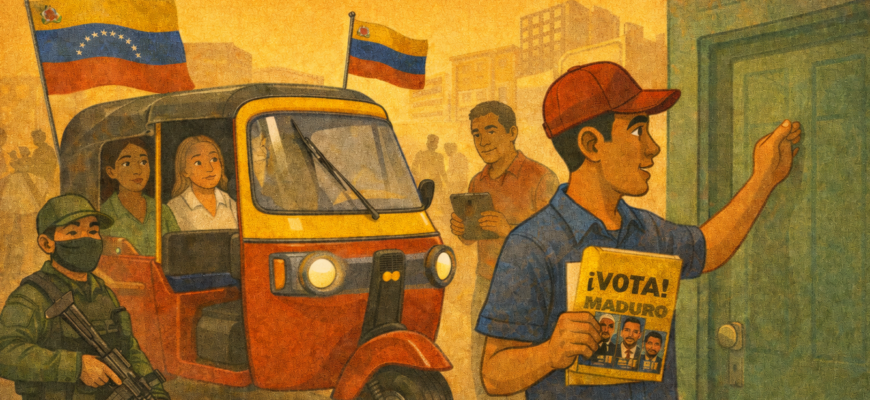
When protests erupted, the Maduro regime launched “Operación Tun-Tun” (Operation Knock-Knock) — a coordinated campaign of digital surveillance and physical repression.
According to Freedom House, the operation “used social media to disseminate videos of arrests and forced confessions in order to discourage Venezuelans from attending antigovernment protests or speaking out online.” Venezuela’s counterintelligence agency DGCIM used its social media accounts to warn that the operation was “just beginning” and set up a telephone hotline to receive reports about protesters.
The DFRLab investigation revealed three components of the digital repression:
1. VenApp — the surveillance app: The government co-opted VenApp, a citizen services app, to report alleged “fascist guarimbas” (protests) and target dissidents. The app was eventually removed from app stores due to backlash.
2. Doxxing campaigns: Social media accounts affiliated with senior official Diosdado Cabello doxxed opposition critics, exposing their personal information.
3. Forced confessions: Videos of detained protesters being forced to recant spread across social media as a warning to others.
Human rights organizations described the mass arrests as “arbitrary.” Alfredo Romero, director of NGO Foro Penal, said the operation represented “a de facto suspension of constitutional rights without being officially decreed.”
The Human Cost
The repression was devastating:
- Over 2,400 people arrested since July 29, including children, journalists, political leaders, and lawyers defending protesters
- At least 25 killed during protests
- 114 children arrested, according to Foro Penal
- 1,848 political detainees held as of November 2024
A UN Human Rights Council report found that Venezuela’s National Guard played a key role in Operation Knock-Knock, documenting torture, sexual violence, and mass arbitrary detentions.
Maduro announced he was preparing two maximum-security prisons for “re-education” of detained opposition members, whom he labeled “new generation gangs.”
The Social Media Shutdown
As protests spread online, Maduro systematically blocked access to platforms used by the opposition:
X (Twitter): On August 8, Maduro ordered a 10-day ban, accusing owner Elon Musk of “inciting hatred, fascism, civil war.” The ban was never lifted — as of September 2024, X remained blocked without VPN. Venezuela joined North Korea, Iran, China, Myanmar, Pakistan, and Turkmenistan among countries blocking X.
WhatsApp, TikTok, Signal: Maduro urged supporters to abandon Meta-owned WhatsApp, claiming it was being used to threaten families of soldiers and police officers.
Fact-checking websites: According to ICIJ, “Two fact-checking websites got blocked by the government” the same day the presidential campaign officially began (July 4), followed by another shortly after — right as “the disinformation campaigns were ramping up.”
News websites: VE sin Filtro reported that more than 200 domains were blocked between July 2024 and January 2025.
On August 12, Maduro created the National Cybersecurity Council, a new entity for “technological surveillance and control of telematic incidents” — essentially institutionalizing online surveillance.
State Disinformation Infrastructure
Long before the election, the Maduro regime had built a sophisticated disinformation apparatus. According to a 2024 ICIJ investigation:
- State-controlled TV and radio stations were “flooded with propaganda favorable to the ruling party”
- “State-orchestrated disinformation campaigns regularly leveraged online tools — including paid troll accounts on social media and fake fringe websites — to defame and harass journalists, human rights advocates and politicians”
- “The government controls what people can access, perceive and see on the internet… they just completely cover independent perspectives and critical voices with misinformation, disinformation attacks”
The NGO Cazadores de Fake News characterized the manipulation efforts during the 2024 election as “surpassing episodes from previous years.”
International Response
The international community largely refused to recognize Maduro’s claimed victory:
- The United States, Argentina, Chile, and other countries recognized González as the legitimate winner
- The European Parliament recognized González as president-elect on September 2, 2024
- The Organization of American States demanded transparency and publication of voting tallies
- Brazil, Colombia, and Mexico — initially sympathetic to Maduro — also called for detailed results
However, China and Russia congratulated Maduro on his victory.
January 2025: Maduro’s Inauguration
Despite all evidence, Maduro was sworn in for a third six-year term on January 10, 2025, extending his rule until 2031.
Opposition leader María Corina Machado was briefly detained after a protest on January 9. Her team reported she was coerced into recording videos. González, who fled to Spain in September 2024, faces arrest if he returns.
The Lesson
Venezuela 2024 represents a new model of authoritarian control: using digital infrastructure both to surveil and to silence. The regime combined traditional election fraud with systematic platform blocking, doxxing campaigns, forced confession videos spread via social media, and a surveillance app repurposed for political persecution.
As former Canadian Ambassador Ben Roswell told ICIJ: “If we want to see the future of authoritarianism elsewhere in the world, we need only look to Venezuela.”
Sources:
- Carter Center. Statement on Venezuela Election. July 30, 2024.
- Carter Center. Final Report. February 2025.
- Freedom House. Venezuela: Freedom on the Net 2025.
- DFRLab/DDIA. Maduro’s Digital Repression. September 2024.
- UN Human Rights Council. Report on Venezuela’s National Guard. December 2025.
- ICIJ. How post-election repression compounded press freedom fears. November 2024.