
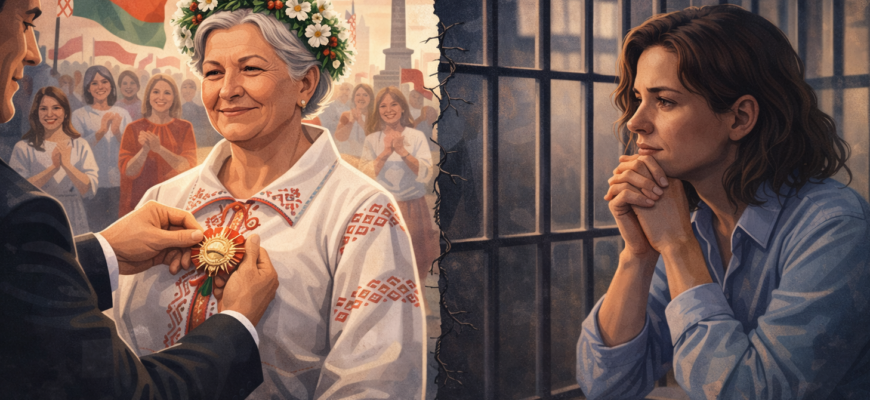
On January 1, 2026, Alexander Lukashenko signed Decree No. 1, declaring 2026 the “Year of the Belarusian Woman.” State media began actively promoting the theme.
At the same time, according to the Viasna Human Rights Center (as of February 17, 2026), 1,150 people were recognized as political prisoners in Belarus. According to belaruswomen.org (as of August 2025), 192 of them were women. The exact current number of women political prisoners after the 2025 pardons wave requires clarification.
We analyzed 1,018,587 documents from the FORESIGHT corpus (state media, independent outlets, Telegram channels, and YouTube) for the period from International Women’s Day 2025 to International Women’s Day 2026. We found that on most topics, state and independent media barely overlap, creating two distinct narratives about the same women.
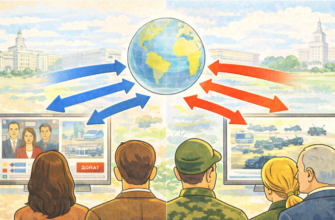
Parallel Universes
The most striking finding: topics dominating women’s coverage in state media are almost entirely absent from independent outlets, and vice versa.
Extreme values: “Year of Woman,” 96% state media. Political prisoners, 99% independent. The two information spaces do not overlap.
| Topic | Documents | State media | Independent |
|---|---|---|---|
| “Year of the Belarusian Woman” | 1,538 | 96% | 4% |
| Hero mothers | 4,037 | 86% | 14% |
| Women political prisoners | 5,485 | 1% | 99% |
| Maria Kalesnikava | 8,408 | 3.5% | 95% |
Two Vocabularies
State and independent media use fundamentally different words to describe the same women in the same country.
State media vocabulary
Independent media vocabulary
The share of negative framing in state media is just 5.7%. Domestic violence, discrimination, and inequality are virtually absent from the state narrative about women.
Names and Their Coverage
On December 13, 2025, as part of negotiations with US President Donald Trump, Lukashenko pardoned 123 political prisoners. Among them were Maria Kalesnikava, Viktar Babaryka, and Nobel laureate Ales Bialiatski. All those released were deported from the country.
Our analysis covers the full year (March 2025 to March 2026), encompassing imprisonment, release, and subsequent coverage. The data on key name mentions shows how differently the two types of media covered these names throughout the entire cycle.
Context: Maria Kalesnikava freed December 13, 2025, deported to Ukraine. Siarhei Tsikhanouski freed summer 2025. Both pardoned and no longer in Belarus.
Data caveats: searches used surname stems. “Tsikhanouska*” includes both Sviatlana and Siarhei Tsikhanouski. “Kalesnikav*” may include namesakes. Data reflects total coverage for the full year, without breakdown into pre- and post-release periods.
Even accounting for the massive December release coverage, for every state media mention of “Kalesnikav*” there are 27 mentions in independent outlets. State media covered the releases primarily through the “presidential mercy” frame (see Mechanism 4).
The Vocabulary of Mercy
When the regime releases political prisoners, state media frames it not as restoring justice, but as the president’s personal mercy.
State narrative: the president shows humanity, prisoners repent, they are pardoned. Independent narrative: political prisoners are freed after unlawful imprisonment, forced to repent, and deported from the country.
The cliché “act of humanity” is essentially a pure state media product: 36 documents, 86% in state outlets. When combined with the word “women,” the result is even more telling: 15 documents, 93% state media. The data shows that the “humanity” frame combined with the women’s theme exists almost exclusively in state media.
Attention Dynamics: When the State Turns On and Off
State coverage of the women’s topic is uneven: peaks in March (International Women’s Day), July, and October (maximum, 5,471 documents), with sharp drops in between. The reasons for specific peaks require separate content analysis.
The most telling anomaly: November 2025 – January 2026, when independent media surpasses state media for the first time. This coincides with the pardons wave: in December, publications about pardons reach their peak (464 documents). State media frames releases through “presidential mercy” (287 documents), while independent media focuses on the prisoners’ own stories.
By February 2026, state media restores its dominance (3,528 documents vs. 1,720 independent). It is precisely in this period that the “Year of the Belarusian Woman” theme first appears in the corpus (198 documents in February, 102 in March, all 300 from the sample belong to state media).
March 8: The Holiday as Product
Comparison of International Women’s Day coverage in 2025 and 2026:
82.5%
90.5%
The “Year of the Belarusian Woman” coincided with an increase in the state share of IWD coverage. In a sample of 200 documents per year, the independent share dropped from 17.5% (2025) to 9.5% (2026).
Four Mechanisms as a System
Parallel Universes: topics important to one side do not exist for the other. Two Vocabularies: the same events are described in fundamentally different language. Names and Their Coverage: key female figures are covered by state and independent media in radically different proportions. The Vocabulary of Mercy: release from unlawful imprisonment is presented as the ruler’s personal grace.
These mechanisms operate simultaneously. They create a coherent alternative picture for the state audience, in which women are celebrated and supported, but only as long as they remain in approved categories: mothers, workers, beauties, heroines. The topic of women political prisoners exists almost exclusively in independent media (99% of 5,485 documents), even during the mass releases of December 2025.
The numbers make this asymmetry measurable: 1,538 documents on the “Year of Woman” (96% state) vs. 5,485 documents on women political prisoners (99% independent). On key topics (political prisoners, “Year of Woman,” hero mothers), the two information spaces diverge radically. Exceptions: pardons (50/50) and domestic violence (54/46), where both types of media are present.
Methodology
Corpus: 1,018,587 documents from the FORESIGHT ANALYSIS system (PostgreSQL/pgvector). Sources: BelTA, SB.by (state); Zerkalo, Nasha Niva, Reform.by, Euroradio (independent); Telegram channels (pro-regime, independent, regional); YouTube.
Period: March 8, 2025 – March 7, 2026 (a full year between two International Women’s Days).
Classification: by the source_type database field. State (state_media + telegram_state + telegram_proregime, 50.5% of corpus) vs. independent (independent + telegram_independent, 49.0%).
Methods: SQL queries with ILIKE for 10 thematic co-mentions, framing markers (positive/negative), pardons vocabulary, and specific names. Full query specifications available on request.
Limitations: Keyword-based analysis captures explicit mentions but does not cover implicit framing. Volume comparisons reflect corpus composition. “Feminism” analysis is limited to explicit use of the term. Data on 164 women political prisoners: Viasna Human Rights Center, March 8, 2026. Since 2020, at least 1,917 women have been convicted (Viasna). On December 13, 2025, 123 political prisoners were pardoned, including Maria Kalesnikava and Viktar Babaryka. On March 5, 2026, 18 more were pardoned, including 11 women.