

What happened?
On April 3, 2026, YouTube removed the channels of three major Belarusian state media outlets: BelTA News Agency (2.3 million subscribers), STV (2.4 million), and ONT (1.4 million). Five days later, on April 8, STV’s backup channel (CTVPLUS), created after the initial blocking, was also removed. The platform provided no public explanation. The official Belarusian explanation is sanctions, although the organizations themselves claim they are not subject to sanctions.
This isn’t the first time. Belarusian state media have been blocked on YouTube in waves since 2021. In August 2024, 18 channels of the Belteleradiocompany holding company were removed, including Belarus 1, Belarus 2, Belarus 3, Belarus 5, and several radio stations. Previously, channels of state-owned enterprises (Naftan, Belaruskali, and Belshina) and regional police departments were blocked. The April removal of BelTA, STV, and ONT was the largest in terms of combined audience.
We analyzed 1,813 videos published on three deleted channels in January, February, and March 2026 using the FORESIGHT Analysis platform. The goal was to determine which content could have triggered the accumulation of strikes and led to a lifetime ban.
The Illusion of Coverage: Shorts vs. Long Format
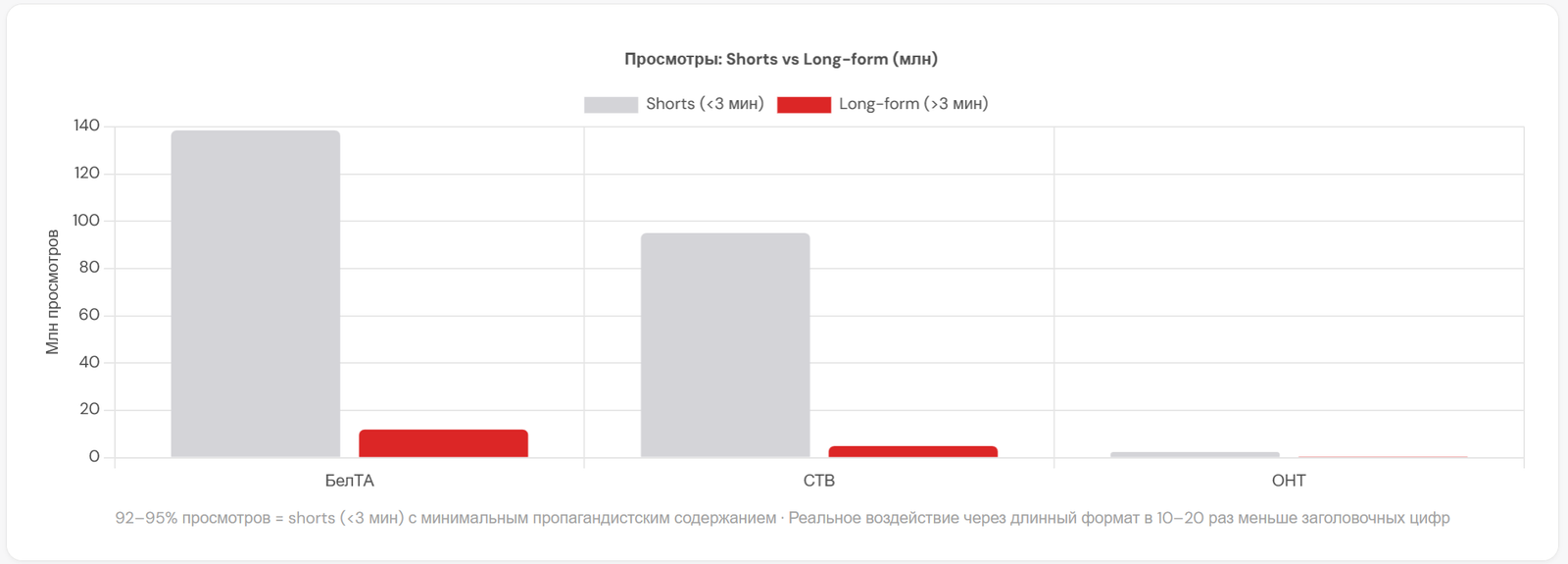
The three channels collectively garnered 253.2 million views in three months. However, the vast majority of these views were for short videos under three minutes long.
BelTA’s shorts account for 92% of views. STV’s figure reaches 95%. The most-viewed video of the entire period was “Lukashenko Helped Builders and PLASTERED the Wall!” (3.8 million views), an entertaining short without any propaganda content. The actual impact of long-form analytical formats (programs, documentary series) is 10-20 times less than the headline figures suggest.
This is important context: a loss of 253 million views sounds like a lot, but the vast majority of those were from content that a user scrolls through in three seconds.
The main candidate for a ban trigger: Iranian content
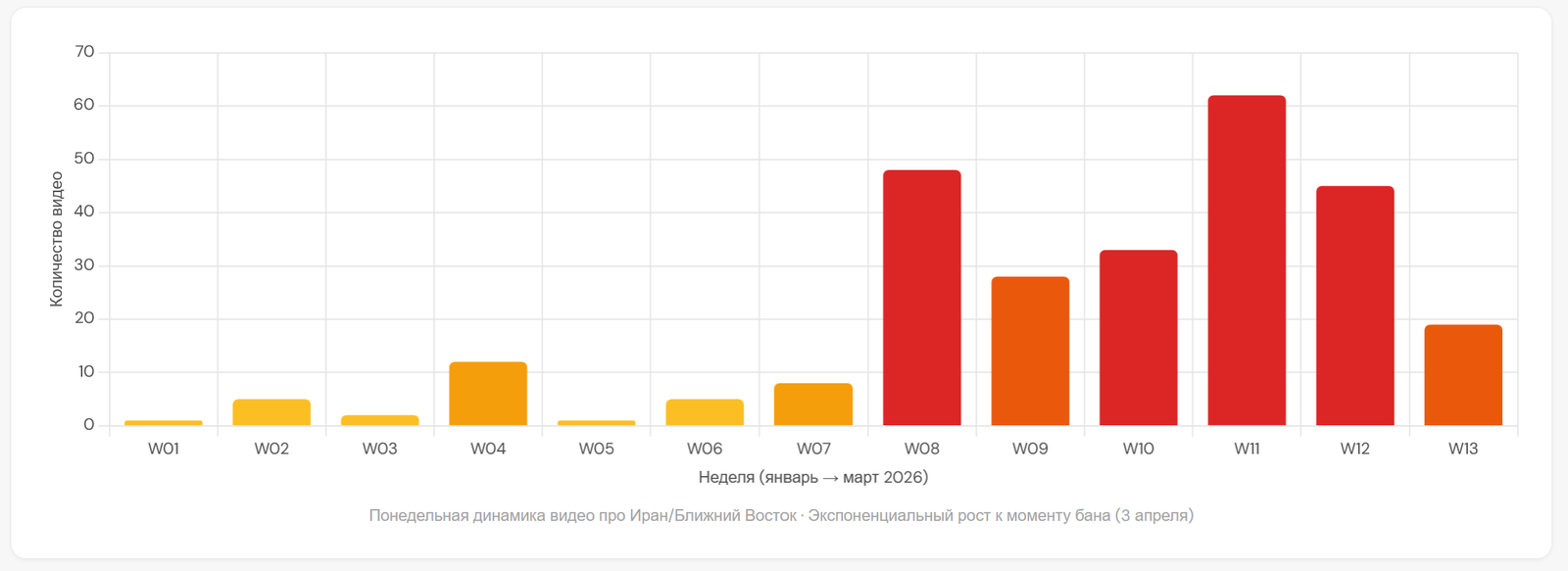
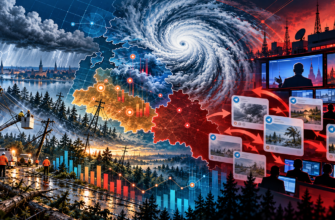
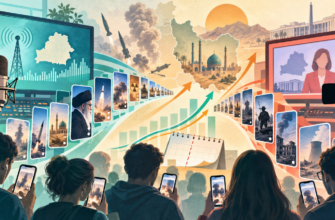
Our analysis revealed an exponential increase in content about the Iran-Israel-US war in the period immediately preceding the ban. In January, channels published 12 videos on this topic. In February: 52. In March: 149. A total of 213 videos (11.7% of all publications) garnered 69.5 million views (27.5% of all views across the three channels).
The nature of the headlines suggests why YouTube’s algorithms may have flagged violations. Videos with titles like “Hundreds of Iranian Strikes on US Bases! Israel Amasses Army!” (2.1 million views), “Iran Strikes Netanyahu’s Office, Israel Burns Downtown Tehran!” (2 million), “Tanker Sinks! Missile Hit Vessel!” (1.7 million), and “Bombs Will Fall EVERYWHERE!” (490,000) potentially fall under several categories of YouTube’s guidelines: “graphic violent content,” “sensationalization of armed conflict,” and “disinformation about armed conflict.”
STV and BelTA divided this content unevenly. STV published 75 videos on Iranian topics, garnering 43.1 million views. BelTA: 124 videos, 26.1 million views. ONT: 14 videos, 0.4 million views. With 149 such videos in March, the likelihood of accumulating strikes within YouTube’s 90-day window was extremely high.
Risk Zones: Five Content Categories
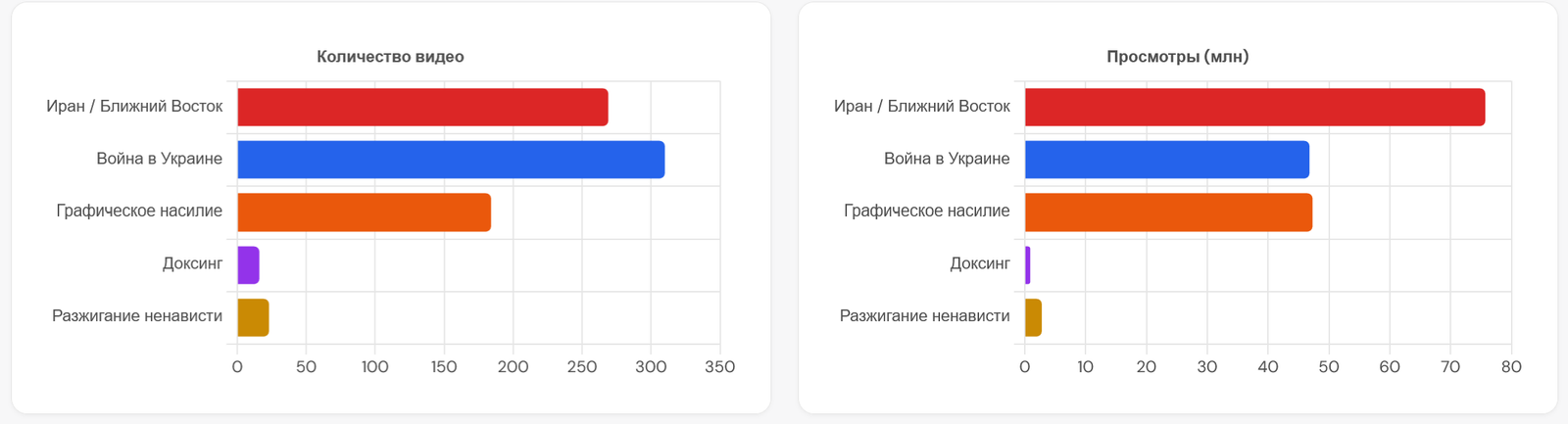
Categories overlap: videos can simultaneously be classified as Iranian content and contain graphic violence. A total of 628 of the 1,813 videos (34.6%) contain at least one risk marker. The remaining 65% are relatively neutral content: coverage of Lukashenko’s visits, agriculture, sports, and entertainment.
Doxxing: The Last Straw
A separate risk category: Roman Protasevich’s broadcasts on STV that disclose personal data. Over three months, we identified nine such videos with a total of 699,000 views. The volume is small, but the violation is critical: the disclosure of personal data of specific individuals (such as Stas Ivashkevich, founder of the Belarusian Investigative Center, and participants in the Freedom Day protests in Vilnius).
The latest videos are dated March 26-27, 2026: “You can’t hide from the Belarusian security services even in your own car,” “They’ll find everyone! Freedom march lovers are under surveillance.” This was a week before the April 3 deletion. Even one such video can trigger a strike under YouTube rules, and three strikes in 90 days means a lifetime ban.
Expert content with elements of hate
Another risk area: a video with commentator Yakov Kedmi. 18 videos, 6.4 million views. Headlines: “They came up with 130 types of executions! Banderites found this AMUSING!”, “The President of Lithuania thanked Stalin WITH TEARS!”, “The most brutal Nazis: NOT Germans?” This content teeters on the edge of hate speech and historical revisionism. Combined with other violations, it could generate additional strikes.
Why is Google silent?
Svaboda contacted Google for comment but did not receive a response. This is standard company practice: Google eschews comment on specific moderation decisions, citing legal risks, the confidentiality of the process, and the scale of the process (the platform deletes millions of accounts annually).
There’s also a practical reason: a public explanation would create a guide for circumventing the rules. If Google said, “We removed you for doxxing,” it would provide a prescription: don’t doxx, and you won’t be blocked. For state propaganda, this would be a guide to action.
The blocking process is automated and goes through several stages: public access to the channel is blocked instantly (within seconds), a global update on all CDN servers takes up to an hour, and complete removal from Google and YouTube search results takes 24-72 hours. There is an appeals process for those who have been removed. However, in the case of sanctions, the chances of reinstatement are minimal.
Hypothesis: Ban mechanism
→ February-March:201 videos about Iran with graphic titles. YouTube’s algorithms flag strikes for “sensationalization of armed conflict” and “graphic violent content.”
→ March 26-27:Protasevich posts a video featuring doxxing (revealing the personal information of specific individuals). Strike for privacy violation.
→ 3 strikes in 90 daysIf a single creator account is involved, all three channels will be permanently banned. YouTube uses identity linking technology: device fingerprint, IP address, financial footprint, and AI-powered content analysis.
→ Sanctions statusCloses the appeals process. Attempted ban circumvention (CTVPLUS) = automatic ban on April 8th.
This isn’t “political censorship” in the sense described by Maria Zakharova, who called the deletion “a vile act of informational sabotage.” The platform didn’t remove content for criticizing the West. It removed accounts that systematically violated the rules: doxxing, sensationalizing armed conflicts, and affiliation with sanctioned entities. The simultaneous deletion of three channels indicates a connection between the accounts (a single creator), rather than meaningful moderation of each channel individually.
What has state propaganda lost?
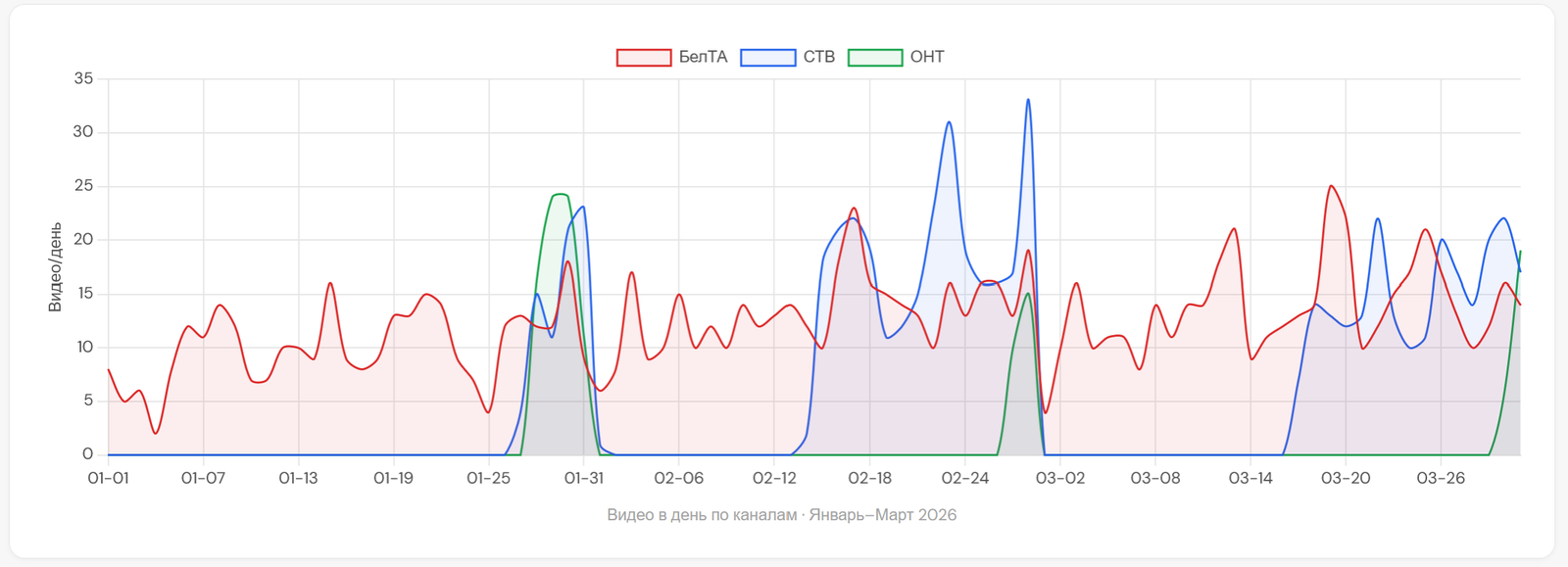
The loss is significant in scale, but less profound in impact than the headlines suggest. Combined, the three channels had over 6 million subscribers. By comparison, BelTA’s Instagram has 35,000 subscribers, while ONT’s Instagram has 73,000. The difference is tens of times greater. Alternatives like Rutube or VK Video don’t compensate for this audience.
However, our analysis shows that 92-95% of views were for shorts with minimal propaganda content. The most effective propaganda formats (expert programs with a high propaganda index, according to our publication “Fear Factory”) had 10,000-100,000 views: a narrow, already loyal audience. The main topics in the videos with the highest views were Iran and the war in Ukraine, not Belarusian domestic problems.
Will YouTube be blocked in Belarus?
The Belarusian Television and Radio Broadcasting Company (Belteleradiokompaniya) threatened to designate YouTube as an “extremist platform.” By March 2026, 97 internet resources have been designated extremist, and 62 have been blocked. The blocking infrastructure is in place.
But our synthetic survey (N=1,500, March 2026) shows that 74% of active Belarusian internet users on social media already use a VPN. Of these, 24% do so almost daily, and 30% once a week.
However, these 74% are active internet users present on social media. Among the general population, including pensioners and residents of the regions, the percentage will be significantly lower. Blocking YouTube will primarily impact ordinary users and state-owned media outlets themselves, which upload a huge amount of content to the platform every month.
Conclusions
The removal of the three largest Belarusian state channels from YouTube was not due to “political” or “Russophobia” reasons. Our analysis of 1,813 videos from January to March 2026 points to a specific mechanism: the exponential growth of Iranian military content (12 → 52 → 149 videos per month) with graphic titles, coupled with doxxing in Protasevich’s broadcasts in late March, led to the accumulation of a critical mass of strikes. A single account linked the three channels into a single ban chain. The sanctions status precluded appeal.
For Belarusian independent media, this is a lesson in diversification. Platforms act unpredictably. YouTube doesn’t explain its decisions. The only strategy is a multi-platform presence, its own archives, and the readiness to lose any channel at any moment.
Methodology.The data was obtained from the YouTube monitoring system using YouTube Data API v3. Content categorization was performed using regular expressions on video titles and descriptions (7 categories, 5-15 keywords each). Video duration (ISO 8601) was used to divide videos into shorts (<180 секунд) и long-form. Анализ выполнен на платформе FORESIGHT Analysis (PostgreSQL/pgvector, 1,24 миллиона документов, 21 источник).