
TL;DR
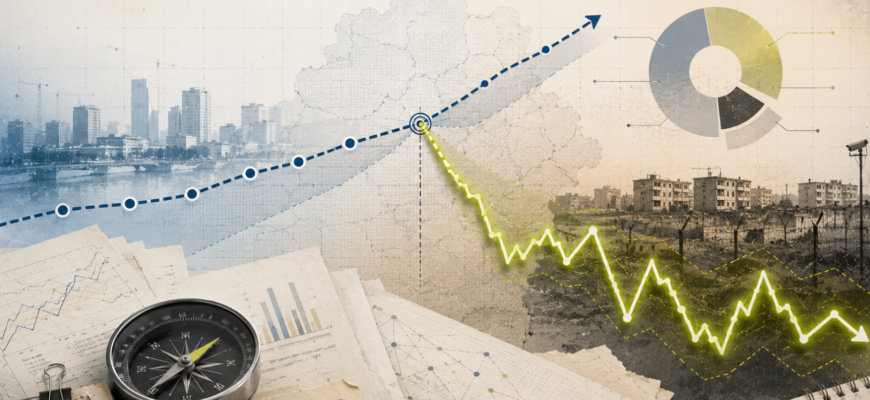
Using our analytical platform, which contains over 1.9 million documents from Belarusian state and independent media, we conducted a systematic verification of forecasts made about the future of Belarus between 2005 and 2013.
This analysis utilized two historical archives: a collection of over 20,000 English-language articles about Belarus from 2005 to 2011, and 1,346 think tank publications covering the period from 1996 to 2021. We scanned 21,511 documents using semantic search, extracted 715 specific predictive statements, and assessed the 157 most verifiable of them against the current situation.
Result: Overall Accuracy65.0 from 100.
What was predicted?
In the years between the disputed 2006 elections and the catastrophic defeat of December 2010, a characteristic consensus emerged among Western analysts. Belarus was finally ready for change. Lukashenko, under economic pressure and in periodic conflict with Moscow, would be forced to liberalize. The EU’s “Eastern Partnership” offered incentives. A new generation of Belarusians, connected to the world via the internet, would demand change.Specific predictions sounded like this. In 2009, analysts wrote that Lukashenko’s reaction “could be a radical turn toward the EU.” In 2010, they asserted: “This model can and should work, as Ukraine’s experience has shown,” implying that Belarus was capable of simultaneously being friends with Russia and joining the EU. The irony of this phrase, written before Crimea, before 2020, before everything that followed, is double. Lukashenko personally promised an average salary of $500, calling it a “sacred number.” State plans envisioned GDP growth of 11-13%. Analysts at e-belarus.org were no exception: they predicted an improvement in Belarus’s position in the ITU rankings by 2015.
Another example is also telling: in 2010, opposition candidate Andrei Sannikov welcomed what he called“the last year of the dictatorship,”Rejecting Lukashenko’s regime as incapable of overcoming current problems. Following mass protests on December 19, 2010, he was arrested and sentenced to five years in prison in May 2011. He spent a total of approximately 16 months in prison. Sixteen years later, Lukashenko remains in power.
What happened?
Reality took a different turn. Instead of emerging from isolation, Belarus sank deeper into authoritarianism after the 2020 elections, becoming more dependent on Russia than at any point since independence. Instead of integrating with the EU, the regime firmly entrenched itself in Moscow’s orbit, deploying tactical nuclear weapons on its territory. The balancing act that had defined Belarusian policy for two decades collapsed.The 2020 protests triggered the most brutal repression in the country’s post-Soviet history. More than 200,000 people fled Belarus. Independent media were systematically destroyed. Civil society organizations were shut down or driven underground. An entire media ecosystem relocated to Poland, Lithuania, and Georgia, continuing its work from exile.
The promised economic modernization did not materialize as predicted. The “holy number” of $500 was derailed by the 2011 currency crisis. According to Belstat data for March 2026, the nominal accrued average salary is 2,975.8 rubles (approximately $1,069 at the current exchange rate), while the median, calculated for November 2025, is 2,081.7 rubles (approximately $748). Formally, the “sacred number” is doubled, but the context is radically different. The net median salary of an average worker (after deducting 13% income tax and 1% contribution to the Social Security Fund) is approximately $643. The Belarusian ruble has strengthened against the dollar by 20% in 2025, artificially inflating the dollar equivalent. The range across industries is enormous: from 6,957 rubles in the IT sector to 2,066 rubles in education. The Belarusian economy is now structurally dependent on the needs of Russia’s militarized economy, and rising housing costs are largely due to the relocation of Russian citizens. When compared with the Baltic states and Poland, the gap remains stark, although domestic discourse compensates for this with arguments about the cost of food and utilities.
The information environment has evolved in directions almost no one foresaw. A 2006 article warned that“The internet in Belarus will soon be under state control.”At the time, it sounded alarmist. It turned out to be one of the most accurate forecasts in the entire corpus.
Scorecard
Of the 157 forecasts evaluated, 84 were confirmed, 27 were partially confirmed, 39 were refuted, and 4 were inverted: the exact opposite occurred.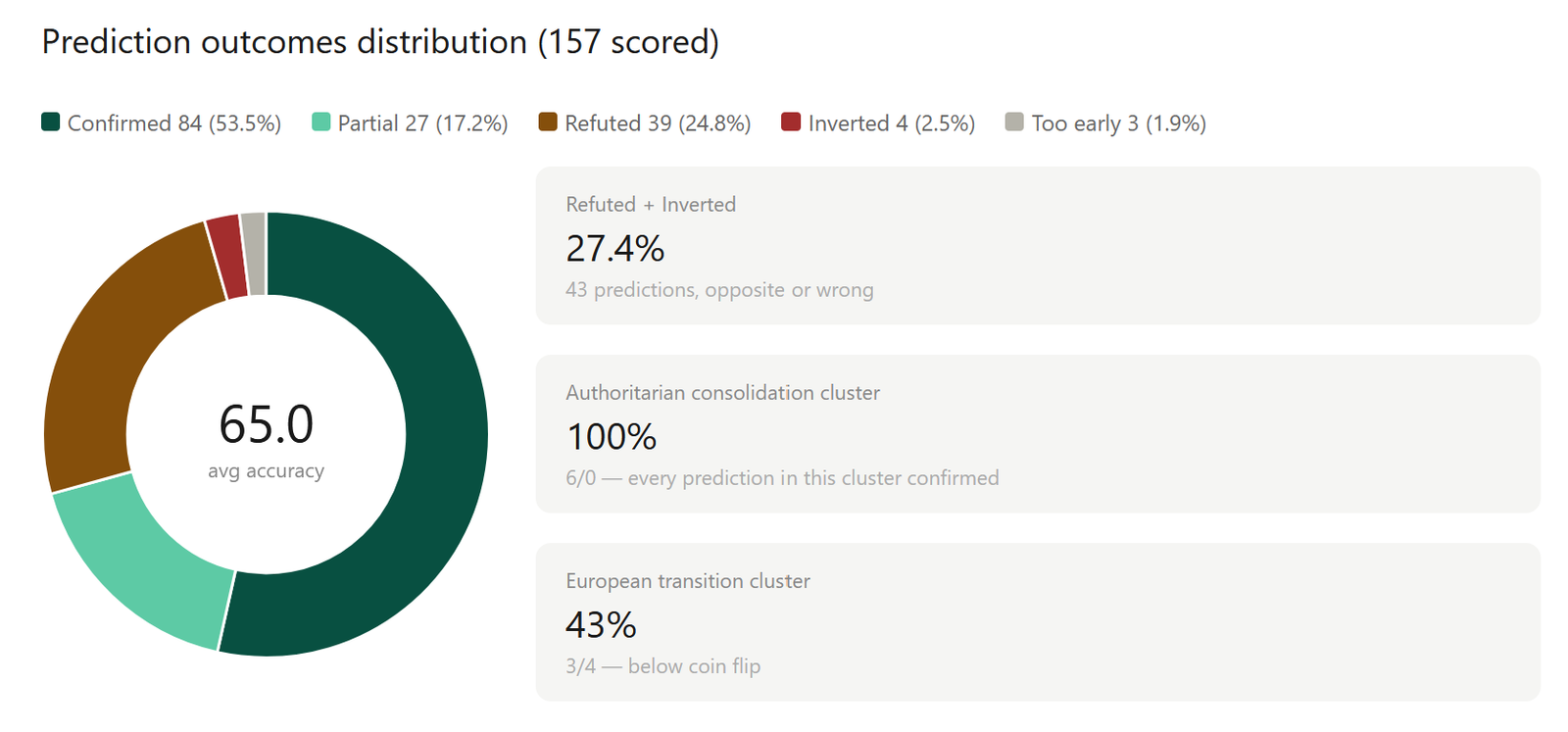
The confirmed forecasts paint a recognizable portrait. “Lukashenko will declare victory in the 2010 elections” (100/100). “The authorities will use all means to suppress the opposition rally” (95/100). “Opposition candidates will not be elected due to an unfair electoral process” (95/100). “Belarus will remain heavily dependent on Russian energy” (95/100). “This law is another attack on media independence” (95/100, source: Reporters Without Borders). All describe the mechanics of authoritarian control. All took the regime’s statements literally.
The partially confirmed forecasts point in the right direction, but are off in scale. “Belarus will be forced to join Russia on Russia’s terms” (75/100): dependence has increased, but formal annexation has not occurred. “Rising gas prices will pose a serious challenge” (70/100): the 2011 crisis occurred, but the regime survived.
The disproven are united by a belief in the inevitability of change. “2010 will be the last year of the dictatorship” (5/100). “Belarus will enter the top 30 countries for business climate” (5/100). “Lukashenko will extend a hand to the moderate opposition after international condemnation” (5/100). “GDP will grow by 11-13%” (15/100, source: Jamestown Foundation).
Four inverted: the exact opposite occurred. “Lukashenko could make a radical turn toward the EU” (5/100). “Belarus could follow the Ukrainian model” (5/100). “Belarus should integrate into the global economy and move toward Europe” (10/100). “Belarus is emerging from isolation and will continue dialogue with the EU” (15/100). All four touched on the European vector. Each predicted rapprochement. Each saw the opposite.
Domain Accuracy
Accuracy varied dramatically across topics, and this pattern is a central finding of the study.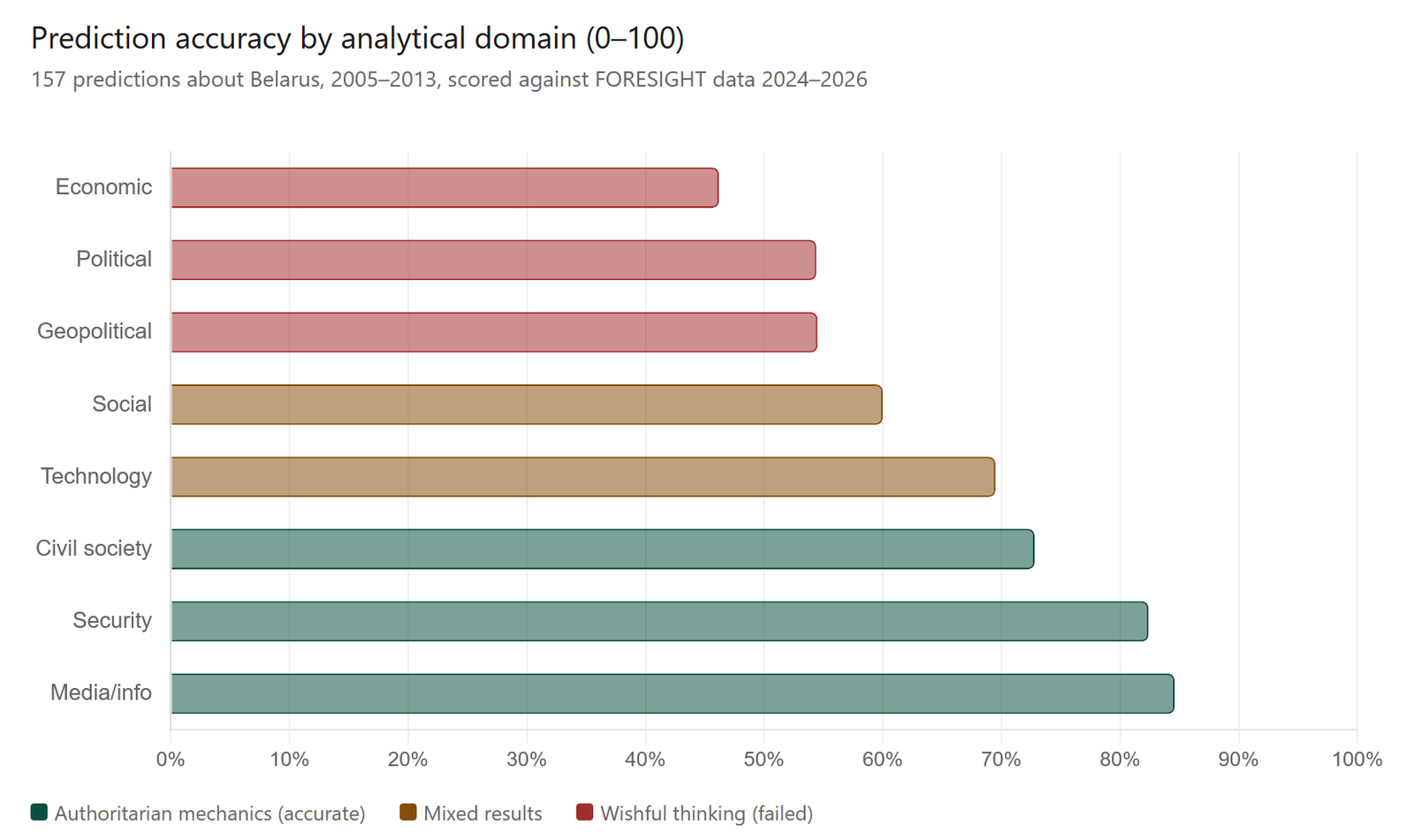
| Domain | Accuracy | Characteristic |
|---|---|---|
| Media/information | 84.6% | Predictions about control over the Internet and the press |
| Safety | 82.4% | Forecasts about the ability of security forces to suppress |
| Civil society | 72.8% | Forecasts of pressure on organizations |
| Technologies | 69.5% | Infrastructure is correct, ratings are not. |
| Social sphere | 60.0% | Limited sample (3 forecasts) |
| Geopolitics | 54.5% | Systemic reassessment of the European vector |
| Policy | 54.4% | Elections are correct, transit is not. |
| Economy | 46.2% | Propaganda was taken for a forecast |
The closer to the mechanics of authoritarianism, the more accurate the forecast. The closer to expectations of change, the worse.
Who was wrong: source ranking
Attribution of forecasts to sources through text extraction from the database revealed three analytical schools with varying degrees of accuracy.| Source | Accuracy | Forecasts | School |
|---|---|---|---|
| Belapan | 91.0 | 3 | Documenting |
| Reporters Without Borders (RSF) | 88.3 | 12 | Documenting |
| Reuters | 86.5 | 2 | Documenting |
| Charter97 | 72.5 | 4 | Opposition |
| OSCE | 57.5 | 4 | Diplomatic |
| BBC | 57.0 | 5 | Institutional |
| Radio Liberty | 49.7 | 6 | Transitological |
| Jamestown Foundation | 18.3 | 3 | Transitological |
The documentation school (RSF, Belapan, Reuters) recorded the regime’s actions without interpreting its intentions through the lens of democratization. Accuracy: 86-91%.
The diplomatic-institutional school (OSCE, BBC) balanced between realism and normative expectations. Accuracy: 57-58%.
The transitional school (Jamestown Foundation, Radio Liberty) applied democratic transition models. Accuracy: 18-50%.
A 70-point gap between RSF and the Jamestown Foundation: a single figure that explains twenty years of erroneous forecasting. The further the analyst departs from the facts and the closer to democratic transition theory, the worse the forecast.
What words predicted the error?
A lexical analysis of 157 assessed forecasts (forecast text only, without retrospective explanations) revealed a strong correlation between word usage and accuracy.Words that appeared exclusively in failed forecasts: “potential,” “become,” “top,” “world,” “protest,” “rise,” “must,” “reform,” “europe.” Words that appeared exclusively in accurate forecasts: “independent,” “media,” “elections,” “authorities,” “gas,” “presidential.”
When grouped into narrative clusters, the picture became even clearer. Authoritarian consolidation cluster (control, pressure, restrictions, surveillance, dependence): 6 accurate, 0 incorrect. 100% accuracy. European transition cluster (reform, integration, business, openness): 3 accurate, 4 incorrect. 43%.
WordstabilityIt appears only in accurate forecasts. When analysts used it to describe the institutional resilience of authoritarianism, they were right. The regime’s propaganda about the “island of stability” uses the same word, but with the opposite meaning: not a diagnosis, but an advertising slogan. For all these years, state media have systematically exacerbated the problems of democratic countries and presented Belarus as an island of order in a “sea of chaos.” Today, this narrative is in remarkable contradiction with the growing rhetoric of ideological warfare: the regime simultaneously tells the population that Belarus is uniquely stable and that it is under siege, and that sanctions are an existential threat.
The language of democratic transition (“transition,” “reform,” “democratization,” “opening,” “crossroads”) was found in erroneous forecasts 1.6 times more often. The more the analyst used this vocabulary, the worse the forecast. The more the language described
the system as it is, rather than as it should be, the closer it came to reality.
The paradox of confidence
The hypothesis was that the most confident predictions would be the most erroneous. The data showed the opposite.| Confidence level | Average accuracy | Forecasts | Catastrophic failures |
|---|---|---|---|
| High | 78.7 | 60 | 2 |
| Average | 47.5 | 34 | 7 |
| Cautious | 44.3 | 10 | 1 |
High-confidence forecasts were confident in the mechanics of authoritarianism: “Lukashenko will definitely win,” “the authorities will definitely suppress,” “the media will definitely be restricted.” The authors were confident in negative outcomes, and they were right. Moderately confident and cautious forecasts were unsure about positive scenarios: “Belarus could move toward the EU,” “reforms are possible.” The authors were doubtful, and rightly so, but for the wrong reasons: they assumed both outcomes, while reality only allowed for one.
Not overconfidence, but asymmetric certainty: analysts were correctly calibrated when they said what the regime would do, and uncalibrated when they said that the regime might change.
What no one foresaw
Of the 12 key developments that defined Belarus after 2013, we checked for each in a corpus of 715 forecasts. Ten turned out to be complete blind spots: not a single mention. A total repressive restructuring of the state. Emigration of over 200,000 people. Telegram as an infrastructure for protests and media in exile. The deployment of Russian tactical nuclear weapons. The use of migration as a weapon against the EU. The interception of a Ryanair flight. Loss of information sovereignty. A complete internet shutdown as a crisis management tool. The normalization of a state of emergency for years. The use of Belarusian territory to invade Ukraine.Only mass protests were partially predicted (one mention: “if hundreds of thousands come out, the security forces will go over to the side of the people,” which also turned out to be an error). Mass emigration received one partial mention: “continued repression could lead to mass emigration.”
With a doubled sample size (715 instead of 349 forecasts), not a single new topic moved from a blind spot to a predictable one. This is not an artifact of the small sample size, but a structural property of analytical thinking from 2005 to 2013.
False thaws
A time-lapse analysis revealed three periods when forecast optimism was high and forecast accuracy was low.2007:The gas conflict with Russia has sparked expectations of a turn toward the West. Optimism: 38.8%; accuracy: 42.5 out of 100.
2009:The global financial crisis and the “thaw” in relations with the EU. Peak optimism: 47.8%, low pessimism: 15.9%. Analysts widely predicted a rapprochement with Europe. A year later, the mayhem in the square occurred.
2010:Election cycle. 232 forecasts, more than any other year. Optimism 42.7%, accuracy 44.7 out of 100.
Every event interpreted as a “breakthrough” (the release of political prisoners, dialogue with the EU, the gas conflict, the economic crisis) generated a wave of liberalization forecasts. Almost all of them failed. After 2010, optimism fell to 28.1%, pessimism rose to 56.2%. Reality shattered these illusions, but only temporarily: in 2012-2013, optimism returned in the technological domain.
Why They Went Wrong: Five Systemic Biases
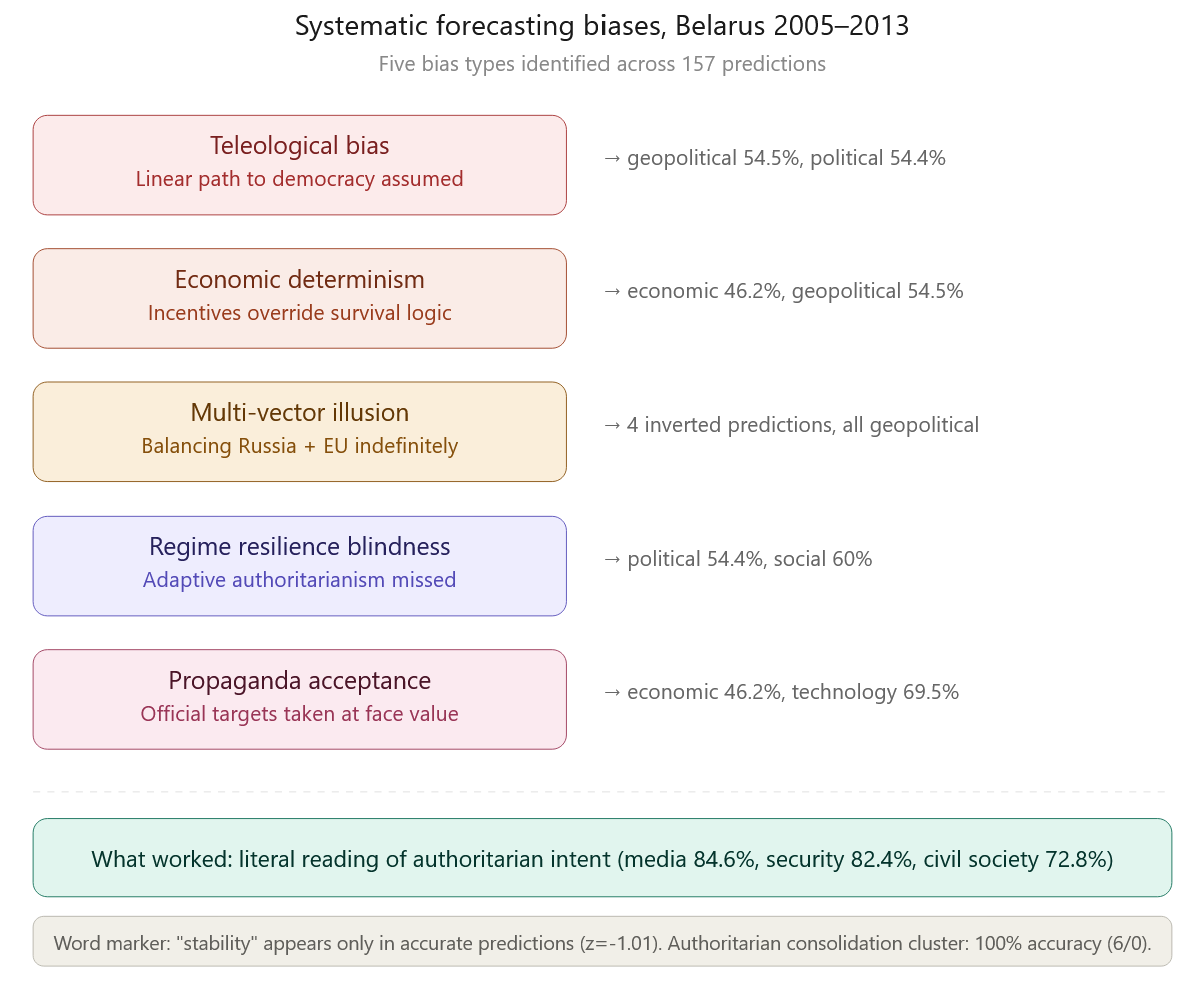
Belief in the inevitability of democratization.Analysts considered authoritarianism a transitional phase, not a stable state. In 2005, it was predicted that “Belarusian youth will be very active in the 2006 elections, and it will be a year of great change.” A direct import of the Georgian and Ukrainian scenarios into a country where it didn’t work.
Reassessing economic incentives.When faced with a choice between economic efficiency and political control, Lukashenko invariably chose control. This pattern can be traced through the 2011 currency crisis, the post-sanctions adaptation after 2020, and the current economic integration with Russia.
The illusion of multi-vectorality.It seemed as if Belarus could balance endlessly between Russia and the EU. One analyst in 2006 was closer to the truth than most: “Despite some in the West’s hopes, Belarus is not another domino ready to fall at the first election.” This forecast received a score of 95.
Underestimating the adaptability of the regime.The focus was on weaknesses, overlooking potential. Political scientist Vladimir Podgol in 2007: “The protest potential is too small to bring about political change, and propaganda will not allow it to grow.” He proved right 13 years later.
Mistaking propaganda for a forecast.When the regime promised 11-13% GDP growth or entry into the top 30 countries for business climate, analysts took it as a plan. It was always propaganda.
Information space
Belarusian state media have become part of the Russian information space. European institutions distinguish between foreign information manipulation (FIMI) and domestic information manipulation (DIMI). In Belarus, this distinction has become irreconcilable: narratives originating in Russia are coordinated through TASS and amplified through Belarusian channels, while the regime’s own propaganda (the “island of stability” narrative) employs the same techniques. The two countries’ information systems have merged to the point where distinctions are impossible. Sovereign information production within the country has effectively ceased to exist as a separate category.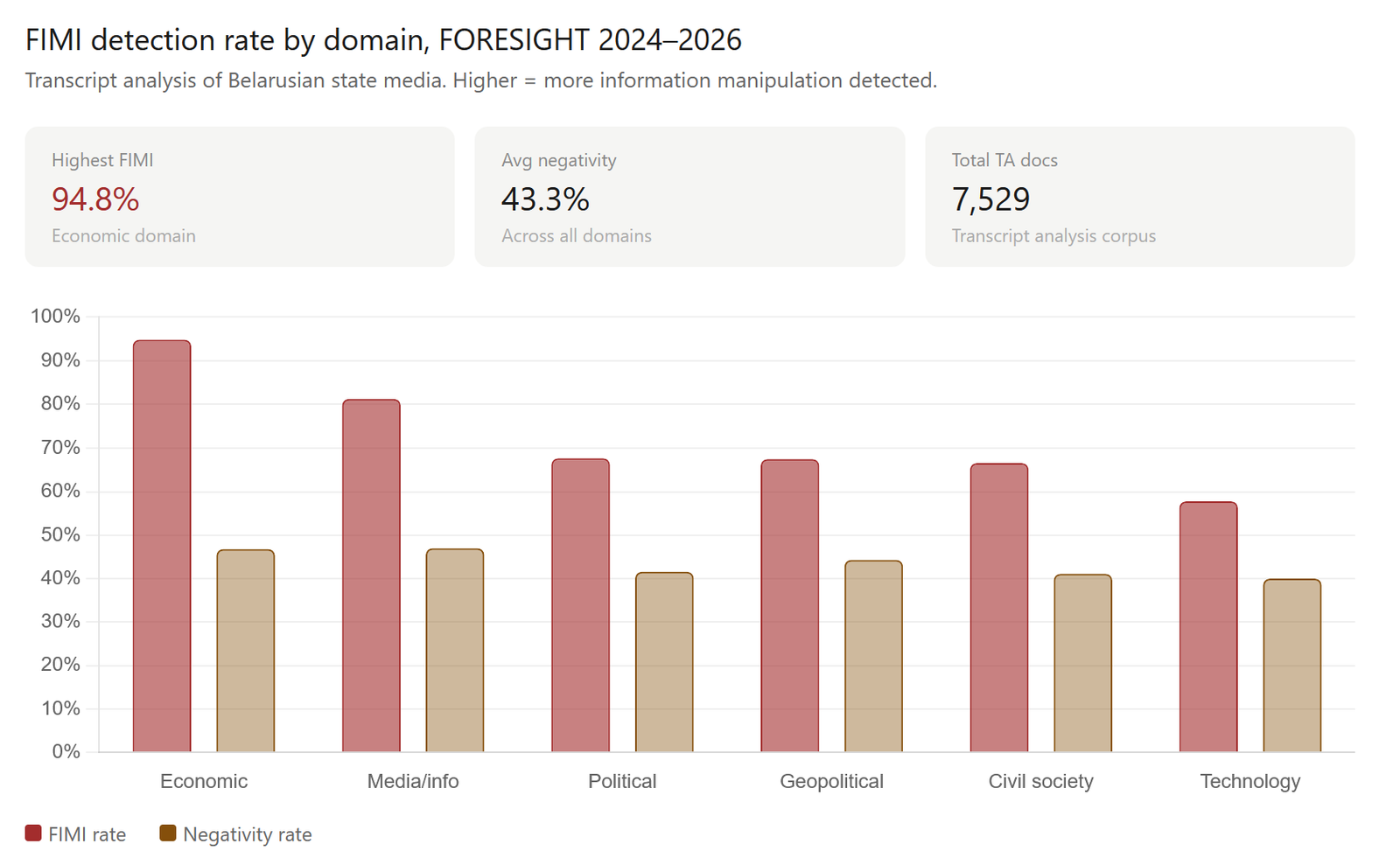
The detection rate of information manipulation in Belarusian state media, according to FORESIGHT, is as follows: economics 94.8%, media/information 81.2%, politics 67.7%, geopolitics 67.5%, civil society 66.6%, and technology 57.8%.
What follows from this?
Pay close attention when the current regime talks about restrictions. Media control laws, requirements for re-registration of organizations, internet surveillance laws: when analysts took such statements literally, the accuracy rate exceeded 85%. When interpreted as a negotiating position, it fell below 50%.Don’t trust the regime when it promises development. Economic, technological, and social targets turned out to be the least reliable forecasts.
Don’t project other people’s experiences. Neither the Georgian, Ukrainian, nor Polish scenarios applied to Belarus. Every forecast based on analogy failed.
Evaluate the stability of the regime, not the potential of the opposition. Forecasts about the strength of the opposition consistently achieved 20-30% accuracy. Forecasts about the strength of the regime, 85-95%.
Look at the information environment. The degree of integration of Belarusian state media into the Russian information space is the most significant and least discussed indicator of the loss of sovereignty.
Issues of succession are becoming increasingly pressing. The forecasting failures of the last twenty years provide grounds for caution.
What’s next?
Cycles of false thaw. Each event interpreted as an “opening” generated a wave of predictions of liberalization. It’s possible to measure which events generated the greatest surge of false optimism and how long it took for these predictions to be disproved.
What no one predicted. Why were 10 of the 12 key developments completely absent from the forecast? What exactly in the analytical thinking of 2005-2013 created blind spots?
Can forecast vocabulary predict its accuracy? Preliminary data show that the authoritarian consolidation cluster yielded 100% accuracy, while the European transition cluster yielded 43%. If this pattern is confirmed across a larger sample, it allows for the construction of quantitative models to assess analytical quality.
Comparison with other countries. Are the same distortions repeated in forecasts for Russia, Iran, Venezuela, and Central Asian countries? If so, the Belarusian case becomes a critique of post-Soviet forecasting in general, and the methodology can be applied to any authoritarian context.
About the data.Forecasts were extracted from archives spanning 2005-2011 and 1,346 publications, spanning 1996-2021, using the following pipeline: semantic filtering via pgvector (500 candidates from 21,511 documents), structured extraction via Claude Sonnet (715 forecasts), and evaluation using FORESIGHT platform data (1.9 million documents, 50 sources, spanning 2024-2026). All data and scripts are available upon request for research purposes.