
At first glance, China’s role in the Belarusian state media landscape looks like a story of expansion. In absolute numbers, publications citing Chinese media sources (Xinhua, CGTN, People’s Daily, Global Times, and others) grew from roughly 100 in 2020 to over 1,000 in 2025. However, a normalised analysis drawing on 1.9 million documents from 73 sources in the FORESIGHT platform reveals a fundamentally different picture.
A Stable Topic, Vanishing Sources
China holds a steady 5–8% share of Belarusian state media output throughout the period under review (2020–2026). This share shows neither sustained growth nor decline: China is a permanent fixture on the agenda, but it is not gaining airtime.
Meanwhile, the share of articles that actually cite Chinese media sources has collapsed. In December 2022, 22.8% of all China-related publications referenced Chinese media. By 2026 that figure had dropped to 3–6%, a fivefold decline in three years.
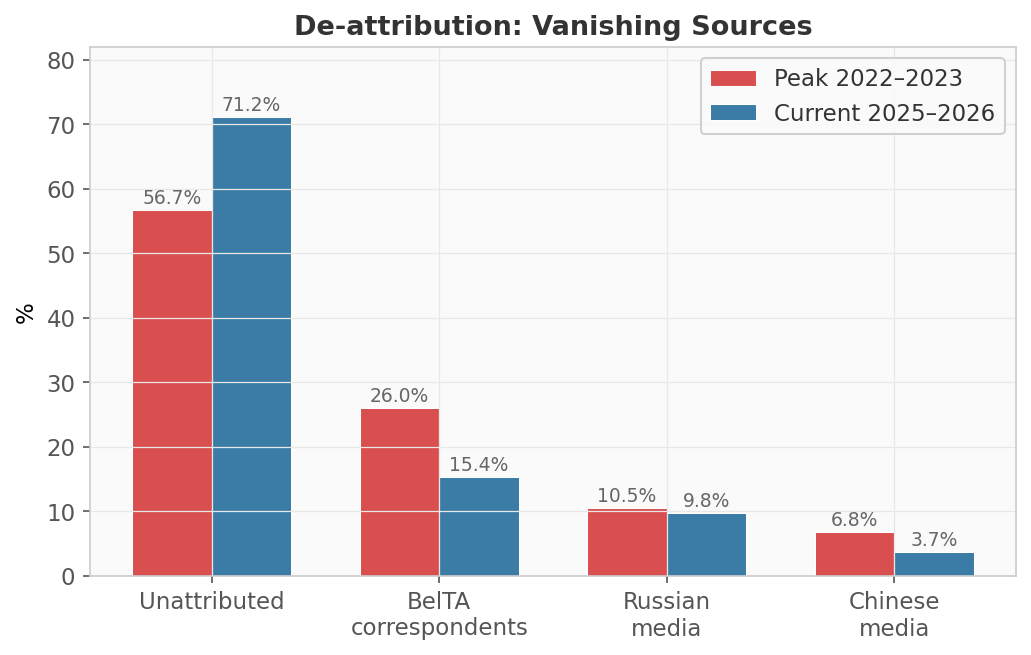
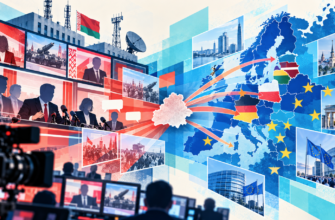
Where did the sources go? The BelTA correspondent network (including the joint BelTA–Xinhua wire) covered 40–50% of China-related publications in 2020–2021; today it accounts for just 16–20%. Russian media (TASS, RIA Novosti, Interfax) temporarily filled the gap in 2023, reaching up to 25% of China coverage, but did not hold that level. The main beneficiary of the process is unattributed content, whose share rose from 57% to 71%.
The 2022–2023 Peak: A Party Congress, a State Visit, a Declaration
The period of peak Chinese media citation (October 2022 – March 2023) is anchored by two events. In October 2022, the 20th CPC National Congress re-elected Xi Jinping for an unprecedented third term, generating a major news cycle in itself. On 28 February – 2 March 2023, Aliaksandr Lukashenka made a state visit to Beijing, after which the two sides signed a joint declaration on “exemplary relations of all-weather and comprehensive strategic partnership.” The media effect of both events was amplified by the context of the first year of Russia’s full-scale invasion of Ukraine, during which Minsk was actively positioning itself on the Russia–China axis and anti-Western rhetoric in state media was at peak intensity.
It was during this period that the share of publications citing Chinese media reached 22.8% of all China coverage (December 2022). Subsequent analysis shows that this peak did not become the new normal; it remained a one-time maximum, followed by a systemic decline.
Three Axes of Transformation
Semantic analysis of 9,518 documents (classified across 10 thematic categories and 6 geopolitical frames) identified three structural shifts between the peak period (October 2022 – March 2023) and the current period (October 2025 – May 2026).
1. From Propaganda to Showcase
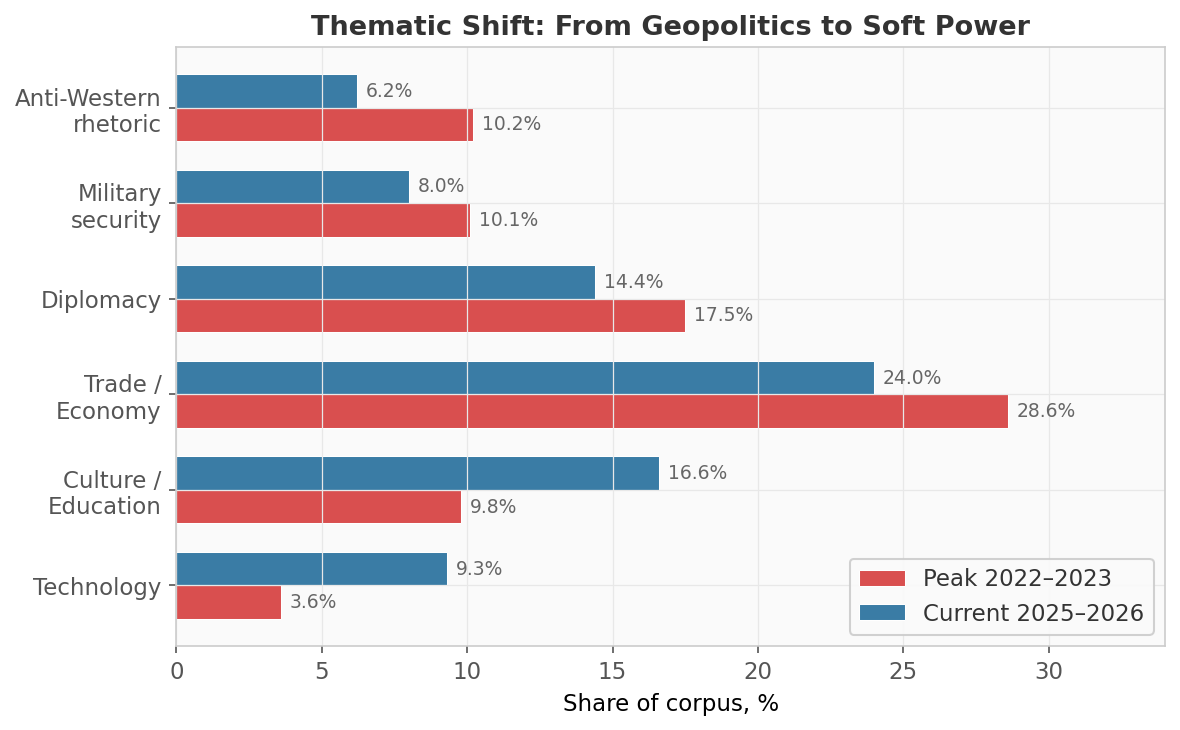
Hard geopolitical categories (anti-Western rhetoric, military security, diplomacy) fell from a combined 37.8% to 28.6% of the corpus. Soft-power categories (culture and education, technology) rose from 13.4% to 25.9%. Trade and economy remains the single largest category (29% to 24%), but its dominance has narrowed.
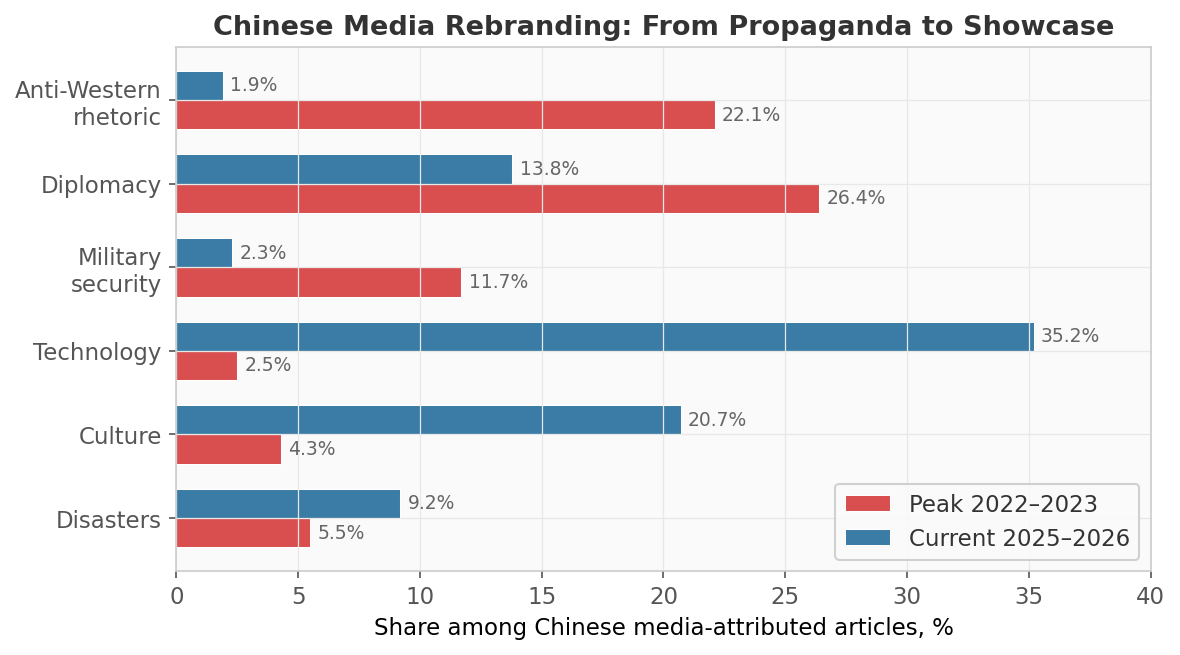
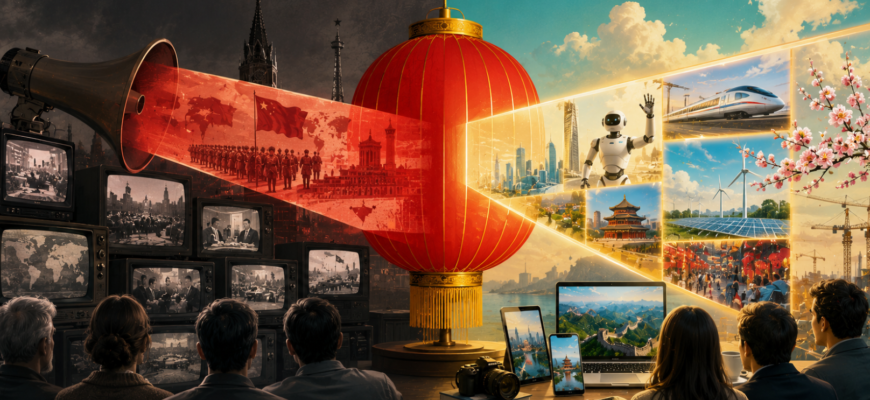
The shift is especially dramatic among articles attributed to Chinese media sources. Anti-Western content via Chinese sources plunged from 22.1% to 1.9%. Military security fell from 11.7% to 2.3%. Their place was taken by technology (up from 2.5% to 35.2%) and culture (from 4.3% to 20.7%). Chinese media in the Belarusian space have pivoted from a geopolitical propaganda function to a technology showcase: robots, artificial intelligence, space, electric vehicles.
2. From Partnership to Decoration
The share of publications with a bilateral Belarus–China focus fell from 36.7% to 25.3%. The “strategic partnership” geopolitical frame shrank from 30.5% to 19.6%, while the “anti-Western bloc” frame dropped from 13.8% to 7.7%. Neutral factual framing grew from 49.2% to 64.9%.
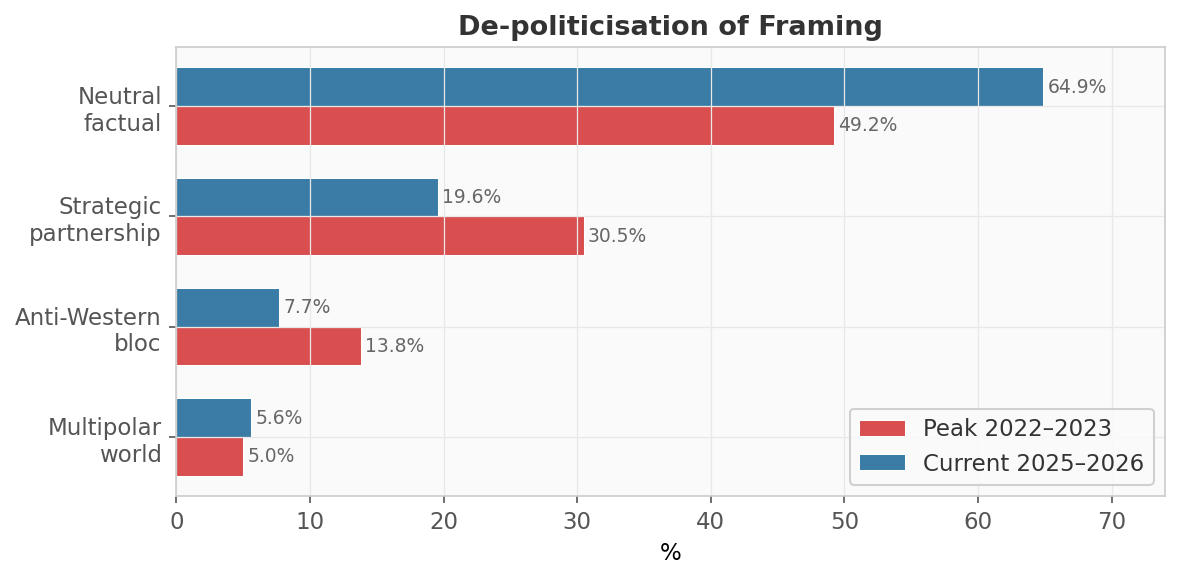
In the Belarusian media space, China is shifting from strategic partner to decorative element: it is mentioned in the context of world news, but is less and less often presented as a subject of bilateral relations or a key ally.
3. The Xinhua Effect: A Wire Service, Not a Narrative Tool
A detailed analysis of the August 2025 spike (201 publications) showed that 90% of the content came from BelTA, and consisted of Xinhua wire reprints about world events: floods in Nepal, an earthquake in Mexico, a shooting in Los Angeles. Xinhua is used as a wire service for the “World News” section, not as a source of narrative influence.
A similar pattern was found with CGTN: its only significant spike (18 publications in October 2024) turned out to be the media echo of a single event, Aliaksandr Lukashenka’s interview with CGTN at the BRICS summit in Kazan.
Hidden Tensions: The Russian Channel
Analysis of tone by attribution channel revealed an unexpected pattern. Chinese media sources display 77% positive tone toward China (expected). The BelTA correspondent network produces a balanced 49/48% positive-neutral split. However, Russian media show 14.5% negative tone toward China, the highest across all channels. For comparison, negativity from Chinese media is 0.8%, from BelTA correspondents 3.3%, and from unattributed content 3.4%.
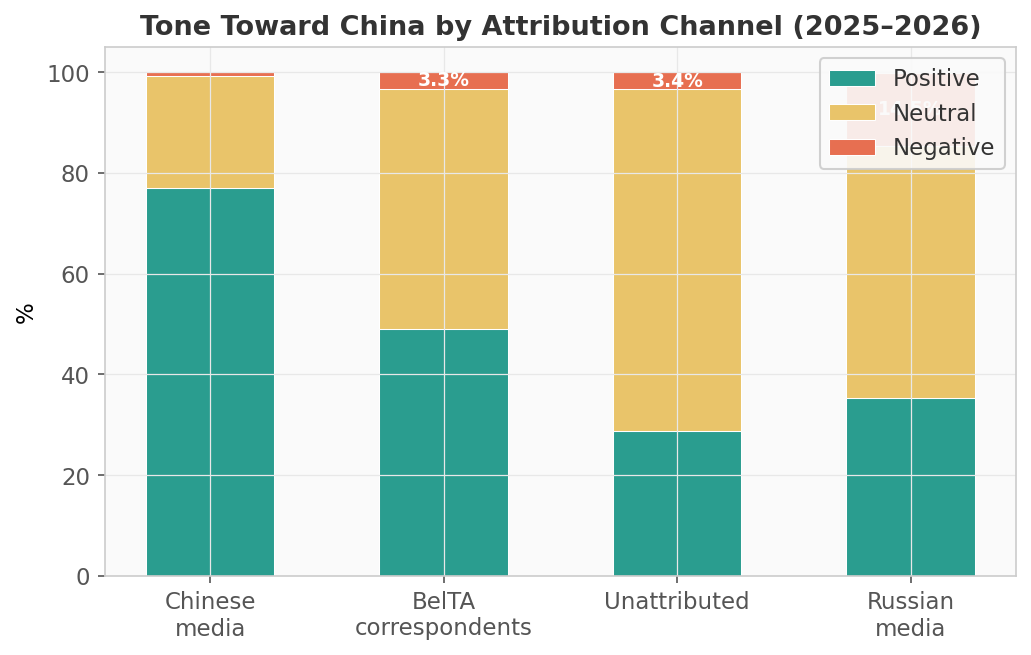
The overall tonal shift between periods is also notable: positivity toward China fell from 41.9% to 34.2%, while neutral framing rose from 54.1% to 61.4%. Belarusian state media have not become more negative toward China, but they have become noticeably more reserved.
This negativity in the Russian channel reflects internal tensions within the Russian media sphere regarding China: competition for Central Asian markets, divergences on the Middle East agenda, and resentment of China’s growing technological leadership. Belarusian state media, by retransmitting Russian sources, import this tension.
Conclusions
1. China is stable on the agenda, but Chinese media are exiting it. The share of China-related news holds at 5–8% over six years. Yet citation of Chinese media sources has shrunk fivefold: from 22.8% of China coverage in December 2022 to 3–6% in 2026. Xinhua remains dominant among Chinese sources, but it is used as a wire service for the “World News” section, not as an instrument of narrative influence.
2. Chinese media have been rebranded: from geopolitical propaganda to a technology showcase. Anti-Western content via Chinese sources plunged from 22% to 2%. It was replaced by technology (35%) and culture (21%). This is not a spontaneous process; it is a deliberate shift in communication strategy.
3. Belarusian state media are de-attributing China content. 71% of China-related publications appear without reference to a specific source (up from 57%). The BelTA correspondent network has halved. This reduces the transparency of the information chain and makes narrative attribution more difficult.
4. Russian media transmit hidden tensions. The Russian channel shows 14.5% negative tone toward China, 4 to 18 times higher than other channels. Belarusian state media, by retransmitting Russian sources, import intra-Russian contradictions regarding Beijing.
5. China is turning from a partner into a decoration. Bilateral focus dropped from 37% to 25%. Neutral framing rose from 49% to 65%. China increasingly appears as a background element of world news, rather than a strategic ally of Minsk.
Methodology
The study is based on data from the FORESIGHT analytical platform (approximately 1.9 million documents, 73 sources). The corpus for semantic analysis comprised 9,518 documents from Belarusian state media containing references to China. Two comparison periods were used: the peak of Chinese media citation (October 2022 – March 2023, n=2,392) and the current period (October 2025 – May 2026, n=7,126).
Attribution channel was determined by the presence of markers in the text: Xinhua, People’s Daily, Global Times, CGTN, CCTV, China Daily (Chinese media); TASS, RIA Novosti, Interfax, RT, and others (Russian media); “BelTA correspondent,” “BelTA–Xinhua” (correspondent network).
Thematic classification was performed using GPT-4o-mini via the OpenAI Batch API (10 thematic categories, 6 geopolitical frames, 3 tone levels). The “other” category accounted for 14.6% in the peak period and 17.9% in the current period. Validation showed that approximately 11% of these documents contained false positives (China was not substantively mentioned), while the remainder represented a long tail of miscellaneous topics (talk shows, interviews, personnel appointments) with no hidden thematic clusters. The ten base categories cover all significant patterns.