
On April 2, the global fact-checking community celebrates International Fact-Checking Day. The Poynter Institute’s International Fact-Checking Network (IFCN) published its annual report for the day.State of the Fact-Checkers 2025, based on a survey of 141 organizations from 71 countries. At the same time, the European Commissionsigned a €5 million grantwithin the European Democracy Shield to support independent fact-checking in Europe. These two documents are worth reading together, as together they paint a picture that neither one alone reveals.
IFCN Report: Numbers You Can’t Ignore
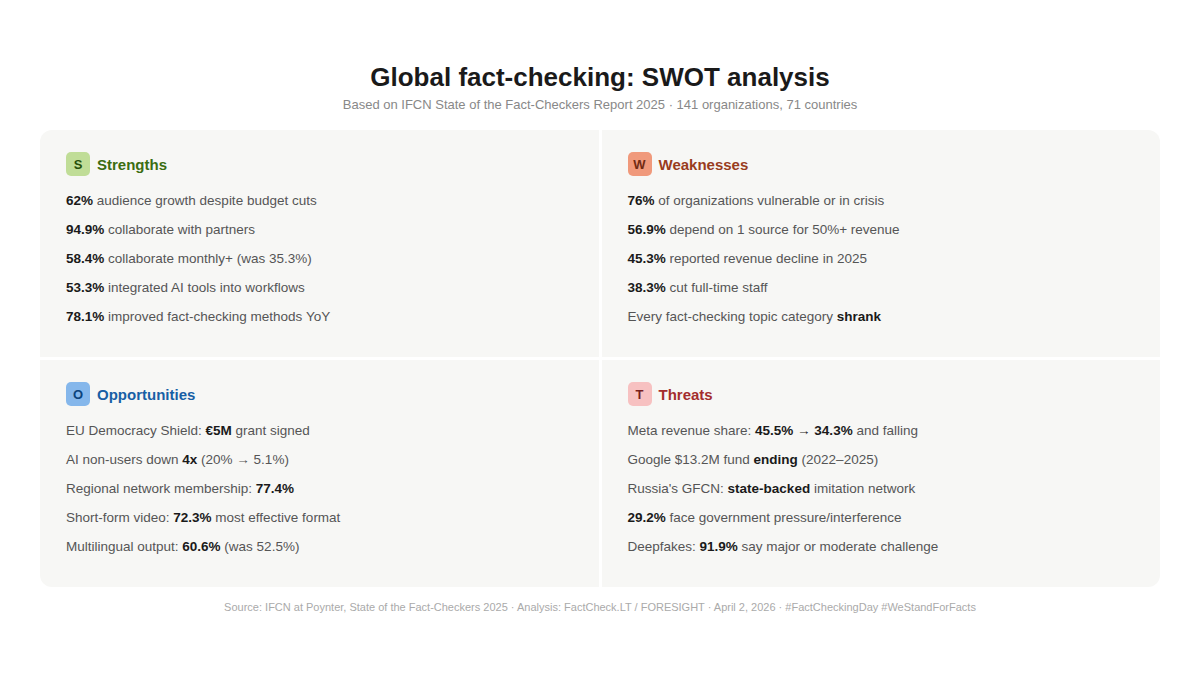
The main figure of the report:76% of the world’s fact-checking organizations ended 2025 with the status of “vulnerable” or “in crisis.”Only 22.6% described themselves as resilient, meaning they had diversified revenues, multi-year commitments, or sufficient reserves. 67.2% described themselves as vulnerable, defined by dependence on a single donor, short grant cycles, and insufficient reserves. 8.8% reported a crisis, including salary issues, budget deficits, and possible closure within six months.
In 2024, almost half of organizations reported revenue growth. In 2025, 45.3% reported a decline. 38.3% reduced their workforce (compared to 14.9% in 2024). All fact-checking categories declined: climate fell from 75.2% to 55.5%, historical claims from 59.9% to 40.1%, and elections and politics from 95.6% to 87.6%.
Meanwhile, the audience is growing: 62% of organizations reported growth despite budget cuts. Collaboration has intensified: regular collaboration (monthly or more frequently) has increased from 35.3% to 58.4%. AI integration has accelerated: 53.3% have implemented AI tools, while only 5.1% do not use AI at all (compared to 20% in 2024). The community is adapting operationally, but the financial foundation is crumbling.
The end of the era of two pillars
In three years, the fact-checking community has lost both of its technological pillars of funding. The Google/YouTube program, launched in 2022 with a $13.2 million grant over three years through the Global Fact Check Fund, has ended. The $750,000 distributed in January 2026 through the SUSTAIN round ($30,000 per organization) is no longer an investment in development; it’s palliative care with simplified reporting and the slogan “sustain your current capacity.”
Meta, which accounted for an average of 45.5% of the income of its fact-checking program participants in 2024, announced its withdrawal from the program in the US in January 2025. By the end of 2025, its share of average income had fallen to 34.3%. Participation in the program declined from 61.4% to 56.2%. Meanwhile, among the remaining participants, dependence remains critical: 21.2% receive 76-100% of their income from Meta, while another 16.5% receive 51-75%. At the GlobalFact 12 conference in Rio de Janeiro in June 2025, IFCN invited Meta, but Meta declined to attend. The conference’s only technology partner was TikTok, whose share of fact-checkers’ income plummeted from 11.9% to 5.1%.
56.9% of organizations rely on a single source for more than half of their revenue. 34.3% rely on a single source for 75-100%. This is a classic single-point-of-failure, and the point of failure has already been triggered.
€5 million from the EU: a rescue or a safety net?
On March 31, 2026, the European Commission signed a €5 million grant agreement to support independent fact-checkers through the FACTEUR (Fact-Checkers for European Resilience Against Disinformation: Network for Emergency, Protection, and Technology) project. The project is led by the European Fact-Checking Standards Network (EFCSN), with seven partners. The project duration is 30 months. Over 60% of the funds are to go directly to fact-checking organizations across Europe.
The grant is structured appropriately: it creates infrastructure, not just hands out money. It includes legal protection (20.4% of organizations faced lawsuits in 2025). Cybersecurity (29.2% experienced cyberattacks). Psychological support (65% face harassment). A fact-checking repository reduces duplication of effort. This is an important signal that the EU views fact-checking as an element of democratic defense.
But the scale is this: €5 million for 30 months for approximately 60 European organizations. For comparison, Google provided $13.2 million over 3 years for a global community of 140+ organizations. The EU grant covers approximately 10-15% of the losses from the Meta reduction for the European segment. It’s a cushion that softens the decline, but doesn’t prevent it.
The closed perimeter problem
And here arises a question that troubles me as the head of an organization operating in exile. The grant is channeled through the EFCSN, an association that describes itself as having “over 60 verified members.” This figure hasn’t changed since 2023, when the first rounds of admissions were held. I haven’t found a single public announcement about accepting new members in 2025 or 2026.
Formally, the EFCSN is open. In reality, the accession process involves a review by two external assessors, a solicitation of opinions from existing members from the same region, and a final decision by the Governance Body by a two-thirds majority. This is not an application, but a full audit, which existing members can block.
The European Commission sets the goal of “ensuring fact-checking coverage in all EU Member States and official EU languages, as well as countries associated with the Digital Europe Programme.” If the EFCSN does not expand its membership and the grant is channeled through the EFCSN, the gap between the coverage ambitions and the reality of distribution will widen. New initiatives, exile organizations, and startups from countries where disinformation is most dangerous risk being left outside the funding perimeter.
For organizations outside the EU, the situation is even more acute. Africa, Asia, and Latin America, which suffered the most from the cancellation of USAID and the end of the Google program, are left without systemic coverage. SUSTAIN, at $30,000 per organization, with an average budget of $100,000-500,000, covers 6-30% of the annual budget.
GFCN: Imitation at the Moment of Maximum Vulnerability
It was precisely at this moment of structural weakness in genuine fact-checking that Russia launched its own imitation. The Global Fact-Checking Network (GFCN), founded in November 2024 by TASS and ANO Dialog (both sanctioned by the EU for disinformation operations, including Project Doppelganger), is positioned as an alternative to the IFCN.
According to RSF, EDMO, StopFake, and Wikipedia, GFCN is a Russian state-sponsored structure masquerading as an international fact-checking organization. Its “experts” include figures involved in the Storm-1516 investigations and propagandists operating in the occupied territories of Ukraine. As IFCN Director Angie Drobnik Hjoland noted, “This is part of a long series of tactics by Russia aimed at imitating independent institutions while serving Russian political interests.”
In our publication for International Fact-Checking Day, prepared using the FORESIGHT corpus (1M+ Belarusian media documents), we demonstrated that Belarusian state media are already citing GFCN as an “international fact-checking association,” without any indication of Kremlin affiliation. The newspaper “SB. Belarus Segodnya” cites GFCN in a story about “EU digital censorship ahead of the Hungarian elections,” lending the propaganda narrative the appearance of expert verification.
The asymmetry is complete. GFCN is funded by the Russian budget and has no sustainability issues. 76% of real fact-checkers are vulnerable or in crisis.
A view from Vilnius
Our organization, FactCheck.LT, operates from Vilnius and specializes in analyzing disinformation in Eastern Europe. We are not a classic fact-checking newsroom; we are an analytical center using corpus methods and AI to monitor propaganda narratives. Our FORESIGHT corpus contains over a million documents, and our LLM-inferred attitudes methodology is validated with an accuracy of 88.3%.
We work at the intersection of worlds: between the IFCN fact-checking community, academic disinformation research, and civil society in exile. And from this vantage point, it’s clear how all three are experiencing the same crisis: the decline of platform funding, the closure of grant flows within established networks, and the growth of imitation structures.
In June 2026, GlobalFact 2026 will take place in Vilnius, our home city. Organizers: EFCSN, IFCN, Delfi, and LRT. This is an opportunity to raise questions that can no longer be postponed: how to ensure financial sustainability without platform dependence; how to open up European grant mechanisms for organizations working on the front lines of disinformation; and how to counter the Kremlin’s imitation of fact-checking.
The threat posed by Russia’s disinformation and propaganda system to everyone, everywhere, must be remembered every day. Not just on April 2nd.
Links:
IFCN State of the Fact-Checkers Report 2025: poynter.org/ifcn
EU €5M grant for EFCSN:digital-strategy.ec.europa.eu
GFCN (Wikipedia):en.wikipedia.org
RSF on GFCN:rsf.org
GlobalFact 2026 registration: register.globalfactconference.org