

FORESIGHT Multi-Agent System • Q1 2026
Belarus Q1 2026: A Regime Between Two Futures
What 1.2 million documents and 16 AI agents reveal about the Belarusian information space in the first quarter of 2026
FactCheck.LT / FORESIGHT Analytical System • April 2026
Every quarter, our FORESIGHT Multi-Agent System processes the entire Belarusian media landscape: 1.24 million documents across 23 sources, from state television to independent news portals to Telegram channels. Sixteen analytical agents work in parallel, each examining a different dimension of the information space.
Q1 2026 produced a striking finding: a regime simultaneously hardening and hedging, talking about Eastern integration while keeping European doors slightly ajar, celebrating nuclear prestige while its economic indicators flash red.
The European Pendulum
The most dramatic shift this quarter is the reversal of the “European moment” that briefly appeared in Q4 2025, when pro-European framing surged to 45.1% of discourse, overtaking the Eastern turn for the first time. By Q1 2026, the pendulum swung back: Eastern turn at 57.6%, pro-European framing retreated to 26.7%.
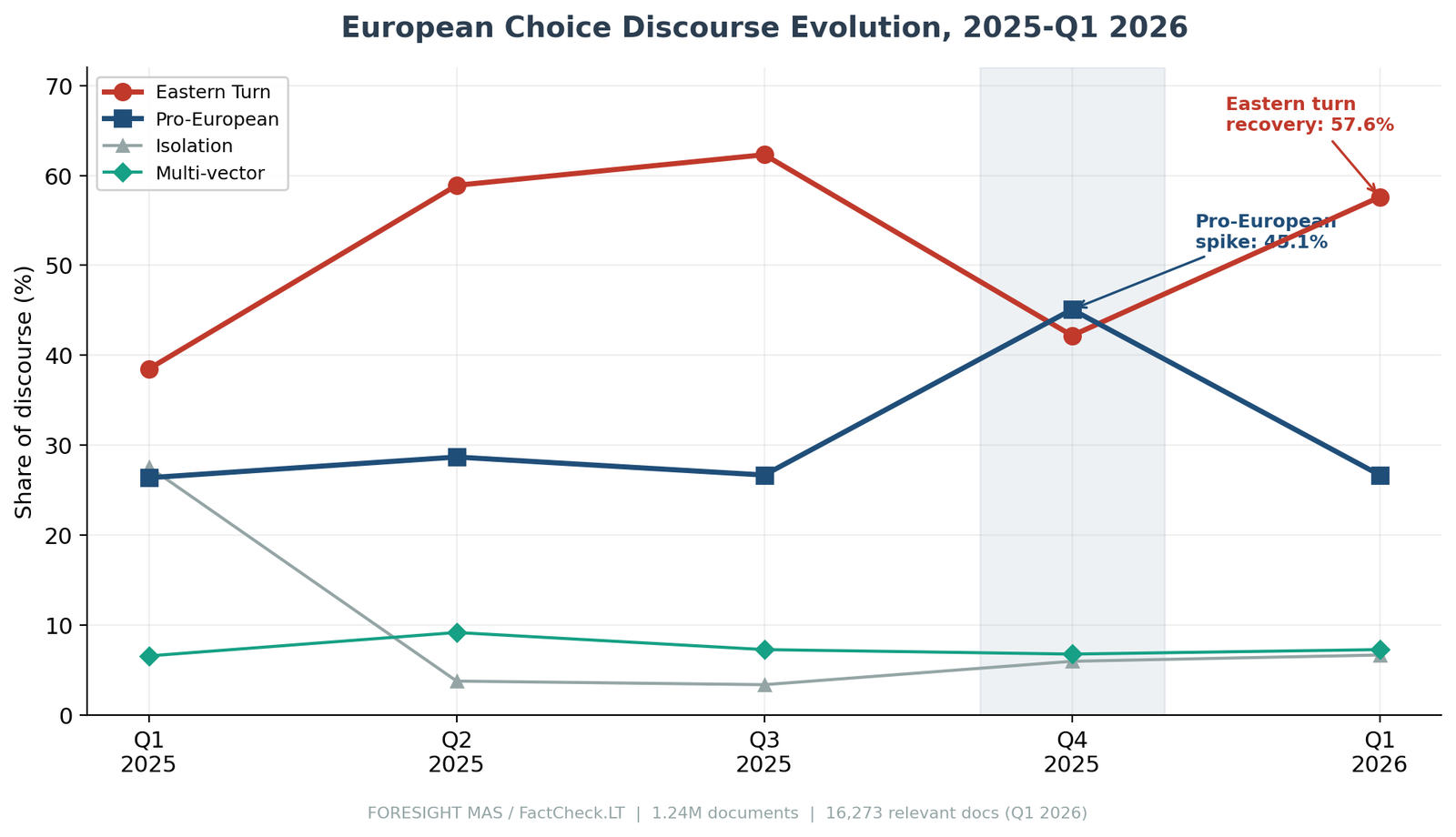
European Choice framing across 78,759 documents. The Q4 2025 pro-European spike was unprecedented and short-lived.
The pattern suggests strategic ambiguity as deliberate policy: the regime tested a European signal and withdrew it. Whether this was a diplomatic probe or a reaction to external dynamics (the Trump administration, Ukraine negotiations), the result is a regime that keeps both doors open.
Five Key Numbers
FIMI Discourse: How Belarus Labels Information Threats
The FORESIGHT system tracks how Belarusian media use two key terms: “fake” (фейк) and “disinformation” (дезинформация). These are not synonyms: “fake” is populist and dismissive, while “disinformation” is institutional and implies a systemic foreign threat. The ratio between them reveals the regime’s framing strategy.
Across Q1 2025 through Q1 2026, we recorded 74,871 mentions of these terms across web-based sources: 33,487 uses of “fake” and 41,384 of “disinformation.” But the Q1 2026 data reveals a dramatic shift: 19,588 mentions in a single quarter (+45% over Q1 2025), with the fake-to-disinformation ratio surging from 0.70 to 0.94. The two terms are converging: “fake” is no longer just a populist label for internal opponents but has become a universal weapon aimed overwhelmingly at the West.
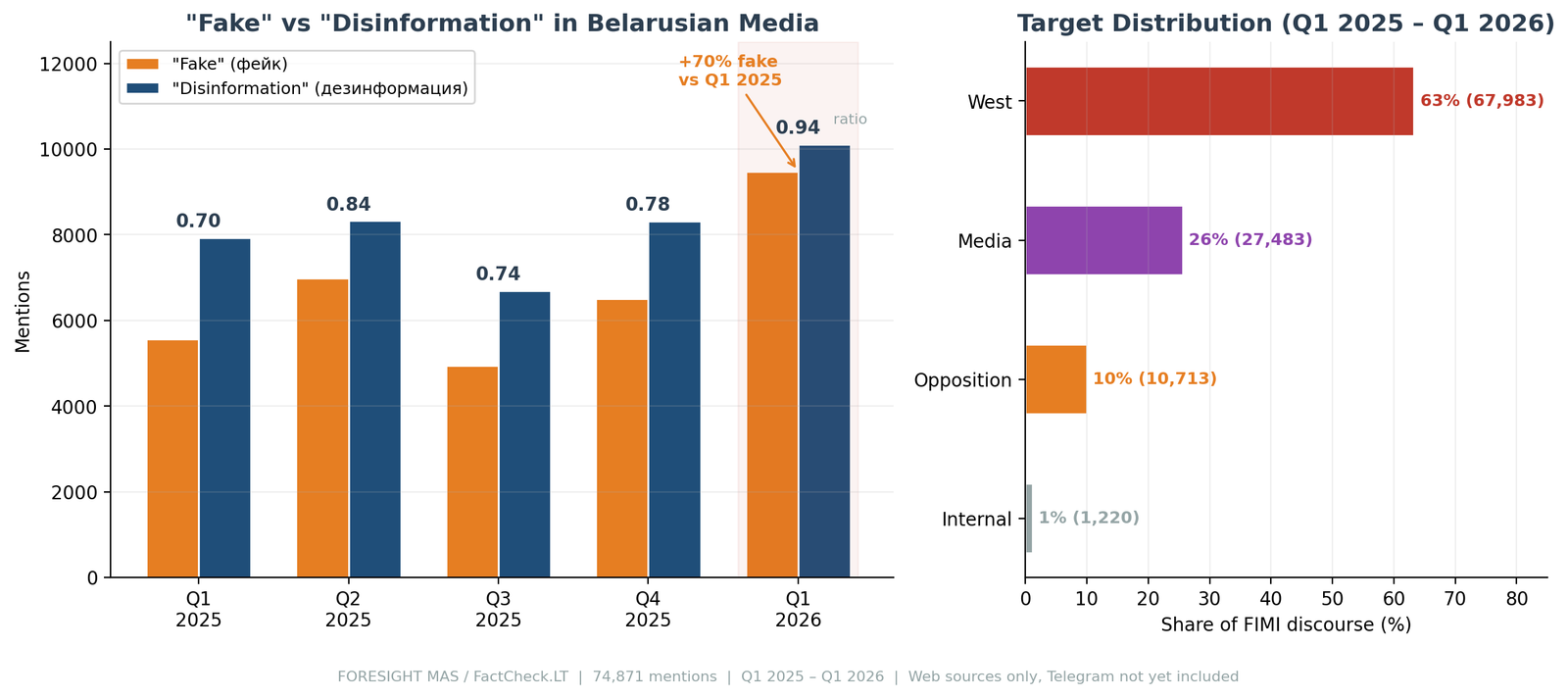
Left: quarterly dynamics of “fake” vs “disinformation” with convergence ratio. Right: target distribution across five quarters. Web sources only; Telegram analysis forthcoming.
The target distribution is striking: 63% of all FIMI discourse is directed at “the West” as a source of information threats. Media outlets are the second target (26%), followed by the opposition (10%). Internal targets account for only 1.1%, confirming the regime frames its information defense almost entirely as an external security issue.
The Q1 2026 surge (+70% in “fake” mentions vs Q1 2025) correlates with the Oreshnik discourse and NATO-Baltics escalation detected by the weak signals agent. When external security threats intensify, the FIMI apparatus scales up proportionally.
Note: This analysis covers web-based sources only (state and independent media websites). Telegram channels, which account for 16% of the FORESIGHT corpus, are not yet included in the FIMI agent. A dedicated Telegram FIMI run is planned for Q2 2026.
Q2 2026 Forecast
Based on the outputs of all 16 agents, the scenario engine calculated these probabilities for Q2 2026:
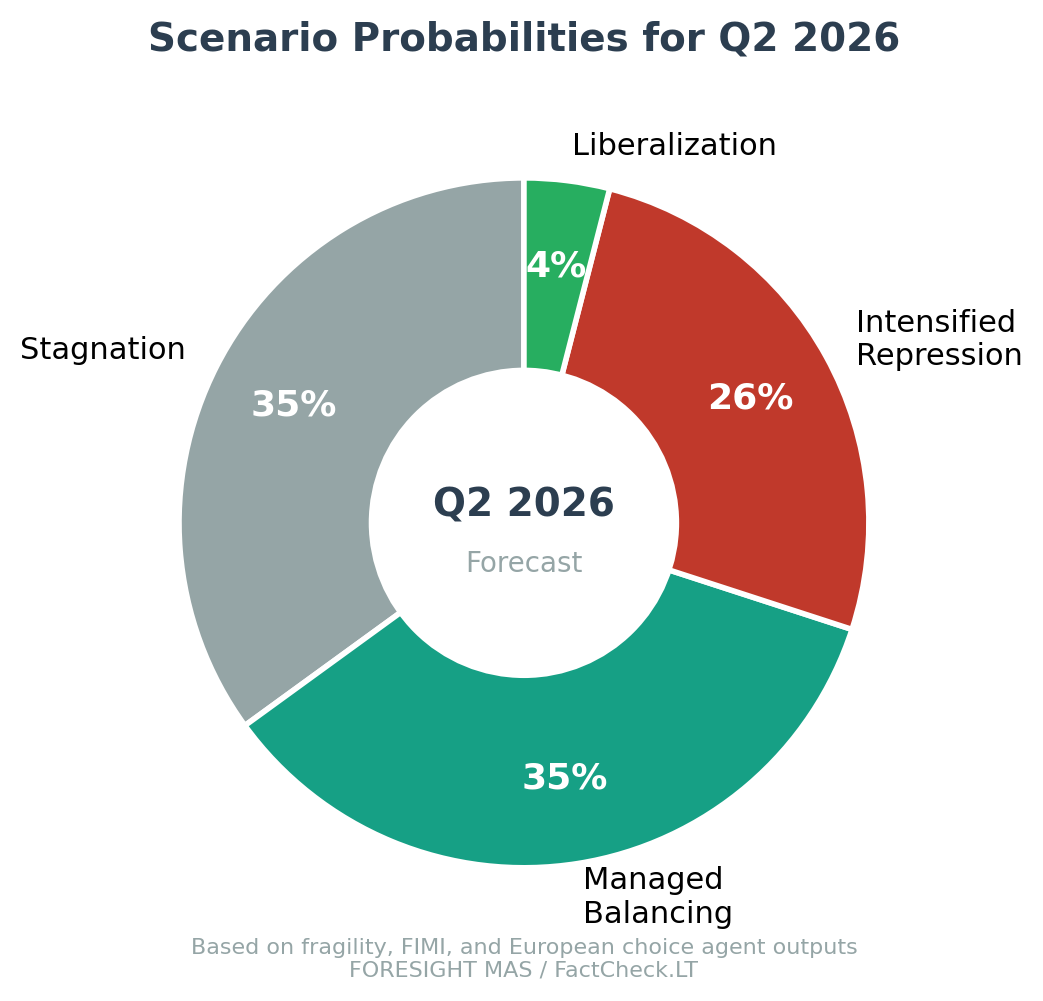
The equal weighting of stagnation (35%) and managed balancing (35%) reflects the European choice data: the regime maintains optionality without committing. Intensified repression (26%) is elevated by six critical events detected in March, including Oreshnik deployment questions and NATO-Baltics escalation (177 documents). Liberalization remains at 4%.
Semantic Capture: The Civil Society Substitution Index
The FORESIGHT civil society agent tracks how the regime appropriates the term “civil society” itself. The Substitution Index (SI) measures the balance between regime-framed and independent-framed uses of the term across 5,520 documents from 2021 to 2026.
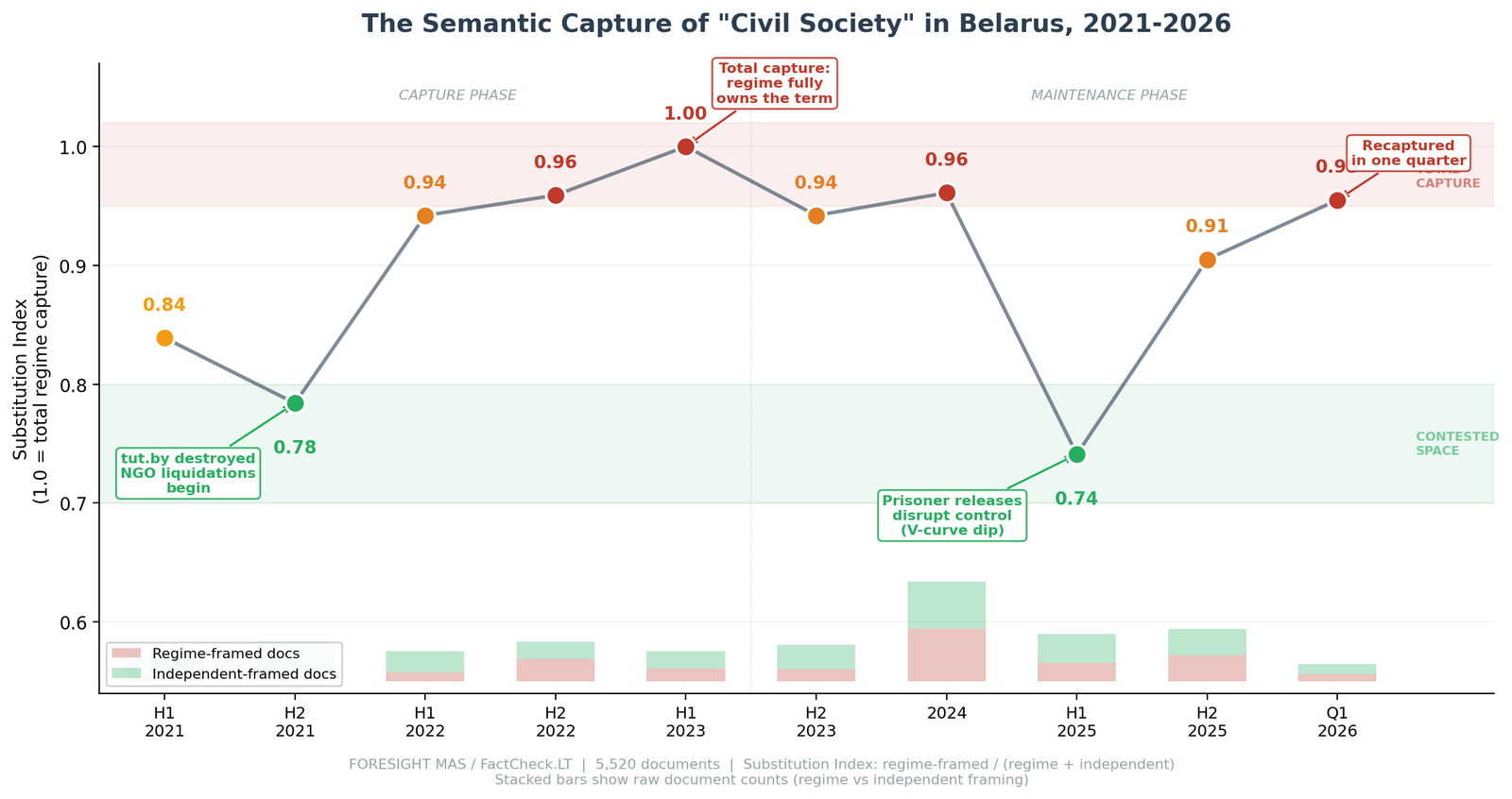
The trajectory reveals a V-curve of semantic capture:
The regime lost control of the “civil society” concept twice (H2 2021 and H1 2025) and recaptured it twice, each time more rapidly. The current 0.96 index means that 96% of media discourse about civil society uses regime-aligned framing: “All-Belarusian People’s Assembly,” “constructive dialogue,” “patriotic education” rather than “human rights defenders,” “solidarity,” or “political prisoners.”
Methodology
FORESIGHT MAS v1.2 processed 1,241,982 documents from 23 sources using 16 analytical agents in 2.5 hours. Agent types: discourse analysis (European choice, national identity, FIMI, nuclear narrative, discourse weaponization, civil society), strategic assessment (fragility pentagon, scenarios, progress tracking), early warning (weak signals, economic signals), media ecosystem analysis, and coordination detection. All analyses use context-aware detection with navbar contamination filtering. In addition to this quarterly deep-dive, FORESIGHT produces automated weekly 12-actor monitoring reports via an n8n workflow with Mailchimp distribution, covering the same corpus in near-real-time. Developed by FactCheck.LT (Vilnius, Lithuania).