
TL;DR
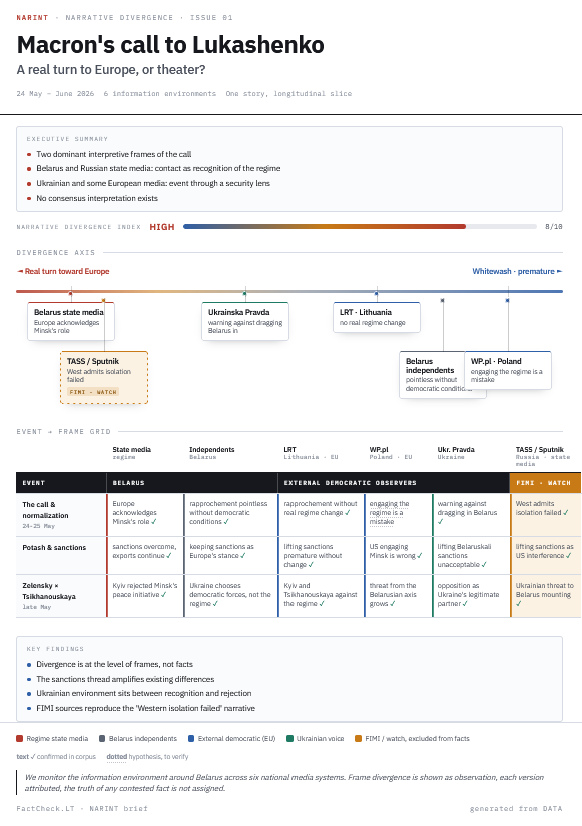
- An analysis of six information environments identified two dominant frames for interpreting the 24 May phone call between Emmanuel Macron and Alexander Lukashenko.
- Belarusian and Russian state media treat the contact as evidence of the regime’s international recognition and of a weakening of the isolation policy.
- Ukrainian and part of the European media read the event primarily through the lens of security, sanctions policy, and the risks of premature normalization with Minsk.
- There is no consensus interpretation: the differences appear less at the level of facts than at the level of interpretive frames.
Narrative Divergence Index: HIGH (8/10)
Context
On 24 May, French President Emmanuel Macron held a phone call with Alexander Lukashenko. The following day, the Belarusian Ministry of Foreign Affairs confirmed that diplomatic contacts between the sides were continuing.
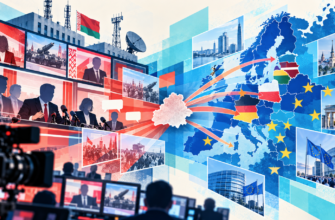
The fact of the call is not in dispute. Its political meaning, however, is interpreted in fundamentally different ways across media environments. The analysis reveals several competing narratives that describe the same event through different political and strategic frames.
Key interpretive frames
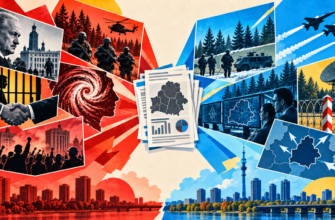
The corpus analysis identifies two principal interpretive frames.
The recognition and normalization frame
Belarusian state media present the call as evidence of Minsk’s growing international recognition and a confirmation of its diplomatic relevance. A similar logic runs through Russian state media, where the contact is treated as proof that the policy of international isolation of Belarus has failed.
Despite differences in rhetoric, both environments reach a similar conclusion: the very fact of contact is read as a political success for the current regime.
The security and deterrence frame
Ukrainian and part of the European media offer an alternative reading. In this frame the call is seen not as a step toward normalization but as an instrument of diplomatic pressure and security risk management.
Ukrainska Pravda emphasizes the deterrent character of the contact, while Poland’s WP.pl treats the very act of engaging with Lukashenko as a politically mistaken step. The Lithuanian environment links the discussion of the contact to broader debates about sanctions policy toward Belarus.
The divergence between environments thus arises primarily at the level of frame choice, not at the level of individual facts.
Positioning of the information environments
The distribution of sources along the axis of attitude toward a possible normalization of relations between Belarus and the European Union shows a pronounced asymmetry.
On the side that supports rapprochement are Belarusian state media and Russian state sources. The latter are treated separately, as an object of observation for FIMI (Foreign Information Manipulation and Interference), and are used to capture additional interpretive patterns.
The Ukrainian environment occupies an intermediate position, with attention focused mainly on security questions rather than on the prospects of political normalization.
The most skeptical position is held by Belarusian independent media and external democratic observers. Their publications acknowledge the fact of contact but question its significance as a sign of real political change.
The sanctions thread as an indicator of narrative divergence
A similar structure of divergence appears in coverage of the sanctions against Belaruskali.
Belarusian state media emphasize the resilience of export flows and the economy’s ability to adapt to restrictions. Russian state media interpret sanctions policy through the rhetoric of external interference.
At the same time, Belarusian independent media together with Lithuanian and Ukrainian sources treat sanctions as a continuing instrument of pressure on the regime. Positions range from keeping the current restrictions to the need to tighten them further.
Around the sanctions thread, then, a wide spectrum of interpretations takes shape, from a narrative of restrictions overcome to a narrative of the need to tighten them.
Competing notions of political legitimacy
Contacts between Ukrainian representatives and Sviatlana Tsikhanouskaya in late May became another point of divergence between the information environments.
For Ukrainian and Belarusian independent media, engagement with Belarus’s democratic forces is seen as a legitimate format of cooperation. State Belarusian and Russian media, by contrast, interpret similar events through frames of external interference and destabilization.
In the Polish environment this thread is additionally linked to questions of regional security and potential threats from the Lukashenko regime.
Analytical significance
The findings point to a high degree of fragmentation of the information space around Belarus.
In most cases the divergences arise not from differences in the factual basis of the reports but from the use of different interpretive frames. The same diplomatic episode can serve at once as evidence of the regime’s international recognition, as an example of the West’s failed policy, or as an instrument for preventing security threats.
For researchers of the information space this points to the need to analyze not only facts and messages but also the meaning structures through which events become part of competing political narratives.
On method
We monitor the information environment around Belarus across six national media systems. Frame divergence is shown as observation: each version is attributed to its source, and the truth of any contested fact is not assigned.