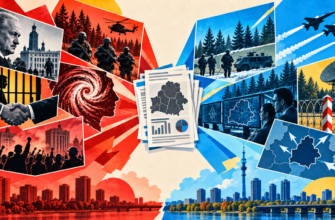

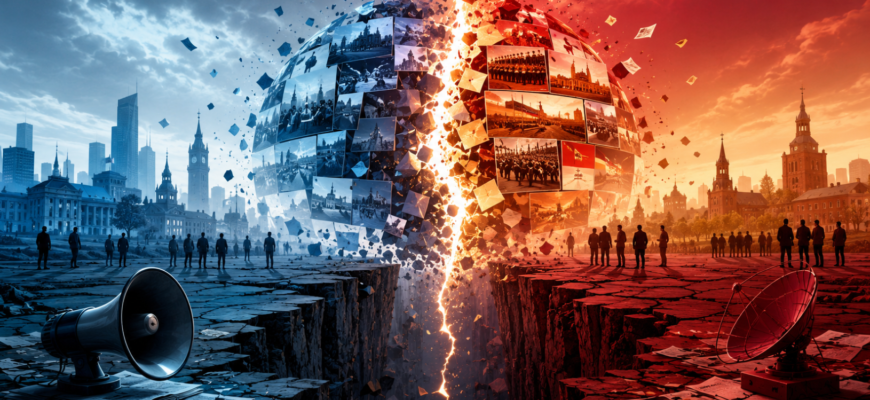
The second issue of the monthly narrative intelligence series by FactCheck.LT. We automatically compare how the same event is presented across eight information environments: Belarusian state and independent media, the media of Lithuania, Latvia, Poland and Ukraine, Russian state media, and China’s Xinhua news agency. The Narrative Divergence Index (NDI) measures how far apart the interpretations have drifted; a separate piece in this series explains how to read the index.
July in one paragraph
The FORESIGHT platform grouped July’s stream from 26 sources into 1,346 events; ten of them, covered by at least four information environments, went through scoring. July proved tenser than June: six events against five reached the HIGH level, meaning incompatible versions of reality. And for the second month running the same structural pattern repeats: an event with high divergence simultaneously turns out to be an object of state media silence. In June it was the analysis of the Valdai-Beijing tour; in July it became Ukraine’s consideration of a criminal case against Lukashenka.
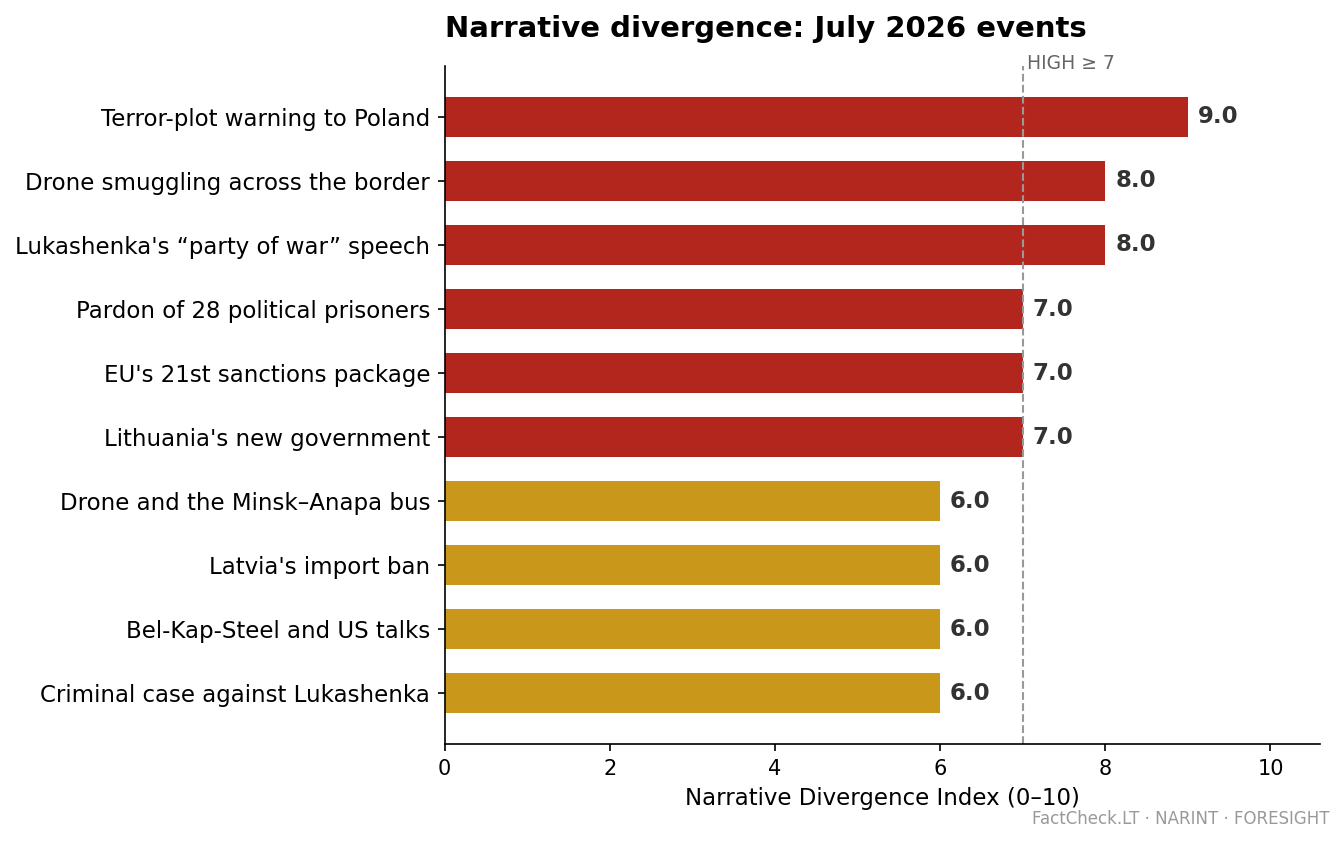
Event of the month: the terror-plot warning to Poland. NDI 9.0
On 23 July, Belarus’s Ministry of Foreign Affairs handed Poland’s chargé d’affaires Krzysztof Ożanna information about a terrorist attack allegedly being prepared on Polish territory: according to Belarusian law enforcement, the targets were to be the minor children of a Belarusian activist living in Poland, and the alleged organiser is a man previously convicted in Belarus whose protection status Poland had recently revoked. Nobody disputes the fact that the information was handed over. Everything else diverged by nine points.
Belarusian state media (position 0) built the frame of a responsible, good-neighbourly partner: the country “proves by deeds” its commitment to fighting terrorism, while incidentally discrediting the Belarusian diaspora, from whose midst the threat supposedly comes. Russian state media (position 0) reproduced this version verbatim and amplified it. At the other pole, Ukrainian media (position 9) classified what happened as a propaganda operation by the security services. Between the poles, a telling gradation: independent Belarusian media (position 7) recorded the fact of the handover while stressing the absence of any confirmation of the threat; Lithuanian media (position 8) pointed to the oddity of the genre itself, since the publicity of the warning contradicts how states actually exchange such information; Polish media (position 7) found themselves in the most uncomfortable spot, balancing obligatory seriousness towards any threat to children against scepticism towards the source.
Note the construction of this frame: the state media version accomplishes three tasks at once. It demonstrates Minsk’s “constructiveness” at the moment of negotiations with the West, criminalises the image of Belarusians who left, and puts the Polish authorities before a choice with no good options: to ignore means to “neglect the safety of children”, to react means to legitimise the source.
Drone smuggling: a scheme or isolated episodes. NDI 8.0
In the last week of July the Lithuanian side reported intercepting drones carrying contraband cigarettes flying in from Belarus. Independent Belarusian (position 1), Lithuanian and Latvian media describe a technologically diverse and growing smuggling scheme operating from the Belarusian side of the border: drones, tunnels, caches. Belarusian state media (position 9) show the mirror image: Belarusian border guards themselves exemplarily suppress isolated violations by individual citizens; no systemic pattern, let alone state involvement, exists. TASS (position 8) reduces the story to an administrative episode. A classic “system versus episode” dispute, in which the very scale of the phenomenon becomes the subject of divergence.
The “party of war” speech: peacemaker or information warfare front. NDI 8.0
Lukashenka’s 6 July address to the military, with its theses about sovereignty, unwillingness to fight and the Western “party of war”, produced the month’s second-deepest divergence. For Belarusian and Russian state media (positions 1) it is the speech of a guarantor of peace resisting hybrid Western aggression. For independent Belarusian (position 8) and Polish media (position 9) it is manipulative rhetoric shifting responsibility for the military threat onto the West while Minsk in fact remains complicit in Russia’s war. Ukrainian media (position 7) seized on a telling slip in the speech, “but there is one but”, as a marker of the conditionality of all the peaceable promises.
The pardon of 28 political prisoners: humanism or an instrument. NDI 7.0
The most widely covered event of the month in the entire corpus: the 1 July decree pardoning 32 people, 28 of them convicted under “extremism” articles, on the eve of the official Independence Day. Belarusian and Russian state media (positions 1) present it as an act of humanism by the head of state, organically embedded in the festive frame: the pardoned “petitioned, admitting guilt and repenting”. Independent Belarusian media (position 8) place the same event in a different arithmetic: according to the Viasna human rights centre, 864 people were recognised as political prisoners in Belarus as of 1 July, and practice shows that pardons often go to those with little time left to serve. Lithuanian (position 8) and Polish (position 7) media read the gesture in a negotiating context: the releases coincide in time with stages of US sanctions easing. Tellingly, what diverges here is not the evaluation of the event but the coordinate system in which to count it: 28 released against 864 remaining.
The EU’s 21st sanctions package: leverage or self-harm. NDI 7.0
On 23 July the Council of the EU adopted the 21st package of restrictive measures, which the EU’s chief diplomat Kaja Kallas called the largest in four years: 218 individuals and entities, more than a hundred banks and crypto operators, over forty “shadow fleet” vessels, and, for the first time, the Mozyr oil refinery, the second of Belarus’s two refineries, together with the state exporter European Trading Company. Independent Belarusian and Lithuanian media (positions 1) describe a legitimate and historically tough instrument of pressure on the aggressor’s economy. Belarusian state media (position 8) tell the story of the same package through the EU’s internal contradictions and the damage to European business; Russian state media (position 7) record the adoption while removing agency and the cause of the sanctions from the picture. A seven-point divergence with full agreement about the package’s contents.
Lithuania’s new government: a softening or a technical edit. NDI 7.0
The change of government in Lithuania in early July produced a dispute over a single paragraph: the previous accents of isolation disappeared from the programmatic wording on Belarus. Belarusian state media (position 1) saw in this a split in Lithuanian politics and a de facto admission that the previous course had failed; Russian state media (position 2) announced a real softening. Lithuanian media (position 8) and the leadership of the Seimas itself insist the edit is technical, the principled position unchanged, and that what caused unease was the very possibility of a double reading. Independent Belarusian media (position 7) took an intermediate position: the change is real, but it means a shift from unconditional to conditional pressure, not a reversal. A case where the object of the information battle is not an event but a wording.
The middle band: four events with NDI 6
The drone and the Minsk-Anapa bus (NDI 6.0). The strike on a Belarusian bus in Russia’s Bryansk region early in the month: Russian state media (position 1) immediately and unreservedly attributed the strike to Ukraine as a “deliberate terrorist attack on civilians”. The ally’s distance is notable: Belarusian state media (position 7) presented what happened as a tragic incident requiring a state response, refraining from unambiguous attribution. Independent Belarusian media stressed the very fact of risk to Belarusian citizens on the territory of a country at war. A rare case of the Belarusian and Russian state frames publicly diverging on attribution.
Latvia’s import ban (NDI 6.0). The Saeima’s decision to ban imports of goods from Belarus and Russia was covered by Latvian media procedurally, as a domestic political story with voting details; Lithuanian media stressed the precedent of one of the first national bans of its kind in the EU; independent Belarusian and Ukrainian media placed it in the logic of economic decoupling from the aggressors. Belarusian state media (position 2) confined themselves to a dry recording of the fact, which is telling in itself: the polemic one might have expected never came.
Bel-Kap-Steel and the talks with Washington (NDI 6.0). On 23 July, OFAC removed from its sanctions list the Miami-registered company Bel-Kap-Steel, linked to the Belarusian Steel Works and sanctioned since August 2023. For Belarusian state media (position 9) this is the result of Lukashenka’s “principled stance” and recognition of Belarusian sovereignty; for independent media (position 3) another step in an asymmetric deal in which the regime receives economic relief in exchange for dosed concessions. Russian state media took an unexpectedly supportive position (position 7), presenting the normalisation as the restoration of Belarus’s “normal rights”.
Ukraine considers a case against Lukashenka (NDI 6.0). The report that Kyiv is assessing the possibility of opening a criminal case against Lukashenka was read by independent Belarusian media (position 7) as a historically significant precedent of personal accountability; by Russian state media (position 1) as a politically null initiative unworthy of serious discussion; by Ukrainian and Lithuanian media as a procedural fact at a standard stage of consideration. This event deserves a separate word, and here is why.
The silence map: tunnels and the criminal case
July’s asymmetric silence, events covered by at least three external environments with zero coverage in Belarusian state media, was recorded twice, and both cases are substantive. First: the discovery by Lithuanian border guards of two underground tunnels from Belarus within a single week, on 22 July near the Kabeliai checkpoint (about a metre in diameter, at a depth of one and a half metres, with no exit on the Lithuanian side; Polish specialists were brought in for the search) and on 27 July near the village of Pertakas. Lithuania’s State Border Guard Service links such tunnels to smuggling and the illegal movement of migrants. Belarusian state media mentioned neither.
The second case is methodologically remarkable: the criminal case against Lukashenka landed simultaneously in the top ten measured divergences and in the silence map. Russian state media found the event worth ridiculing; Belarusian state media preferred it not to exist. This is the same pattern as June’s analysis of the Valdai-Beijing tour: when a story touches Lukashenka personally from a vulnerable angle, the allied propaganda argues while the domestic one stays silent. Two months of observation already allow us to call this a stable signature.
The reverse cut, the domestic agenda existing only in the state media environment, numbers 93 storylines in July: the harvesting campaign, regional harvest festivals, reports to the president, anniversary ceremonies. In June there were more than 150 such storylines; the seasonal core (harvesting instead of fodder preparation) remained the same.
Takeaways of the month
First: the dispute is not about facts. In none of July’s ten events did any environment dispute the basic facts: the decree was signed, the package adopted, the tunnel found. All the divergence, up to nine points, is created by the choice of frame: what to call the cause, what the scale, what the semantic centre. For the reader this is a practical skill: on encountering a dispute about an event, it helps to ask first whether the sides are arguing about what happened or about what it means. It is almost always the latter.
Second: the allies argue, the home front stays silent. For the second month running the same signature repeats: a story personally inconvenient for Lukashenka is attacked or ridiculed by Russian state media and completely ignored by Belarusian state media. In June it was the analysis of the Valdai-Beijing tour, in July the criminal case. The two propaganda systems appear to have different instructions for this scenario: one is tasked with devaluing the story, the other prefers that the event not exist.
Third: allied propaganda is coordinated but not monolithic. In the Poland warning case, Russian state media reproduced the Belarusian version verbatim, yet in the Minsk-Anapa bus story the frames publicly diverged: Moscow immediately named the culprit, Minsk refrained from attribution. Such points of divergence mark the boundaries where the allies’ interests stop coinciding, and they deserve separate observation.
Fourth: silence is measurable and informative. Two tunnels under the border in a single week, covered by four external environments against a total zero in state media, say as much about the topic’s sensitivity as any article would. The systematic absence of a story from a controlled media environment is just as much an editorial decision as its presence; it is simply a decision that is harder to see without an instrument that counts the zeros.
Methodology
The full July stream of 26 sources across eight information environments in five languages, aligned into a single semantic field, was automatically grouped into 1,346 events; ten events covered by at least four environments were selected for scoring. The axis of divergence and the environments’ positions were determined by a language model (Claude Sonnet 4.6) reading the material of all environments simultaneously; NDI equals the spread of positions on a 0-10 scale. The environment theses in the text are analytical paraphrases; the issue’s key facts were additionally verified against primary sources (MFA statements, the pardon decree, the EU regulation, the OFAC notice, State Border Guard Service reports). Positions of environments with few materials were flagged and interpreted with caution. Regular rubrics are excluded from the domestic agenda figure. Full scoring data available on request: info@factcheck.lt.