
8,323 materials · 14 countries monitored · Baltic + Weimar + V4 + Iberia + Benelux
|
8,323
Total materials
|
3,667
AI deep-analyzed
|
2982
Propaganda identified
|
1470
High risk
|
14
Countries monitored
|
• Top target by volume: 🇫🇷 France: 2,013 materials. Followed by: 🇵🇱 Poland (1,892), 🇱🇻 Latvia (1,686).
• Top narrative: Internal problems: 753 materials in deep analysis (25% of identified propaganda).
• Multimodal FIMI on YouTube: Baltic cluster 27.7%, Weimar Triangle 29.8%. Highest among countries with 20+ videos: 🇵🇱 Poland (39.4% on 104 videos).
• AI: 3,667 materials processed, 1470 flagged as HIGH risk (40.1%). 2982 identified as propaganda (excluding neutral and not-about-targets).
• Coordination: TASS cited in 136 materials, the most cited external source. 130 coordination events (low confidence, see below) across 31 days.
Mentions by Country
🇫🇷 France leads with 2,013 materials.
| 🔶 🇵🇱 Poland | 1,892 | |
| 🔵 🇱🇹 Lithuania | 968 | |
| 🔵 🇱🇻 Latvia | 1,686 | |
| 🔵 🇪🇪 Estonia | 510 | |
| 🔶 🇩🇪 Germany | 1,566 | |
| 🔶 🇫🇷 France | 2,013 | |
| 🟢 🇨🇿 Czech Republic | 305 | |
| 🟢 🇭🇺 Hungary | 270 | |
| 🟢 🇸🇰 Slovakia | 111 | |
| 🟠 🇪🇸 Spain | 775 | |
| 🟠 🇵🇹 Portugal | 96 | |
| 🟣 🇳🇱 Netherlands | 173 | |
| 🟣 🇧🇪 Belgium | 114 |
Propaganda Narratives
| Country | Propaganda materials | Dominant narrative | Distinctive feature |
|---|---|---|---|
| 🔶 🇵🇱 Poland | 827 | Internal problems (27%) | 104 videos |
| 🔵 🇱🇹 Lithuania | 455 | Military buildup (32%) | Military buildup 32% |
| 🔵 🇱🇻 Latvia | 598 | Military buildup (25%) | 95 videos |
| 🔵 🇪🇪 Estonia | 177 | Military buildup (35%) | Military buildup 35% |
| 🔶 🇩🇪 Germany | 454 | Internal problems (25%) | 104 videos |
| 🔶 🇫🇷 France | 269 | Internal problems (38%) | Internal problems 38% |
| 🟢 🇨🇿 Czech Republic | 65 | Internal problems (28%) | 47 videos |
| 🟢 🇭🇺 Hungary | 59 | Internal problems (26%) | 24 videos |
| 🟢 🇸🇰 Slovakia | 20 | Internal problems (33%) | Internal problems 33% |
| 🟠 🇪🇸 Spain | 363 | Migration (70%) | Migration 70% |
| 🟠 🇵🇹 Portugal | 31 | EU internal division (32%) | EU internal division 32% |
| 🟣 🇳🇱 Netherlands | 39 | Internal problems (24%) | 16 videos |
| 🟣 🇧🇪 Belgium | 23 | Internal problems (25%) | 11 videos |
Radar: narrative distribution
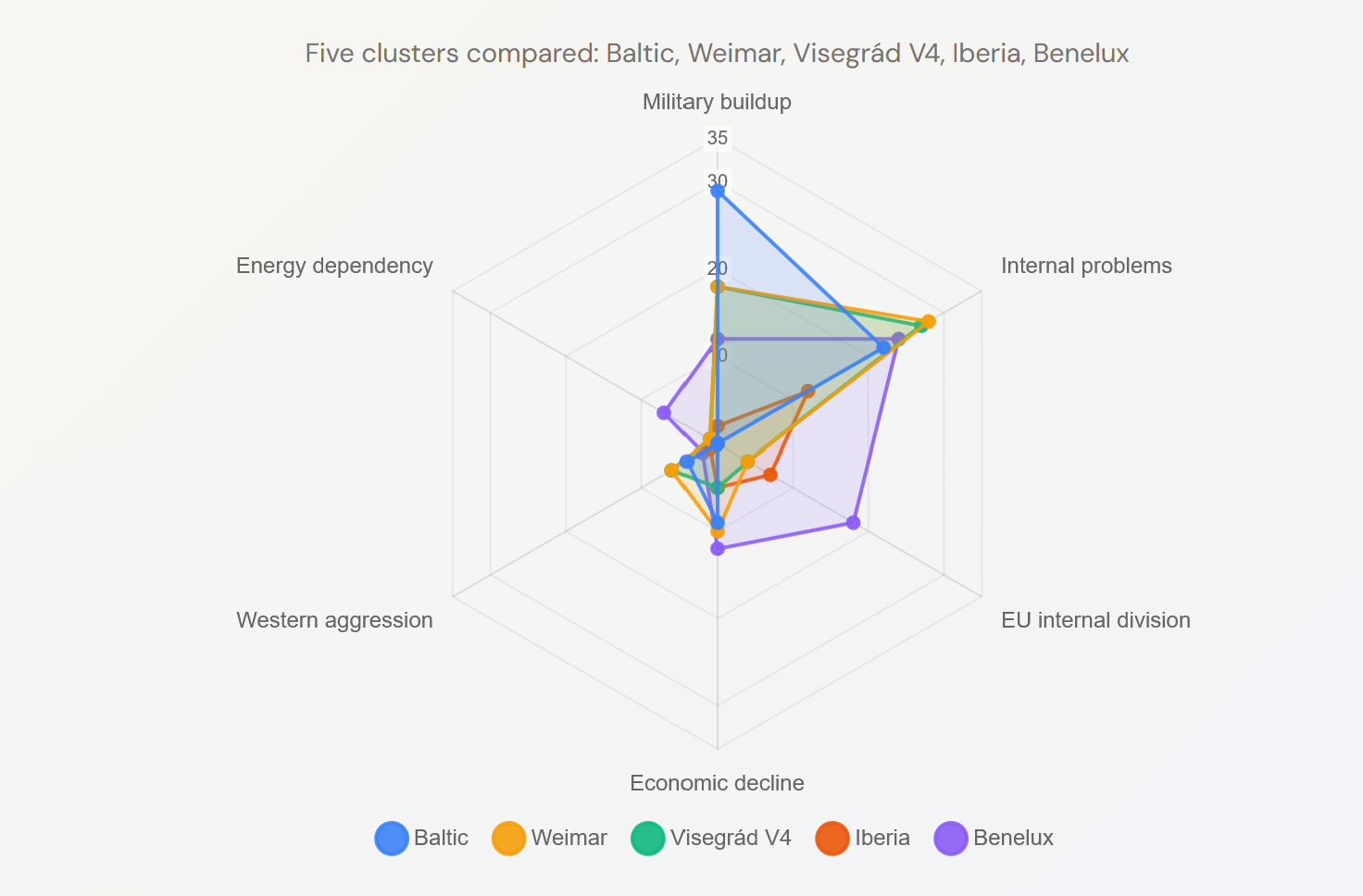
The Weimar Triangle countries (Poland, Germany, France) receive fundamentally different propaganda treatment than the Baltic states. While the Baltics face a monotonal military threat narrative, each Weimar country is attacked through its unique perceived vulnerability.
|
🔵 Baltic States: military monotone
|
🔶 Weimar Triangle: diversified attack
|
The Visegrád Four (Poland, Czech Republic, Hungary, Slovakia) are framed through a third lens. This month the cluster’s leading category is “Internal problems” (27%). Poland appears in both Weimar and V4 clusters as an analytical lens, not double-counted in totals.
|
🟢 V4: “Internal problems” leads
|
🇵🇱 Poland: two contexts
In the Weimar context Poland is attacked as a Western military partner; in the V4 context it appears among Central European neighbours where the EU-division frame dominates. One dataset, two strategic constructions. |
Latvia accounts for 1,686 materials in August, the largest increase in this issue on a source base comparable with July: up 50%, while Poland and France stayed at their July level and Germany fell by a quarter. The rise does not come from a single outlet: national news sites, YouTube and Telegram all grew, and the level held throughout the month, peaking in the first week of August. Six in ten Latvia materials now come from Telegram.
There was one point of entry: the temporary closure of a crossing point on the Latvian-Belarusian border in the first days of August. According to the same state media, the Latvian government did not back the initiative and traffic resumed on the evening of 4 August. Yet a brief episode became the frame for the whole month. The Belarusian Foreign Ministry said that by closing the border Latvia was trying to ‘pump money out of the European Union’ and called the decision ‘a cynical pre-election step’; ONT carried the version that it had been ‘a planned sounding-out of the electorate’, and SB wrote about EU money and fear of the visa-free regime. Vitebskiye Vesti, the paper of the only Belarusian region bordering Latvia, told the same story as a neighbour’s retreat: ‘they initiated closing the border with Belarus but then backed down’. Latvia is that paper’s leading EU country for the month.
Familiar lines were built around this core: militarisation of the border (‘Mining their own future’), the neighbour’s supposed non-viability (‘Can Latvia survive on its own?’) and a contrast between Belarusian and neighbouring authorities (‘Belarusians can rely on their government, while residents of Lithuania and Latvia have no such luxury’). The high-risk share for Latvia is 41% (25% by both models), below Poland (54%) and Lithuania (47%). The Saeima election on 3 October is mentioned in only 27 Latvia materials in August, but already within a pre-election frame: candidates are called ‘open Nazis’, and pro-government Telegram gives a platform to a former Saeima deputy explaining what Latvia should learn from Belarus. This is the baseline against which September will be read.
270 materials in August; on thumbnails Orbán 0, Magyar 0 (propaganda 6.8/10). The personalised Hungarian storyline, closed since May, has not returned, but the texts show a nuance: Magyar is named in the headlines of nine materials, and all of them are news-agency items rather than attacks: the election of András Baka as president, Hungary meeting EU conditions for €10 billion, doubts over the environmental permit for the Paks II nuclear plant. The high-risk share is 21% (12% by both models), one of the lowest in the issue, and the month’s leading category is neutral news (41 of 119 materials analysed). In August Hungary is not a target for Belarusian state media but a country from the agency wire.
| 26% | |
| 16% | |
| 16% | |
| 15% | |
| 7% | |
| 7% |
Spain and Portugal have been monitored since the July 2026 issue. Volumes remain an order of magnitude below the core clusters (775 materials on Spain, 96 on Portugal); the cluster is read mainly through Spain, with Portugal as background.
|
🟠 Iberia: narrative mix
|
🇪🇸 Spain
🇵🇹 Portugal
|
Ceuta and the tunnels: someone else’s crisis versus one’s own
Spain accounts for 775 materials in August. On a source base comparable with July this is a rise of about a quarter, and almost all of it is Ceuta. The migration crisis in the Spanish enclave, which state media picked up in the last days of July, became the main foreign story of the first week of August: 468 materials over the month, almost half of them (226) on 1–6 August, a second surge on 14–19 August (93) and a fade to single mentions after the 20th. The story was carried by Telegram channels (262 materials) and the websites of national state media (187, led by SB, CTV and BelTA with 76, 59 and 47); regional newspapers barely noticed it (4). The model assigned more than half of the Spain materials analysed (265 of 466) to the ‘migration as a weapon’ category.
The frame was set from day one: not a humanitarian situation on the border with Morocco but a ‘migrant tsunami’ that split Europe. Around agency reports on migrants returning to Morocco, pro-government Telegram also spread conspiracy versions, for instance that the migrant ‘invasion’ of Spain was organised by Morocco with the backing of the US and Israel. YouTube reduced the story to the formula ‘Brussels in panic’. Portugal (96 materials) remained background with scattered stories; its link to Ceuta is, for instance, tighter control of its maritime border. FIMI indicators appear on 24.5% of the cluster’s thumbnails, but the video base is small and the share is not carried into the conclusions.
In the same weeks a migration story of Belarus’s own was unfolding on its border. On 3 August the Zapadny Rubezh channel reported that Lithuania accused the Belarusian authorities of helping migrants build tunnels under the border; on 17 August BelTA reported that the head of Lithuania’s border guard service had resigned after an incident on the border. State media devoted about 35 materials to tunnels under the Lithuanian and Latvian borders, roughly thirteen times fewer than to Ceuta. The register ranges from mockery to attempts at analysis. On one side is denial: ‘An invented threat’ in SB, ‘myths about tunnels’ on YouTube, a ‘funny tale’ told by Lithuanian border guards on the ZhS Premium channel, forwarded almost seven hours later by Myasorubka, or ‘supposedly 12 tunnels’ on the Nevolfovich channel. On the other are texts that acknowledge the tunnel but turn the conversation to a Lithuanian border service supposedly hiding incidents, and from there to whether claims of a Belarusian ‘hybrid war’ can be trusted. Tellingly, one such post in a pro-government channel turned out to be a reprint from Teni Pribaltiki, a pro-Kremlin Baltic channel aimed at Russian-speaking audiences in the Baltic states. At the edges of the spectrum the accusations harden: the head of Lithuania’s border service is accused, without any source, of ‘schemes with migrants’ and cigarette smuggling, and the Nevolfovich channel compares Lithuanian border guards to the collaborators of 1941 in a photo collage. In both registers responsibility for the border lies with Lithuania, and the accusation against the Belarusian authorities is not addressed on its merits.
Someone else’s crisis is presented as proof of Europe’s weakness; one’s own, on one’s own border, as the neighbours’ invention or failure. This is the agenda substitution we promised to examine in the July issue: the migration theme does not disappear, it is moved to where Belarus looks like a spectator rather than a participant.
The Netherlands, Belgium and Luxembourg have been monitored since the July 2026 issue (173, 114 and 6 materials). The cluster is read through the Netherlands; Belgium is background and Luxembourg is kept as a footnote without a country profile. Capitals are deliberately excluded from country matching: in this corpus “Brussels” means the EU and NATO in over 90% of cases and “The Hague” means international courts, not the country.
|
🟣 Benelux: narrative mix
|
🇳🇱 Netherlands
🇧🇪 Belgium
|
* Luxembourg is counted in the Benelux total but has no country profile: 6 materials this month.
Benelux: Belgium as an argument for EU division
In the second month of monitoring the cluster (293 materials) again has one story of its own, again Belgian (114), but in a different role. In July Belgium was the militarisation exhibit; in August it is the country that rejected using frozen Russian assets to finance Kyiv; pro-government Telegram presented this as ‘the door is closed’, adding that the others are afraid of responsibility. Once again Belgium is not a country in its own right but an argument, this time for the thesis of a divided EU. A second motif, the Brussels prosecutor admitting police powerlessness against street gangs, feeds the familiar internal-problems frame. The Netherlands (173) is examined separately below; Luxembourg (6) appears only as a footnote. The cluster’s thumbnail FIMI share is 32.1%, on a small base of omnibus shows, so it is not carried into the conclusions.
173 materials, 16 videos mentioning the country, FIMI indicators on 25.0% of thumbnails. In August the Netherlands for the first time has a story of its own, if a small one: farmers’ protests against environmental policy and ‘nitrogen restrictions’. It was relayed both by agencies (BelTA) and by pro-government Telegram, where the picture matters more than the text: a formation of more than 500 tractors, thousands of tractors on main roads, ‘tractors back on the streets’. This continues the July line, when farmers appeared in the headline of an SB TV talk show as an illustration of a ‘revolt against the EU’, but in August the story stood on its own.
Otherwise the picture is unchanged: the Netherlands mostly appears in lists, in the themes of arms deliveries to Ukraine, EU division and ‘Europe preparing for war’. The high-risk share is 23% (13% by both models), one of the lowest in the issue, and the leading category is neutral news (26 of 79 materials analysed). For Belarusian state propaganda the Netherlands is still not a target but part of the background called ‘Europe’, and that is what makes the farmers’ story interesting: it is how a country otherwise barely noticed enters the agenda.
Country Narrative Profiles
Each country has a distinct propaganda profile. Baltic states face a monotonal military threat; Weimar Triangle countries are attacked through individual vulnerabilities.
|
🇵🇱 Poland
|
🇱🇹 Lithuania
|
||||||||||||||||||||
|
🇱🇻 Latvia
|
🇪🇪 Estonia
|
||||||||||||||||||||
|
🇩🇪 Germany
|
🇫🇷 France
|
||||||||||||||||||||
|
🇨🇿 Czech Republic
|
🇭🇺 Hungary
|
||||||||||||||||||||
|
🇸🇰 Slovakia
|
🇪🇸 Spain
|
||||||||||||||||||||
|
🇵🇹 Portugal
|
🇳🇱 Netherlands
|
||||||||||||||||||||
|
🇧🇪 Belgium
|
The text layer of the mention analysis (threat categories per video) combined with thumbnail visual analysis (Vision LLM, codebook v2.1) reveals how the same propaganda system uses different visual packaging for different target countries.
Cluster comparison
| Cluster | Videos | Clickbait | Propaganda | FIMI %* |
|---|---|---|---|---|
| 🔵 Baltic States | 184 | 3.21 | 6.0 | 27.7% |
| 🔶 Weimar Triangle | 349 | 3.25 | 6.15 | 29.8% |
| 🟢 V4 | 186 | 3.32 | 6.02 | 32.8% |
| 🟠 Iberia | 53 | 3.32 | 6.02 | 24.5% |
| 🟣 Benelux | 28 | 3.47 | 6.71 | 32.1% |
| Country | Videos | Clickbait | Propaganda | FIMI %* | Top visual technique |
|---|---|---|---|---|---|
| 🔶 🇵🇱 Poland | 104 | 3.42 | 6.08 | 39.4% | appeal_to_authority |
| 🔵 🇱🇹 Lithuania | 66 | 3.41 | 6.1 | 36.4% | appeal_to_fear |
| 🔵 🇱🇻 Latvia | 95 | 3.05 | 5.82 | 22.1% | appeal_to_authority |
| 🔵 🇪🇪 Estonia | 23 | 3.3 | 6.48 | 26.1% | appeal_to_fear |
| 🔶 🇩🇪 Germany | 104 | 3.39 | 6.23 | 31.7% | appeal_to_authority |
| 🔶 🇫🇷 France | 141 | 3.02 | 6.14 | 21.3% | appeal_to_authority |
| 🟢 🇨🇿 Czech Republic | 47 | 3.06 | 5.28 | 19.1% | appeal_to_authority |
| 🟢 🇭🇺 Hungary | 24 | 3.5 | 6.8 | 29.2% | appeal_to_fear |
| 🟢 🇸🇰 Slovakia | 11 | 3.09 | 6.89 | 36.4% | appeal_to_authority |
| 🟠 🇪🇸 Spain | 49 | 3.31 | 6.27 | 22.4% | appeal_to_fear |
| 🟠 🇵🇹 Portugal | 4 | 3.5 | 2.95 | 50.0% | appeal_to_fear |
| 🟣 🇳🇱 Netherlands | 16 | 3.38 | 6.88 | 25.0% | appeal_to_fear |
| 🟣 🇧🇪 Belgium | 11 | 3.73 | 6.57 | 45.5% | demonization |
* FIMI indicator under visual codebook v2.1 (EEAS operationalisation). Confidence in the visual layer is moderate; see the section on confidence in findings.
🧭 DISARM: Tactics & Techniques (indicative)
Since the June 2026 issue, narrative categories and manipulation types identified by the AI analysis are translated into techniques of the open DISARM Red framework — the shared vocabulary of EEAS, FIMI-ISAC and the counter-disinformation community. Counts are materials carrying indicators of a technique; one material can map to several. Deterministic v0 translation layer, not per-item behavioural coding.
| ID | Technique | Materials |
|---|---|---|
| T0135 | Undermine | 1059 |
| T0023 | Distort Facts | 912 |
| T0078 | Dismay | 803 |
| T0075.001 | Discredit Credible Sources | 753 |
| T0079 | Divide | 730 |
Coordination layer: T0002: 255, T0084: 255, T0119: 62.
High-propaganda thumbnails: what the audience sees first
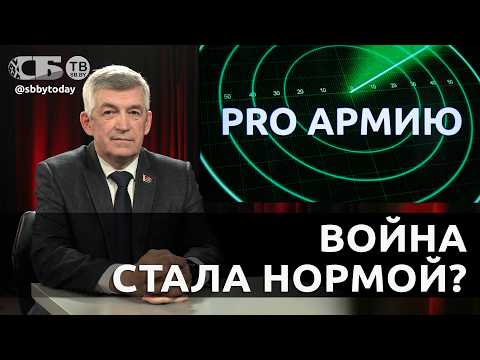
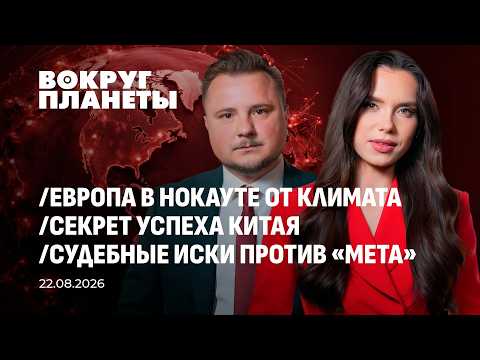
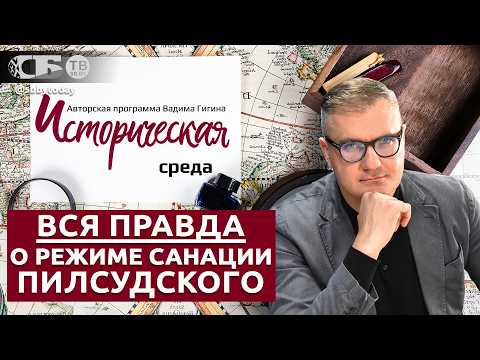
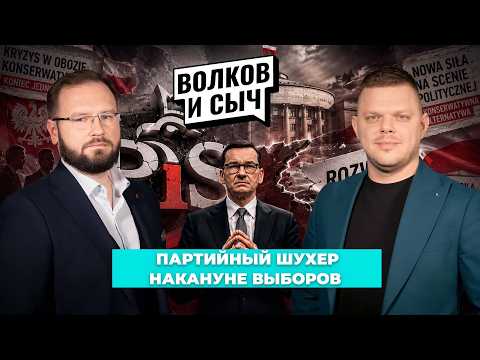
Real YouTube thumbnails from videos scored 8–10/10 on propaganda scale. These images are the first contact point with the audience — designed to trigger emotional response before the content is even consumed.
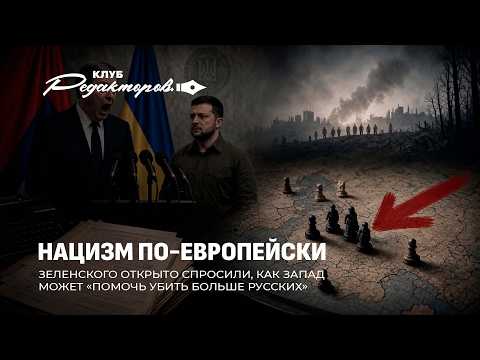
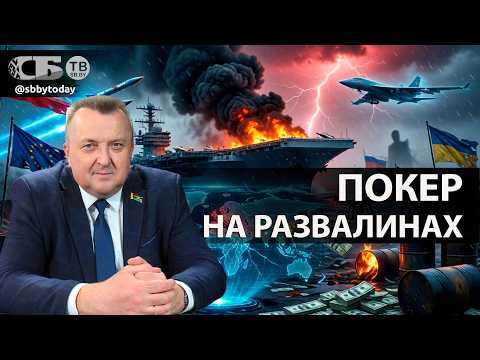
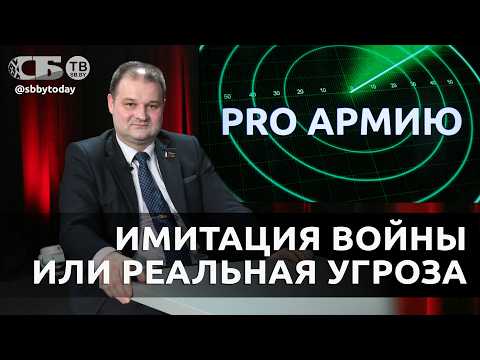
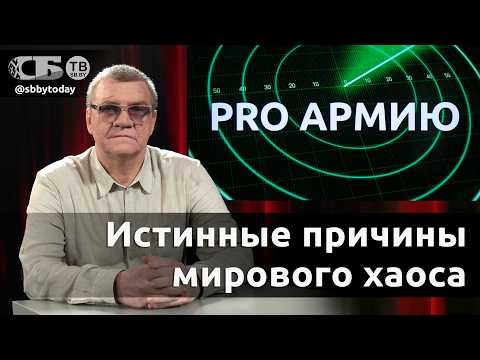

Cross-modal divergence: thumbnail vs content
A distinct May finding: for a share of videos the thumbnail is alarmist while the transcript’s assessed threat is low. The cover does emotional work the content does not. Divergence is highest for 🇵🇹 Portugal (75.0%).
| Country | Divergence | Alarmist cover / low-threat text |
|---|---|---|
| 🟠 🇵🇹 Portugal | 75.0% | 3/4 |
| 🟣 🇧🇪 Belgium | 45.5% | 5/11 |
| 🟣 🇳🇱 Netherlands | 31.2% | 5/16 |
| 🔶 🇵🇱 Poland | 30.8% | 32/104 |
| 🔵 🇱🇹 Lithuania | 28.8% | 19/66 |
| 🔶 🇩🇪 Germany | 27.9% | 29/104 |
| 🟢 🇭🇺 Hungary | 25.0% | 6/24 |
| 🟢 🇨🇿 Czech Republic | 23.4% | 11/47 |
| 🔵 🇱🇻 Latvia | 21.1% | 20/95 |
| 🟢 🇸🇰 Slovakia | 18.2% | 2/11 |
| 🔵 🇪🇪 Estonia | 17.4% | 4/23 |
| 🟠 🇪🇸 Spain | 16.3% | 8/49 |
| 🔶 🇫🇷 France | 12.8% | 18/141 |
Claims for Fact-Checking
AI analysis extracted verifiable claims from high-risk materials. They were not checked by hand for this issue and are therefore all shown as requiring verification. Claims are shown in the original Russian language as published by state media. Click ↗ to view the original material.
Verifiable claims requiring fact-check
Coordination
| Source | Citations |
|---|---|
| цитирование тасс | 120 |
| цитирование риа новости | 68 |
| цитирование белта | 26 |
| ссылка на тасс | 16 |
| ссылка на риа новости | 15 |
| публикация на sb.by | 10 |
1. Two cluster strategies persist. In August 2026 the Baltic cluster (LT, LV, EE) accumulated 3,164 mentions, while the Weimar Triangle (PL, DE, FR) reached 5,471 mentions. Multimodal YouTube analysis shows Baltic FIMI at 27.7% and Weimar at 29.8% — both clusters operate as fully-formed propaganda targets, with Weimar slightly more intense.
2. 🇫🇷 France: top target by volume. With 2,013 materials, this country dominates the monitoring period. The dominant narrative is 38% Internal problems.
3. YouTube as propaganda amplifier. Multimodal analysis covered 696 video–country pairs across the target countries. Among countries with 20+ videos, the largest share of FIMI-flagged thumbnails is in content about 🇵🇱 Poland (39.4%).
4. TASS as the main external source. TASS cited in 136 of analyzed materials, followed by RIA Novosti (83). This shows reliance on Russian state agencies; it is not in itself evidence of coordination, which this series rates as low confidence.
5. Factual manipulation dominates. Of all detected manipulation types, factual manipulation (cherry-picking real data to distort conclusions) accounts for 4308 cases — more than emotional (2948) and logical (2319) combined. This makes the propaganda harder to detect than outright fabrication.
6. Iberia and Benelux remain an order of magnitude smaller. Iberia (ES, PT) accumulated 871 materials and Benelux (NL, BE, LU) 293, against 3,164 for the Baltic cluster and 5,471 for Weimar. Each of the two clusters is read through one country (Spain, the Netherlands); the rest is background. Country matching uses country stems and demonyms only; capitals and politicians were tested and excluded because most of their mentions do not concern the country.
Methodology
Materials come from every source the FORESIGHT corpus classifies as Belarusian state-owned or pro-government media: state web outlets (BelTA, SB.BY, CTV, ONT, Zviazda and regional newspapers, from August 2026 for all six regions), state and pro-government Telegram channels including ministry channels, and the national state YouTube channels of the core list (see the limitations for the current month); regional YouTube channels stay outside the totals. Keyword-based monitoring covers fourteen countries in five clusters: Baltic (LT, LV, EE), Weimar Triangle (PL, DE, FR), Visegrád (PL, CZ, HU, SK), Iberia (ES, PT) and Benelux (NL, BE, LU). Poland is counted in two clusters as an analytical lens, not twice in totals. Luxembourg is counted in the Benelux total but has no country profile. For Iberia and Benelux, country matching uses country stems and demonyms only: capitals and politicians were tested and excluded (Brussels appears without Belgium in 92% of documents, The Hague without the Netherlands in 71%, Rutte without the country in 82-97%). AI deep analysis used GPT-5-mini with structured output. Multimodal YouTube analysis combines the text layer of the mention analysis with thumbnail Vision LLM codebook v2.1. Average model self-reported confidence: 81.3%.
DISARM and STIX 2.1: a common language for describing information operations
Confidence in findings and source reliability
From this issue we state confidence in findings on the scale used in the STIX 2.1 threat-sharing standard: low (1–29), moderate (30–69), high (70–100).
Language-model findings: moderate. Deep analysis of 3,678 materials was run with gpt-5-mini, as in every issue of the series; 3,667 responses were parsed. The same set was labelled independently by a second model (gpt-5.6-luna). Agreement on risk level is 68% (Cohen’s kappa 0.53, 0.64 when the order of levels is taken into account) and on narrative category 69% (kappa 0.65); by segment kappa ranges from 0.49 (websites) to 0.70 (regional newspapers). The disagreement runs one way: 96% of the materials the second model rates high-risk are rated the same by the main model, and the difference lies in the threshold. The high-risk share is therefore given as two values: 40.1% by the main model (for comparison with earlier issues; 39.0% on July’s source set against 37.9% in July) and 22.8% by agreement of both models as a conservative lower bound. The visual layer was labelled in a single run of a vision model; in repeat runs about 10% of labels change, so visual shares are also in the moderate band.
Coordination: low. A coordination event is the same theme appearing across several sources on the same day, without a test of publication synchrony. In August the set of Telegram sources was also greatly expanded, so the number of events (130) is not compared with earlier months.
Source reliability. Assignment to the state segment is high-confidence for the websites, YouTube and Telegram channels of state media and for ministry channels, which are official outlets. For pro-government personal and anonymous Telegram channels it is moderate: their place in the network was established from reposts and cross-references rather than official status.
August limitations. Radio-1, the First National Channel of Belarusian Radio, was terminated by YouTube on 14 September, before the August data were collected, so the YouTube layer covers six of the seven core channels. Four regional newspapers (Brest, Vitebsk, Gomel, Mogilev) and a network of pro-government Telegram channels, including ministry channels and the Telegram channels of state media themselves, enter the sample for the first time; channels outside the state segment were excluded from the Telegram layer. All comparisons with July in this issue are made on July’s source set.