

In fourteen months, pro-regime Telegram cut its output by 27% without changing its hierarchy or its roles. Russian state and pro-Kremlin sources are embedded in the core of this system as a permanent channel. Belarusian and Russian state agendas coincide on almost everything, except stories about Belarus’s own role. Our analysis draws on the FORESIGHT corpus, a forward graph, the Narrative Divergence Index and a TikTok sample.
Output is contracting
We counted monthly posts from 60 pro-regime Telegram channels since 2020, 2.18 million documents in total, deduplicated by post URL. One channel previously on the roster was excluded as an opposition aggregator.
The segment is born in August 2020, when output rises in a single month from 3,776 to 10,797 posts. The all-time high comes in March 2022, the start of the full-scale war, with 42,598 posts. Three years of plateau at 32,000–38,000 a month follow, with a last peak in June 2025 at 38,518 posts.
Between June 2025 and August 2026, output fell by 27%, to 28,101 posts a month. The channel roster did not change over this period, so the decline reflects the channels’ own behaviour, not a change in the sample. The wartime maximum of March 2022 has not been matched in four and a half years.
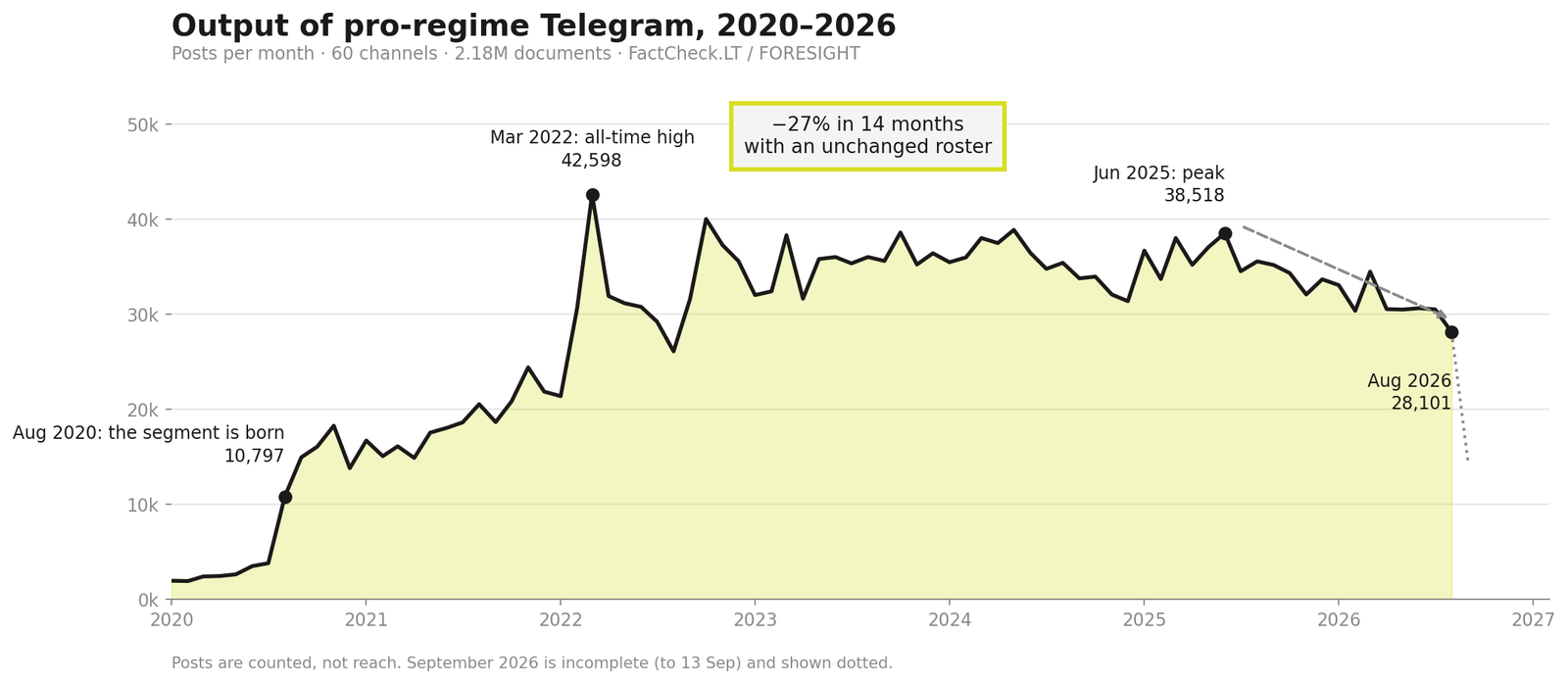
The curve shows the segment’s production capacity, not its audience. The distinction matters, so we set it out separately.
Posts, views, reach
In classical media measurement, reach is the share of a target audience that came into contact with a medium at least once during a period. It is a measure of people, and it can only be obtained through a panel: a sample of real people whose media consumption is recorded. In Belarus such a panel exists only for television: mediameter.by measures the urban population and 12 TV channels.
Platforms do not know people; they know technometrics: accounts, devices, sessions and IP addresses. One person can watch from several accounts and devices, one device can be shared, part of the views come from bots, and with widespread VPN use the user’s country cannot be determined. For Telegram, TikTok and YouTube, nobody measures reach in people today, the platforms included.
We measure two other quantities. Posts show production: how much material the segment releases. Views show contacts: how many times that material was opened. One person may watch a video ten times; one post may be opened in several channels via forwards. Converting contacts into people is impossible without frequency data.
The findings of this piece therefore concern production and contacts. Neither tells us how many Belarusians see this propaganda, or how that number has changed.
The vertical does not move
Shrinking output could be read as a system coming apart. The forward graph shows the opposite.
We took the personal channels of five propagandists (Azarenok, Tur, Gigin, Dzermant, Shpakovsky) and built a graph of their direct public forwards: who relays whom. The method is deliberately simple and does not depend on interpreting texts.
The five made 47,173 forwards from 1,322 sources. The network looks wide, but if we keep only the nodes that all five forward without exception, 40 remain, and those 40 account for 72% of all forwards. This is the core of the system.
At the top sits Pul Pervogo, the channel of the regime leader’s press service: 10,236 forwards from the five, more than any other node. It relays almost nothing itself: forwards make up 3.6% of its own posts. The agenda is produced here and distributed downwards.
Below the apex are the state media: CTV | Novosti (4,780 forwards), ONT NEWS (3,902), NEWS.BY (1,429), BelTA (1,421). In the same row stands the anonymous channel Zheltye Slivy (Yellow Leaks) with 4,201 forwards, ahead of ONT: an anonymous channel built into the vertical on a par with state television. The next layer consists of state institutions and security services: the House of Representatives, Belorussky Silovik, the Interior Ministry’s internal troops and the Ministry of Defence.
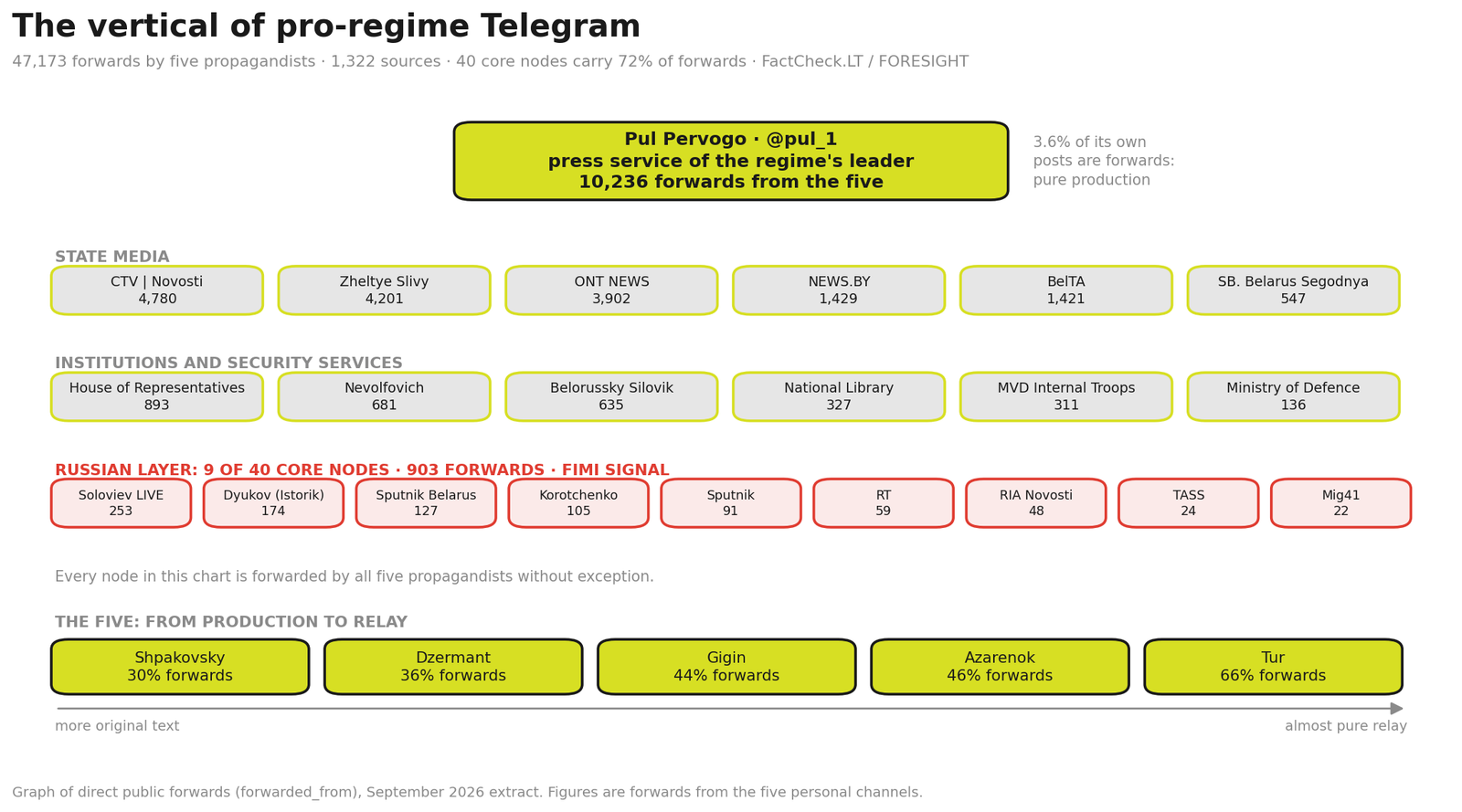
Each propagandist’s share of forwards in their own output describes their function: Tur 66%, Azarenok 46%, Gigin 44%, Dzermant 36%, Shpakovsky 30%. The first are closer to relays; the last write more themselves. In July 2026 we obtained the same shares to within a percentage point. Output is falling, but the division of roles is unchanged.
The graph is heavily weighted towards one participant: 28,308 of the 47,173 forwards were made by Azarenok. That is why the core is defined structurally, by a node’s presence across all five, not by volume.
Russian sources in the core: a FIMI signal
Nine of the forty core nodes are Russian: Soloviev LIVE (253 forwards), the historian Alexander Dyukov (174), Sputnik Belarus (127), Igor Korotchenko (105), the main Sputnik feed (91), RT (59), RIA Novosti (48), TASS (24) and the military channel Mig41 (22).
In volume this is modest: 903 forwards, 2.6% of the core. Its significance lies elsewhere. Each of these nine sources is forwarded by all five Belarusian propagandists without exception. Russian state and pro-Kremlin media make up almost a quarter of the core by composition and are present in every one of the five channels.
This is a textbook case of foreign information manipulation and interference (FIMI) in the form of sustained amplification. Russian content enters the Belarusian segment not through one-off campaigns but through permanent links inside the vertical, and by its place in the structure the foreign source is indistinguishable from the domestic one.
Minsk and Moscow: one agenda, four exceptions
If Russian content is embedded this deeply, how far does the agenda itself coincide? To answer this we use the Narrative Divergence Index. Each month ten significant events are selected. For each event an axis between two opposing interpretations is defined from the corpus, and each media environment receives a position on that axis from 0 to 10. For the prisoner exchange, for example, the axis runs from “Belarus as a neutral humanitarian platform with an active peacemaking role” (0) to “Belarus as a technical transit corridor with no role of its own” (10). The direction of the axis differs from event to event, so what we compare is the gap between environments, not their positions.
Thirty events were assessed for June, July and August 2026. In 24 of them both Belarusian and Russian state and pro-regime media took a position. In 17 of the 24 they differ by one point or less, in 19 by two points or less. The mean gap is 1.7 points. Between Belarusian state and independent media, the mean gap on the same events is 5.9 points, and in 22 of 25 cases it is five points or more. The dividing line in the media field runs between state and independent media, not between Minsk and Moscow.
That makes the rare divergences all the more telling. A gap of four points or more appears in four events.
- A drone strike on a Belarusian Minsk–Anapa bus in Russia’s Bryansk region (axis: who is responsible). Russian state media unambiguously call it a terrorist attack by Ukraine’s armed forces on civilians (1). Belarusian state media present it as a tragic incident requiring a state response and do not directly attribute responsibility to Ukraine (7). Minsk did not adopt Moscow’s attribution.
- The 103-for-103 prisoner exchange (axis: Belarus’s role). Belarusian media present the country as a proactive peacemaking force (1). Russian media describe the exchange as a routine procedure for bringing home Russian servicemen, with Belarus merely a place of temporary stay (6).
- The visit of Chinese Vice-President Han Zheng (axis: political weight of the visit). For Minsk it is a strategic stage of integration with concrete results (9). For Moscow it is a neutral diplomatic fact within the Russia–Belarus–China triangle; TASS notes that before Minsk the guest met Putin (5).
- The Belarusian–Chinese exercise Swift Eagle 2026 (axis: geopolitical load). Minsk presents the drills as routine counter-terrorism training (4). Moscow frames them as part of building a Eurasian security bloc against the United States and NATO (9).
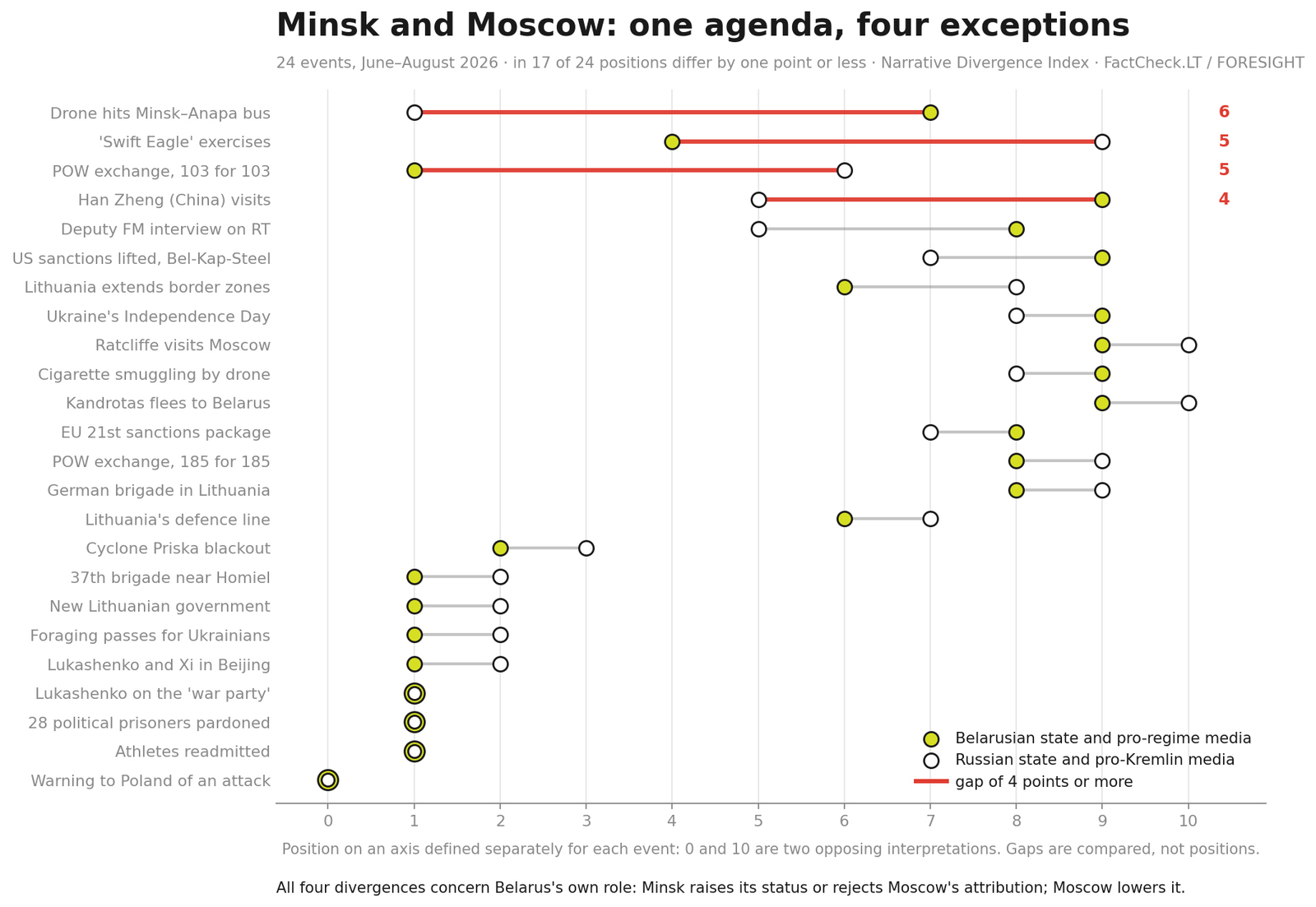
All four divergences concern one thing: the role and agency of Belarus itself. Minsk raises its own status (peacemaker, strategic partner of China) or rejects Moscow’s account of a strike on its own citizens. Moscow lowers that status or folds Belarusian stories into its own bloc framing.
On anti-Western stories, the positions coincide: EU sanctions (8 and 7), the German brigade in Lithuania (8 and 9), the warning to Poland about a terrorist attack (0 and 0). The autonomy of Belarus’s state agenda exists, but it is narrow. It shows up where Belarus’s place is at stake and does not touch the shared frame of confrontation with the West.
Three months yield 7–9 events with both positions each, so we do not claim a month-by-month trend.
TikTok: fewer views, same return per video
We measured TikTok again almost a year after the previous measurement. The January–August 2026 sample covers 91,905 videos from 215 Belarusian channels, 4.58 billion views, an average of 573 million a month. The number of views remains of the same order as a year ago.
Monthly views are nevertheless declining: 667 million in January, 469 million in August. Part of the decline is a method effect. Views are cumulative at the time of collection, and January videos had 243 days to accumulate them while August videos had 31. The anchor metric is therefore different: the median views per video, which barely depends on accumulation time. Over eight months it has not changed: 6,852 in January, 6,727 in August. The return per video holds; there are simply fewer videos.
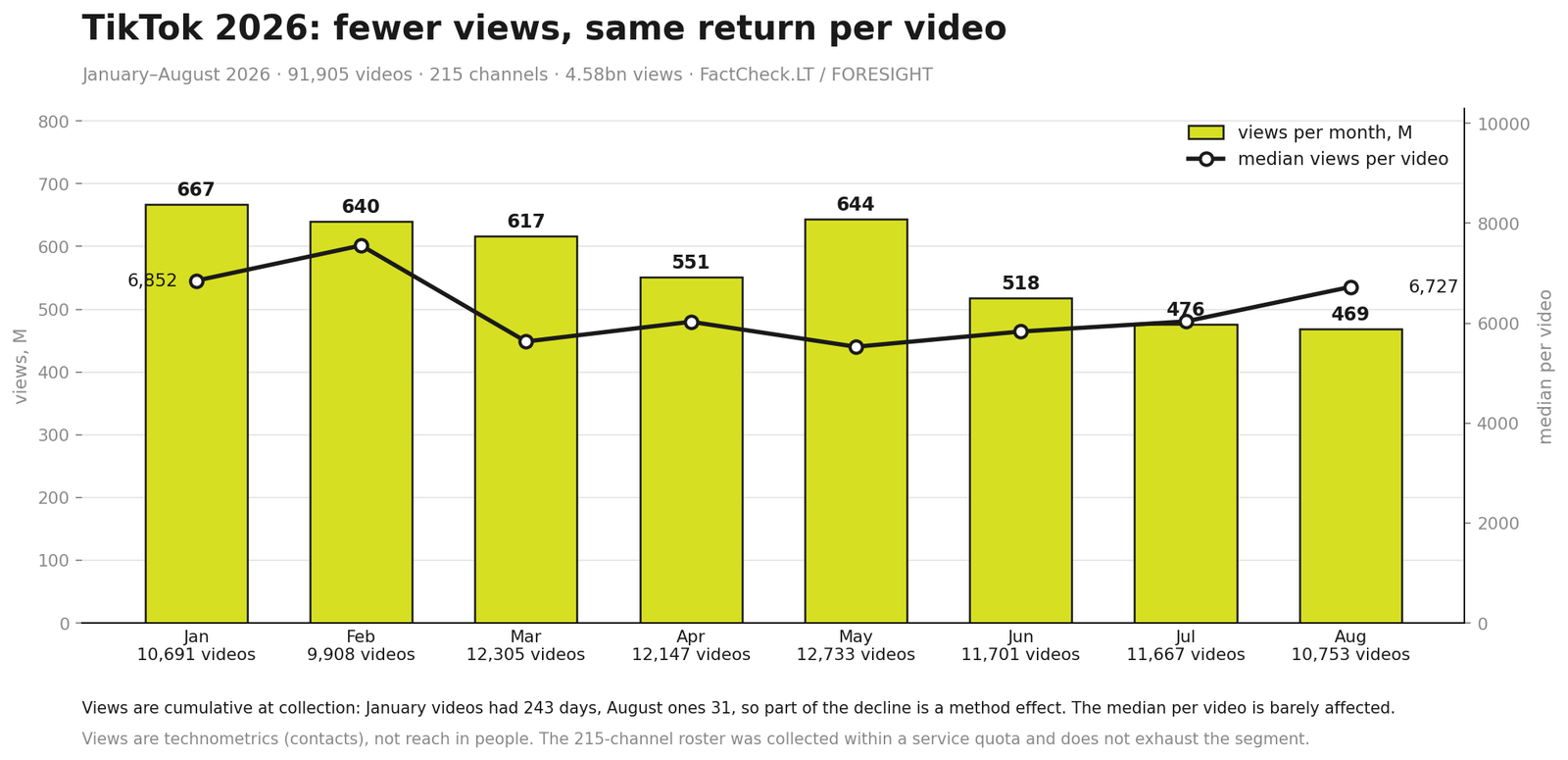
Concentration within the segment is growing: 20 channels take 66% of all views, 37 channels account for 80%, and one per cent of videos bring in 28.5% of views.
The 215-channel roster was collected within a service quota and does not exhaust the segment, so we do not compare channel counts with last year’s measurement. Our conclusions rest on the median and concentration, which barely depend on roster size.
Platforms change the rules
The environment has changed as well. In 2026 YouTube twice terminated channels of Belarusian state media. On 3 April it removed the channels of BelTA, CTV and ONT, and five days later CTV’s backup channel. On 14 September it removed CTV mid-broadcast, Radyjo Stalica, Radio Kultura BY, the First National Channel of Belarusian Radio and BELARUS-RTR | Belarus News of the CTV group. Checks from European and Turkish exit points showed the same notice of a Terms of Service violation, meaning account terminations rather than a regional block.
The September wave showed why the backup-channel strategy does not work. After the April ban, BELARUS-RTR took over the CTV group’s output: it doubled its release rate, changed its name in May, and grew from 48,000 to 134,000 subscribers and thirteenfold in views. YouTube’s rules explicitly bar the owner of a terminated channel from using other channels and treat this as circumvention of termination. The more successfully a successor inherits the audience, the more visible the link that becomes the ground for the next decision. Our analyses of the April wave and the September wave are published on FactCheck.LT.
What has changed
In a year, Belarus’s pro-regime media field has become smaller in output and unchanged in structure. The Telegram segment releases a quarter fewer posts, yet the apex, the layers and the roles remain in place, and Russian sources are still embedded in the core. TikTok keeps its number of views with fewer videos and growing concentration. The Belarusian state agenda coincides almost entirely with the Russian one and deviates only where Belarus’s own role is at stake.
Contracting output does not mean weakening control. It means the same vertical is working at a lower volume. How many people it reaches remains an open question that open data cannot answer today.
Methodology. Monthly series: 60 pro-regime Telegram channels, FORESIGHT corpus, deduplicated by URL; posts are counted. Forward graph: direct public forwards of five personal channels (forwarded_from field), September 2026 extract; the core is defined as nodes forwarded by all five. NDI: for each event, the axis and the positions of media environments are assessed by a language model on the FORESIGHT corpus, one run per month; in 9 of 30 events one environment is flagged as low-data; the Belarusian and Russian groups include state and pro-regime media according to the monitoring’s source classification. TikTok: collected via Exolyt, January–August 2026; views are cumulative at collection.