

In brief. On 14 September 2026 YouTube terminated another group of Belarusian state media channels. We analysed 3,593 videos from two of them, published between January and August 2026. What these channels published does not explain the platform’s decision well. What does explain it: since April one of them had been acting as the successor channel of a structure removed in the previous wave, and YouTube’s own rules treat that as circumvention of a termination.
What happened
This is the second large wave this year. On 3 April 2026 YouTube removed the channels of BelTA (2.3 million subscribers), CTV (2.4 million) and ONT (1.4 million), and on 8 April it closed the backup CTV channel created after the first removal. We examined what those channels had published and suggested that accumulated strikes for war content and doxxing had driven the decision.
On 14 September the CTV channel went down during a live talk show, and Radyo Stalitsa, Radio Kultura BY and the First National Channel of Belarusian Radio disappeared shortly after. In the same wave the channel BELARUS-RTR | Belarus News, which belongs to the CTV group, stopped opening. State agencies listed the first four but not this one.
We checked both channels of interest from a European and from a Turkish exit. In both cases the page returns the same notice: the account has been terminated for a violation of YouTube’s Terms of Service. This is a global account termination, not a country-level restriction on sanctions grounds, and the wording matches the one ONT quoted in April.
The material
| Channel | Videos | Views | Median | Subscribers, August |
|---|---|---|---|---|
| BELARUS-RTR | Belarus News | 1,661 | 107.2M | 5,517 | 134,000 |
| First National Channel of Belarusian Radio | 1,932 | 32.5M | 2,448 | 460,000 |
Together this is 139.7 million views, 1.63 million likes and 164,500 comments over eight months. The gap between the mean and the median is wide: almost 60% of Belarus-RTR videos do not reach ten thousand views, while the top ten videos deliver 39% of the channel’s traffic.
Finding one: the successor channel
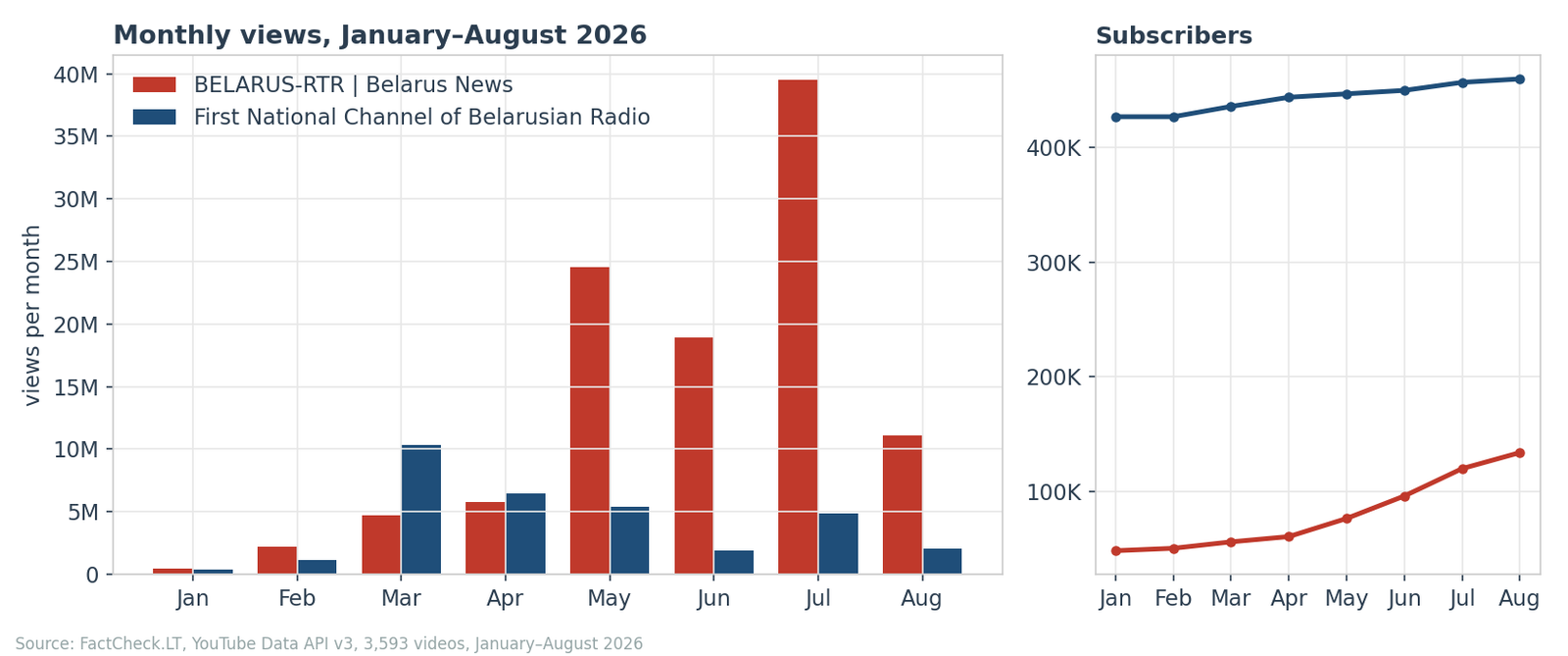
The most interesting thing in the data is not the content but the calendar. In January Belarus-RTR collected 470,000 views; in July, 39.5 million. Cut the corpus at the April removal date: January to March gave 388 videos and 7.4 million views, April to August gave 1,273 videos and 99.8 million. Views grew 13.6 times.
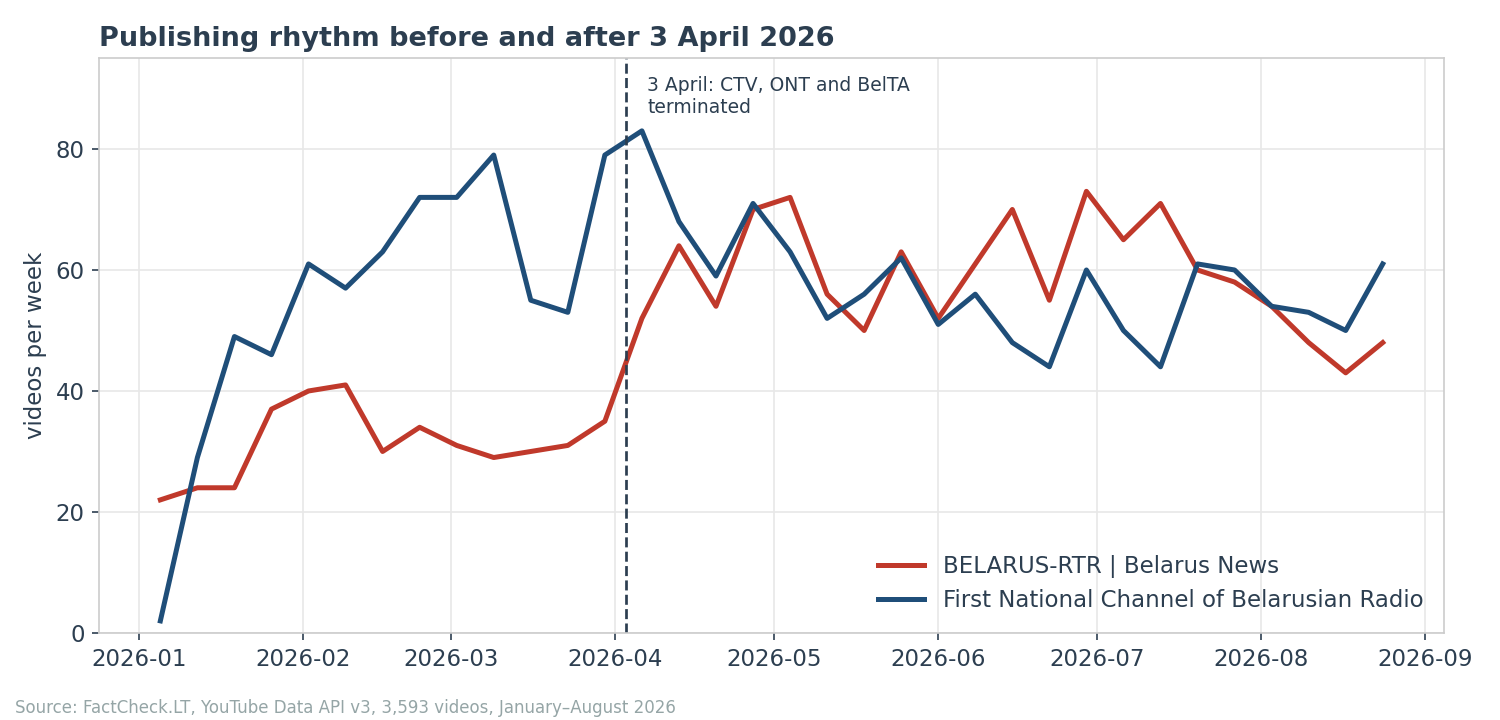
The break also shows in the publishing rhythm. In March the channel posted about thirty videos a week. From the week beginning 6 April, immediately after CTV, ONT and BelTA went down, the pace rises to 50-73 videos a week and stays there until the end of summer. Subscribers went from 48,400 in January to 60,700 in April and 134,000 in August.
One detail is visible only in the raw data: in the May snapshot the channel changes its name. Up to April it is simply Belarus News; from May it becomes BELARUS-RTR | Belarus News. A new sign, double the output, triple the audience. This is not organic growth but a transfer of broadcasting to the holding’s surviving outlet.
Finding two: 80% of views are Lukashenko shorts
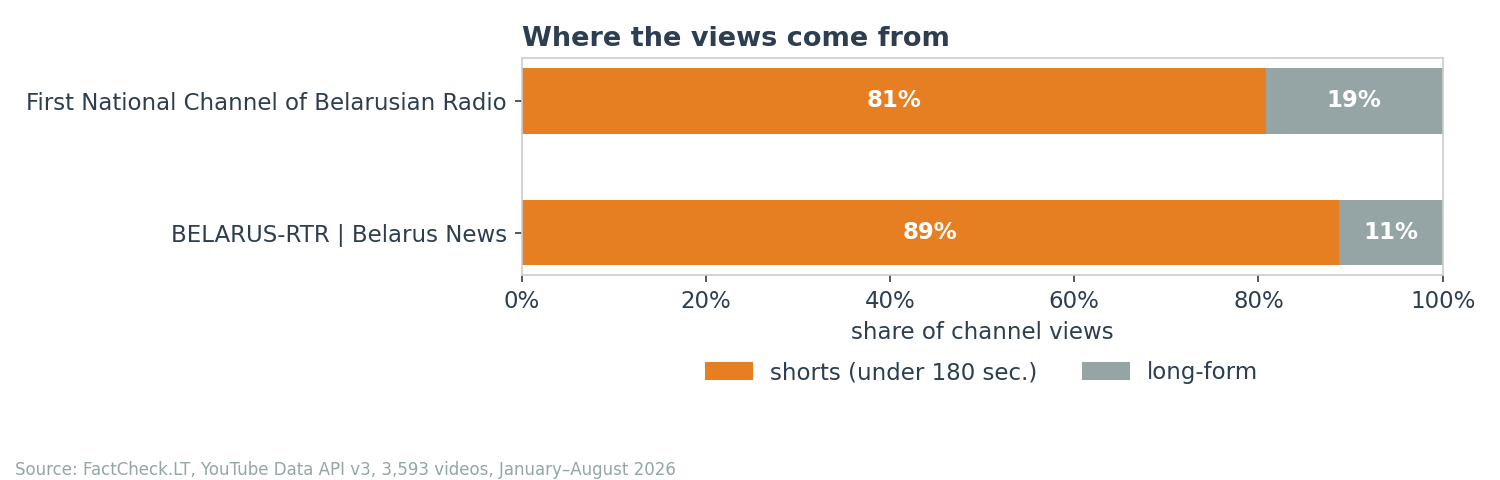
Of 3,593 videos, 1,533 (42.7%) mention Lukashenko in the title or description, and they account for 112.1 million views, or 80.3% of all traffic on the two channels. On Belarus-RTR the share is higher: 90.5% of the channel’s views, with 453 short videos about Lukashenko delivering 86% of its traffic.
The content of these shorts is far from ideology. The monthly leaders: “Lukashenko is shown a Belarusian wonder-tractor!” (13.8 million views, May), “Dad, dismissively. What Nikolai Lukashenko calls his father” (6.3 million, July), “Lukashenko and Kim Jong Un exchanged gifts!” (3.4 million, March). The head of the regime appears as a character in domestic comedy.
In May the same tractor clip also topped the radio channel (2.2 million views). Two newsrooms from different holdings independently pushed the same piece of the presidential pool to the top: the content is produced centrally and the channels work as parallel distribution points. Meanwhile the median long-form video gets 2,470 views on Belarus-RTR and 676 on the radio channel. The broadcasting itself had almost no audience on YouTube.
Finding three: the Iran layer belongs to another season
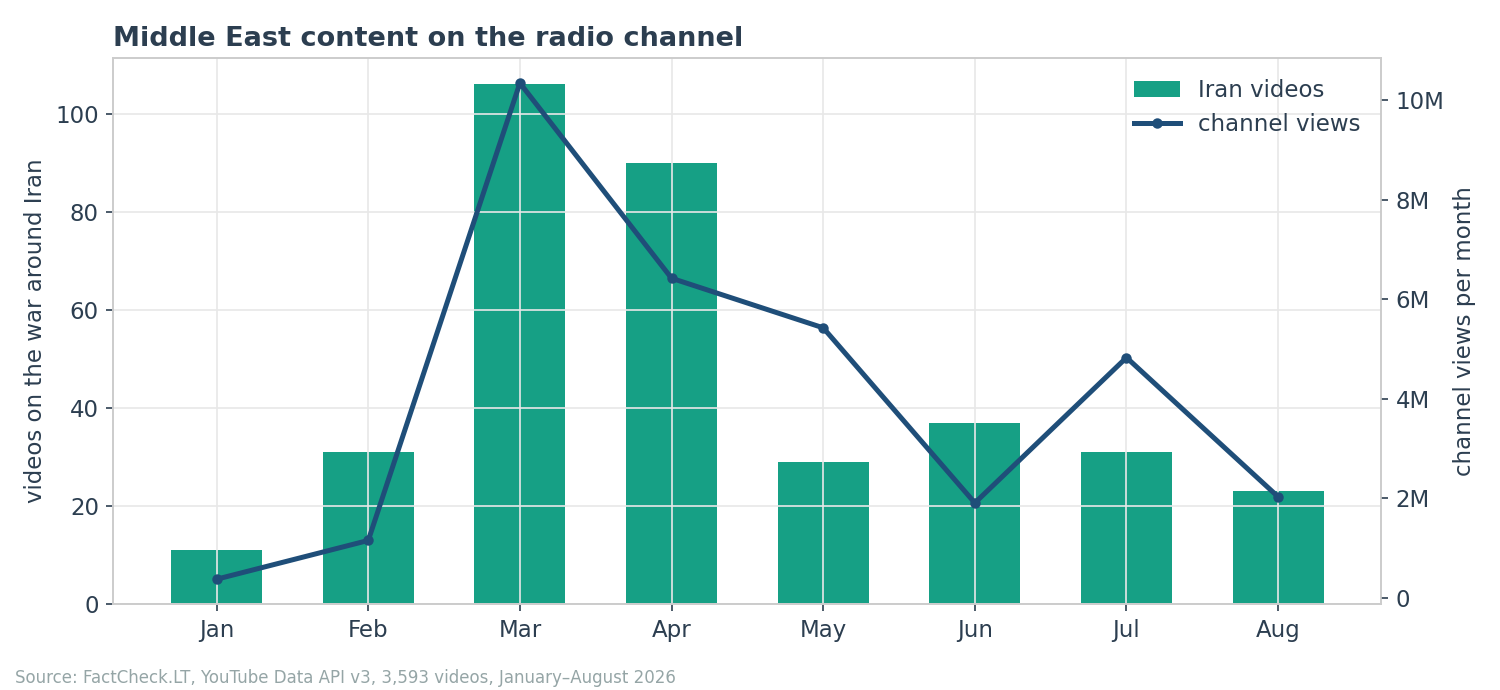
In April we linked the removals to a flood of videos about the war around Iran. On the radio channel this layer is indeed large: 358 videos and 12.7 million views, 39.1% of the channel’s traffic. The headlines are exactly the type that platform rules on sensationalising armed conflict are written for: “Iran now dictates the terms for ending the war!” (1.8 million), “Will Trump strike Iran with nuclear weapons?” (460,000).
But the peak came in March (106 videos) and April (90). After that the count falls to 29, 37, 31 and 23 in May to August, and monthly views drop from 10.35 million in March to 2.03 million in August. By the time the account was terminated the topic had been fading for almost four months. On Belarus-RTR the Iran layer barely exists: 45 videos and 1.7% of views.
Finding four: there is no doxxing here
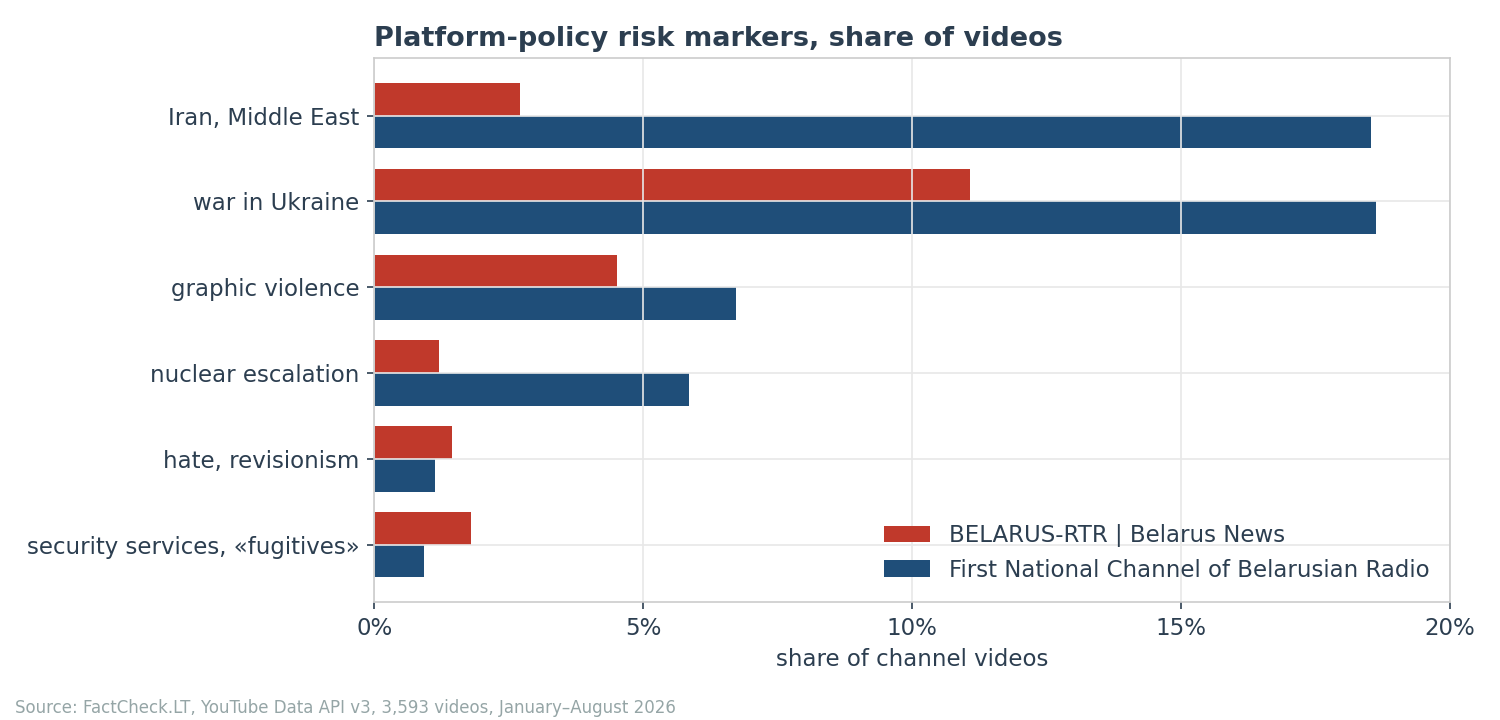
The April hypothesis rested on programmes that published the personal data of named people. The September pair has no such layer. Security-service markers appear in 48 of 3,593 videos, 1.3% of the corpus and 0.55% of views, only 15 of them in titles, and the content is crime reporting such as “A foreign fake priest detained”. Hate and revisionism markers: 46 videos, 0.66% of views.
In total, at least one risk marker appears in 18% of Belarus-RTR videos and 39% of radio channel videos; counting titles only, without descriptions, the figures are 9% and 23%. The rest is agriculture, weather, concerts, ice hockey and everyday shorts.
The mechanism: the circumvention rule
YouTube’s help pages state it plainly: once a channel is terminated, its owner may not use, own or create any other channel, and may not let owners of terminated channels use their channel to get around the termination. The ban covers all existing channels, any new ones created or acquired, and channels in which the terminated party is repeatedly or prominently featured. Circumvention is itself a Terms of Service violation, punishable by termination of all linked channels.
Our data describe exactly that configuration. From the first week after April, Belarus-RTR doubled its output, took over the broadcasting of a group whose main channel had been terminated on 3 April, and in May renamed itself to include the television channel’s name. The CTV backup channel survived five days after the April removal and Belarus-RTR survived five months, but both are the same type of decision. The Belteleradiocompany radio channels fit the same logic through the organisation: three channels of one holding terminated on one day.
The wording of the notice supports this. Terminations for accumulated strikes are usually explained with a reference to the Community Guidelines and a specific policy, while both of our channels display the general Terms of Service wording, that is, a decision at account level rather than about individual videos. The mapping between notice texts and decision types is nowhere officially documented, so this is an observation, not a rule.
What this means
The April hypothesis is not overturned, it is narrowed. Accumulated strikes for war content explain why CTV, ONT and BelTA reached the queue in spring. The September decision on Belarus-RTR is explained by the circumvention rule, and the radio channels by their membership of a terminated organisation. In content terms these channels are very different: one draws 39% of its traffic from a Middle Eastern war, the other 90% from shorts about tractors. They have one thing in common, and it is the owner.
The practical conclusion for state media: the backup-channel strategy cannot work. The better a successor inherits the audience of a terminated channel, the more obvious the link between them, and the faster that link becomes grounds for the next decision.
For independent newsrooms the conclusion is the same in reverse. The platform does not explain its decisions and is not obliged to: a public explanation would become a manual for evading the rules. Any channel can disappear at any moment, and the only protection is presence on several platforms and an archive of your own.
It is worth recording what Belarusian state propaganda actually lost. Not 594,000 viewers of analytical programmes, but a machine producing viral shorts in which politics is present homeopathically. Over eight months of 2026 that machine generated 139.7 million views with a median of 3,371 views per video. What was lost is not an audience but a recommendation lottery.
Methodology and limitations
The data were collected through the YouTube Data API v3 in monthly snapshots for January to August 2026; each snapshot holds videos published in that month. After deduplication by video_id, 3,593 unique videos from the two channels were selected. Views, likes and comments are a snapshot taken at collection time rather than final values, so recent videos are undercounted relative to older ones.
Categorisation was done with regular expressions over titles and descriptions, seven categories. Word boundaries are set with explicit character ranges, because standard boundaries do not work on Cyrillic. Descriptions on both channels are often news digests that glue unrelated items together, so every category is counted in two layers, title plus description and title only, and both numbers are given where they differ. The stems for “strike”, “footage” and “drone” were excluded from the graphic violence category: they produce false positives on peaceful material such as archive footage and agricultural drones. Shorts are separated from long-form at 180 seconds.
The corpus holds no data for September 2026; the last observations are from 31 August. Channel status was checked on 15 September 2026 from two exits, European and Turkish. We do not have the platform’s correspondence with the newsrooms and do not know the formal grounds of the decision: the conclusion about the mechanism rests on YouTube’s public rules and on the measured behaviour of the channels, not on a document.