
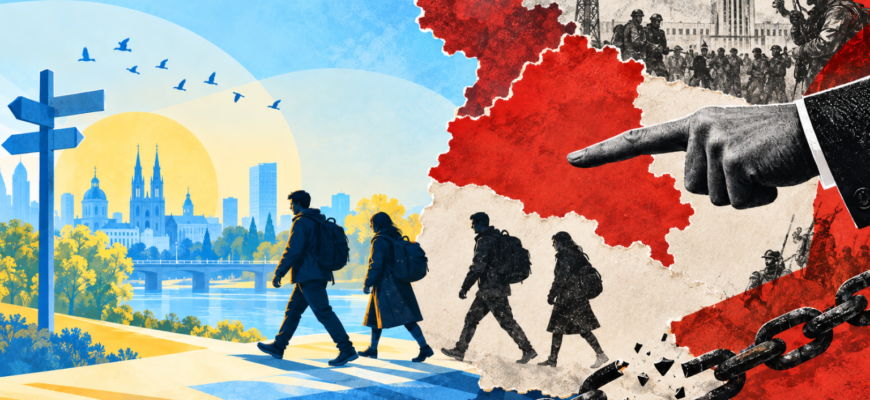
When Belarusian state propaganda settled on beglyye — “the fled ones” — as its name for those who left after 2020, the intended effect was simple: fled means runaway, runaway means coward. The word is short, contemptuous and fits a headline. But it has a history, and that history runs the other way.
The dictionary
Open any Russian dictionary. The adjective beglyy has two main senses. The first: one who escaped, who left without permission a place where he was held. The second: quick, light, unhindered, not dwelling — a beglyy glance, beglyye notes, begloye reading. And, above all, beglaya rech: fluent speech. To speak beglo is to speak fluently, without stumbling, without groping for words.
Propaganda uses only the first sense. The second, it turns out, describes the same people far more accurately.
Whom the fugitives were fleeing
In Russian the word is bound to one subject above all: serfdom. Runaway peasants, runaway serfs, runaway people. That is what sixteenth- and seventeenth-century documents called those who walked away from an owner, from tax obligations, from debt, from arbitrary power.
The state answered the only way it knew: by tightening. In 1581 the “forbidden years” barred peasants from moving between owners. In 1597 the “fixed years” set a five-year window in which a runaway could be dragged back. The Council Code of 1649 abolished the time limit altogether: the search for runaways became perpetual. That is the point at which serfdom becomes a finished system rather than a custom — a system in which a person who walks away from unfreedom is a criminal for life.
The construction is worth pausing on. The word was born inside a system that needed to explain why a person had no right to leave. The fugitives did not invent the name. It was invented by the people hunting them.
What the fugitives became
Where did they go? To the Don, the Volga, the Urals, Siberia, across the Lithuanian border. “From the Don there is no extradition” was not a proverb but a practice: the Cossack host was built in large part out of runaways. After the church schism came runaway Old Believers, carrying away books, printing presses and whole congregations. After Peter’s reforms came runaway conscripts and runaway soldiers. Each wave followed not laziness or cowardice but another turn of the screw.
And they did not dissolve. They built: settlements, free villages, hermitages, communities beyond the state’s reach. It was from those places that the state later had to obtain its grain, its troops and its new territories. Read honestly, the history of the beglyye is the history of people who left unfreedom and made something where they landed.
Soviet power barely used the word; it had its own, nevozvrashchentsy, non-returnees. Also a brand, but a different one. It is telling that in 2020 Belarusian propaganda reached past it, four centuries back, to the vocabulary of hunting runaway serfs. That is a slip of the tongue about how the state sees its relationship with a person: as the relationship between an owner and his property.
Fluently
Now the second sense. Belarusians who left after 2020 speak beglo — fluently — in the most literal way: they speak freely, because nobody jails them for it. They speak Belarusian fluently, which inside the country grows riskier every year. They speak Polish, Lithuanian, English and German fluently, because they learned. They write, film, count and investigate fluently. Fluent speech, by the dictionary, is speech without stumbling. Inside the country the stumble has become the norm: a pause before every word, because any word can become a criminal charge.
The two senses meet at a single point. Beglyye: those who left unfreedom. Beglo: how they speak now. Propaganda took the word without noticing that it was double-edged from the start, and that the second half of its meaning does not belong to the people using it.
What the corpus shows
We traced the word’s biography through the FactCheck.LT corpus: 4.6 million items from Belarusian and regional media and Telegram channels since 2020. Used as a label — rather than “a fleeting glance” or “a fugitive oligarch” — it appears in 45,000 of them.
Lukashenka did not start it. The first labelling use in the corpus is 7 September 2020, in the anonymous pro-government channel “Belarus i mir”: “a fled member of the Coordination Council”. On 21 October the same channel produces “the fled cook”; on 25 October the first bare “our fled ones”, the adjective already standing on its own as the name of a group. The head of the regime says the word in public on 10 November 2020, and the same day it appears on BelTA, CTV and in SB. From 17 November it is in the headlines of state agencies. In January 2021 the state segment carries 189 items with the label, 168 of them with no mention of Lukashenka anywhere nearby: the word has become editorial voice. From anonymous channel to front page took two months.
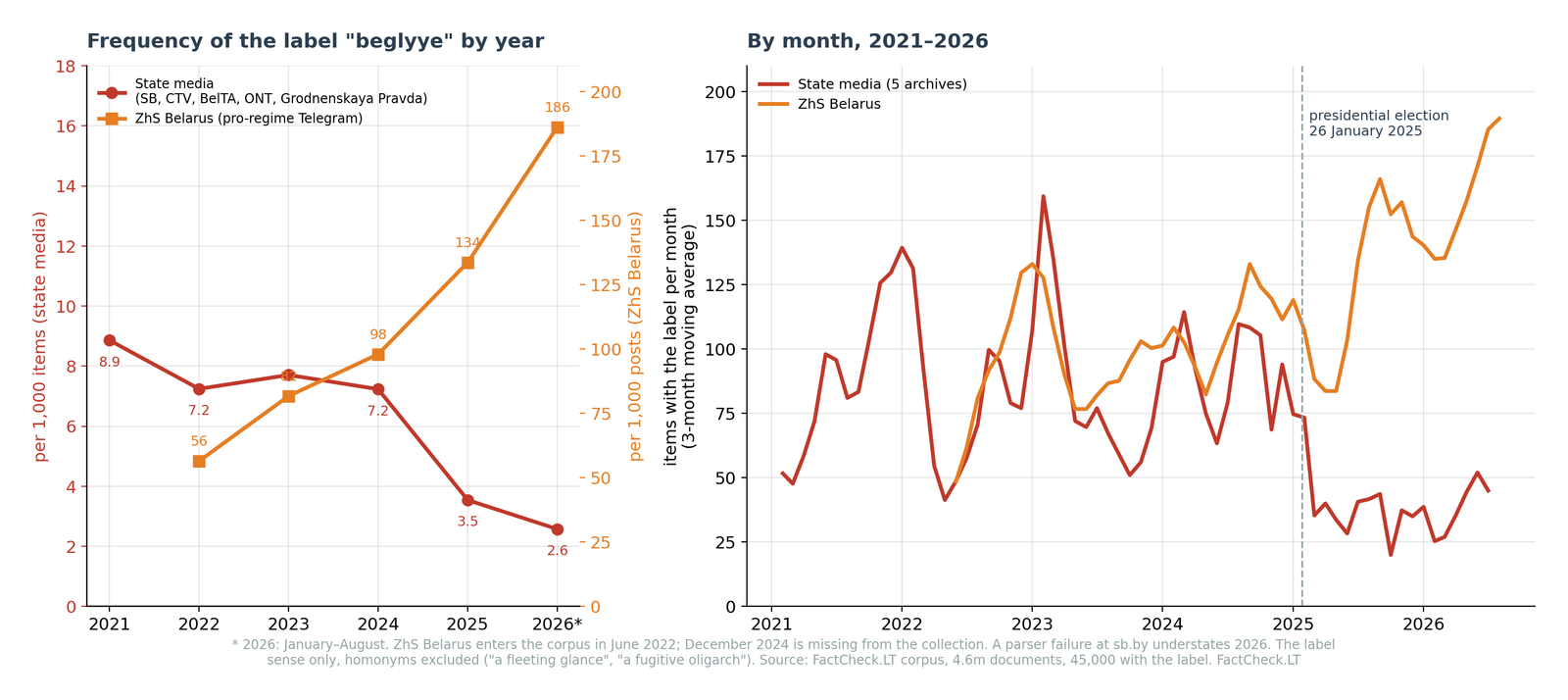
Frequency then climbed: 8.9 items per thousand in the state segment in 2021, about 12 in 2023–2024. CTV peaks in 2024 at 15 per thousand. On propagandists’ personal channels the label appears in every twentieth post (Ihar Tur) and every tenth (“Zholtyye slivy”).
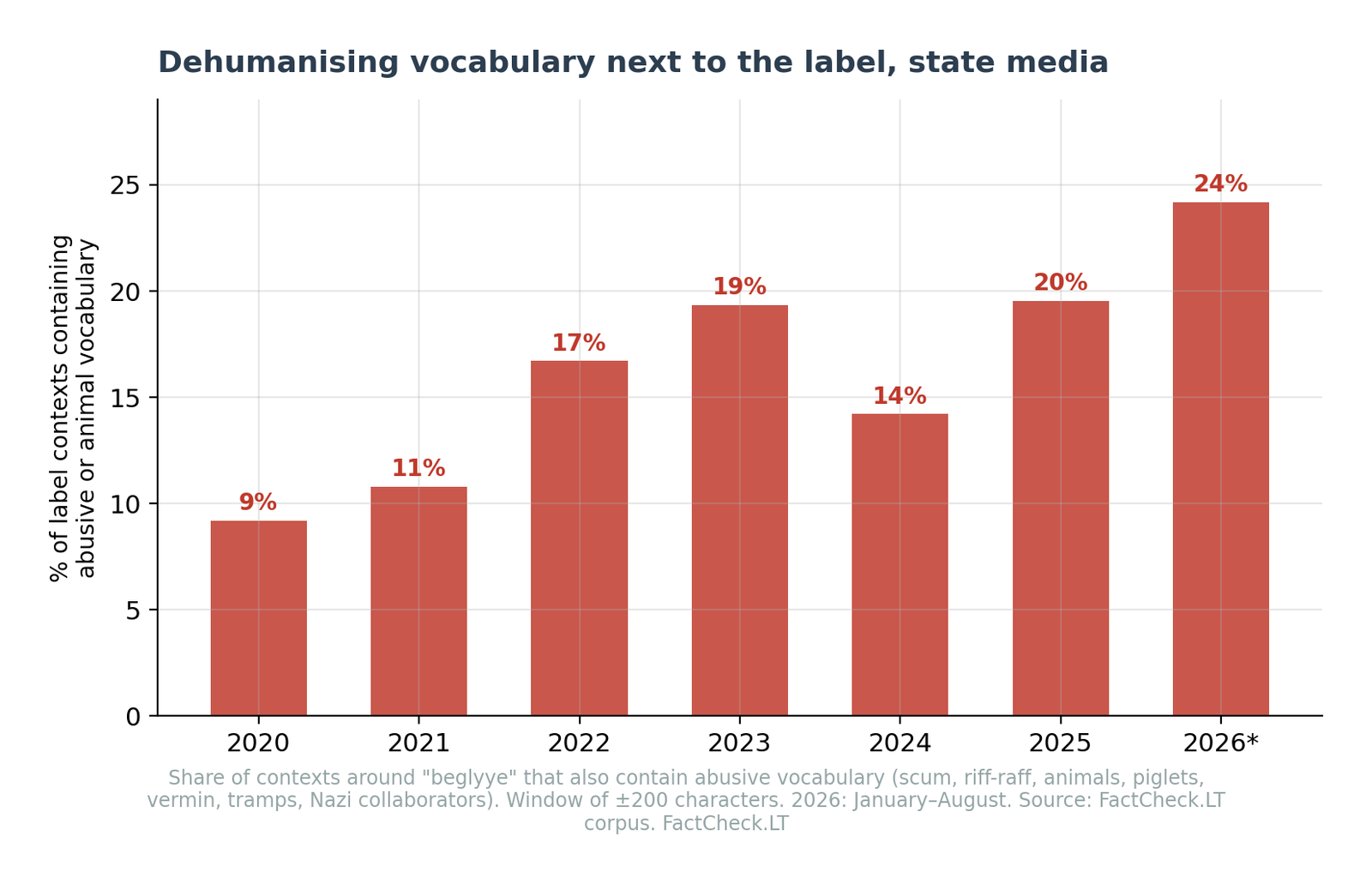
The word travels with a bestiary. Its most frequent companions in the state segment are zmagary, opposition, extremists, gang, terrorists, traitors, puppets. The share of contexts where abusive vocabulary sits next to the label — scum, riff-raff, animals, piglets, tramps, Nazi collaborators — rose from 9 per cent in 2020 to 24 per cent in 2026, with a dip to 14 in 2024. The word did not merely take hold; it gets nastier every year.
And then the part we did not expect. After the election of January 2025 official outlets largely set the word aside: CTV falls from 15 to 8 per thousand, SB from 5.4 to 2.8, BelTA from 4.6 to 2.3, Grodnenskaya Pravda from 36 to 11. Their publication volumes did not change; their vocabulary did. Anonymous channels, over the same two years, doubled: “Zholtyye slivy” goes from 98 per thousand in 2024 to 134 in 2025 and 186 in 2026 — nearly every fifth post. The label has gone back where it came from: out of the editorials and into anonymous channels, where nobody answers for words.
Independent media use the word too, at roughly two items per thousand, but half of those are quotations of Lukashenka and another 40 per cent put it in quotation marks. Of grassroots reclaiming there is, so far, no trace in the corpus. One detail stands out: among state commentators exactly one, Aliaksandr Shpakouski, brackets the word in quotation marks six times out of ten. Even inside the system somebody keeps his distance.
What to do with it
There are two strategies for a branding word. The first: do not repeat it, so as not to entrench it. The second: take it. That is what the Geuzen did — “the beggars”, as the Spanish authorities in the Netherlands contemptuously called them, who turned the insult into the name of a revolt. It is what the Impressionists did with a title lifted from a mocking review.
The second strategy only works when the group itself chooses it — not analysts, not newsrooms, but the people who were named. We cannot decide that for them. What we can do is point out that the word has a history and a second meaning, and that neither belongs to those trying to make an insult of it. And we can point to the moment: the word is leaving official speech and staying on as a weapon of anonymous channels.
The fled ones speak fluently. There is nothing to be done about that.
Method. FactCheck.LT corpus, 4.6 million items since January 2020: state and independent media, pro-regime and independent Telegram channels, YouTube. All inflected forms of the adjective were captured in a window of ±200 characters; homonyms (“a fleeting glance”, “fluent reading”, “fluent in a language”) and uses outside the Belarusian political context (“a fugitive oligarch”, “an escaped prisoner”) were excluded. A use counted as the label if a Belarusian political marker appeared in the window, or if the adjective stood alone as a noun. Frequencies are normalised by each source’s monthly volume. 2026 data cover January to August.