

Belstat explains the pay gap between women and men by where women work. Its own tables do not bear this out, and for 2024 it published pay by occupation no longer split by sex.
|
25.7%
how much lower women’s average pay was than men’s in December 2025
|
6.0%
the adjusted gap for October 2024, which Belstat presents as the answer
|
|
< 1/3
of the December gap is explained by the industries women work in (our calculation)
|
0 of 24
independent media items gave only the 6% figure; in state media, 10 of 23 did
|
Sources: Belstat; FORESIGHT corpus, 31.01.2025–09.10.2026
Belarus now has two official values for the gap between women’s and men’s pay. The first, 26.8%, shows how far women’s average hourly wage in October 2024 fell below men’s. The second, 6.0%, comes after an adjustment: Belstat compares women and men in the same narrow occupation group, with the same tenure and education, and adjusts for the type of activity and for pay differences between organisations. Belstat explains the larger number by where women work. Its booklet “Labour and Employment in the Republic of Belarus, 2026” asks “Why do women earn less than men?” and answers: “men mainly work in better-paid spheres of activity”.
We tested that explanation against Belstat’s own table for December 2025. The industries women work in explain less than a third of the gap, while more than two thirds comes from pay differences inside the same industries. Belstat used to publish a table that let readers check occupations too: it did so for October 2021. For October 2024, the very month on which the 6% is based, pay by occupation group came out no longer split by sex.
We then checked how the media retold these numbers. From 31 January 2025, 18 of the 23 items in state media and pro-government Telegram channels that gave a figure carried the adjusted one, and 10 of them gave no other. None of the 24 such items in independent media gave the adjusted figure alone. What we do not know is how much of the gap each factor in the adjustment removes. Belstat publishes only the result.
Two numbers from one office
The adjusted number came first. On 31 January 2025, Belstat’s chair Inna Medvedeva gave journalists the figure of 5.8%, and BelTA put it in a headline: “the difference in pay between men and women in Belarus is 5.8%”. The word “adjusted” does not appear in the headline. The calculation was experimental and used data for 2021. The unadjusted gap for the same October 2021, 24.3% in hourly pay, follows from page 29 of the “Labour and Employment” booklet of 2022: 9.20 rubles an hour for men and 6.96 for women.
On 6 March 2025, ahead of Women’s Day, Irina Bondarenko, who is in charge of labour statistics at Belstat, went further. The experiment, she said, confirmed that there was no significant gap, and she explained the unadjusted 25–26% above all by the fact that most women work in the social sphere (BelTA, SB). SB’s headline: “Why women’s pay is 25% lower than men’s, Belstat explained”.
On 30 April 2025 Belstat put both numbers into one infographic marked as new: for October 2024, the gap in hourly pay was 26.8% unadjusted and 6.0% adjusted. Among the factors, the infographic names the industry factor, workers’ education and “occupational segregation”. Belstat’s Telegram channel announced the result in a single line: “Belstat: the adjusted gender gap in Belarus was 6.0%”. Two days later CTV summed it up: “the main reason for differences in income is the type of activity”.
Put the two survey rounds side by side and a pattern appears. From October 2021 to October 2024, the unadjusted gap grew from 24.3% to 26.8%, and the adjusted gap from 5.8% to 6.0%. Almost all of the increase fell in the part that the adjustment removes. The 2021 calculation was experimental, and the method may have changed since, so this is a guide rather than a measurement.
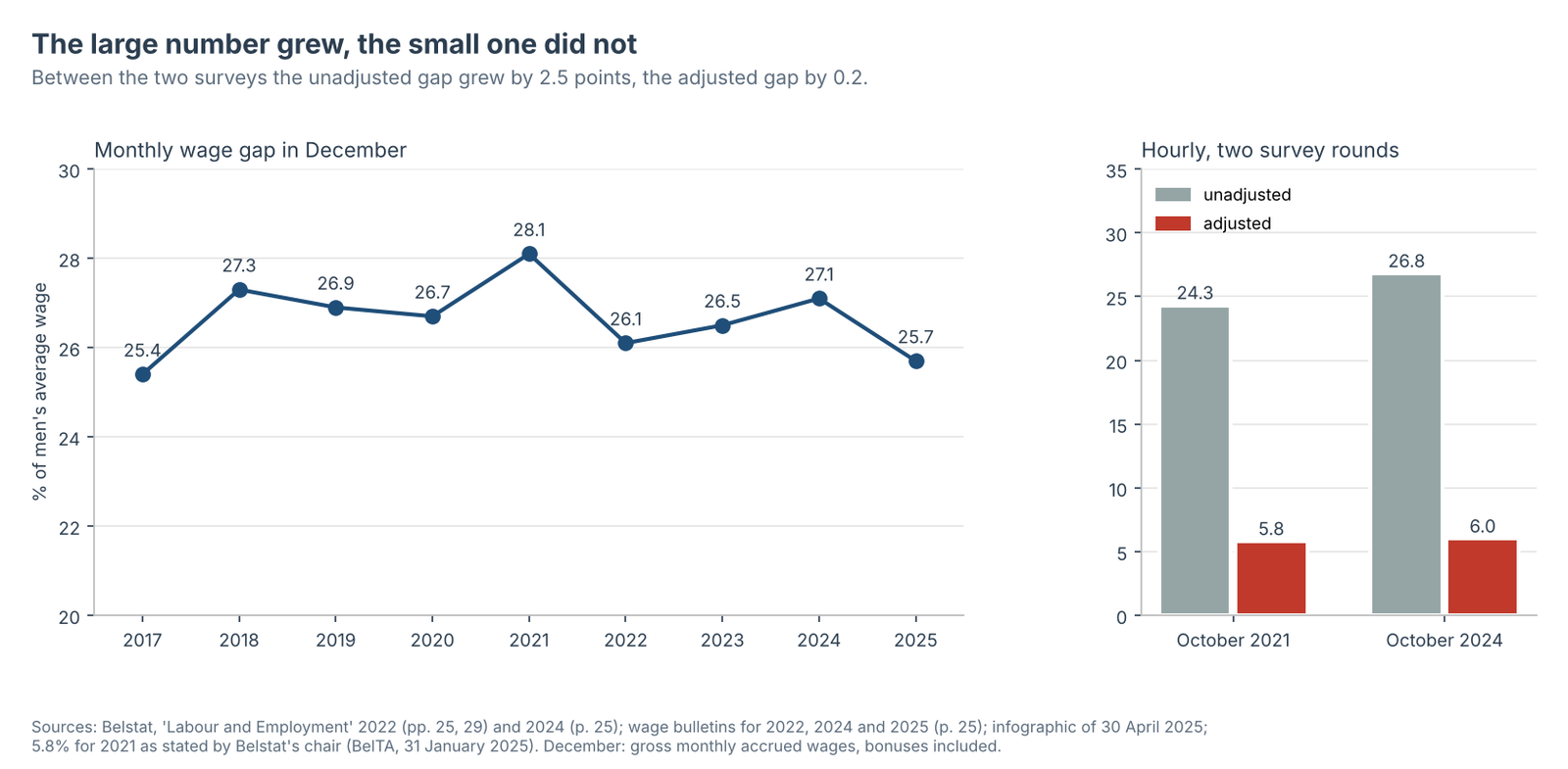
Belstat’s December series for 2017–2025 and the two rounds of the hourly survey. The unadjusted gap grew by 2.5 points, the adjusted gap by 0.2.
In January 2026 Belstat made the adjusted indicator official. The methodology, approved by resolution No. 1 of 23 January, defines only this indicator and has no unadjusted gap. Workers are compared within “minor groups” of the occupation classifier, with the same tenure in the organisation and level of education, and the adjustment also allows for the organisation’s type of economic activity and for differences in pay levels between organisations. The methodology does not promise to publish the contribution of each factor. In the “Labour and Employment” booklet of 2026, registered on 30 September, the adjusted figure is flagged as appearing for the first time, and next to it stands that same answer about “better-paid spheres of activity”. That answer can be tested.
The table that argues with the explanation
The test is a table in Belstat’s bulletin on headcount and wages in 2025. On pages 25–27 it gives the number of women and men and their average accrued wage in each industry for December 2025. Women made up 53.0% of the 3,156,383 employees counted. Their average wage was 2,581.5 rubles, against 3,474.1 rubles for men: 74.3% of men’s pay, a gap of 25.7%.
With such a table, the gap splits into two parts. One comes from the industries women work in, the other from pay differences inside each industry. Across the 19 sections of the classification of economic activities, the first part is 4.4 to 6.0 points, depending on the weights. If manufacturing and trade are divided into their branches, it rises to 5.4–7.8 points. Either way, more than two thirds of the gap comes from differences inside the same industries. The table for December 2024 gives almost the same, 4.9 to 8.0 points of 27.1, and the table for December 2022 5.2 to 8.5 points of 26.1.
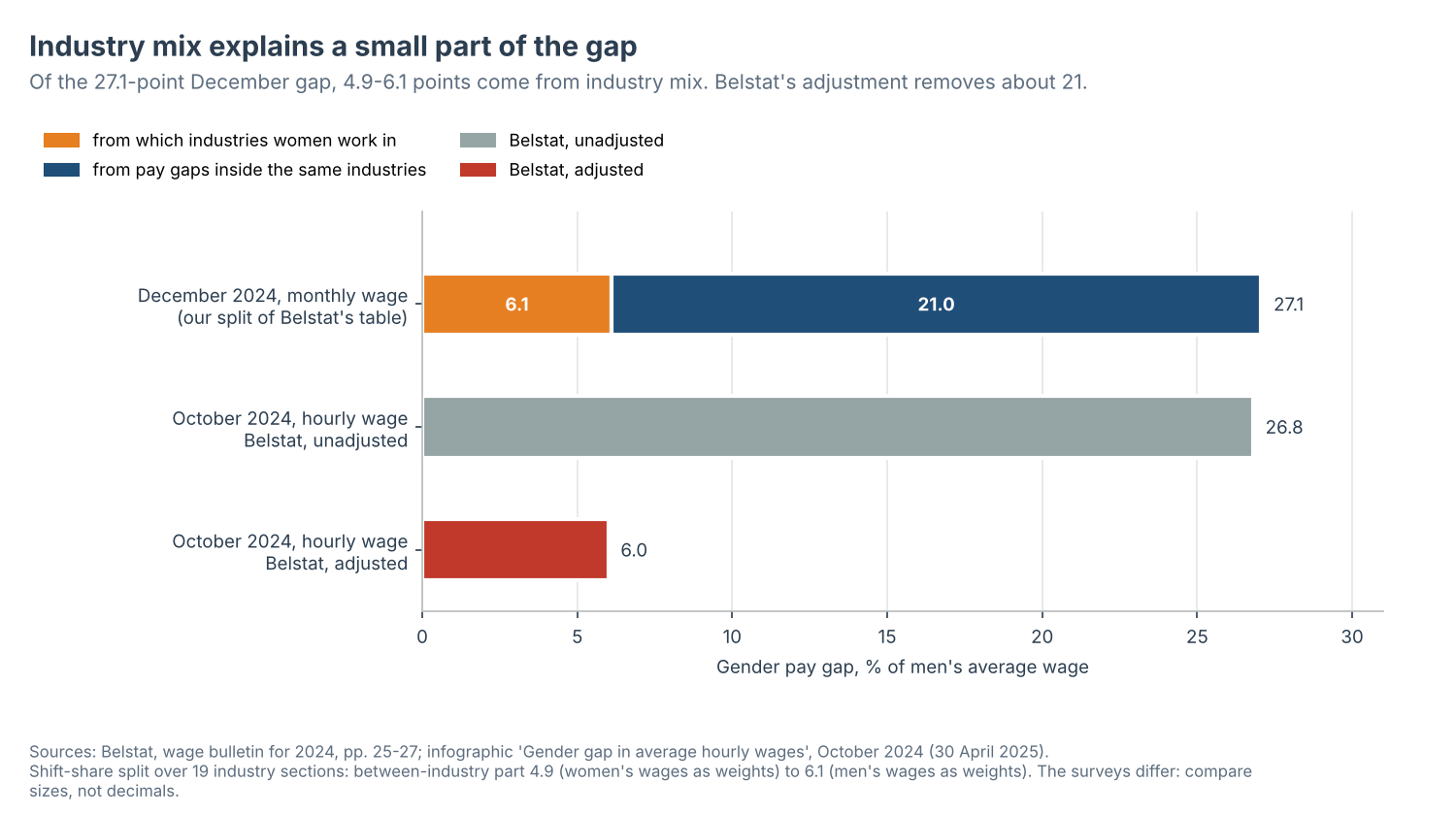
December 2024: our split of Belstat’s table next to Belstat’s two numbers for October 2024. The surveys differ, so compare orders of magnitude.
Inside industries, the gap is large both where women are many and where they are few. In health and social work, where women are 85% of workers, they earn 21.5% less than men. In finance and insurance (72% women) the gap is 24.1%, in trade (62%) 28.0%. In mining, where women are 20%, it is 26.5%, and in information and communication 37.7%. Only education and transport come close to no gap: 4.6% and 6.2%. Women earn more than men in one industry, real estate, and only by 0.5%. Zerkalo showed the same picture using the 2024 table.
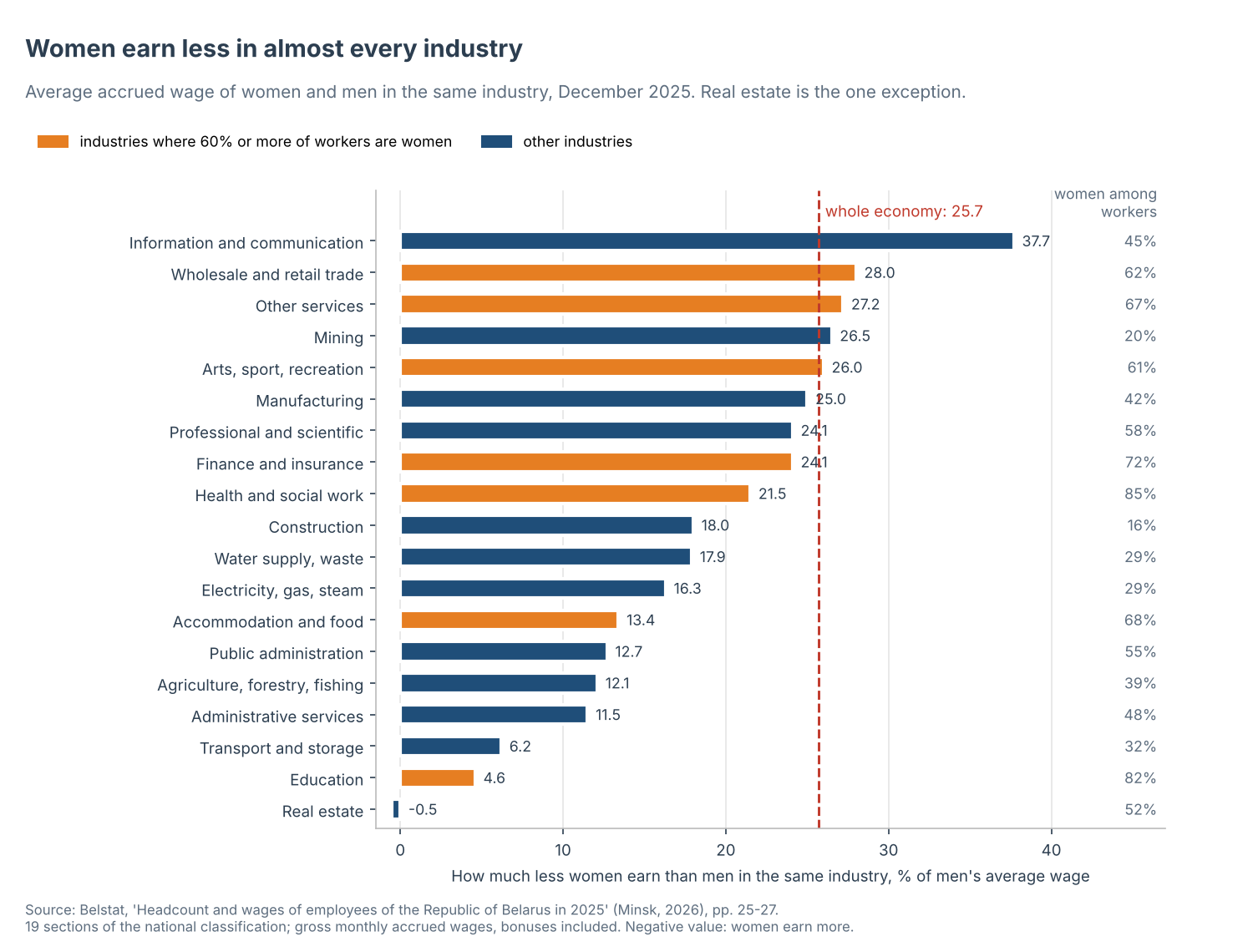
The gap inside each of 19 industries, December 2025. Orange marks industries where women are 60% or more of workers.
More than two thirds of the gap comes from pay differences inside the same industries.
Women and men do work in different places. By the standard Duncan index of dissimilarity, 35% of women would have to change industry for their distribution to match men’s, and 40% with a finer split. But this division runs through both well-paid and badly paid industries. Women are the majority in education and health, which pay below average, and in finance, which pays far above it. Men are the majority in construction and manufacturing, but also in agriculture and transport, where wages are below average. So the division by sex is strong, while its effect on average pay is small.
The same table can be read another way. Pay differences inside industries may reflect hours worked, tenure, education and choice of job, and none of these in itself means unfair treatment. December pay includes annual bonuses, which can widen the gap for one month. But in 2024 the hourly gap for October, 26.8%, was close to the monthly gap for December, 27.1%. So women’s shorter working time does not explain most of the gap. The figures come from different surveys, so the comparison is approximate.
The table that is no longer there
For October 2021, Belstat published what allowed readers to test the second part of the explanation as well, occupations. On page 28 of the “Labour and Employment” booklet of 2022 it gives accrued pay by major occupation group for men and women separately, and on page 29 hourly pay by type of activity, also by sex.
The table on page 28 shows a large gap inside one and the same occupation group. In October 2021, women in the “professionals” group earned 1,381.6 rubles on average, and men in the same group 2,815.3 rubles, about twice as much. Among managers the gap was 29.5%, among unskilled workers 34.6%. Women earned more than men only among service and sales workers and among skilled agricultural and forestry workers. This is monthly pay, and part of the difference comes from hours worked. A broad group brings together very different professions, and the table does not show which of them women hold and which men hold.
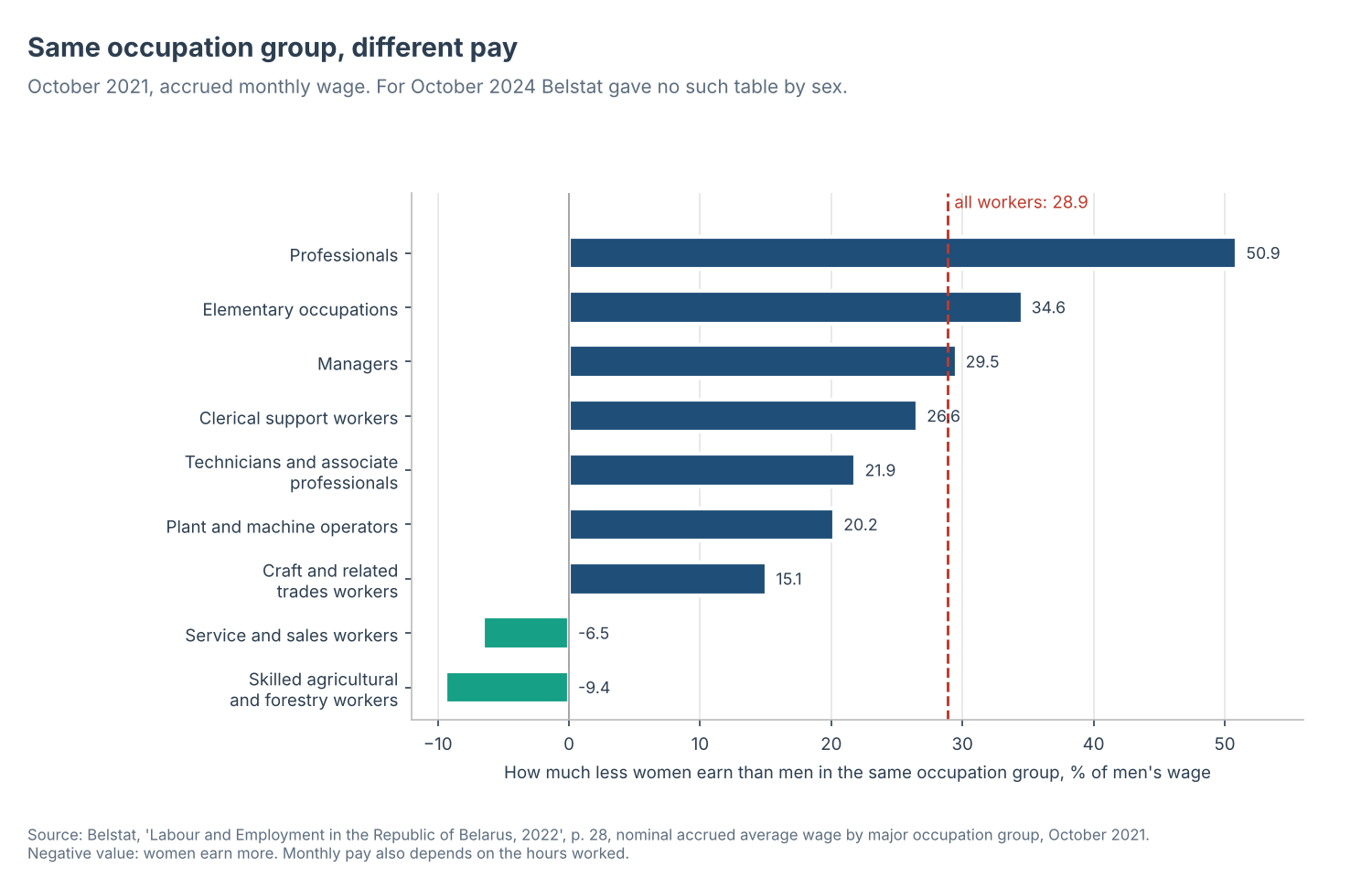
The gap inside nine major occupation groups, October 2021. Belstat’s booklet has no such table by sex for October 2024.
For October 2024, the month for which both 26.8% and 6.0% are calculated, the booklet has no such table. The 2026 booklet gives pay by occupation group for October 2024 without splitting men and women (p. 24). Hourly pay by sex appears as two totals, 13.58 and 9.94 rubles (p. 26). The booklet has no table that combines sex with type of activity or occupation group. Readers get the result of a comparison within groups, but not the groups themselves.
Belstat’s adjustment compares women and men within “minor groups” of occupations and allows for the organisation they work for. So what the 2021 table shows drops out of the result: the way women and men are spread across occupations and employers with different pay. How many of the 21 points removed by the adjustment are due to occupation, and how many to tenure, education, industry and employer, Belstat does not say.
A caveat: on the booklet’s page Belstat writes that the most complete labour market data are in its information and analytical system, dataportal.belstat.gov.by. We have not checked it. The December table by sex and industry still appears in the annual wage bulletin.
How the media retold it
To see which of the two numbers reached readers, we searched the FORESIGHT corpus for items on the pay gap between women and men in Belarus from 1 January 2024 to 9 October 2026. The search returned 185 items. We checked by hand all items in state media and pro-government Telegram channels from 31 January 2025, when the adjusted number appeared, and all items in independent media that gave a figure over the same period.
In state media, of 23 items that gave a figure, 18 carried the adjusted one, and 10 of them gave no other. Five gave only the unadjusted figure. Four headlines, at BelTA, SB and on the Telegram channels of BelTA and ONT, called 5.8% simply “the difference in pay between men and women”. Seven more items gave no figure and claimed that there was no gap or that it was insignificant. In August 2025 a BelTA headline read: “Belstat: there are no differences in wages depending on the sex of the worker in Belarus”. A year later, in a BelTA interview republished by Grodnenskaya Pravda, Medvedeva said that the adjusted gap was “only 6%” and added: “This confirms that there is no significant pay gap between men and women in Belarus”. In the same interview she compared poverty levels and the digital economy’s share with other countries; Belarus Brief examined those comparisons.
Where state media gave both figures, the larger one was often presented as outdated. CTV wrote of it: “The indicator was 26.8%, but it did not take into account the individual characteristics of workers”. Belarus-news.by mentioned “almost 27%” as the result of the first experimental calculation.
This need not be the newsrooms’ choice. State media usually retell Belstat’s releases, and Belstat’s Telegram channel itself announced the result with the adjusted figure alone. Nor did state media hide the table. In May 2026 1prof.by reported the 25.7% gap for December 2025, but under the headline “In which sectors do most women work and where do they earn more than men?”. The answer to the second half of the question was one industry: in real estate, women’s pay is 0.5% higher than men’s.
In independent media the picture is the reverse. Of 24 items with a figure, none gave the adjusted one alone: 11 gave both figures and 13 only the unadjusted one, six of those 13 in passing, in stories on other topics. Zerkalo opened with 26.8% and gave the 6% further down, under the headline “Women began to earn even less than men”. Charter97 and Euroradio headlined that the gap had grown. One independent site read the change of measure as a change in pay. On 31 January 2025 Pozirk set 5.8% against 24.3% and wrote in its headline: “The difference in pay between men and women has shrunk more than fourfold in 3 years”. Both figures refer to 2021.
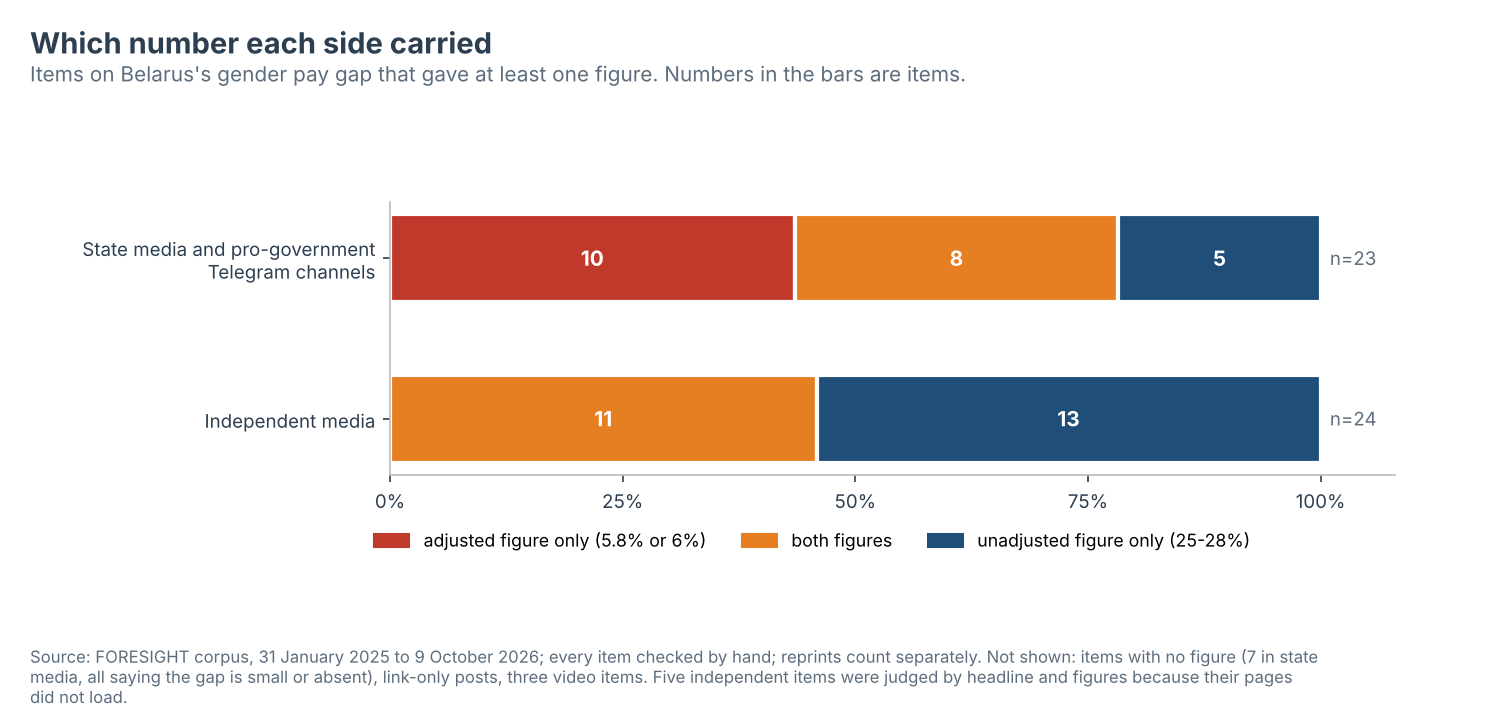
Which figure state and independent media gave, 31 January 2025 to 9 October 2026. Only items on the gap in Belarus that gave at least one figure; each checked by hand.
A Year of the Woman without a pay table
By Decree No. 1 of 1 January 2026, Lukashenko declared 2026 the Year of the Belarusian Woman. Belstat’s plan for the year has 13 items, including sports contests, charity work and meetings with clergy. None concerns pay data; the only statistical item provides for reviews and infographics for holidays. We read all six infographics on the page for the year: the statistical portrait, demography, employment and decision-making, education and science, gender equality and time use. None gives pay by sex. The year’s 12-page statistical booklet collects the same infographics and gives no pay by sex either. Its last page says that its design and printing were supported by a joint project, “Supporting the efforts of the Republic of Belarus in nationalising and localising the Sustainable Development Goals”, “financed by the Russian Federation”. The employment infographic reports that women make up 49.7% of managers. Yet in October 2021 women managers earned 29.5% less than men managers, according to the “Labour and Employment” booklet of 2022. The gender equality infographic cites the Gender Inequality Index, on which Belarus ranks 27th of 172 countries. That index, which UNDP calculates, does not measure pay.
State media wrote a great deal about the Year of the Woman, but hardly ever about pay. From 31 December 2025 to 9 October 2026, the corpus holds 4,885 state media items that name the Year of the Belarusian Woman. By our search, three of them speak of a pay gap. Two carry the words of Sergei Aleinik, the national coordinator for achieving the Sustainable Development Goals: “there is no difference in pay for performing the same duties” (BelTA). Two days later Zerkalo replied that over the past ten years the gap “has not fallen below 20%”. FactCheck.LT examined in March how differently state and independent media speak about women this year.
What an adjustment is entitled to explain
Here a book helps: “Missing Voices in Economics”, edited by Veronika Dolar and Teresa Perry and published by Palgrave in January 2026. It is about women in economics as a profession and does not mention Belarus. But in the first chapter Marlene Kim describes the habit of thought behind the reading “there is no significant gap”. Mainstream theory, she writes, explains differences in pay and occupation by preferences, skills and productivity. Kim quotes a senior economist, citing a 2020 work by Julie Nelson: “The word ‘discrimination’ has almost disappeared. It’s the wage gap and unexplained factors or women being less competitive or household responsibilities … anything other than discrimination.”
Two other chapters measure segregation with the same index we use. Giulia Zacchia and Izaskun Zuazu apply it to the research fields of the world’s leading economists, and Giulia Zacchia and Marcella Corsi to the topics of Italian economists. In both chapters, segregation is a result to be measured and explained.
Belstat’s adjustment treats occupation the other way round. When women and men are compared within one narrow occupation group, with adjustments for industry and organisation, the sorting of women into lower-paid occupations and employers drops out of the result. Belstat’s own infographic names “occupational segregation” among the factors behind the gap. Then what remains after it is removed is presented as the answer.
Both numbers are true. The question is which of them gets the explanation.
An adjusted gap is an ordinary tool of labour statistics. A 6% gap between women and men in the same narrow occupation group, with the same tenure and education, after adjusting for industry, is not that small, and it is not zero, although officials call such a difference insignificant. The official reading leaves the larger part aside. By Belstat’s two numbers for 2024, the adjustment removes about 21 points. By our split of the December table for the same year, industries account for 5 to 8 of them. The rest, roughly speaking, lies inside industries: in occupations, tenure, education and in which employers women work for.
What to watch
We expect, with high confidence, that Belstat’s review for Mother’s Day on 14 October 2026 will give no pay by sex. The wage bulletin for 2026, which Belstat has registered at the end of May in each of the past two years, will show a December 2026 gap of 24–28%, and industries will again explain less than a third of it; high confidence. By the end of 2027 Belstat will not publish its October 2024 tables by sex and occupation group or type of activity, nor the contribution of each factor in its adjustment; medium confidence. If it does, we will recalculate.
How we counted
The December tables by sex and industry come from Belstat’s bulletins on headcount and wages for 2022, 2024 and 2025 (pp. 25–27). The series for 2017–2021 and 2023 comes from the “Labour and Employment” booklets of 2022 and 2024. All three tables are internally consistent: industries add up to the total within rounding, and the published ratios match the wages.
We split the gap into between-industry and within-industry parts with the standard shift-share method and report both weighting schemes, because the result depends on them. The Duncan index of dissimilarity is half the sum of the absolute differences between women’s and men’s shares across industries. December pay is accrued, before tax, and includes annual bonuses. The hourly data come from a separate October sample survey, so we compare orders of magnitude, not decimals. Our division of the 21 points removed by the adjustment is approximate: Belstat does not publish the contribution of factors, and its adjustment also allows for differences in pay between organisations.
The media count uses the FORESIGHT corpus: state media, independent and exile outlets, Telegram channels. A search for words on pay, sex and gap returned 185 items about Belarus. We checked by hand all state media items from 31 January 2025 and all independent media items with a figure over the same period. Most were read in full; a few reprints and five items whose pages did not load were classified by headline and by the figures the search extracted. We excluded items not about the gap, link-only posts and three video items we could not check. Reprints in different outlets count separately. The automatic count missed figures that stood far from the word “gap”, so the text gives only hand-checked numbers. The Year of the Woman count covers state media items from 31 December 2025 to 9 October 2026 that name the year.