

The fourth issue of the monthly narrative intelligence series by FactCheck.LT. We automatically compare how the same event is presented across information environments: Belarusian state and independent media, the media of Lithuania, Latvia, Poland and Ukraine, and Russian state media. The Narrative Divergence Index (NDI) measures how far apart the interpretations have drifted; a separate piece in this series explains how to read the index.
September in one paragraph
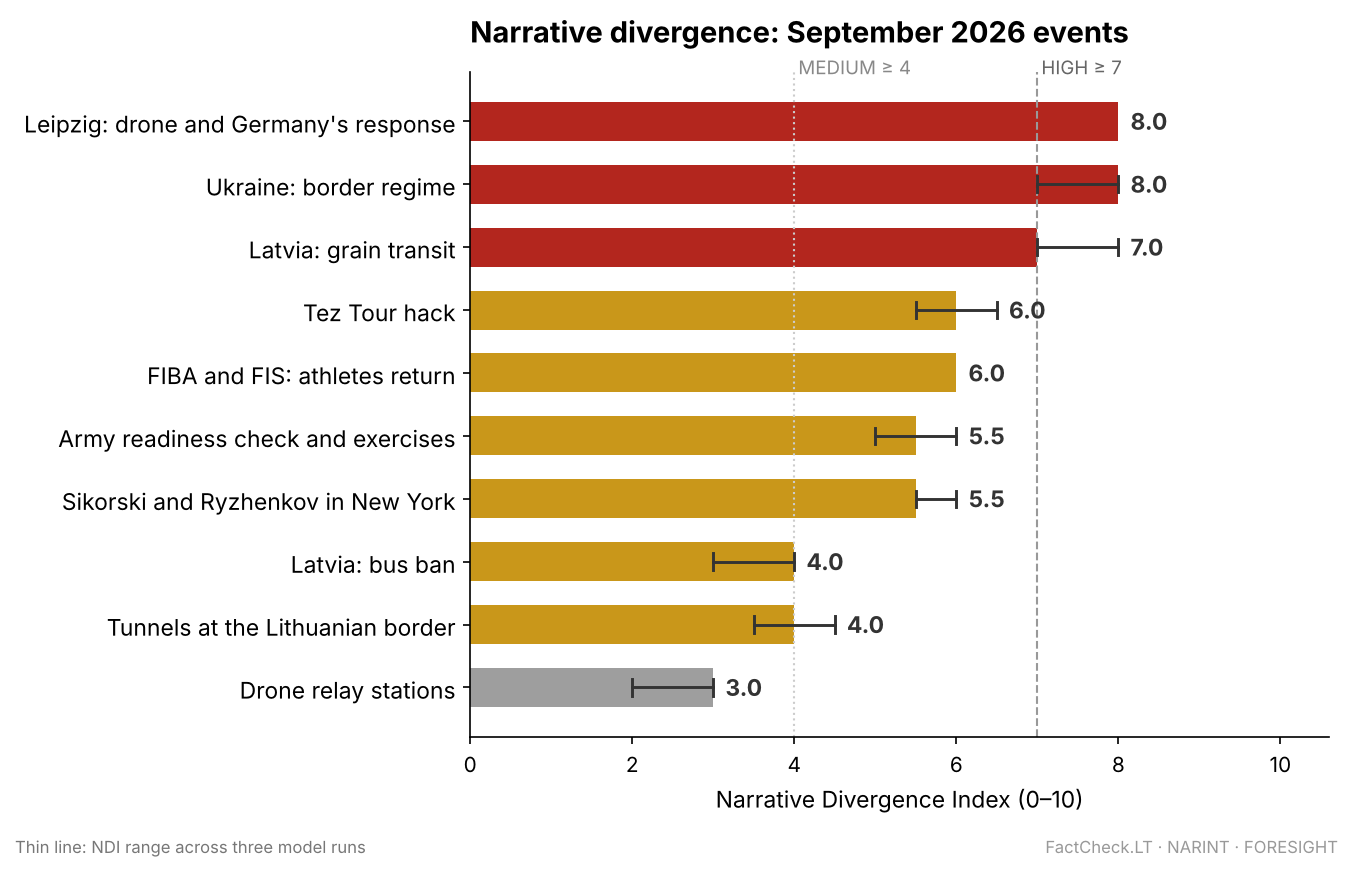
The FORESIGHT platform grouped September’s stream from 26 sources into 1,578 events; ten went through scoring, three reached the HIGH level, and the month’s maximum was 8.0. For the first time, both events on the silence map entered the index top ten at once, and both landed in the lower part of the scale: external environments diverge on them less than on most events of the month, while Belarusian state media did not mention either of them. One technique runs through several events of the month: state media take a position not in their own words but through a selection of other people’s words. And a methodological change: from this issue a new model does the scoring, each event is scored three times, and so every figure comes with a measured margin of error. The series of indicators since June has been recomputed the same way.
Leipzig: a Belarusian trace and borrowed voices. NDI 8.0
On 1 September the German government officially stated that the attempted sabotage at Leipzig/Halle airport had been organised on behalf of Russian state bodies: in early August a drone carrying explosives was found there next to a Ukrainian transport aircraft with military cargo. Berlin announced the closure of Russia’s consulate general in Bonn and of the Russian House in Berlin. For a Belarusian audience the story has a dimension of its own: according to the investigation, one of the suspects, a resident of Belarus holding a Russian passport, entered the EU on a visa issued in Minsk, and Italy is investigating how he obtained it.
The event’s axis: Russia’s involvement is established and Germany’s measures are justified (0), or the accusations are unproven and the incident serves as a pretext for escalation (10). The result is stable: all three runs gave 8.0. Belarusian independent media (position 1) go through the investigation’s evidence: the DNA, the suspect’s route, the Minsk visa. Latvian media (1.5) write that the identified suspects confirm the German version. Russian state media (7) sidestep the question of guilt and present Russia as the injured party through the fate of the expelled diplomats. Furthest of all are Belarusian state media (9), and they dispute the evidence less with arguments of their own than with other people’s voices, above all that of a Bundestag member from Alternative for Germany. BELTA quotes AfD deputy Steffen Kotré, who says the evidence of Moscow’s involvement is insufficient, and his complaints about how the government answered a request about the Nord Stream sabotage. SB, in a piece on the same statements, writes that the German government had apparently been “just waiting for a pretext” for measures against Russia.
Minsk stands further out than Moscow here in all three runs, by two points or more. A caveat: the Russian state media position rests on few documents. But the direction is telling: in a story featuring a resident of Belarus and a Minsk visa, domestic propaganda defends more loudly than its ally.
Ukraine introduces a special border regime: the Belarusian argument cut out. NDI 8.0
Ukraine’s Cabinet of Ministers established a special border regime in a one-kilometre strip along the border with Belarus and Russia for the period of martial law: entry, residence and work not related to defence are prohibited there. The event’s axis: the measure is presented as Kyiv’s internal defence decision, with the Belarusian threat left unmentioned or questioned (0), or as a justified response to a real threat from Belarusian territory (10). Belarusian independent media (8) relay in detail the argument about the possible use of Belarusian territory for destabilisation; the Ukrainian position (9) rests not on a report about the regime itself but on a piece about the context: according to military intelligence, Russian drone relay stations operate on Belarusian territory near the border, and Belarus is forming a new airborne brigade 40 km from the border. Belarusian state media (2) did not keep silent about the event, but retold it without the Belarusian argument: the only reason given is the need “to resolve urgent issues related to strengthening the country’s defence capability”, and the threat from Belarusian territory is left out. Sputnik (1) went further, writing that Kyiv refers to the “allegedly possible use of the territory of Belarus”. This is the same context isolation we described in August, only in miniature: the fact is reported, the Belarusian argument is cut out. The event is compact, seven documents, and it scored 8.0 in two runs out of three and 7.0 in one.
Latvia restricts grain transit and food imports: procedure as a frame. NDI 7.0
After a sharp rise in grain transit through Latvian ports, on 17 September the Saeima backed amendments (66 votes to 17) that open the way to a manifold increase in the rail tariff, and the idea of a full transit ban is also being discussed. The axis: a justified protection of Latvia’s security and agriculture (0), or a politically motivated measure that harms Latvia itself (10). Latvian media (1.5) set out the logic of the explanatory memorandum: transit has reached volumes that threaten exports of the country’s own farm produce. Lithuanian media (2.5) write about another part of the same package, the extension of Latvia’s food import ban, and see it as a continuation of sanctions policy. Belarusian independent media (3) explain the context with statistics: Russian grain transit through Latvian ports grew by more than half, and more than 80% of the Belarusian flow, which did not exist before, is of Russian origin. Russian state media (8.5) call the authors of the ban idea “nationalists” and write about losses of hundreds of millions of euros that stevedores warn of. Belarusian state media (6) do not argue with the decision directly; instead they retell it through selected procedural details: the minister himself conceded that the higher fee could lead to litigation, and the opposition voted against. Formally this is a news report; in fact it assembles the image of a contested decision. A caveat: the event has seven documents, and for four of the five environments the positions rest on little data.
The middle zone: four events with NDI 5.5 to 6
The attack on Tez Tour (NDI 6.0). On 15 September the group DATASUCKERS attacked the tour operator’s resources in the Belarusian domain; the National Personal Data Protection Centre launched an unscheduled inspection. The axis: a large-scale leak of personal data (0), or a localised incident under control (10). Belarusian independent media (3) put the hackers’ claims of almost 400 million lost records at the centre and give the company’s denial second; Russian (6) and Belarusian (7) state media move the story to the regulatory plane: an inspection is under way, work is being done. Unexpectedly, the Lithuanian environment is furthest out (9): there the event is reduced to a technical failure of the booking system, and the local company pointedly distances itself from entities of the same name in Russia and Belarus. The edge of the scale is held not by propaganda but by a corporate frame.
The return of athletes, round two: FIBA and FIS (NDI 6.0). From 1 September FIBA lifted personal restrictions on Belarusian and Russian basketball players, coaches and referees; FIS admitted athletes to individual events of the 2026/27 season with neutral status. The axis: an unacceptable return of representatives of aggressor states (0), or a natural return, a step towards normalisation (10). Lithuanian media (2) carry the Lithuanian basketball leadership’s public condemnation of the FIBA decision; Latvian media (3) are close by. Belarusian state media (8) write that “there is one winter intrigue fewer” and present the postponement for national teams as a technical step towards a full return. Belarusian independent media (5) stand exactly in the middle: they record the admission and stress that it is conditional and incomplete. The series already met this topic in June, but then the dispute was about the status of the admission, now it is about its legitimacy. The follow-up is already in the corpus: according to Euractiv, the EU is looking for ways to contain the return of Belarusian and Russian sport.
The army readiness check and exercises (NDI 5.5). On 11 September Lukashenka said it was time to “shake up” the army and ordered a check of its readiness “up to and including mobilisation”; on 15 to 18 September a command and staff exercise was held with the Western Operational Command. Belarusian state media (1) reproduce the defence ministry’s thesis about the defensive character and compliance with the Vienna Document; TASS (2.5) retells Lukashenka’s words without assessment. Ukrainian media (6) call Lukashenka a dictator and place the check in the context of a general military threat, though they render the quotes close to the official text. Furthest out are Belarusian independent media (6.5): they place the check in a long series of mobilisation measures that bring the country closer to a wartime regime, stress how close the training grounds are to the borders of Lithuania and Poland, the formation of people’s militia units and curfew drills, and present the General Staff’s assurances that there is no threat as the ministry’s position, not as established fact.
The meeting of the Polish and Belarusian foreign ministers (NDI 5.5). The most widely covered event of the top ten: on 22 September in New York, on the sidelines of the UN General Assembly, Radosław Sikorski met Maksim Ryzhenkov, called the meeting a first and introductory one and compared the prospects of normalisation to a snowdrop that “may bloom under favourable conditions”. The axis: an introductory contact, with normalisation conditional (0), or a breakthrough and the start of normalisation (10). Lithuanian media (3) place the meeting in the history of migration pressure and hybrid operations; Polish media (4) present a possible turning point with a question mark and experts’ scepticism; Belarusian independent media (4.5) relay the divided voices of the democratic forces. At the other end, Belarusian state media (8.5) write that the Polish foreign minister himself called the meeting a “breakthrough”, leaving out his caveats about a first and introductory meeting; Latvian media (5.5), retelling the same meeting, specify that it was not Sikorski who called the meeting a “breakthrough”: he was only commenting on such a remark. Russian state media (7.5) present Sikorski’s words on the border and on Poczobut as Warsaw’s admission that the issues have been settled. The moderate NDI should not mislead: by political weight this is the main event of the month.
The lower end of the scale: buses, tunnels, relay stations
Latvia prepares a ban on bus services (NDI 4.0). Latvia’s Ministry of Transport submitted amendments banning bus services to Belarus and Russia from 2027; Lithuania said it does not intend to follow suit. The axis: a justified security measure that should be extended to the Baltic states (0), or a politically and electorally motivated step (10). The most interesting thing here is who stands together: Lithuanian media, Belarusian state media and Russian state media took the very same point (6). The Lithuanian government itself calls the step hasty and linked to the Latvian elections, and Belarusian state media build their coverage on the Lithuanian prime minister’s words that the border should be closed “not for political reasons”; Russian state media stress the Latvian ministry’s own admission that the ban is easy to get around, and Lithuania’s refusal to follow suit. A working disagreement within the Baltic states becomes a ready-made narrative resource: even the neighbours consider the ban political. Latvian media (2) describe a planned process, Belarusian independent media (4) the practical consequences for passengers.
Tunnels on the Lithuanian border (NDI 4.0). Lithuania’s interior minister reported 12 tunnels dug under the border barriers in five months and a counteraction plan together with Frontex. The axis: a hybrid attack run by the Belarusian regime (0), or a humanitarian and legal problem (10). Polish (1), Belarusian independent (2) and Latvian (3) media read the tunnels as an instrument of pressure; Belarusian independent outlets add a telling detail: on the day political prisoners were taken out, there were no illegal crossing attempts for the first time in a week, which points to a managed flow. The Lithuanian environment (5) is the only one to see more than security in its own border: next to the operational report runs a piece on the legality of pushbacks and their human cost.
Relay stations for Russian drones (NDI 3.0, LOW level). On 11 September the head of Ukraine’s military intelligence, Ivashchenko, said that some of the relay stations on Belarusian territory linked to Russian drone flights over western Ukraine were working again. External environments agree that Belarus is involved; they differ on who the actor is. Lithuanian headlines (8.5) make Minsk itself the actor: citing Ukraine, they report that Belarus switched the stations back on; Polish media (8) link them to a strike near the Polish border. Belarusian independent media (6) write about Russian infrastructure on Belarusian territory, and in the Ukrainian environment (5.5) a technical debate is under way: Serhiy Beskrestnov (Flash) points to Russian operators’ SIM cards roaming on Belarusian networks. Belarusian state media take no part in this debate at all.
The silence map: two zeros, both at the bottom of the scale
In September something happened that had not happened in any previous issue: both events of asymmetric silence entered the index top ten at the same time. Relay stations and tunnels are covered by external environments densely enough for scoring, while Belarusian state media did not publish a single item on either. And both events landed in the lower part of the scale, with NDI 3.0 and 4.0: outside, they are disputed less than almost any other event of the month. Two events are too few for a pattern, but the picture is coherent: what external environments almost agree on is not talked about at home at all.
Both topics are also recurring. Tunnels were on July’s silence map (Kabeliai and Pertakas), and relay stations have run through the series since June. Domestic silence turns out to be not a one-off editorial decision but a consistent policy for a whole class of topics: the complicity of Belarusian territory in the war and in hybrid pressure on its neighbours. The reverse view, the domestic agenda that exists only in state media, counts 145 stories after regular rubrics are removed: hockey and harvest festivals, the “Belarus Adzinaya” campaign, reports and anniversaries.
Minsk and Moscow: the September reading and the new model
From this issue, scoring is done by Claude Opus 5.5, and each event is scored three times. Before switching, we ran June to September with three models, three times each. With the previous model, the NDI of four events out of forty moved by two points or more between runs; with the new one, only one did: thirty-nine scores out of forty reproduce within one point. The level of an event (HIGH, MEDIUM, LOW) changes between runs about equally often under both models, for eight or nine events out of forty: this is a property of the thresholds, not of the model. Changing the model does, however, shift the averages by itself, by more than half a point in some months, so the whole series since June has been recomputed with the new model. The figures below differ from those printed in earlier issues: those were produced by the previous model in a single run.
Positions of different events are not compared with each other: each event has its own axis and its own direction of the scale. Distances between environments are comparable. Average NDI across the ten events: 5.7 (5.6 to 5.7 across three runs; June 7.1, July 7.0, August 6.3). Gap between Belarusian state and independent media: 4.5 (4.4 to 4.6; June 5.9, July 5.6, August 4.7). Gap between Belarusian and Russian state media: 1.4 (1.2 to 1.6; June 1.5, July 1.8, August 2.2).
Minsk and Moscow still almost always tell the same story: there was no gap of four points or more in any of the three September runs. The largest, up to three points, came on grain transit, where Moscow stands further out; in Leipzig, discussed above, the gap is smaller, but Minsk stands further out. Moscow’s position in six of the seven comparable events rests on few documents, so the figure of 1.4 itself should be read with that caveat. The gap within Belarus in the recomputed series is below five points for the second month running, but above four, which we named in advance as the sign of a real shift in the media field. The events show where this value comes from: in five of the eight stories where both Belarusian environments are present, the gap between them is four points or less, and the wide divergences fall on war and security: Leipzig (8), the special regime on the Ukrainian border (6), the army readiness check (5.5). These are monthly values, not a trend: the events in the top ten differ every month.
Takeaways of the month
First: through other people’s mouths. September’s technique recurred in several events in a row: on Leipzig, Belarusian state media speak through the quotes of an AfD deputy; on the Latvian buses, through the words of the Lithuanian prime minister; on grain transit, through how the Latvian opposition voted and the minister’s caveats; on the New York meeting, through the word “breakthrough”, which BELTA attributes to Sikorski himself. No editorial thesis of their own is needed: it is enough to select other people’s statements so that they do all the work. For the reader this gives a practical rule: in a “neutral” news item, look not at the tone but at whose voices are gathered in it and whose are not. And a consequence for everyone who argues publicly within the democratic camp: neighbours’ working disagreements are readily turned into the argument “even they don’t agree with each other”.
Second: outside they argue about details, at home they are silent about the event. Both of September’s state media zeros fell on events that external environments dispute less than most others: relay stations and tunnels. Both topics recur from month to month. For the class of stories about the involvement of Belarusian territory in the war and in pressure on its neighbours, domestic silence is systematic: external environments are left to argue about details, while the domestic audience is not given the event itself.
Third: when there is a Belarusian trace, Minsk defends more loudly than Moscow. In Leipzig, Belarusian state media stand further out than Russian state media in all three runs, by two points or more. The overall gap between the two state environments remains small, 1.4, and Moscow’s position almost everywhere rests on few documents. There is a mirror case too: on grain transit, which is mostly about Russian grain, Moscow stands further out. The observation is worth testing further, but it is consistent with the recomputed series: Minsk–Moscow gaps of four points or more have occurred only in stories that directly concern Belarus, namely the prisoner exchange through its territory, the Belarusian-Chinese exercise, the drone strike on a bus with Belarusian passengers and the new Lithuanian government’s policy towards Minsk.
Fourth: the margin of error has become part of the result. Three runs per event show which conclusions hold. Leipzig gave 8.0 in all three runs and the relay stations between 2 and 3, and these are stable scores. Others sit closer to the thresholds and can change level from run to run: buses and tunnels move between 3 and 4.5. An index that shows its own margin of error says less than an index without one, but what it says can be checked.
Methodology
The full September stream of 26 sources in five languages, aligned into a single semantic field, was automatically grouped into 1,578 events; ten events covered by at least four environments were selected for scoring. The axis of divergence and the environments’ positions are determined by a language model, Claude Opus 5.5, reading the material of all environments simultaneously; each event is scored in three independent runs. An event’s NDI equals the distance between the two most distant environments on a 0-10 scale; for each event the issue gives the median run, so the figure and the positions in the text come from the same run. Monthly averages are computed across all runs and given with their range. Each event has its own axis and direction, so positions of different events are not compared; distances are. The June to August issues were prepared with Claude Sonnet 4.6 in a single run; the series of averages since June has been recomputed with the new model, chosen by a rule set in advance and applied to three models on forty events: reproducibility of scores across runs and compliance with editorial norms in the wording. The environment theses are analytical paraphrases; quotes were checked against the original publications, and key facts were verified against external sources. In all ten events at least one environment published few documents; such positions are flagged and interpreted with caution. Regular rubrics are excluded from the domestic agenda figure.