

The first issue of a monthly narrative intelligence series by FactCheck.LT. We automatically compare how the same event is presented across eight information environments: Belarusian state and independent media, the media of Lithuania, Latvia, Poland and Ukraine, Russian state media, and China’s Xinhua news agency. The Narrative Divergence Index (NDI) measures how far apart the interpretations have drifted.
How to read this issue
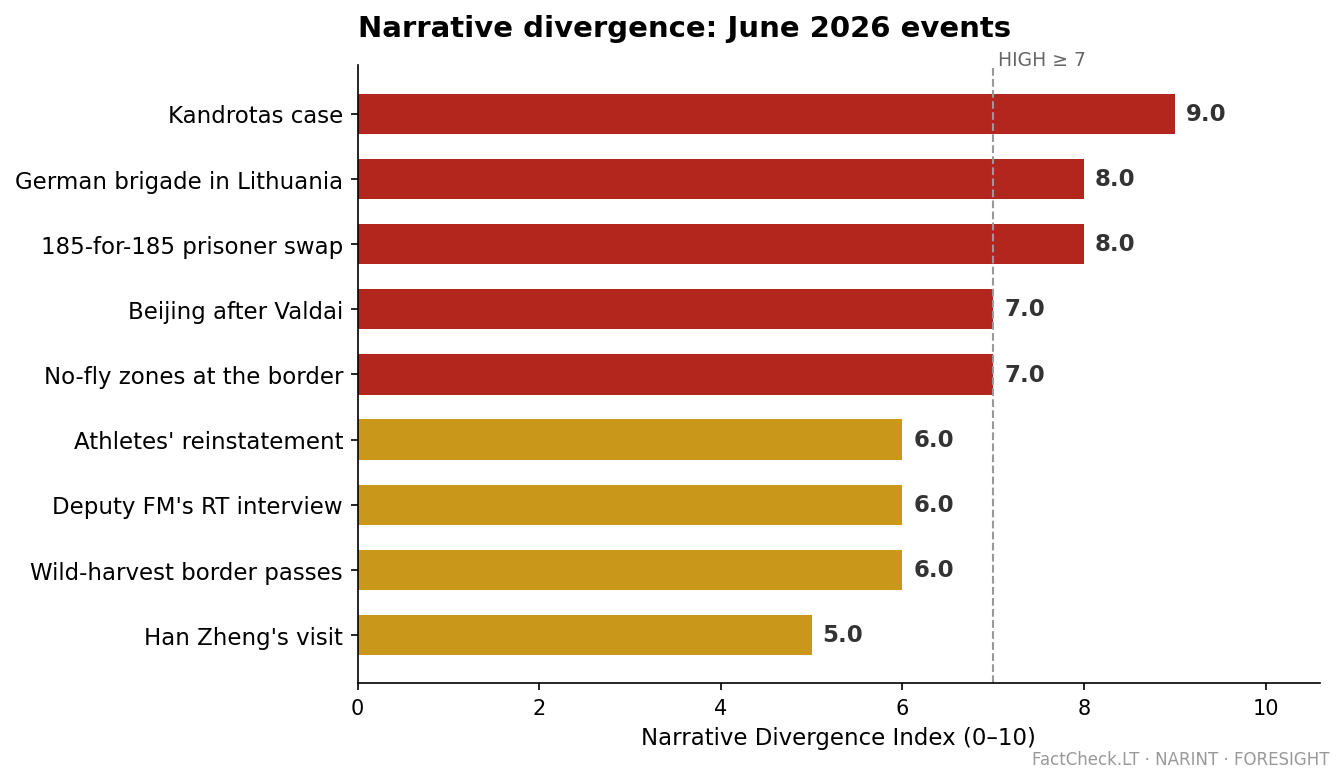
In June 2026, the FORESIGHT platform processed 26,320 publications from 26 sources in five languages, aligned into a single semantic field. The algorithm automatically grouped them into 1,620 events and selected ten that were covered by at least four information environments. For each event we identify the axis of divergence, that is, the central question on which interpretations split, and the position of each environment on a scale from 0 to 10. An event’s NDI equals the spread between the extreme positions: a value of 7 or higher means that audiences of different environments inhabit incompatible versions of what happened.
One important caveat: all of June’s events share a consensus on the basic facts. Nobody disputes that the prisoner exchange took place, that a German brigade is deploying in Lithuania, or that Lukashenka met Xi Jinping. What diverges is not the facts but the frames: what counts as the cause, who counts as the hero, what constitutes the semantic core of the event.
Event of the month: the Kandrotas case. NDI 9.0
June’s largest divergence came from the story of Lithuanian blogger Antanas Kandrotas (Celofanas), who left for Belarus in early May after a Lithuanian appellate court sentenced him to 3.5 years in prison for tax and financial crimes. In June, Lithuanian police announced their intention to seek him through Interpol. These are facts no environment disputes. Beyond them, two incompatible realities begin.
Lithuanian, Latvian and independent Belarusian media (positions 1 out of 10) describe a convicted man who violated his bail conditions, fled the execution of his sentence and became a relay for Kremlin propaganda: Lithuanian investigative reporting points to a coordinated network around Kandrotas and Latvian politician Rosļikovs bearing the hallmarks of an influence operation in the Baltic States. Belarusian state media (position 9) present the same man as an honest Lithuanian entrepreneur and activist persecuted for telling the truth about Belarus: BELTA repeatedly offers him a platform as an expert while entirely omitting the criminal context. Sputnik Belarus (position 10) takes the frame to its limit: the criminal case is presented as revenge for pro-Russian views, and his stay in Belarus as a voluntary business venture rather than flight from justice.
The German brigade in Lithuania: two arithmetics of one deployment. NDI 8.0
Germany is deploying its 45th Armoured Brigade in Lithuania with a target of roughly 5,000 troops by the end of 2027; in June, the Freedom Shield 2026 exercise took place at the Pabradė training ground, 20 kilometres from the Belarusian border, involving about 2,900 soldiers. There the consensus ends, and a textbook case of selective focus begins. Independent Belarusian media (position 1) and Polish outlets (position 2) report a deployment running ahead of its infrastructure schedule, citing satellite evidence of Russian military activity as context. Belarusian state media (position 8) and Russian state media (position 9) cover the same deployment almost exclusively through the Bundeswehr’s recruitment shortfall and the prospect of a return to conscription, presenting it as a symptom of crisis in NATO’s military machine. In that version of events, the ahead-of-schedule progress simply does not exist: two mirrors reflecting different halves of the same picture.
The 185-for-185 prisoner exchange: whose homecoming counts. NDI 8.0
On 5 June, Russia and Ukraine exchanged prisoners under a 185-for-185 formula; the exchange passed through Belarusian territory with the UAE and the United States as mediators. The divergence here lies not in evaluations but in the choice of semantic centre. For independent Belarusian media (position 1), the event consists of Ukrainian defenders returning after years of captivity, with gratitude to the mediators and a separate storyline about Belarusians who fought for Ukraine and remain in Russian captivity. For Belarusian state media (position 8) and TASS (position 9), the event consists of Russian servicemen returning home, with the Russian side labelling Ukraine “territory controlled by the Kyiv regime” and the mediators’ role reduced to a minimum.
Xinhua (position 6) deserves separate attention. Formally, the Chinese agency delivers a neutral chronicle with no evaluation of the parties. In practice, the entire report is built on a single source, the Russian Ministry of Defence: the Ukrainian side does not appear as a source, and the mediation by the US and UAE goes unmentioned. Neutrality of tone turns out to be a bias in source structure. This is a persistent pattern in Chinese coverage of Belarusian affairs, and one we will return to in future issues.
Beijing after Valdai: strength or fear. NDI 7.0
On 29 June, Lukashenka met Xi Jinping in Beijing immediately after closed-door talks with Putin at Valdai; the diplomatic flurry was triggered by Zelensky’s ultimatum over broadcast retransmitters near the Ukrainian border. The visit itself is described by every environment in recognisable tones: Belarusian state media speak of a “historic peak” in relations and the exclusive format of a family dinner hosted by Xi, Xinhua of a mutually beneficial all-weather partnership, independent media of deepening dependence on Beijing amid isolation.
The most interesting development, however, happened around the visit. In the final two days of the month, independent Belarusian, Lithuanian, Polish and Russian state media produced a wave of analysis about the trip’s meaning: was Valdai a dressing-down over the unilateral shutdown of the retransmitters, is Lukashenka seeking a point of support in Beijing beyond Moscow, will the “iron friend” restrain the “elder brother”. Polish outlets (position 9) saw the manoeuvre of a cornered dictator; Russian state media (position 2) an element of coordinated multi-vector diplomacy. Belarusian state media took no part in this analytical wave at all: not a single publication. Official Minsk reported the visit itself, but not what it meant. In this case the silence is measurable, and it is a distinct analytical signal, discussed below.
No-fly zones at the border: relocating the source of threat. NDI 7.0
Lithuania extended 12 restricted airspace zones along the border with Belarus until 1 January 2027. Lithuanian and independent Belarusian media (positions 1) describe a justified defensive measure against the backdrop of hybrid threats and drone incidents. Belarusian state media (position 6) confined themselves to a dry procedural note without polemics. The subtlest work with the frame came from Russian state media (position 8): the report on the extension sits alongside mentions of Ukrainian drones straying off course over the Baltic States. There is no direct polemic, yet the source of the threat is implicitly relocated from Belarus to Ukraine, and the logic of the Lithuanian decision dissolves.
The middle band: four events with NDI 5-6
Athletes’ reinstatement (NDI 6.0). The international federations for weightlifting, skating and shooting lifted restrictions on Belarusian athletes following the IOC’s May recommendations. Belarusian state media and Sputnik speak of full restoration of rights and a victory for Belarusian sport; independent Belarusian and Lithuanian media point out that the admission is neutral, subject to individual vetting, without state symbols, and that the original cause of the sanctions was Minsk’s support for Russian aggression.
The deputy foreign minister’s RT interview (NDI 6.0). A telling case of environments diverging over which news to extract from a single interview. Independent media saw a signal of normalisation with Washington, delivered, characteristically, through a Russian propaganda channel; Ukrainian media ignored the diplomatic part and heard only the threat to use “the full potential” should the border be crossed; Belarusian state media pushed both lines at once, dialogue with the West and the military invulnerability of the Union State.
Simplified border passes for wild harvest gathering (NDI 6.0). The proposal to admit residents of the Ukrainian borderland into the Olmany Marshes reserve is presented by state media as a humane gesture free of political subtext. Independent media recall that similar announcements have been made repeatedly since February 2022 and led to no practical consequences. Ukrainska Pravda reproduces the rhetoric of “friendship and good-neighbourliness” without comment, leaving the reader to weigh it against Belarus’s complicity in the war.
Han Zheng’s visit (NDI 5.0). The most interesting divergence here is measured between allies: Belarusian state media (position 9) insist on the partnership’s uniqueness (“China has never had partners like this”) and cite export growth figures, while Xinhua itself (position 7) places the visit within the standard protocol of leadership diplomacy, without singling out the Belarusian track. The asymmetry of the alliance’s exclusivity is visible from both sides.
The silence map: what state media never mentioned
Alongside measuring divergence, the system tracks asymmetric silence: events covered by at least three external environments with zero coverage in Belarusian state media. June produced two. The first has already been mentioned: the wave of analysis about the meaning of Lukashenka’s Valdai-Beijing tour. The second is dated 10 June: the United States imposed sanctions on a weapons supply network to Iran running through Belarus and China, with restrictions against ten companies and individuals. The event was covered by independent Belarusian and foreign media; Belarusian state media did not mention it once.
The reverse cut, events existing only in the state media environment while everyone else looks away, numbered more than 150 storylines of domestic mobilisation agenda in June: city day celebrations, the fodder harvesting campaign, regular reports to the president, the cancellation ceremony for a stamp marking the SCO’s 25th anniversary. This is a measurable portrait of the domestic agenda the regime constructs for its audience while the outside world discusses something else.
Methodology
Corpus: 26,320 publications from June 2026 across 26 sources in eight information environments and five languages (Russian, Belarusian, Lithuanian, Latvian, Polish, Ukrainian, Chinese in translation), aligned into a single semantic field. Events were identified by automatic clustering of text embeddings with a temporal constraint. Events covered by at least four environments were selected for scoring. The axis of divergence and the environments’ positions were determined by a language model (Claude Sonnet 4.6) reading the material of all environments simultaneously; NDI equals the spread of positions on a 0-10 scale. The environment theses quoted in this issue are analytical paraphrases, not direct quotations. Positions for environments with few materials were flagged during analysis and interpreted with caution. Full scoring data available on request: info@factcheck.lt.
This publication was prepared by FactCheck.LT. NARINT (Narrative Intelligence) is a monthly series based on the FORESIGHT platform.