

The fifth issue of the monthly narrative intelligence series by FactCheck.LT. We automatically compare how the same event is presented across information environments: Belarusian state and independent media, the media of Lithuania, Latvia, Poland and Ukraine, and Russian state media. The Narrative Divergence Index (NDI) measures how far apart the interpretations have drifted; a separate piece in this series explains how to read the index.
October in one paragraph
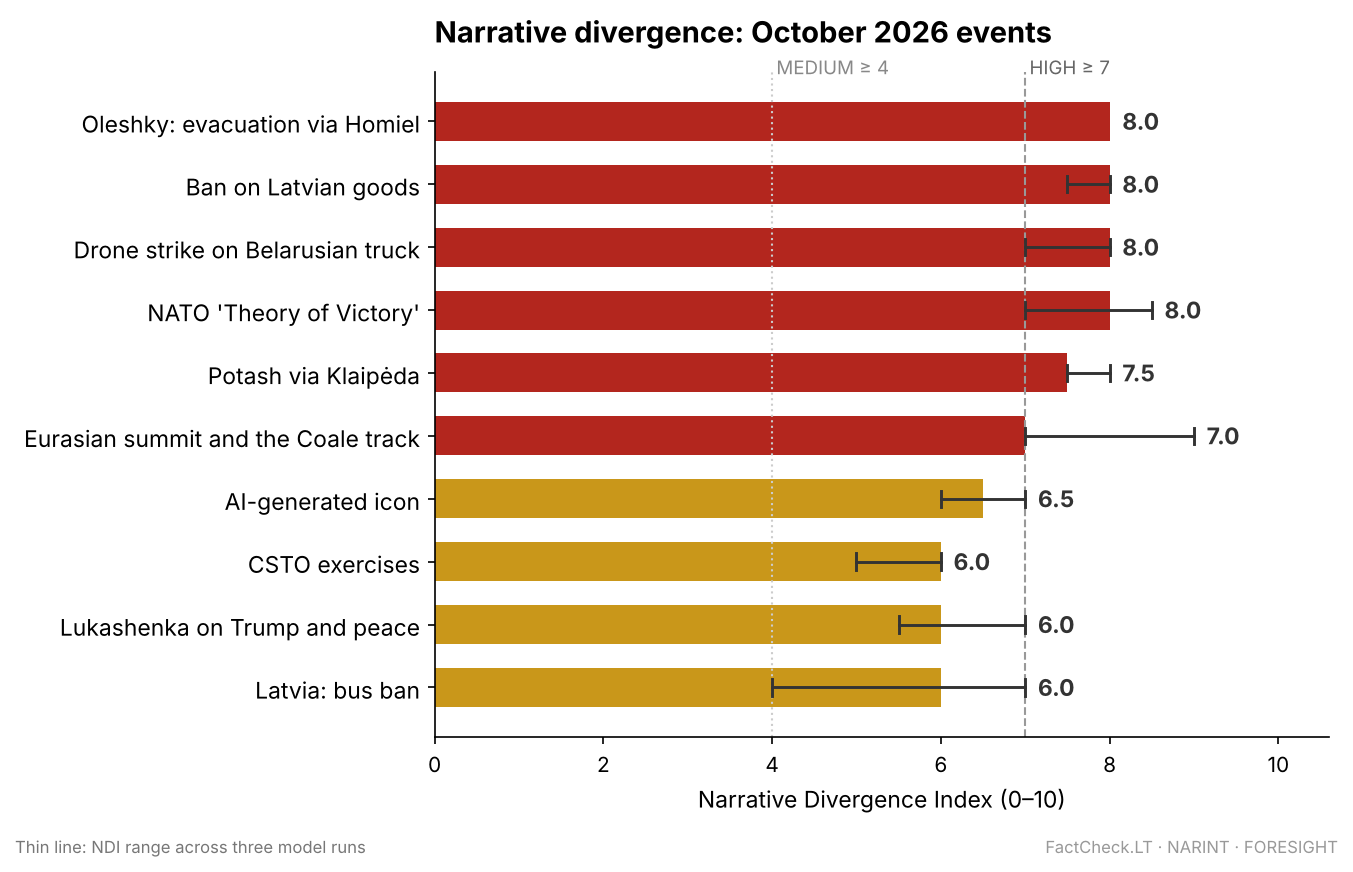
The FORESIGHT platform grouped October’s stream from 26 sources into 1,611 events; ten went through scoring, six reached the HIGH level, and four scored the month’s maximum of 8.0. For the first time in five issues, all ten events were covered by both Belarusian and Russian state media, and the average NDI returned to the level of June and July. One image runs through the month: in six of the ten events Belarusian state media show Belarus as a peacemaker, a reliable partner or a peaceful country under threat, and at that end of the scale Minsk more often stands further out than Moscow. A second technique continues September’s: the fact is reported, while the condition or context that changes its meaning stays out of frame. The gap between Belarusian and Russian state media is the narrowest in five months, and the silence map is empty: its only candidate did not hold up on checking.
Oleshky via Homiel: from transit point to peacemaker. NDI 8.0
With Melania Trump as mediator, Russia and Ukraine agreed on a ceasefire in occupied Oleshky in the Kherson region from 27 October to 1 November, to deliver aid and evacuate residents. Belarus became the platform of the operation: on 29 October Homiel hosted the first face-to-face meeting of the Russian and Ukrainian delegations, and on 31 October three planes brought residents who wished to leave for Ukraine from Anapa to Homiel, from where they crossed the border into the Chernihiv region. With 185 documents, it is second in coverage among the top ten, behind only the Eurasian cluster.
The event’s axis: a limited humanitarian evacuation from an occupied Ukrainian city mediated by the United States, with Belarus only a transit point (0), or a historic peacekeeping mission with a key role for Belarus and Russia, where the crisis was caused by Kyiv’s shelling (10). The result is stable: all three runs gave 8.0. Lithuanian, Latvian and Ukrainian media (1) write a chronicle of people coming home; the Latvian ones centre on Zelensky’s thanks to the United States and Melania Trump. Belarusian independent media (2) stress the occupation, hunger and mined roads, and those who returned describe what they got out of. Russian state media (8) explain the humanitarian crisis by Kyiv’s shelling and tell of Russian Aerospace Forces planes and Belarusian hospitality. Furthest out are Belarusian state media (9): for them Belarus is a key participant and guarantor. ONT runs a piece titled “Peacemaking in action”, and BELTA presents Belarus “as one of the active organisers of this international process”.
Minsk stands further out than Moscow here in all three runs. The Russian version tells of its own planes and of someone else’s shelling; the Belarusian one tells of itself: a transit platform turns into a peacemaker. A caveat: the Lithuanian, Latvian and Ukrainian positions rest on few documents.
Belarus bans Latvian goods: a response without the border context. NDI 8.0
On 19 October the Belarusian government banned imports of some Latvian goods, from canned fish to industrial products, explaining the decision by the Latvian side’s continued “unconstructive approaches and unfriendly rhetoric”. The full list has not been published. The axis: a lawful response to Latvia’s unfriendly policy (0), or a punitive element of hybrid pressure linked to the regime’s own provocations on the border (10). Belarusian state media (1) reproduce the government’s wording; ONT states plainly that the government “adopted retaliatory economic measures”. Russian state media (1.5) trace the story back to the September extension of Latvian bans, which this series covered a month ago: Minsk’s decision looks like a symmetric response. The Russian and Latvian positions rest on few documents.
At the other end are Lithuanian (8.5) and Latvian (9) media. The Lithuanian ones put the official reasoning in quotation marks and immediately recall that in early October masked men crossed the Latvian border, damaged border equipment and returned to Belarus. The Latvian environment hardly discusses the ban itself: at its centre is the case the Latvian prosecutor’s office has been pursuing since July, and the prosecutor’s words that uniformed people on the Belarusian side control migrants’ payments and, under threat of maiming, force them to break border equipment. Belarusian independent media (5) stand in the middle: they relay the official announcement and add context from both sides. In Belarusian state media’s coverage of this ban, the border crisis is not mentioned at all. It is the same context isolation as in September: the response is shown, what it responds to is cut out.
A drone and a Belarusian truck in the Bryansk region: whose strike. NDI 8.0
On 8 October in Russia’s Bryansk region a drone hit a truck with Belarusian registration; a Belarusian citizen was seriously injured and had limbs amputated. On 9 October the Belarusian foreign ministry summoned Ukraine’s chargé d’affaires Ivan Novytskyi, handed him a note of protest and said it reserved “the right to adequate response measures”. Kyiv responded with a protest against attempts to present Ukraine as a source of threats. The axis: an incident with unestablished responsibility, where the Ukrainian trace and intent are only Minsk’s claim (0), or a proven deliberate strike by the Ukrainian armed forces in a campaign to drag Belarus into the war (10).
Polish media (1) present the Ukrainian attribution with caveats: the strike is called alleged, and Ukraine’s authorship is given as Belarus’s claim. This position rests on few documents, and without it the gap would be 6 points. Belarusian independent media (3) write about a drone attack without naming the side and report that Minsk accused Kyiv. Belarusian state media (8) put the drone’s Ukrainian origin in headlines as fact and frame the intent as Minsk’s conclusion: the Belarusian side, BELTA writes, has grounds “to regard the attack as deliberate”. Furthest out are Russian state media (9): the strike is attributed to the Ukrainian armed forces without caveats, the June attack on a bus with young Belarusian footballers is presented as part of the same series, and TASS puts the claim of an attempt to drag Belarus into the conflict in its headline. This is the only event this month where Moscow stands further out than Minsk, and only in two runs of three; in the third they coincide. In a story about the war itself, the Russian version is harsher. The series has met this topic before: the July strike on the Minsk–Anapa bus also scored 8.0 in the recomputed series. October’s runs gave 7, 8 and 8.
NATO’s plan and strikes on Belarus: the condition cut out. NDI 8.0
On 12 October at the Warsaw Security Forum, NATO’s Supreme Allied Commander Europe Alexus Grynkewich presented the “Theory of Victory” concept for the case of a Russian attack. As Meduza summarises the plan, citing the Wall Street Journal, drones and ground robots would hold back an advance, while long-range missiles would strike command posts and air defences in the Kaliningrad region, near St Petersburg and in Belarus. On 14 October the Belarusian foreign ministry’s spokesperson Ruslan Varankov condemned the plan. The axis: a defensive plan of retaliation, applied only if Russia attacks (0), or an aggressive plan of pre-emptive strikes on sovereign Belarus (10).
The whole divergence rests on one condition. Belarusian independent media (1.5) put it in the headline: Nasha Niva writes that the NATO commander described a strategy in case of a Russian attack. In their coverage, strikes on Belarus are possible only as a response to Russian aggression: a country turned into a staging ground becomes a battlefield. Polish media (2) present Minsk’s protest as part of Russia’s information war. Belarusian state media (9.5) drop the condition and shift the details: in the foreign ministry’s version as relayed by BELTA, the plan provides for “pre-emptive strikes on the territory of Belarus using drones and ground robotic systems”, whereas “Belarus has never threatened anyone”. Drones and robots from the defensive part of the plan become weapons for strikes on Belarus. In SB, experts are already discussing NATO’s plans to deliver pre-emptive strikes. Russian state media (9) relay the Belarusian criticism in full and also cast doubt on the very premise of a Russian threat, putting the words about a potential attack in quotation marks. Both state positions rest on few documents; the runs gave 8, 7 and 8.5.
Potash via Klaipėda: Lithuania’s refusal and Belarus as indispensable. NDI 7.5
According to Politico, citing four European officials, the US special envoy for Belarus John Coale sounded out Lithuania’s readiness to ease the ban on Belarusian potash transit through Klaipėda. EU sanctions are renewed every year, and Lithuania as the next holder of the EU Council presidency could in theory block a renewal, but the Lithuanian leadership says it refuses. The axis: US pressure is illegitimate, sanctions must stay, and the potash deal with Minsk is an illusion (0), or Belarusian potash is indispensable to the world and the sanctions blockade is pointless (10). Lithuanian media (1) relay a unanimous refusal: the president’s adviser, the foreign minister and the prime minister say transit is impossible. Belarusian independent media (2) call the potash deal a bluff: there are no spare volumes, and the route via Russia eats up the price advantage. Latvian media (2.5) retell Politico, stressing Lithuania’s reliability as an ally of Ukraine.
Russian state media (7.5) present Vilnius’s refusal as stubbornness while supplies go ahead without it: Sputnik recalls that a first consignment of 30,000 tonnes has already reached New Orleans. Belarusian state media (8.5) move the conversation to another plane: Belarusian potash is presented as a contribution to global food security and a merit of the country’s leadership, without mentioning sanctions or Lithuania. Both state positions rest on few documents, but the direction is telling: where the story is about Belarus being indispensable, Minsk again stands further out than Moscow.
The Eurasian summit and the Coale track: two stories in one. NDI 7.0
On 1–2 October Minsk hosted meetings of the Eurasian Intergovernmental Council and the Union State Council of Ministers and the “Innoprom. Belarus” exhibition; Lukashenka met Kazakhstan’s prime minister Bektenov. The algorithm merged these events with a parallel story about Minsk’s talks with the US special envoy, and the cluster held 293 documents. The model’s axis turned out to be about Minsk’s foreign policy: a regime’s forced bargaining, political prisoners in exchange for concessions while staying dependent on Moscow (0), or successful integration as equals and reliable partnership (10). Belarusian state media (9) write about partnership: in the words of Kazakhstan’s prime minister, Belarus is “a reliable and time-tested partner”, and the two countries have 16 joint industrial projects. Russian state media (9) speak of exemplary integration in the Union State and the EAEU. Belarusian independent media (3) cover the Eurasian contacts with restraint and see the main story elsewhere: Lukashenka’s bargaining with Washington and the fate of political prisoners, who risk being left without attention if the envoy switches to Russia. Polish media (2, on few documents) write about prisoners as bargaining chips. In their coverage of this story, Belarusian and Russian state media do not mention the US track or political prisoners.
The divergence here comes from the selection of topics, not from judging one fact, and this affects stability: the runs gave 7, 9 and 7, and in one of the three the model reversed the direction of the scale. The HIGH level holds in every run, but the figure itself should be read as approximate.
The middle zone: four events with NDI 6 to 6.5
An icon made with AI (NDI 6.5). On 11 October Archbishop Emeritus Tadeusz Kondrusiewicz blessed, in the church in Novolukoml, an image of Saint Carlo Acutis created with artificial intelligence. The axis: a legitimate church innovation, described through the saint’s symbolism and mission (0), or a contested act that provoked protest from believers (10). Belarusian state media (1) describe the image’s symbolism in detail; Russian ones (1.5) write about a cyber-apostle and God’s influencer and about the first such icon in Belarus. Belarusian independent media (4) present a curious precedent and mention criticism from some believers in second place. Lithuanian (7) and Polish (7.5) media build their stories around that criticism. There is no politics here, which makes the mechanism all the clearer: the divergence comes not from judgement but from the decision whether to include the dissenters. The runs gave 7, 6.5 and 6, so the level moves between HIGH and MEDIUM, and the Lithuanian and Polish positions rest on few documents: without them the NDI would drop to 3.0.
CSTO exercises (NDI 6.0). On 12–16 October Belarus hosted the “Unbreakable Brotherhood 2026” and “Barrier 2026” exercises with Belarus, Kazakhstan, Kyrgyzstan, Russia and Tajikistan: more than 1,500 troops, over 300 pieces of equipment and about 80 drones; the declared tasks were a peacekeeping operation and dealing with biological threats. Belarusian state media (1) present the exercises as routine peacekeeping training aimed at no one. Belarusian independent media (4) mostly retell the defence ministry with moderate distance. Russian state media (5) openly place the exercises in the logic of deterring an aggressive West. Lithuanian and Ukrainian media (7) put the declared peacekeeping goals in quotation marks and stress that Russia and its allies are starting exercises in Belarus. This is the only event this month where the gap between Minsk and Moscow reaches four points, but only in one run of three; in the other two it was 2 and 1. Here too Minsk stands at the edge of the scale: by acknowledging the military logic of the exercises, the Russian version ends up closer to the Lithuanian and Ukrainian ones than the Belarusian version does. The Lithuanian and Ukrainian positions rest on few documents; without them the NDI would be 4.0.
Lukashenka on Trump, Zelensky and the timing of peace (NDI 6.0). On 16 October in the Verkhniadzvinsk district Lukashenka said that Trump should not dictate who is to be Ukraine’s president, but reminded Zelensky of his promise to serve only one term and predicted peace if not this year, then next. Belarusian state media (1) show a wise, independent leader who defends Ukraine’s sovereignty and warns countries that imagine themselves all-powerful. Russian ones (2) see a sober mediator. Polish media (5) note the ambiguity. Belarusian independent media (7) put his words about Russia’s exhaustion in the headline and recall that Lukashenka himself did not keep his 2020 promise to step down after a new Constitution; Ukrainian media (7) are close by. The Russian, Polish and Ukrainian positions rest on few documents, but the NDI is set by the two Belarusian environments. The runs gave 6, 5.5 and 7, so the event’s level moves between MEDIUM and HIGH.
Latvian buses, round two (NDI 6.0). Latvia extended to 31 October 2027 its ban on irregular bus services to Belarus and Russia; amendments are being prepared to stop bus services entirely from 10 January 2027. Latvian media (1) relay the official rationale: to keep security measures in place without a legal gap. Belarusian independent media (4) write about the consequences for passengers; Zerkalo recalls that the Latvian authorities themselves admitted that “such trips cannot be stopped completely by national restrictions alone”. Lithuanian media (5) give a brief note. The Latvian position, which sets the edge of the scale, rests on few documents, as do the Lithuanian and Russian ones. Belarusian and Russian state media (7) drily list dates and border crossings and leave out Latvia’s reasons, so the ban looks unmotivated. This is the least stable score of the month: the runs gave 6, 4 and 7, and in one the model flipped the axis. In September the same topic scored 4.0. The divergence here lies in selection, not in direct judgement, and the figure of 6.0 should be read as MEDIUM with a large margin of error.
The silence map: the candidate did not hold up
In October the algorithm found only one candidate for asymmetric silence: a story about the first consignment of Belarusian potash for the United States since 2021, shipped through the port of St Petersburg. The cluster holds eight documents from Lithuanian, Polish, Russian state and Belarusian independent media, and none from Belarusian state media. Checking showed there is no silence: state media did write about the shipments, but in pieces the algorithm assigned to other events. On 22 October, for instance, BELTA reported that “one cargo of our potash is already in the port of New Orleans”. We publish this case because the silence map is built from clusters, and a cluster does not always cover a whole topic. October’s map is empty; neither of September’s two topics, the drone relay stations and the border tunnels, made October’s top ten.
The reverse view, the domestic agenda that exists only in state media, counts 133 stories after regular rubrics such as horoscopes and news round-ups are removed. These include a welcome week for foreign students at the Belarusian State University and hockey, the anniversary of the first All-Belarusian People’s Assembly, trade and tourism with China, volunteers of the BRSM youth union, the “Every Third” memory project and a “Star Chanson” concert. A separate strand on other countries’ troubles stands out: Britons urged to stock up on essentials, staff cuts in Polish hospitals, protests by secondary school students in France.
Minsk and Moscow: the October reading
Each event is scored in three runs of the Claude Opus 5.5 model; monthly averages are given with the range across runs. Positions of different events are not compared with each other: each event has its own axis and its own direction of the scale. Distances between environments are comparable. Average NDI across the ten events: 7.1 (6.9 to 7.4; June 7.1, July 7.0, August 6.3, September 5.7). Gap between Belarusian state and independent media: 5.1 (4.9 to 5.4; June 5.9, July 5.6, August 4.7, September 4.5). Gap between Belarusian and Russian state media: 0.9 (0.7 to 1.1; June 1.5, July 1.8, August 2.2, September 1.4).
In October Minsk and Moscow told almost the same story. For the first time in five months both state environments are present in all ten events, and in nine of them their positions differ by no more than a point. The only exception, the CSTO exercises, rests on one run of three. Even the widest October run (1.1) is narrower than the narrowest September run (1.2): this is the narrowest gap in five months. The difference has shifted to emphasis, and almost always in one direction: where the positions diverge, it is usually Minsk that stands at the edge of the scale, including on the NATO plan and the CSTO exercises. Moscow is further out only in the truck story, and only in two runs of three. The caveat stands: Moscow’s position in five of the ten events rests on few documents.
The gap within Belarus is again above five points on average after two months below that mark, but one run of three gave 4.9, so October sits on the line rather than above it. It is far from four points, which we named in advance as the sign of a real shift in the media field. The wide gaps fell on stories about war and about Belarus’s image: the NATO plan (8), Oleshky (7), potash (6.5), the Eurasian summit and Lukashenka’s comments (6 each). The narrow ones, four points or less, fell on four events where independent media kept to neutral reporting: Latvian goods, the CSTO exercises, the icon, the buses. These are monthly values, not a trend: the events in the top ten differ every month.
Takeaways of the month
First: the platform becomes a peacemaker. In six of the ten events Belarusian state media build one image of the country. In Oleshky Belarus is the organiser and guarantor of the mission, in the NATO plan a peaceful country threatened with pre-emptive strikes, in the CSTO exercises a participant in peacekeeping training aimed at no one, in Lukashenka’s statement a wise forecaster of peace, at the Eurasian summit a reliable partner, in the truck story a victim of someone else’s escalation. In four of these six events Minsk stands further out at the edge of the scale than Moscow. For the reader this gives a practical rule: where Belarus was a platform, state media in October wrote about it as a party, and the most peaceful one.
Second: the condition is cut out. The technique we saw in September in the report on Ukraine’s border regime was repeated five times in October. The NATO plan is retold without the words “in case of a Russian attack”, the ban on Latvian goods without the border crisis, Latvia’s bus ban without Latvia’s reasons, potash without sanctions and Lithuania, the Eurasian summit without the US track and political prisoners. Almost all of these pieces are accurate in what they report, except the retelling of the NATO plan, where details are shifted too; what changes the meaning is above all what is missing. Such texts are worth checking not by their tone but by asking: under what condition does this happen, and what came before it?
Third: Minsk and Moscow are closer than ever in the series, but not identical. An average gap of 0.9 and nine events of ten within a point mean that the two state environments essentially tell one story. The difference remains in emphasis: where the positions diverge, Minsk almost always stands at the edge of the scale, and the Belarusian version speaks above all of peace and of itself. For the analysis of influence this matters more than the average: the general line coincides, but Minsk builds the image of Belarus itself.
Fourth: the margin of error has grown. When the model was calibrated on forty events from June to September, only one event’s three runs differed by more than a point. In October four of the ten did: the buses (4 to 7), the Eurasian summit (7 to 9), the NATO plan and Lukashenka’s comments (1.5 points each). Three events change level from run to run. The overall picture is nevertheless stable: the four events at the top scored 8.0 with a spread of no more than one and a half points, and the monthly averages vary within half a point. The unstable ones are above all the events where the divergence comes from the selection of topics rather than from judging one fact, and we flag this for each of them. A second source of uncertainty: in the icon, the buses and the CSTO exercises the edge of the scale is set by environments with few documents, and without them the NDI would drop to 3 or 4 points.
Methodology
The full October stream of 26 sources in five languages, aligned into a single semantic field, was automatically grouped into 1,611 events; ten events covered by at least four environments were selected for scoring. The axis of divergence and the environments’ positions are determined by a language model, Claude Opus 5.5, reading the material of all environments simultaneously; each event is scored in three independent runs. An event’s NDI equals the distance between the two most distant environments on a 0-10 scale; for each event the issue gives the median run, so the figure and the positions in the text come from the same run. Monthly averages are computed across all runs and given with their range. Each event has its own axis and direction, so positions of different events are not compared; distances are. The series of averages since June has been computed with the same model in the same way. The environment theses are analytical paraphrases; quotes were checked against the original publications, and key facts were verified against external sources. In all ten events at least one environment published few documents; such positions are flagged and interpreted with caution. The silence map is built from clusters and checked by hand. Regular rubrics are excluded from the domestic agenda figure. Full scoring data available on request: info@factcheck.lt.