

A corpus analysis of 1 million+ documents reveals how BELTA evolved Orbán’s image through four phases — from technical cooperation to emotional friendship to political leverage — while independent media saw the same politician as an EU obstructor blocking aid to Ukraine.
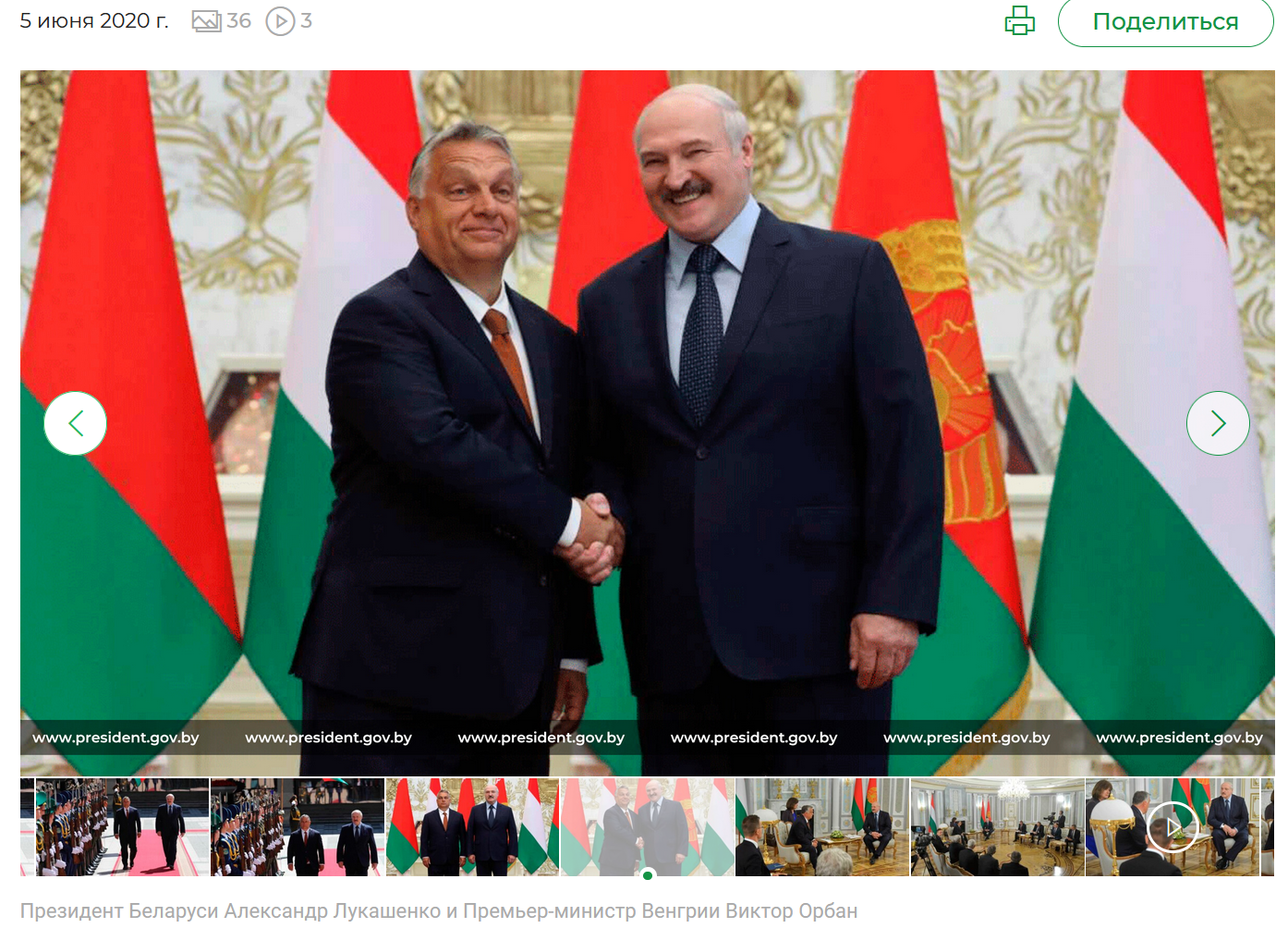
https://president.gov.by/ru/media/details/peregovory-s-premer-ministrom-vengrii-viktorom-orbanom-1591375023
|
81%
BELTA “friendship” frame for Orbán in 2023
|
7%
Same frame in Zerkalo — same year
|
53x
Max BELTA/independent Szijjártó amplification
|
100%
BELTA Szijjártó mentions = Belarus context
|
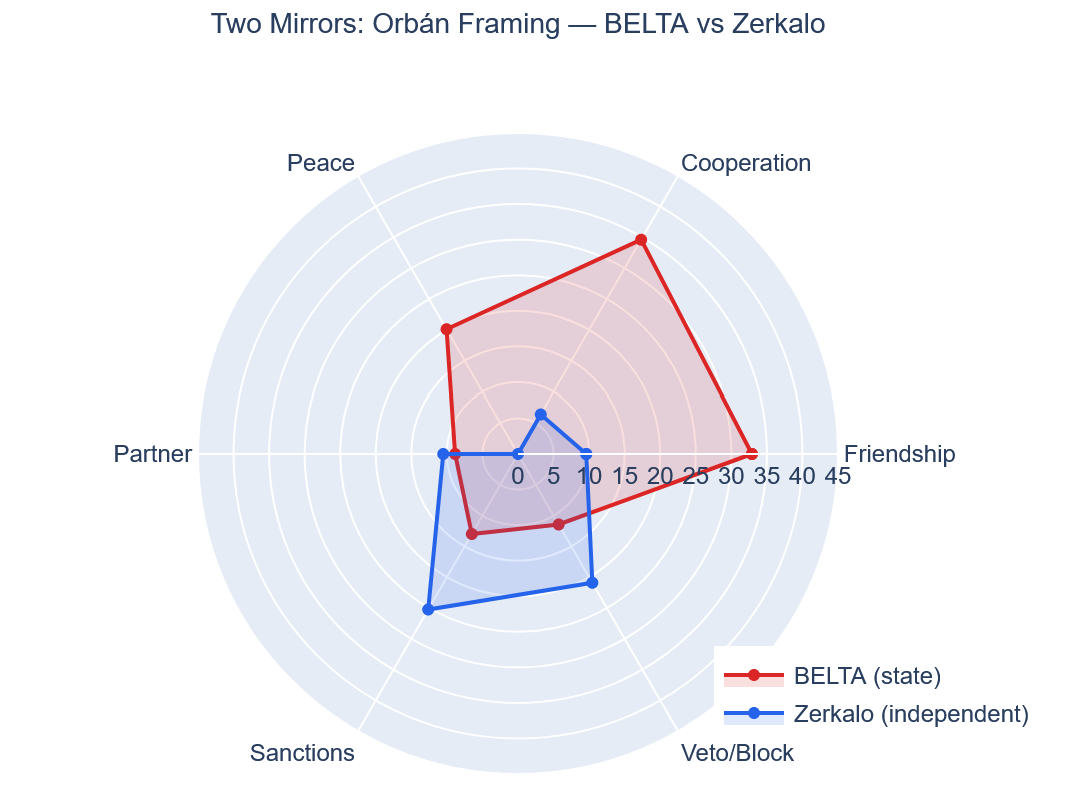
• BELTA framed Orbán as a “friend” in 81% of articles in 2023 — the year Hungary’s FM Szijjártó made his first post-2020 visits to Minsk. In independent Zerkalo, the same politician in the same year was framed through “sanctions” (28%). Same events, opposite portraits.
• Szijjártó is an instrument, not a newsmaker. BELTA amplifies him 3–53x compared to independents (normalized per 1,000 documents). 100% of BELTA’s Szijjártó mentions are Belarus-related. In 2024, Szijjártó (26.6‰) exceeded Orbán himself (10.8‰) in BELTA — a minister of foreign affairs’ visit to Minsk mattered more than the PM.
• Four-phase narrative evolution: BELTA’s framing shifted from “cooperation” (2020–22) → “friendship” (2023–24) → “leverage” (2026, pipeline Druzhba as a tool to block EU aid to Ukraine).
• BELTA mentions Hungary 1.6x more than independents in 2025 (22.8‰ vs 14.4‰ normalized per 1,000 documents). However, in specific political contexts — Szijjártó visits, pipeline crisis — the amplification reaches 13–53x.
• Pipeline Druzhba became a political weapon in 2026: BELTA published 97 articles about the pipeline in February 2026 alone, with 47% mentioning Hungary and 39% mentioning blocking/veto — framing the energy crisis as leverage for Orbán’s blockade of €90 billion EU aid to Ukraine.
1. Szijjártó: Instrument, Not Newsmaker
Péter Szijjártó, Hungary’s Minister of Foreign Affairs and Trade, is virtually unknown to Belarusian audiences. Yet BELTA has turned him into one of the most amplified Western politicians in its coverage — exclusively in the context of his visits to Minsk.
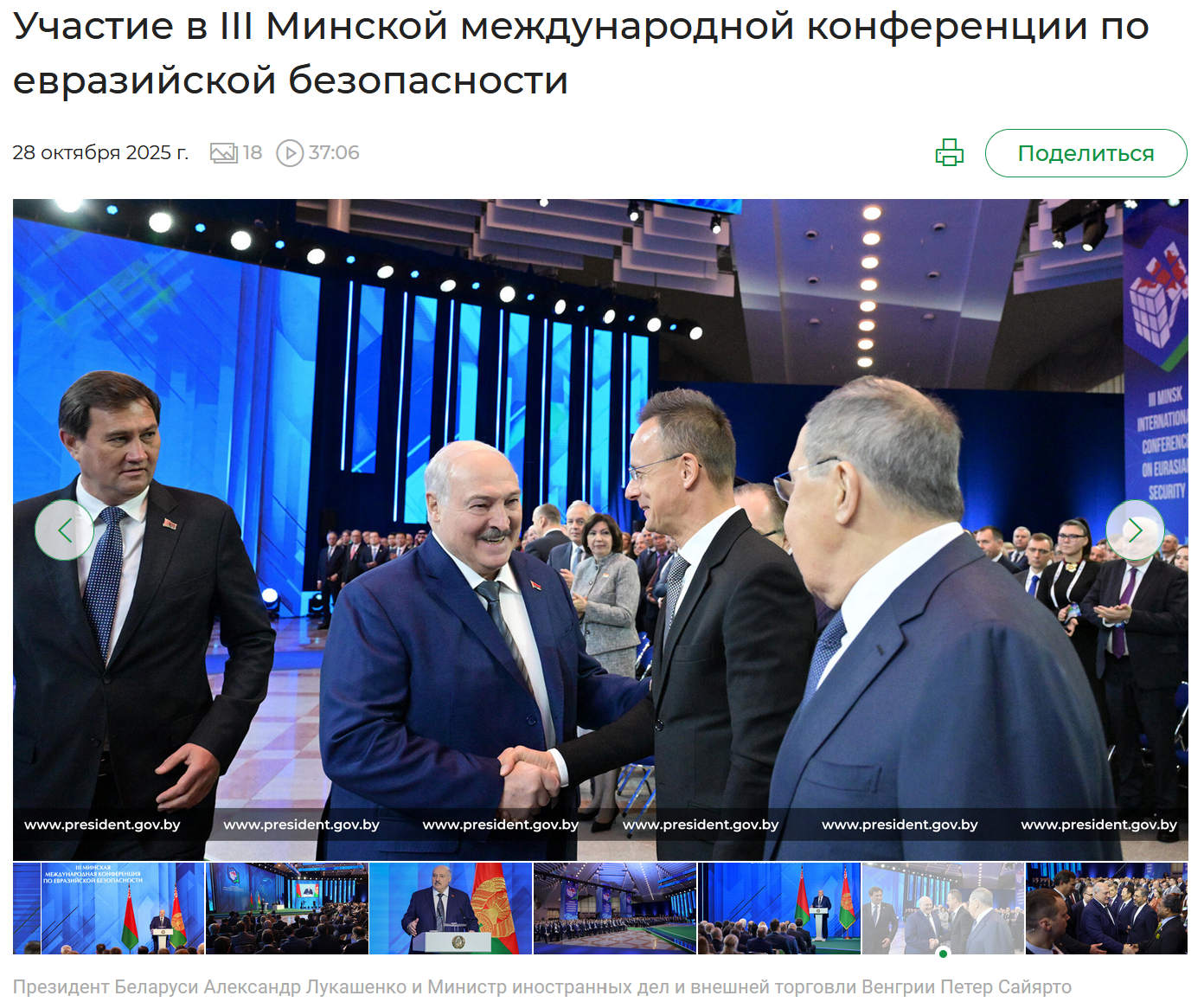
https://president.gov.by/ru/media/details/ucastie-v-iii-minskoj-mezdunarodnoj-konferencii-po-evrazijskoj-bezopasnosti
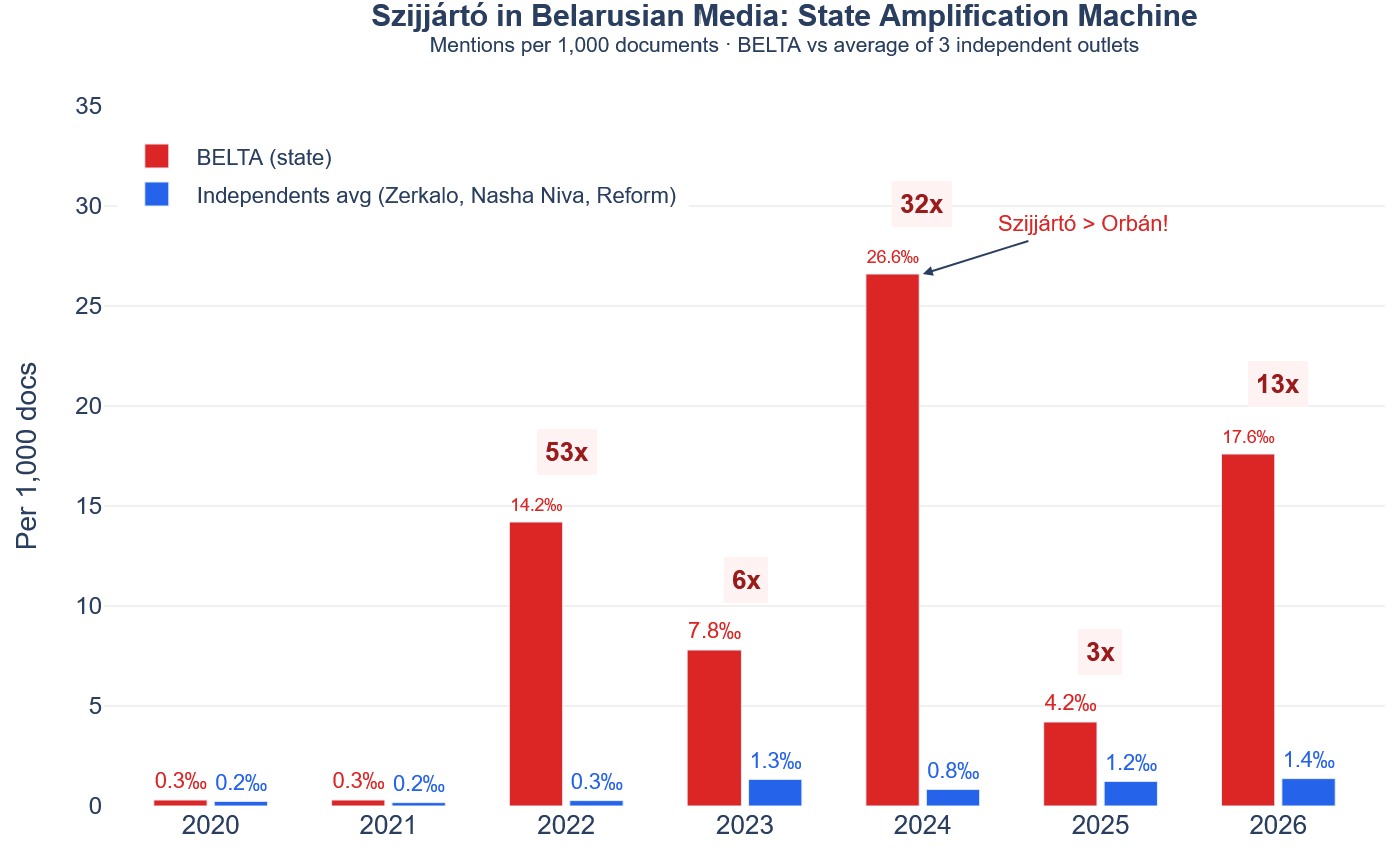
Szijjártó mentions: BELTA vs independents (per 1,000 docs)
| Year | BELTA ‰ | Independents ‰ | Ratio | Context |
|---|---|---|---|---|
| 2020 | 0.3 | 0.4 | 1x | Pre-crisis: nobody covers him |
| 2022 | 14.2 | 0.3 | 53x | War starts; Hungary blocks sanctions |
| 2023 | 7.8 | 1.3 | 6x | First Szijjártó visit to Minsk (Feb) |
| 2024 | 26.6 | 0.8 | 32x | Two visits (May + Oct); exceeds Orbán |
| 2025 | 4.2 | 1.2 | 3x | Between visits |
| 2026 | 17.6 | 1.4 | 13x | Druzhba pipeline crisis |
100% of BELTA’s Szijjártó mentions are Belarus-related. BELTA does not cover him as an EU minister of foreign affairs or a participant in international summits. For BELTA, Szijjártó exists only as “the Hungarian who comes to Minsk.”
2024: When the minister exceeded the PM
In 2024, Szijjártó’s normalized mention rate in BELTA (26.6‰) exceeded Orbán’s (10.8‰). In Zerkalo the same year: Orbán 8.7‰, Szijjártó 0.7‰. For state media, a minister of foreign affairs’ visit to Minsk was bigger news than the Prime Minister himself. For independents, it was a routine diplomatic note.
| BELTA: Szijjártó 2024 | 26.6‰ | |
| BELTA: Orbán 2024 | 10.8‰ | |
| Zerkalo: Orbán 2024 | 8.7‰ | |
| Zerkalo: Szijjártó 2024 | 0.7‰ |
Szijjártó visited Minsk at least six times since the 2020 crackdown: February 2023 (first EU official to visit post-sanctions), October 2023 (met Lukashenko, signed nuclear cooperation memorandum), May 2024 (intergovernmental commission, declared “fewer sanctions, more cooperation!”), October 2024 (II Minsk Eurasian Security Conference alongside Lavrov), September 2025 (intergovernmental commission with 17 Hungarian companies), and October 2025 (III Minsk Eurasian Security Conference, again alongside Lavrov). Hungary is the only EU member state with an ambassador who presented credentials to Lukashenko after 2020.
BELTA and Zerkalo both write about Orbán — but in entirely different frames. The framing table below shows the percentage of Orbán-mentioning articles that contain each keyword cluster. Data is verified: “friendship” was separated from pipeline “Druzhba,” and “peace” was refined to exclude “world” contexts.
|
BELTA — Orbán as Friend (2,578 docs)
|
Zerkalo — Orbán as Obstructor (883 docs)
|
BELTA’s top frames — friendship, cooperation, peace — are virtually absent from Zerkalo. Zerkalo’s top frames — sanctions, blocking, veto — are minimized in BELTA. The overlap is almost zero. Two media systems looked at the same politician and constructed two entirely different figures: a peacemaker-friend vs. an EU obstructor.
3. Four Phases: How BELTA Built Hungary’s Image
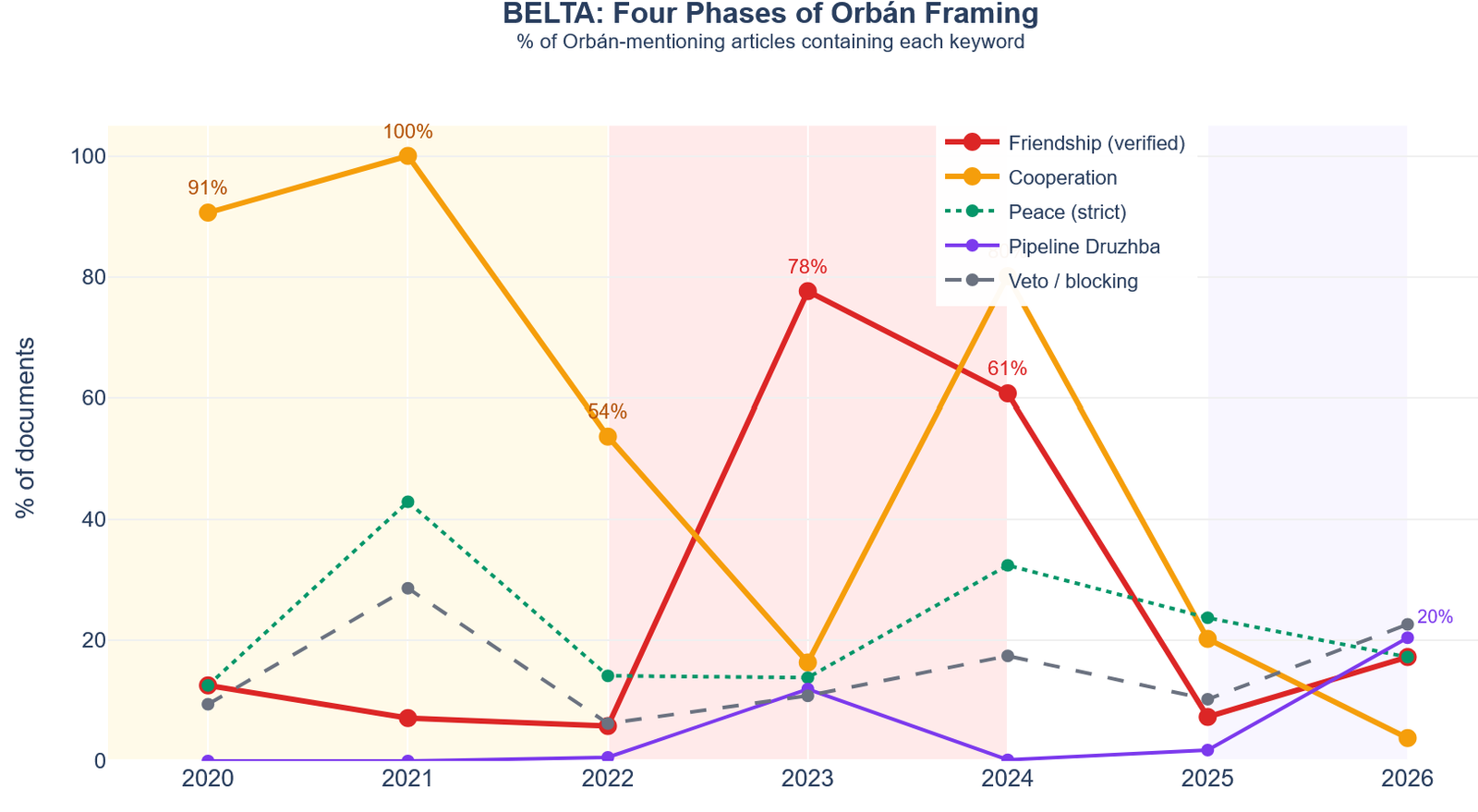
BELTA’s Orbán framing was not static. It evolved through four distinct phases, each serving a different political function. The data below shows the dominant frame in each period — the percentage of BELTA’s Orbán-mentioning articles containing that keyword.
| Phase | Period | Dominant frame | Function | Trigger |
|---|---|---|---|---|
| 🔶 Cooperation | 2020–2022 | cooperation 54–91% | Technical: “we work together” | Post-2020 isolation, need for EU contact |
| 🔴 Friendship | 2023–2024 | friendship 72–81% | Emotional: “they are our friends” | Szijjártó visits to Minsk (Feb + Oct 2023) |
| 🔶 Cooperation | 2024 | cooperation 80% | Institutional: intergovernmental commission | Szijjártó visit May 2024, nuclear deals |
| 🟣 Leverage | 2026 | pipeline 20% + veto 23% | Instrumental: “they block for us” | Druzhba crisis, Orbán blocks €90B for Ukraine |
The friendship spike is the most striking feature. In 2022, 11% of BELTA’s Orbán articles used friendship framing. By 2023, it was 81% — a 7-fold increase that precisely coincides with Szijjártó’s first post-2020 visit to Minsk in February 2023 and his meeting with Lukashenko in October 2023. This was a deliberate editorial decision: BELTA reframed the Hungary–Belarus relationship from a technical (“cooperation”) to an emotional (“friendship”) register.
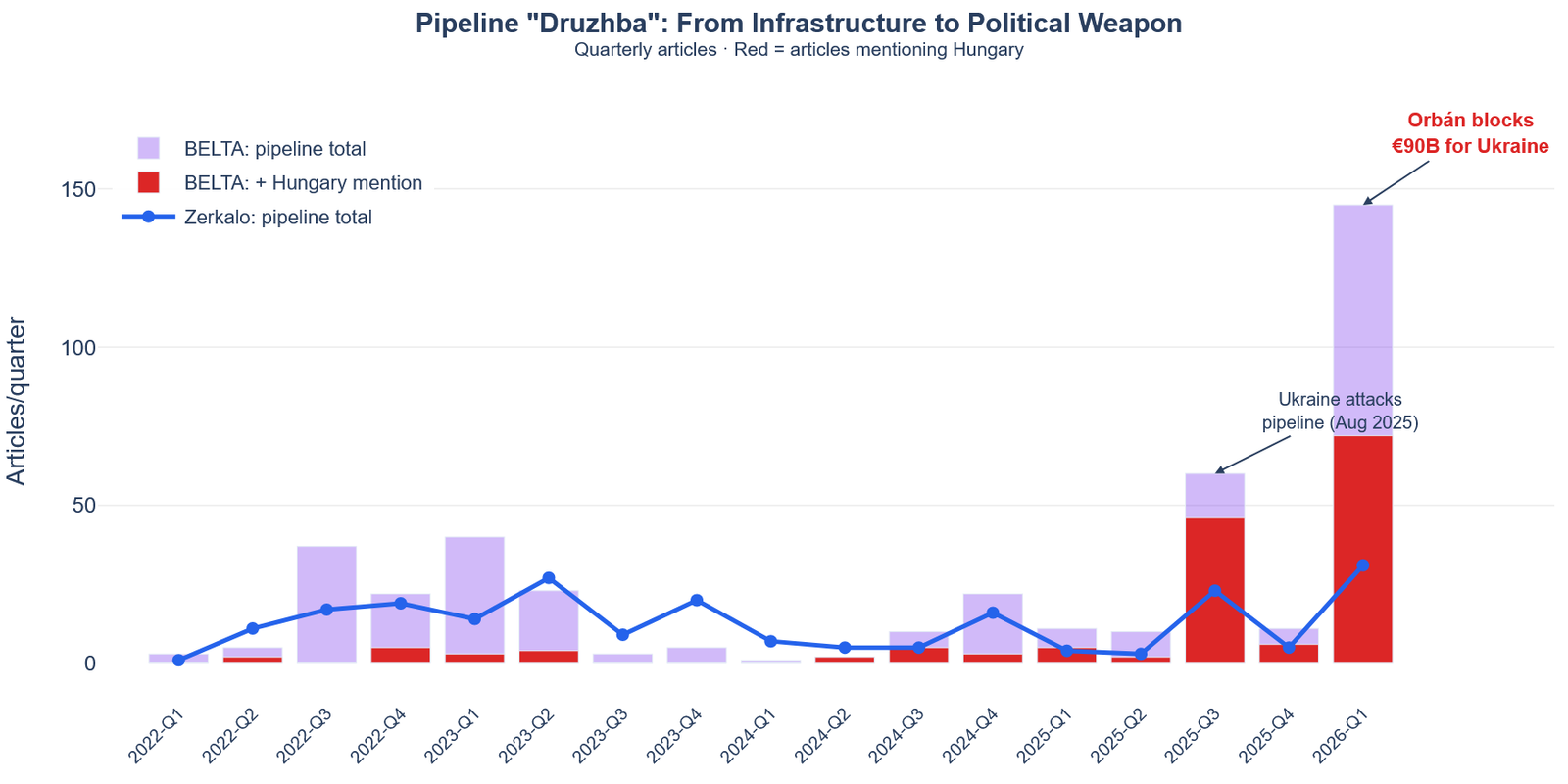
The Druzhba oil pipeline — “Friendship” in Russian — carries Russian crude to Hungary and Slovakia through Ukraine. In 2025–2026, it became the focal point of a new narrative: Hungary blocking EU aid to Ukraine over pipeline disruptions.
BELTA: pipeline article peaks
| Feb 2026 | 97 articles | |
| Mar 2026 | 47 articles | |
| Aug 2025 | 46 articles | |
| 2022–2023 avg/month | 6 articles |
Narrative shift: from infrastructure to leverage
| Year | BELTA (pipeline docs) | Zerkalo (pipeline docs) | ||||
|---|---|---|---|---|---|---|
| docs | % Hungary | % block/veto | docs | % Hungary | % block/veto | |
| 2022 | 67 | 10% | 7% | 48 | 6% | 10% |
| 2025 | 92 | 64% | 12% | 35 | 31% | 20% |
| 2026 | 145 | 50% | 38% | 31 | 58% | 61% |
In 2022, the Druzhba pipeline was a technical story — 10% Hungary mentions, 7% blocking. By 2025, Hungary appeared in 64% of BELTA’s pipeline articles: the pipeline was no longer infrastructure, it was a political actor. In February 2026, BELTA published 97 pipeline articles in a single month, with 47% referencing Hungary and 39% referencing blocking or veto — framing the Druzhba crisis as Orbán’s leverage tool against EU support for Ukraine.
Both BELTA and Zerkalo cover the pipeline in 2026 — a rare shared topic. But the framing diverges: BELTA presents the pipeline disruption as Ukraine’s fault (justifying Hungary’s blockade), while Zerkalo frames it as Hungary using energy dependency as leverage against EU solidarity.
Who owns the oil: MOL and Orbán
A critical detail missing from BELTA’s coverage: the oil in the Druzhba pipeline becomes the property of Hungarian company MOL Group at the Belarus–Ukraine border. As a Hungarian government official confirmed: “The crude oil in question is owned by MOL, it is taken over at a station in Belarus and then arrives in Ukraine. Ukraine only carries out the transport.” Three foundations linked to Orbán control 30.49% of MOL (Center for the Study of Democracy), making it an instrument of his energy policy. Since 2022, Hungary has increased its dependency on Russian crude from 61% to 92% — turning a temporary EU sanctions exemption into a permanent loophole. In September 2025, Szijjártó stated that 73% of Hungary’s oil arrives via Belarus — over 5 million tonnes per year.
Beyond oil: the fertilizer connection
The Belarus–Hungary relationship extends beyond oil. On November 4, 2024 — one week after Szijjártó’s visit to Minsk for the Eurasian security conference — Lukashenko publicly outlined a scheme for circumventing Western sanctions on Belarusian potash fertilizers:
“Let’s do it together and sell complex, mixed fertilizers. We deliver potash somewhere, there’s a factory on the border somewhere — we mix the fertilizers and sell them abroad together right away. The demand is enormous.”
— Aleksandr Lukashenko, November 4, 2024, president.gov.by
Lukashenko did not name the country. But the context is transparent: a “factory on the border” in an EU state, one week after the only EU foreign minister who visits Minsk. The scheme describes sanctions circumvention: import Belarusian potash, mix with other components → “complex fertilizers” → re-export as a non-sanctioned product. In 2022, Lukashenko had signaled this approach: “Trading potash will be like trading weapons — everything must be quiet and calm.”
What Szijjártó actually says in Minsk
At the same October 2024 Minsk conference, Szijjártó delivered claims that don’t survive verification. He stated: “We pay 5 times higher prices for gas than people living in America.” FactCheck.LT’s analysis rated this claim “mostly incorrect”: the maximum EU/US gas price gap (Sweden, Portugal) reaches 3.7x, not 5x, and Hungary’s own gas prices are actually lower than US prices. BELTA, naturally, transmitted the claim without verification — as it does with all Szijjártó statements.
Who owns the oil: MOL and Orbán
A critical detail missing from BELTA’s coverage: the oil in the Druzhba pipeline becomes the property of Hungarian company MOL Group at the Belarus–Ukraine border. As a Hungarian government official confirmed: “The crude oil in question is owned by MOL, it is taken over at a station in Belarus and then arrives in Ukraine. Ukraine and the Ukrainian transport company only carry out the transport.” Three foundations linked to Orbán control 30.49% of MOL (Center for the Study of Democracy), making it an instrument of his energy policy. Since 2022, Hungary has increased its dependency on Russian crude from 61% to 92% — turning a temporary EU sanctions exemption into a permanent loophole. In September 2025, Szijjártó stated that 73% of Hungary’s oil arrives via Belarus — over 5 million tonnes per year.
Beyond oil: the fertilizer connection
The Belarus–Hungary relationship extends beyond oil. On November 4, 2024 — one week after Szijjártó’s visit to Minsk for the Eurasian security conference — Lukashenko publicly outlined a scheme for circumventing Western sanctions on Belarusian potash fertilizers:
“Let’s do it together and sell complex, mixed fertilizers. We deliver potash somewhere, there’s a factory on the border somewhere — we mix the fertilizers and sell them abroad together right away. The demand is enormous.”
— Aleksandr Lukashenko, November 4, 2024, president.gov.by
Lukashenko did not name the country. But the context is transparent: a “factory on the border” in an EU member state, one week after the only EU foreign minister who visits Minsk. The scheme describes sanctions circumvention: import sanctioned Belarusian potash into an EU country, mix it with other components to create “complex fertilizers,” and re-export as a non-sanctioned product. In 2022, Lukashenko had signaled this approach even more bluntly: “Trading potash will be like trading weapons — everything must be quiet and calm.”
5. Headlines: How the Same Events Read Differently
BELTA uses the format “Szijjártó:” + direct quote as headline — pure transmission, no analysis. Independent media provide context and consequences.
|
BELTA (transmission)
• “Szijjártó: Hungary urges EU to lift ban on Russian oil and gas” • “Szijjártó: RF guaranteed Hungary oil and gas at unchanged prices” • “Szijjártó: Ukraine’s money will run out before Hungary’s oil” • “Orbán: Ukraine’s intelligence wiretapped Hungary’s FM” |
Zerkalo / Nasha Niva (analysis)
• “Orbán vs Kyiv. What’s behind the escalation?” • “Hungary and Slovakia blocked a new EU sanctions package” • “EU suspended Hungary from internal negotiations over Russia leak fears” • “Ex-diplomat explains: why are there EU ambassadors in Russia but almost none in Belarus?” |
1. BELTA built a deliberate, evolving image of Hungary as the regime’s friend inside the EU. The four-phase evolution — cooperation → friendship → cooperation → leverage — tracks political needs: from seeking legitimation after 2020 isolation, through emotional bonding during Szijjártó’s visits, to instrumentalizing the pipeline crisis as a tool against EU support for Ukraine.
2. Szijjártó was instrumentalized, not covered. A 3–53x amplification ratio with 100% Belarus context shows targeted media engineering, not journalism. The 2024 inversion — Szijjártó exceeding Orbán in BELTA — is the clearest evidence that state media treated visits to Minsk as political events of the highest order.
3. Independent media see the same politician through a completely different lens. Where BELTA sees friendship (81%) and cooperation (80%), Zerkalo sees sanctions (26%) and blocking (18%). The framing overlap is essentially zero — two parallel media realities coexist for the same events.
4. The pipeline “Druzhba” symbolizes the evolution. A word meaning “friendship” names an oil pipeline that became a political weapon. In BELTA, the Druzhba crisis justified Hungary’s blockade of EU aid to Ukraine; in Zerkalo, the same crisis exposed Hungary’s willingness to leverage energy dependency against European solidarity. The name itself — friendship turned to leverage — is the story of Belarus-Hungary relations in two words.
5. Context: Hungary’s April 2026 elections. As this report is published, Hungary approaches parliamentary elections (April 12) that could end Orbán’s 16-year rule. Polls show Fidesz at 39% vs. opposition Tisza at 48%. If Orbán loses, Belarus loses its only EU-level advocate — the politician whom BELTA spent four years branding as a peacemaker, friend, and partner. The media image built by BELTA may soon lose its subject.
Methodology
Corpus: FORESIGHT knowledge base (PostgreSQL/pgvector), 1M+ documents. Sources used: BELTA (state, 2020–2026), Zerkalo (independent, 2021–2026), Nasha Niva, Reform, Euroradio (independent, 2020–2026). All mention rates normalized per 1,000 documents to control for corpus size differences (BELTA grew 4.6x from 2020 to 2025). Framing analysis: keyword co-occurrence within Orbán-mentioning documents. “Peace” refined to exclude “world” contexts (96% → 20% after correction). “Friendship” separated from pipeline “Druzhba” (81% genuine friendship confirmed).