
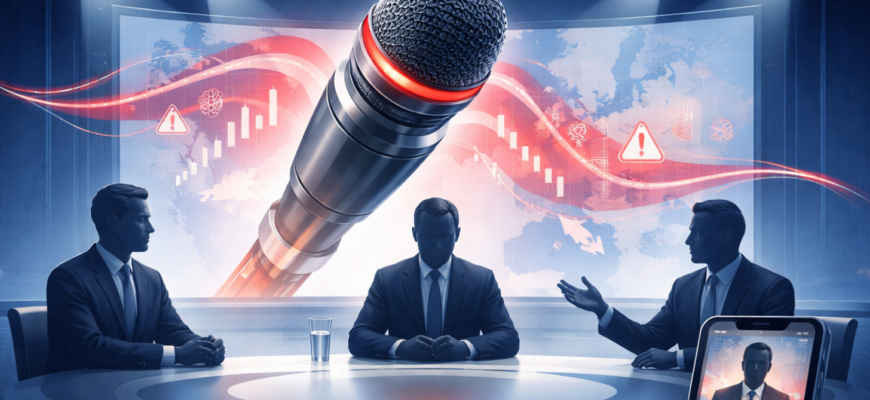
A sofa, three “experts”, a calm tone, serious faces. No shouting. But every thesis is propaganda. Among 50 expert-format videos with propaganda score ≥8 on Belarusian state YouTube channels, 78% carry a fear_inducing tone. They do not shout. They explain — why you should be afraid. And they reach 21.9 million views.
Section 01
Anatomy of the format: who speaks, how, and why
Expert formats on Belarusian state media fall into three types — each serving a distinct function in the propaganda ecosystem.
|
Opinion (20 videos)
An “analyst” monologue. The viewer receives a ready-made conclusion packaged in authoritative delivery. The most common format — and the most invisible.
|
Talk-show (16 videos)
A panel of “experts” discusses a topic. The illusion of debate with total consensus. The range of opinions: from “bad” to “very bad”.
|
Interview (14 videos)
One guest, one position, zero counter-questions. The host is not a journalist — but a moderator for transmitting talking points.
|
The reach paradox: CTVBY dominates with fewest videos
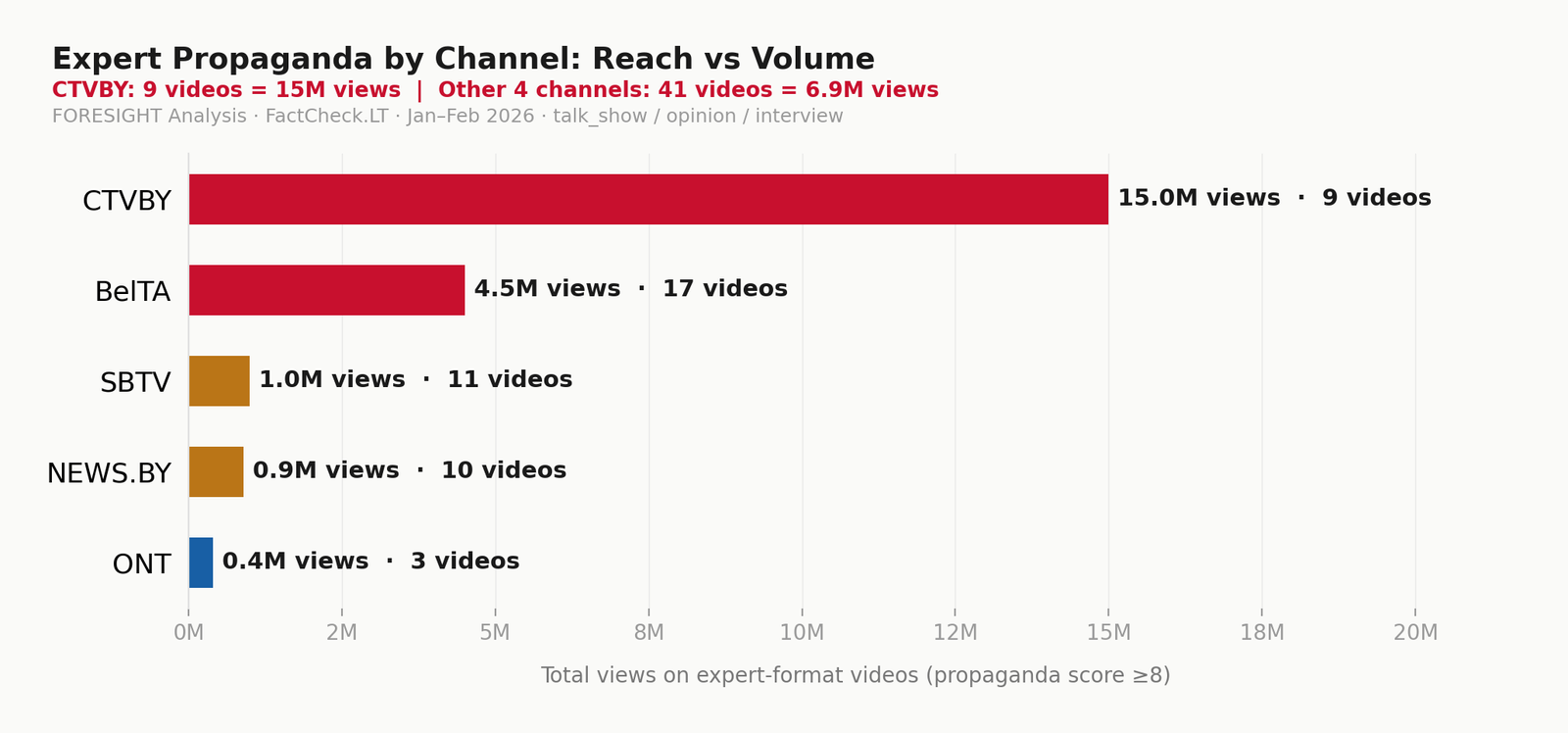
Nine CTVBY expert videos accumulated 15 million views — more than the 41 videos from the other four channels combined. The secret is not volume but format: CTVBY packages propaganda into clip-like edits and #Shorts where an ‘expert’ speaks for 30 seconds — but those 30 seconds are algorithmically promoted to millions.
The tone map: fear speaks in a calm voice
Of 50 expert videos with high propaganda scores, 39 (78%) are classified as fear_inducing. Yet none contain shouting or open aggression — fear is delivered through “analysis”, “forecasts”, and “expert assessments”. Six videos use a contemptuous tone — cold disdain for opponents. Four are aggressive.
- →78% of expert videos with score ≥8 are fear_inducing: fear through “analysis”, not shouting
- →Zero neutral-tone videos among score ≥8 — “objectivity” is absent even as camouflage
- →100% of score=9 videos are fear_inducing — maximum propaganda = maximum fear
The mask of positivity: 5 videos that look like news
Only 5 videos in the entire corpus combine a high propaganda score (7) with a positive tone. All five are about Lukashenko: tariff cancellation, friendship with Russia, comparison with European leaders. This is not a classification error. It is the other half of the system: fear content creates the threat; “positive” experts provide the solution — trust the leader.
The engagement machine: what makes people like propaganda
Zhirinovsky’s video ‘We will never agree with Ukraine’ — 3.5 million views and 70,510 likes. This is not just reach. It is active audience endorsement. The expert format gives propaganda an authority that viewers are willing to share publicly.
- The “expert” has no opponent. No counter-questions, no alternative positions. Debate exists only between shades of one viewpoint.
- The conclusion is predetermined. The “analysis” leads to only one possible outcome. If you already know the ending — it’s not analysis.
- Calm tone about terrifying things. Nuclear war, Western collapse, betrayal — discussed like weather. Calmness is not objectivity — it’s a technique.
- Sources are only “ours”. RIA Novosti, Russian MoD, “my contacts in intelligence”. Independent sources are absent.
- One “expert” across all channels. The same faces appear on BelTA, SBTV, ONT, and NEWS.BY. This is not popularity — it’s a pool.
What this means for civil society
The expert format is the most dangerous type of propaganda. It bypasses both platform algorithmic filters and audience cognitive filters. A person listening to an “expert” does not feel they are being manipulated — they feel they are learning.
For NGOs and media educators, the key task is deconstructing the format. Not “this expert lies” but “here is how this format works: why you’re shown only one side, why there are no counter-questions, why conclusions are predetermined.” The Narrative Dictionary (publication 4) provides specific techniques. This material explains the packaging.