

Errata to the November publication of FactCheck.LTHow Belarusian TikTok is turning into a smear factory
Section 1. Introduction and Methodological Framework
In November 2025, FactCheck.LT published a study, “How Belarusian TikTok is Transforming into a Discredit Factory,” describing 21 Belarusian TikTok accounts based on data collected in October 2025. The study identified a central coordination core of eight accounts with a composite coordination score of 91.7 out of 100, documented 83 simultaneous posting events within a one-minute window between different accounts, and recorded 25 percent of commentators active simultaneously on two or more accounts in the cohort.
Six months have passed since the publication. During this time, a number of significant events have occurred, making it possible and necessary to return to the topic. In early February 2026, the State Television and Radio Broadcasting Company of Belarus created a backup YouTube channel, CTVplus, which became a public signal of the platform risks recognized by the state media infrastructure. On April 4, 2026, YouTube removed three leading state channels: BelTA, ONT, and STV.
Against this backdrop, new specialized hostile TikTok accounts emerged in March 2026 that were not present in the November sample.
The accumulation of these events and the emergence of an expanded dataset made a reanalysis advisable. This errata captures a broader picture through new data and time dynamics. This is not a correction of the errors of the November publication, but rather its methodological continuation using an expanded corpus and time window.
What has changed in the data?
The November publication focused on a single timeframe: October 2025, 21 accounts, 1,770 videos, and approximately 52,000 comments. The current work uses an expanded corpus of 67 accounts in the main registry, with in-depth analysis of 40 key accounts across three time periods: October 2025, March 2026, and April 2026. The total corpus size reached 21,000 videos and 251,000 comments from 154,000 unique users. The corpus size has grown approximately four- to five-fold, significantly increasing the statistical power of the analysis.
The cohort was expanded in three independent ways. First, we added seven specialized hostile accounts that were not included in the November sample (Section 4). Second, we added seven Belarusian regional and neutral portals operating within the country, which serve as a statistically rich anchor sample for normalizing coordination metrics. In the November publication, this anchor sample consisted of one account with 50 videos; it now includes seven accounts with a combined total of over 3,000 videos. Third, we expanded the subcohort of independent media outlets in exile to provide a control comparison of the coordination characteristics of the state-run network with those of an independent network.
Methodological framework
The current analysis is based on a replication of the canonical formula from the November publication—a composite coordination metric consisting of four components: duplicate comments between accounts, the proportion of commenters on two or more accounts in the cohort, the average Jaccard similarity of hashtag sets, and synchronous posts within a one-minute window. This formula is applied uniformly to all subcohorts and time periods, ensuring direct comparability of the results.
In addition to replication, we added four new analytical layers. Cluster-by-cluster decomposition applies the same formula separately to each cluster in the main cohort, allowing us to distinguish the contributions of different subgroups to the overall coordination score. A per-account four-dimensional signature calculates a four-dimensional feature vector for each account (proportion of commenters on multiple accounts, volume growth, post-October birth flag, proportion of duplicate comments), enabling us to qualitatively classify accounts by coordination type. Network analysis of audience overlap and post co-occurrence constructs networks of pairwise connections between accounts, allowing us to identify distinct clusters and accounts with structurally different embeddedness in the overall information environment. A before/after temporal comparison captures changes in the coordination score between October 2025 and April 2026 for each subcohort.
We conducted a control replication test on the November sample for October 2025. Applying our implementation of the formula to the exact same 21-account cohort for the same period yields a coordination score of 85.7. In the November publication, the reported value was 91.7. The 6-point discrepancy is concentrated in the hashtag component of the formula and does not affect the other three components, which are exactly the same. Possible explanations for the discrepancy include differences in hashtag processing during the normalization step and, most likely, different sources of hashtag extraction during dataset preparation. This discrepancy does not affect trajectories and interpretations, as all periods and all subcohorts are processed uniformly by our implementation of the formula, and comparisons within the current study are fully consistent.
The main points of the errataThis analysis leads to four substantive conclusions, which we address in the following sections.
First thesis:The coordination of the central core of the November publication remained virtually unchanged over the course of six months. The seven active accounts of the central core show a coordination score of 85.2 in October, 86.0 in March, and 85.4 in April. Fluctuations within one point indicate that the coordination structure identified in November was not a snapshot, but a persistent phenomenon. This confirms the validity of the November methodology.
Second thesis:In Q1 2026, a specialized hostile infrastructure formed on Belarusian TikTok, consisting of seven accounts not included in the November sample. The coordination score of this cohort in April 2026 was 85.7, which is at the level of the central core of the November publication. Two accounts (pravda.novosti And ai.real999) were born in March 2026 from zero production, two more (01alesia And vesty_ne_molchat) doubled production in March. This process coincided with other signs of platform hedging within the state media infrastructure—the creation of the backup YouTube channel CTVplus on February 6, 2026, and preceded the deletion of the YouTube channels of BelTA, ONT, and STV on April 4, 2026.
Third thesis:The state-owned TikTok network’s audience profile has shifted toward dilution. The average comment frequency in the original 21-account sample decreased from 1.88 in October to 1.56 in April—a 17 percent decline. The same metric in the independent and neutral ecosystems remained stable over the same period. The selective decline in the state-owned network is consistent with the hypothesis of an influx of new passive audiences, likely migrating from YouTube channels after their deletion.
The fourth thesis:Belarusian TikTok as a platform represents a unified information field with active audience circulation between state, independent, and neutral media. The strongest connections in the network of paired audience intersections connect not accounts within the same editorial segment, but rather accounts from different segments. Against this unified field, the new hostile infrastructure occupies structurally heterogeneous positions: some of its accounts are deeply embedded in the overall network, some are isolated in narrow pro-government bubbles, and some have a predominantly non-Belarusian audience.
Errata structure
Section 2 analyzes the robustness of the November sample over an extended time horizon. Section 3 examines audience characteristics and their evolution, including a network analysis of intersections. Section 4 examines the formation of a new hostile infrastructure and its structurally heterogeneous position within the overall Belarusian TikTok network. Section 5 examines the case of Zerkalo’s deletion and the platform risks for independent media. Section 6 contains extensive methodological comments. Section 7 formulates general conclusions and avenues for further research.
Section 2. November Cohort Six Months Later
The November publication described 21 Belarusian TikTok accounts, divided into five clusters based on their output and coordination characteristics using a k-means algorithm. The publication’s main analytical result was the identification of a central core of eight accounts with a composite coordination score of 91.7. Six months later, we have the opportunity to return to this sample with an expanded dataset and verify whether the described coordination structure has been preserved. This section examines whether the November picture was a snapshot of a stable phenomenon or a fixed state that has disintegrated over the course of six months.
Subcohorts and their trajectories
Applying the canonical formula from the November publication to the sample of the original 21 accounts over three time periods (October 2025, March 2026, April 2026), we obtained the following values for the coordination indicator by subcohort.
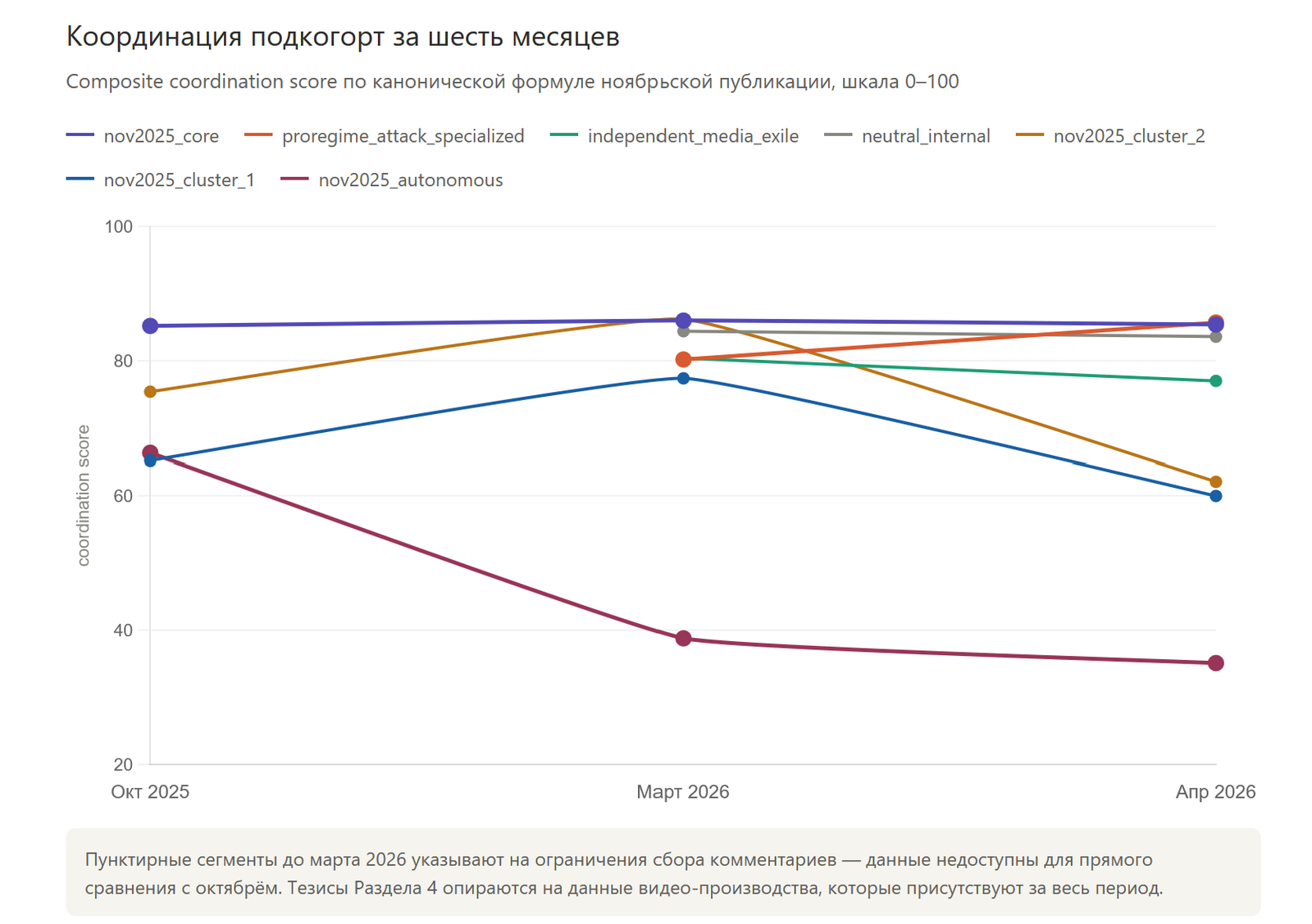
The central core of seven active accounts (the eighth,priestblr, removed by the platform between October and November 2025) shows a virtually unchanged value: 85.2 in October, 86.0 in March, and 85.4 in April. Fluctuations of one point over six months are due to measurement noise, not meaningful dynamics. In other words, the central core of the November publication retained its coordinating properties unchanged.
Cluster 1, consisting offirst_news_ And gaydukevich_oleg, shows 65.2 in October, 77.4 in March, and 60.0 in April. This is unstable behavior, with a peak in March and a dip below the October level in April. Considering that the cluster consists of only two accounts, the statistical variability here is significantly higher than in larger subcohorts.
Cluster 2 of five accounts (mvd_by,gubazatt,llgl46,newsinbelarus,zhivetzhebelarus) shows a different pattern: 75.4 in October, 86.2 in March, 62.1 in April. Here, a clear March spike is visible, followed by a collapse of more than 24 points. This collapse in April requires a separate interpretation, which we will return to below.
Subcohort nov2025_autonomous of five accounts (__79239,azarenok_napryamu,let4k_by,t.me_shpakouski,usytikhanovskoy) shows the most dramatic decline: 66.3 in October, 38.8 in March, 35.1 in April. A decline of more than 31 points in six months, and this decline has not reversed by April. The subcohort has effectively collapsed.
Degradation of the periphery
The decline in coordination in the nov2025_autonomous and nov2025_cluster_2 subcohorts is linked to a specific process that we can document account by account. Of the 21 original accounts from the November publication, six had either been removed by the platform or had ceased activity by April 2026.
Removed by TikTok between October and November 2025:priestblr(was part of the central core, status as of October – 5 videos) anduser1358171015688(Was in the nov2025_autonomous subcohort, with 406 videos as of October, making it one of the most active content producers in the sample.) The removal of an account producing 406 videos per month is a significant platform moderation event, reducing the observed size of the nov2025_autonomous cluster by three to four times in a single action.
Shut down automatically between November 2025 and April 2026:let4k_by(from 9 videos in October to 0 in April),belarushh7(from 33 to 0),marthasbelievsky(from 25 to 0 through intermediate values 31, 22, 5, 24, 4) andazarenok_napryamuThe last case deserves special mention.azarenok_napryamuReleased 7 videos in October, 108 in November (a sharp peak), then 0, 1, 0, 0, 0 in December, January, February, March, and April, respectively. Grigory Azarenok is one of STV’s key propagandists, and his complete silence on TikTok since December 2025 is an editorial decision, not a random pause. We’ll return to the possible reasons in the section on restructuring the propaganda infrastructure.
Six of the 21 accounts in the original November sample are thus inactive by April 2026. This represents 28 percent of the sample. Most of these inactive accounts are concentrated in the nov2025_cluster_2 and nov2025_autonomous subcohorts, which explains the low coordination score in these two subcohorts.
Stability of the central core
Against the backdrop of the periphery’s destruction, the central core of the November publication exhibits the opposite behavior. Seven of its eight accounts remain active in April 2026 (the exception being the one removed by the platform).priestblr). It is also interesting to look at the individual trajectories within the core.
belarusseychas, the central hub of the November publication, had 206 videos in October and 166 in April. A decrease of approximately 19 percent, within normal variability.ont.life, ONT’s official account, on the contrary, grew from 161 videos in October to 422 in April—an increase of more than 2.6 times. ctv_by shows an increase from 40 videos in October to 59 videos in April.pobelkabelarusincreased from 88 to 160 videos in April. That is, three of the four state-run central core accounts increased production in April compared to October.
As for accounts in the proregime_toxic category in the core, the situation is mixed:_prosto_olechka_maintains moderate production, whilebelarushh7 And marthasbelievskyThey had essentially gone silent by April. However, the silencing of two toxic accounts out of four does not undermine the core’s overall coordination properties, since the main contribution to the coordination index comes from government accounts with large production volumes and a stable audience.
Account signatures of the central core accounts in April 2026 show a typical pattern of stable coordination without signs of a ready-made coordinated audience of structures.belarusseychasThe share of commentators on multiple accounts is 32 percent, the share of duplicate comments is 27 percent.first_news_: 34 percent and 23 percent. U ont.life: 32 percent and 20 percent. These are the figures we’d expect from any stable state media structure with an organically accumulated audience over the years: moderate overlap among commentators, a noticeable, but not dominant, share of typical comment phrases. There are no signs of artificial audience influx on these accounts.
Methodological interpretation
The persistence of the central core as the periphery collapses is a methodological result that we interpret as confirmation of the validity of the November publication. In November, the k-means algorithm identified eight accounts as the central core based on their output characteristics and audience overlap. Six months later, these eight accounts (minus one removed by the platform) retained their coordination properties, while the accounts classified by the algorithm as peripheral actually behaved like the periphery—instably, with a tendency to weaken.
If the November k-means classification were an artifact of random clustering at a single point in time, we would expect to see a blurring of boundaries within six months: some core accounts would have dropped out, while some peripheral ones would have moved toward the center. The observed pattern is the opposite: the division between the core and the periphery has intensified. The core maintains coordination at 85+, while the periphery degrades to 35-60.
At the same time, one limitation of interpretation must be honestly acknowledged. The stability of the central core can be explained by two substantively different reasons. The first possibility is that the coordination of the central core is based on a stable institutional infrastructure (state media, their official accounts, and an audience built up over years) that is not dependent on short-term platform events. The second possibility is that the core’s coordination is supported by active editorial management, and the stability of the indicators is the result of continuous work to coordinate content release, rather than the passive inertia of the infrastructure. Distinguishing between these two scenarios using the available metrics is impossible. Distinguishing between these two scenarios would require an analysis of the internal editorial structure of these media outlets, which is beyond the scope of the public TikTok study methodology.
A comparison of the central core of the November publication and the new hostile cohort in April 2026 shows that they have virtually the same composite coordination score (85.4 and 85.7, respectively), but represent structurally different types of coordination. Section 4 is devoted to a detailed examination of this difference.
Section 3. The Changing Nature of the Audience for State TikTok Propaganda
In addition to content coordination metrics, the expanded corpus allowed us to measure the characteristics of the audience itself—the people leaving comments under videos on the studied accounts. With 251,000 comments from 154,000 unique users across three time periods, audience characteristics become clear enough to detect significant changes.
Decrease in average engagement
The simplest aggregated audience characteristic is the average comment frequency: the average number of times a unique user left a comment over a period. This metric is sensitive to the composition of the audience: a high value indicates a loyal, active core of commenters, while a low value indicates a predominance of random, one-off comments.
In October 2025, the average comment frequency across the 21 accounts in the November sample was 1.88 comments per user. In March 2026, the same metric for the same sample was 1.58, and in April, it was 1.56. This represents a 16-17 percent decline over six months. This is a significant and persistent change, which we interpret as audience dilution: the emergence of a large number of passive users who leave a single comment and don’t return, while a core of active commenters remains.
It’s crucial to distinguish between a decline in engagement and a decline in reach. The volume of comments in March for the same sample was 112,051 (87,096 in April), exceeding the October figure of 52,139. In other words, the audience hasn’t decreased, but its composition has changed. A large number of new users joined the comments section of government accounts, left a single comment, and didn’t develop a pattern of returning.
Belarusian TikTok as a unified information field
Before moving on to subcohort-level dilution, it’s important to recognize a common structural feature of the Belarusian TikTok space, which significantly influences the interpretation of all audience metrics.
A network analysis of audience overlaps, conducted on the 28 most active Belarusian TikTok accounts in March-April 2026, shows that the largest pairwise overlaps of commentators occur not within a single editorial segment, but between different segments. Audienceont.life(state ONT) andfirst_news_(state) shares 2,448 total commentators in April. Compare that to a couplebelarusfakty And ont.life: 1,969 total commenters. Orbelarus.now(independent media within Belarus) andont.life: 1,838 total commenters. Orgomel.today(neutral regional portal) andont.life: 1,479 total commenters.
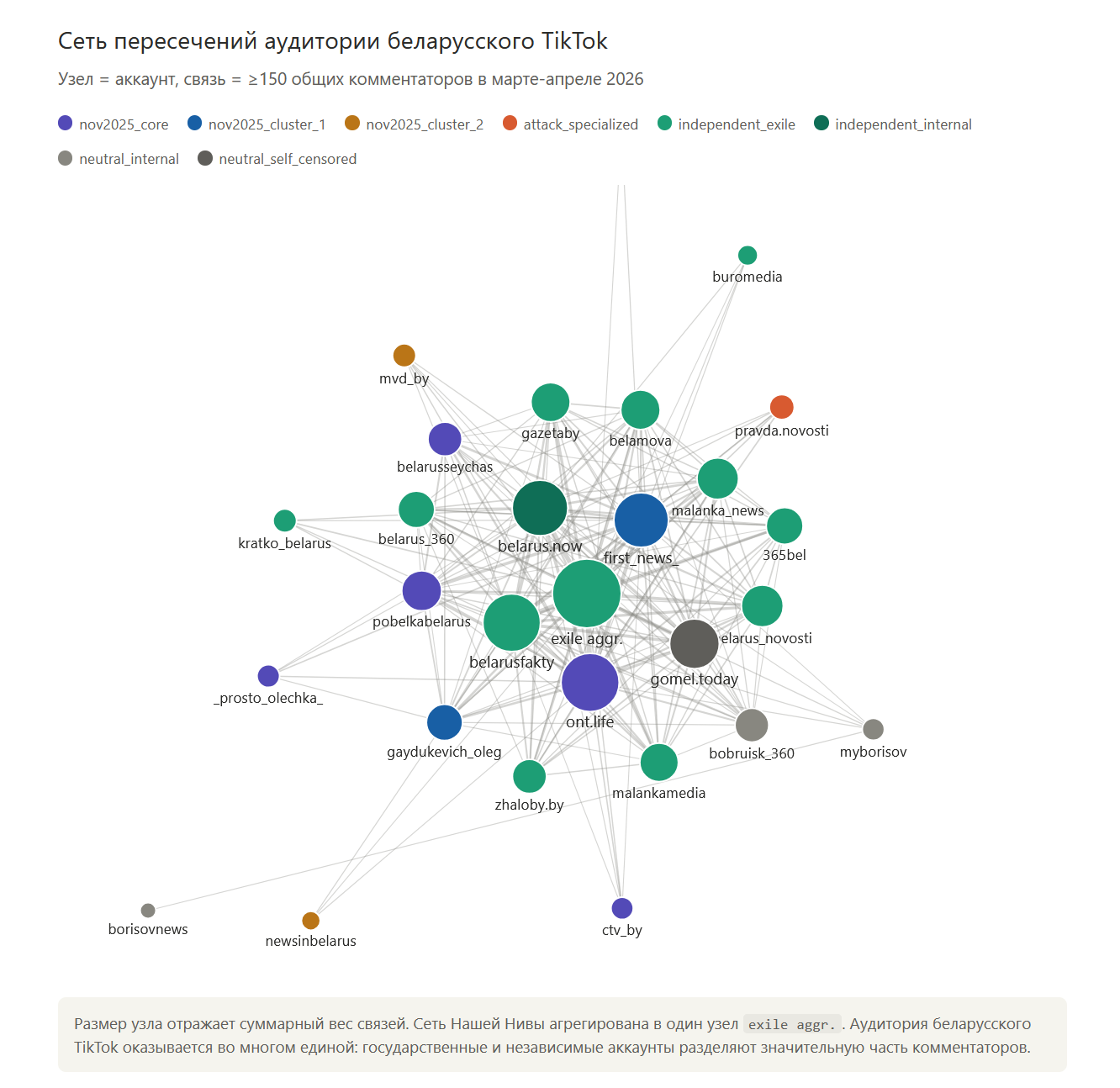
There’s a significant overlap of audiences between state and independent TikTok accounts, comparable to the overlap within the state core. This picture differs significantly from what’s typically seen on Telegram or Facebook in relation to Belarusian political discourse, where the state and independent media ecosystems are much more divided. On TikTok, Belarusian commentators tend to read everything: state news, independent investigations, and regional neutral portals. This is likely due to the specifics of TikTok’s algorithmic recommendation system, which displays content to users based on algorithmic interest predictions rather than following specific accounts, significantly reducing barriers between different editorial camps.
This structural feature of the platform critically affects the interpretation of the proportion of commentators active on multiple accounts. High values for this proportion in a given subcohort indicate not so much coordination within the subcohort, but rather the active engagement of a specific audience in the Belarusian political agenda as a whole. If 42 percent of commentatorsbelarus.nowActive on other Belarusian accounts, this means that this media outlet has a core of politically active readers who read many different Belarusian sources. This is a healthy characteristic, not a sign of coordination.
In this revised perspective, a significant deviation is the low proportion of commenters on multiple accounts with a high volume of activity – as inpravda.novosti(15 percent with 2,905 unique commenters in April). This pattern suggests the account has a distinct audience that doesn’t overlap with TikTok’s typical Belarusian political audience. A likely interpretation is geographic: some commenters are located outside of Belarus, which is consistent with the account’s confirmed multi-country audience spread.01alesia(BY/UA/KZ).
Differentiating the decline in engagement across subcohorts
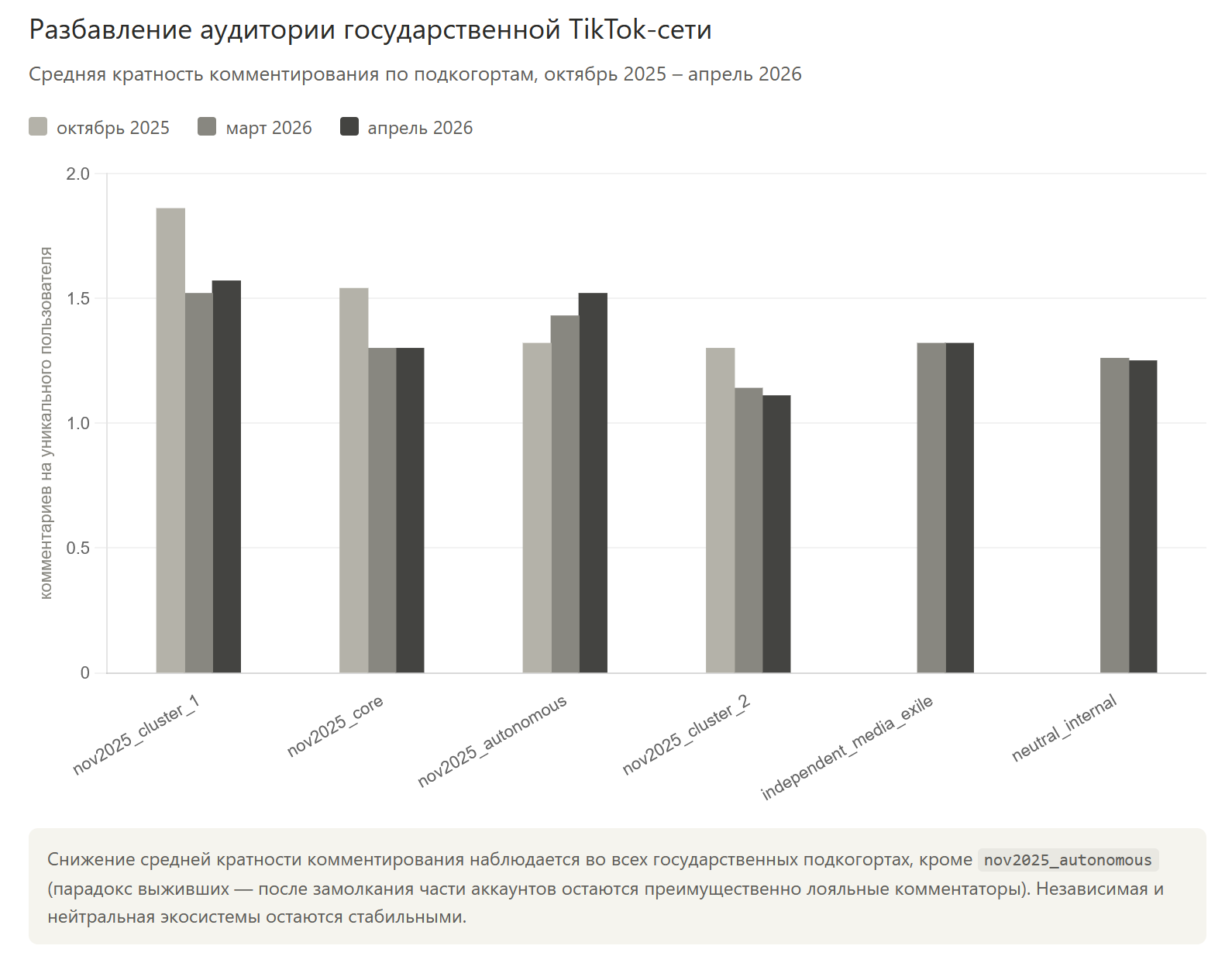
The decline in average comment frequency is unevenly distributed across the subcohorts of the November publication.
The central core (nov2025_core) shows a drop in average comment frequency from 1.54 in October to 1.30 in March and 1.30 in April. This represents a 16 percent decline, stable between March and April. Cluster 1 shows a decline from 1.86 to 1.52 and 1.57. Cluster 2 shows a decline from 1.30 to 1.14 and 1.11.
The nov2025_autonomous subcohort exhibits the opposite behavior: 1.32 in October, 1.43 in March, and 1.52 in April. This represents an increase in engagement, while comment volume and video production decline. This is explained by the so-called survivorship paradox: when some accounts in the subcohort go silent or are deleted, the remaining accounts retain primarily the most loyal subscribers. Casual commenters disappear along with the bulk of the content, while the core loyal followers remain. This is a methodological signal: a single, medium-scale metric can grow while simultaneously concealing the network’s degradation.
A comparison with the independent and neutral ecosystems in March and April 2026 provides context for interpreting these changes. The independent_media_exile subcohort shows 1.32 comments per user in March and 1.32 in April – stable, with no signs of dilution. The neutral_internal subcohort (regional news portals within Belarus) shows 1.26 and 1.25, also stable. This means that audience dilution is a characteristic feature of the state-owned TikTok network and is not observed in independent and neutral ecosystems.
Commenter shares across multiple accounts: A variable beyond engagement
In addition to average multiplicity, we measured the proportion of commenters active simultaneously on two or more cohort accounts. This metric characterizes not individual engagement, but rather the network properties of the audience: the extent to which it circulates between different accounts or, conversely, remains within a single channel.
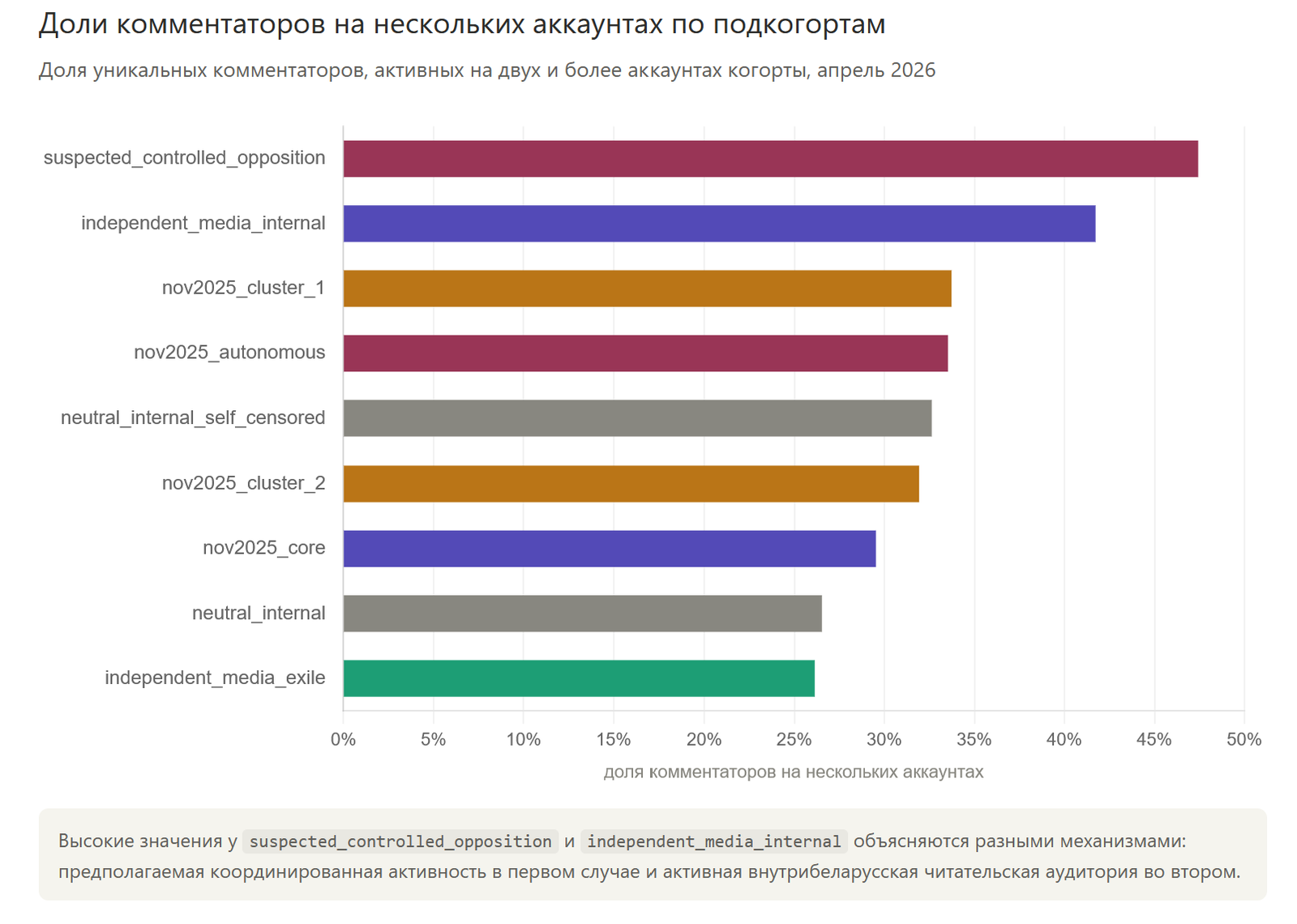
The distribution of this share by subcohort in April 2026 is as follows. The highest figure is for the suspected_controlled_opposition subcohort (the only accountnews_leaks_by): 47 percent. This means that almost every second commenter on news_leaks_by is also active on other Belarusian political accounts. For an independent media outlet, this figure is abnormally high and empirically confirms the hypothesis that this account displays signs of controlled opposition or is a tool for manipulation.
Subcohort independent_media_internal (accountbelarus.now, operating within Belarus) shows 42 percent. The central core of the November publication (nov2025_core) shows 30 percent in April, rising from 27 percent in October. The independent_media_exile subcohort shows 26 percent.
Within the hostile cohort, the diversity of individual values is particularly high. From 15 percentpravda.novosti(likely multi-country audience distribution with audiences outside Belarus) and 22 percent01alesia(confirmed multi-country with distribution Belarus – Ukraine – Kazakhstan) up to 60 percentgolaya_za_kadromand 74 percentai.real999(with a ready-made coordinated audience). Within a single cohort, there are four different modes of audience formation, which reinforces the conclusions of Section 4 about the structural heterogeneity of the new hostile infrastructure.
What does dilution of the state audience mean?
Returning to the main observation of this section: the average comment rate on the state-owned TikTok network fell by 16-17 percent over six months, while the same metric in independent and neutral ecosystems remained stable. In our opinion, the explanatory hypothesis is as follows: after the deletion of the BelTA, ONT, and STV YouTube channels on April 4, 2026, some subscribers to these channels began searching for alternative sources of the same content. TikTok accounts of the same editorial offices (belarusseychas, ctv_by, ont.life) are a natural first step in this search. An incoming audience sees familiar brands, leaves a single comment, doesn’t develop a return pattern, and therefore increases the denominator of the average frequency formula without increasing the numerator proportionally.
This hypothesis is consistent with two additional observations. First, a decline in average multiplicity is already visible in March 2026, right up until the deletion of the YouTube channels on April 4. This means the process began earlier, which is consistent with our timeline reconstruction in Section 4: the state propaganda infrastructure responded to platform risks early, and some audiences also began migrating to TikTok before the YouTube channels were completely deleted. The second observation is that the decline in average multiplicity is concentrated specifically in the state-owned network and does not affect the independent and neutral ecosystems. If this were a general trend across the platform, we would expect to see it equally across all subcohorts. The observed selectivity indicates a process specific to the state-owned network.
It’s important to clearly note the limitations of this interpretation. The YouTube audience migration hypothesis plausibly explains the observed data, but it doesn’t prove them. Alternative explanations are also possible. These scenarios could be distinguished by analyzing the geographic distribution of commenters, which we don’t have for most accounts in the corpus.
Audience composition as an independent indicator
Analyzing audience dynamics provides us with an additional tool for diagnosing coordination phenomena. The composite coordination metric and average comment frequency measure different aspects of the same phenomenon. Issue coordination answers the question “how similar are the accounts,” while audience engagement answers the question “how does the public react to this?” Network analysis of intersections adds a third question: “where is this public circulating?” A change in one metric while the other remains stable provides information that would not be available from either metric alone.
In the case of Belarusian TikTok, we see the following picture by April 2026: the coordination of the central core of the state network has not changed (Section 2), but the nature of this core’s audience has changed, becoming diluted. The coordination of the new hostile infrastructure has reached the core level (Section 4), but the nature of its audience is structurally different from the core – some hostile accounts have isolated audiences and do not circulate with the rest of the Belarusian political TikTok audience, which is an independent indicator of the inorganic nature of their audience.
Section 4. The emergence of a new hostile infrastructure
Between October 2025 and April 2026, a specialized adversarial infrastructure formed on Belarusian TikTok, comprising accounts not included in the November sample. By the end of April 2026, the coordination of this infrastructure, according to the canonical methodology, reached 85.7 points out of a possible 100, which is at the level of the central core of the November sample. This section documents the formation of this new infrastructure, the specific accounts within it, the analytical features by which it differs from the previously described state-run TikTok network, and its structurally heterogeneous position within the overall Belarusian TikTok space.
Seven accounts not included in the November sample
During a hashtag analysis conducted in late April 2026 using the tags #Tikhanovsky and #zmagar, we identified seven accounts systematically producing anti-opposition content that were absent from the November publication.truebynews,pravda.novosti,vesty_ne_molchat,ai.real999,belvestnik,01alesia And golaya_za_kadromAll seven fall into the proregime_toxic category based on their content: they are not state-owned media in the institutional sense, but rather accounts that systematically engage in anti-opposition rhetoric. Their genre profile is diverse: truebynews uses a humorous format with the hashtags #prikol #smirk #lol;vesty_ne_molchatis producing the series “Cause and Effect Relationships”, “Another Scandal in Lithuania”, “The Battle Will Resolve Our Dispute”;ai.real999produces AI-generated content with the recurring character “Superzmagar”;pravda.novostiworks in the format of a serious whistleblower with anti-sanctions rhetoric;belvestnikfocuses on anti-Tikhanovskaya themes.01alesiabelongs to a separate subcategory, which we will return to below.
The monthly dynamics of their video production for the period October 2025 – April 2026 shows three discernible patterns.
The first pattern is birth in March 2026.pravda.novosti And ai.real999October, November, December, January, and February show zero videos. In March, pravda.novosti released 87 videos, and in April, 301, representing a 3.5-fold increase in monthly traffic.ai.real999The numbers are lower: 16 videos in March, 5 in April, but the pattern is the same – the account literally appeared in March.
The second pattern is acceleration in March.01alesiaProduction fluctuated between 215 and 280 videos per month from October to February, reaching 419 in March, exceeding the average by 86 percent.vesty_ne_molchatProduction fluctuated between 2 and 19 videos per month through February, and in March and April it was 31 and 29, respectively, about double the previous average.
The third pattern is a stable background.truebynews,belvestnik And golaya_za_kadromhave been producing anti-opposition content in small volumes (5-40 videos per month) since October 2025, without significant spikes.
Of the seven accounts, four thus demonstrate either an emergence or acceleration in March 2026. This coincidence in timing requires contextual interpretation.
The context of platform risks
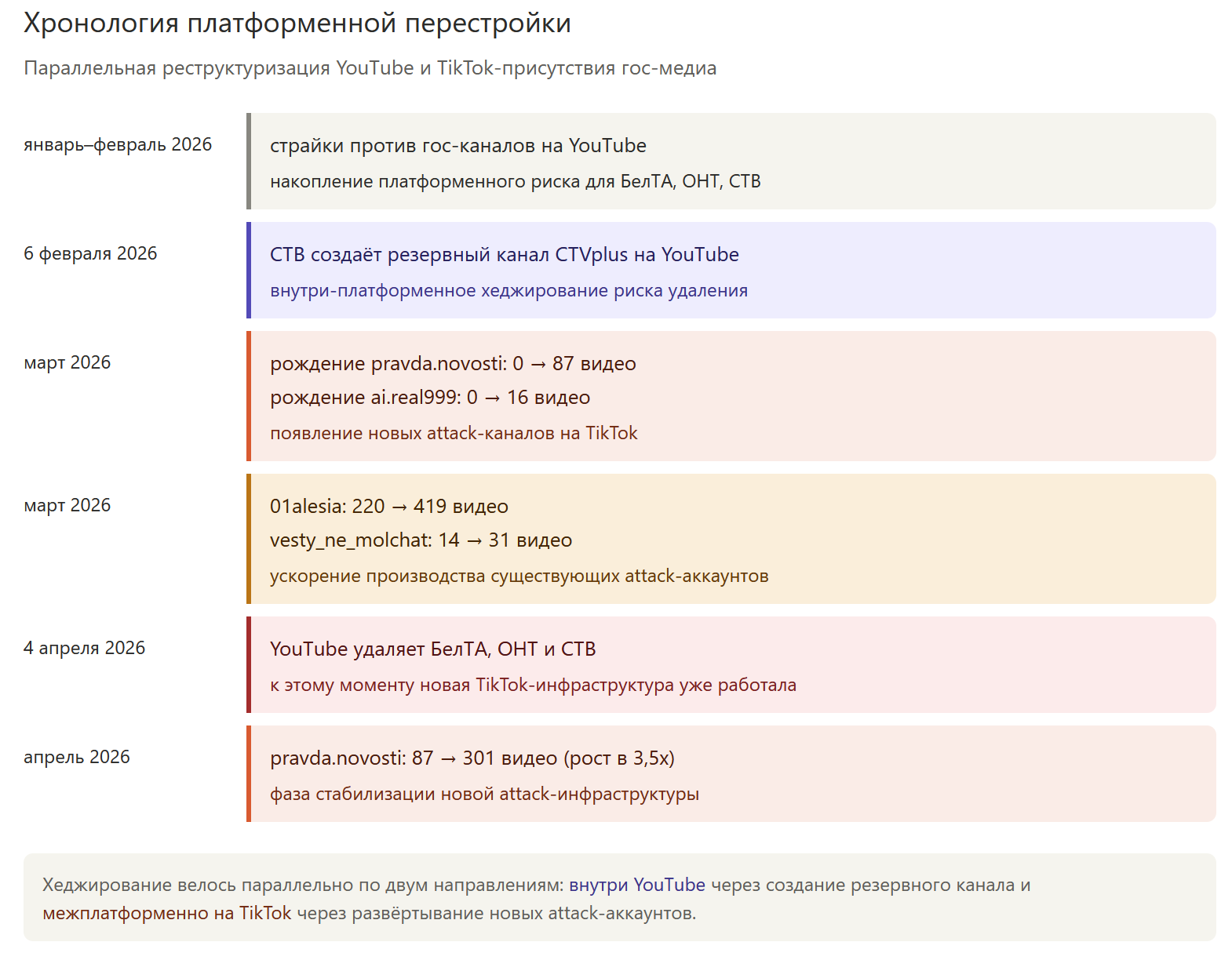
In early 2026, Belarusian state media on YouTube were under increasing pressure. The STV channel created a backup YouTube channel, CTVplus, on February 6, 2026, suggesting it recognized the risk of deleting the original channel long before the deletion. On April 4, 2026, YouTube did indeed delete three key state propaganda channels: BelTA, ONT, and STV. By the time of the deletion, TikTok already had a new hostile infrastructure in place, demonstrating increased activity in March.
We interpret this chronology not as a reaction by the propaganda machine to a platform shock, but as rational institutional hedging of platform risks. Signals about the possible removal of state-owned YouTube channels have been accumulating since the end of 2025 through a strike system. STV’s decision to create a reserve
It’s important to distinguish between two levels of hedging. The creation of CTVplus as a backup YouTube channel is hedging within a single platform: the same content, the same brand, the same type of management. The growth of a hostile infrastructure on TikTok is hedging across platforms, and it occurs through the emergence of new accounts with new names, not through the expansion of established state media. These are two different strategies for the same threat, and they are being pursued in parallel.
Coordination of the hostile cohort in April 2026
To assess the level of coordination in the new cohort, we applied the canonical formula from the November publication to seven hostile cohort accounts using data from March-April 2026. The resulting value was 85.7 points. For comparison, the central core of the November publication scored 85.4 points in April. This difference of a few tenths of a point indicates that the new infrastructure is coordinated at a level comparable to the previously documented central core of state TikTok propaganda.
However, one limitation of the analysis should be clearly acknowledged. October comments for five of the seven hostile cohort accounts are missing from our corpus, as their collection only began in April 2026. This means we cannot reliably determine whether the hostile cohort was coordinated in October 2025. The argument about the emergence of a new infrastructure is based not on the dynamics of the composite indicator (in this case, it is not methodologically comparable between periods), but on two independent facts: the birth of specific accounts in March 2026 (pravda.novosti And ai.real999had zero production before March) and production acceleration for existing accounts in March.
Account-Based Signatures: Four Types of Coordination
To qualitatively classify accounts in the hostile cohort, we calculated four-dimensional signatures for each account: the proportion of commenters on multiple accounts in its audience, the growth in production volume relative to October, the “born after October” flag, and the proportion of comments with duplicate text on other accounts in the cohort.
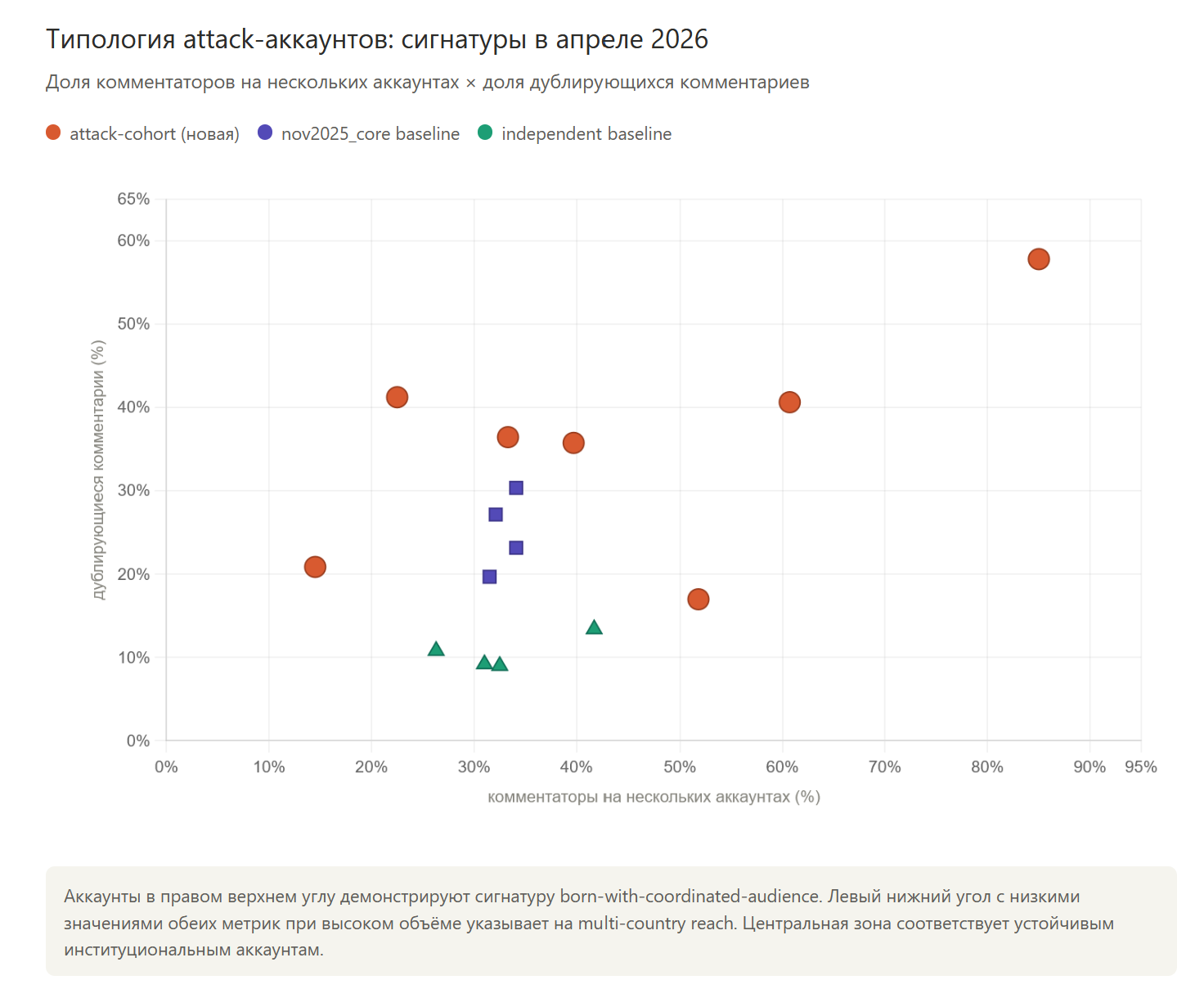
These signatures classify accounts not by intensity, but by the nature of coordination.
The first type is with a ready-made, coordinated audience. These are accounts with a birth flag and a high share of commenters across multiple accounts. In other words, they’ve only just appeared on the platform, but their audience already existed on other accounts. The most striking example isai.real999The birth flag is 1, the share of commenters on multiple accounts is 85 percent, and the share of duplicate comments is 58 percent. This means that 85 percent of the new account’s commenters are simultaneously commenting on other pro-government accounts, and more than half of their comments are verbatim matches of comments on other accounts. This audience structure is incompatible with organic discovery of the new account by TikTok’s algorithm. The audience was redirected to the new account by a coordinated signal.
The second type is integrated with acceleration. These are accounts that have already been working in the pro-government ecosystem, increasing their production volume, and maintaining a high share of commentators across multiple accounts. Example:vesty_ne_molchatVolume increased by 2.2 times, with commentators on multiple accounts reaching 52 percent and duplicates reaching 17 percent. The audience is deeply embedded in the existing pro-government network, and the account is accelerating production, but with no signs of artificially inflating its audience.
The third type is multi-country audience distribution. These are accounts with a geographic distribution of audiences outside of Belarus, resulting in a low share of overlaps with high overall activity.01alesiaIt has a 22 percent share of commenters across multiple accounts and a confirmed audience structure based on third-party data: 33 percent Belarus, 33 percent Ukraine, and 33 percent Kazakhstan. This isn’t a strictly Belarusian hostile account, but a multi-country hostile platform with anti-Western rhetoric, targeting Russian-speaking audiences in three countries.pravda.novostishows a similar pattern: a share of 14-17 percent with high volume (2860-2905 unique commenters), which we interpret as a likely multi-country audience distribution, requiring separate verification through geodata.
The fourth type is low-volume hostile accounts with a stable or small presence on the general network. This group includestruebynews, which has connections with the state core through_prosto_olechka_(96 total commentators) and is integrated into the general Belarusian TikTok field; andbelvestnik With golaya_za_kadrom, whose audiences are not large enough to have significant overlap with other accounts in our sample.
The position of hostile infrastructure in the general network
A network analysis of audience overlaps across the 28 most active Belarusian TikTok accounts in March-April 2026 reveals an additional analytical angle not discernible in aggregated coordination metrics alone. In a pairwise overlap network constructed with a threshold of 150 shared commentators, only one in seven hostile accounts passes the threshold—pravda.novosti. When the threshold is lowered to 20 general commentators, the network also includesvesty_ne_molchat,truebynews,01alesiaand barelyai.real999. Accountsbelvestnik And golaya_za_kadromNo other account in our sample reaches this threshold, indicating the small size of their audience.
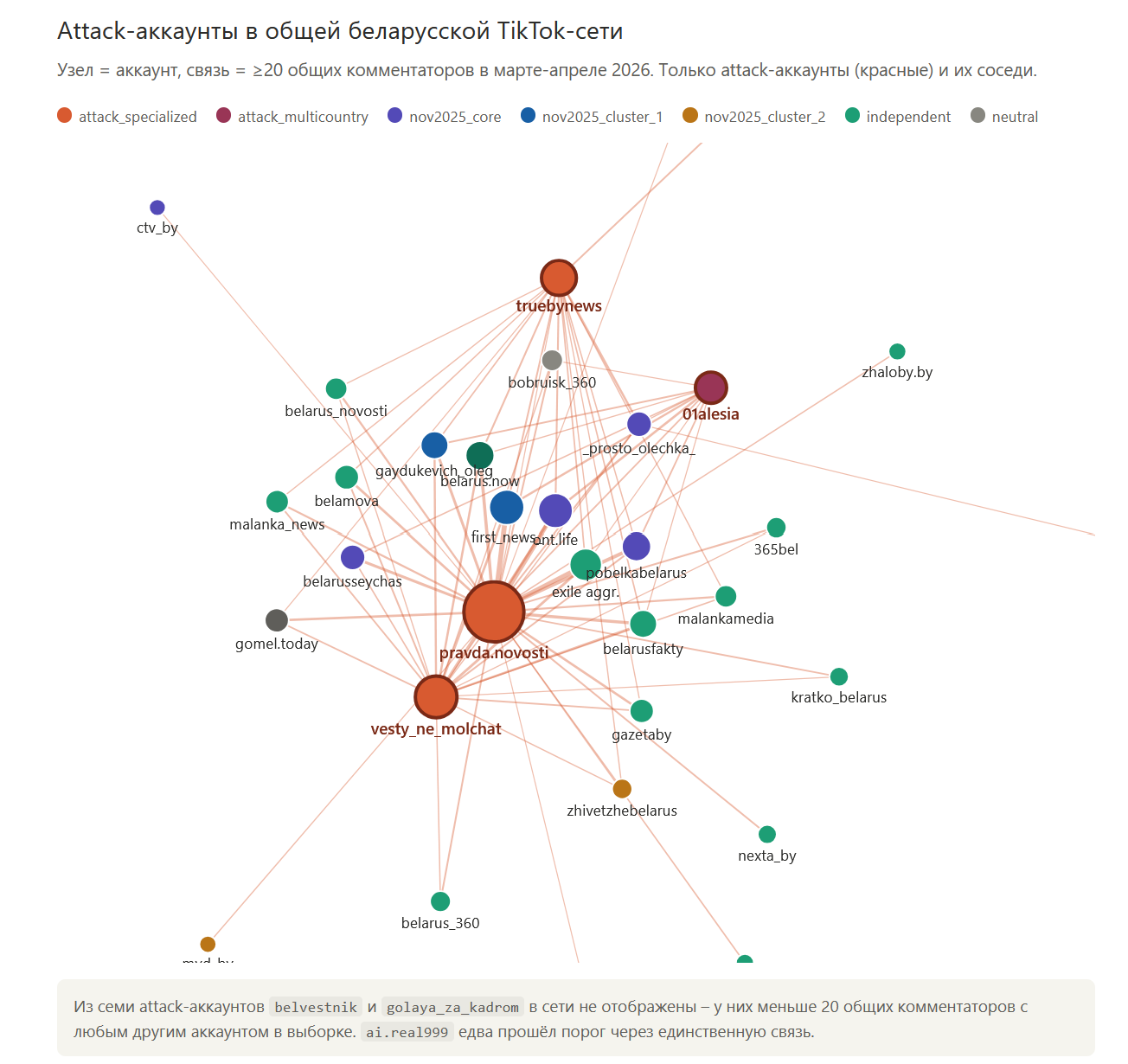
The connections between hostile accounts and the rest of the network are differentiated.pravda.novostiappears to be tightly integrated into the state core: 469 general commentators withfirst_news_, 383 sont.life, 242 spobelkabelarus, 145 sbelarusseychasThus, despite the low share of commentators on several accounts within the hostile cohort (15-17 percent), pravda.novosti has a strong overlap with government accounts within the central core of the network. This explains the account’s high comment volume (approximately 2,900 unique commenters in April): the audience is partially composed of commentators from government channels, who also comment on the new account.
vesty_ne_molchathas more moderate but widely distributed connections: 144 in common withont.life, 111 sfirst_news_, 95 sbelarus.now, 86 sgaydukevich_oleg, 85 sbelarusfaktyThe account is integrated into the general Belarusian TikTok network and is not focused solely on the pro-government segment. The same goes for01alesia: 104 total withont.life, 85 sfirst_news_, while the confirmed multi-country distribution of the BY/UA/KZ audience means that these 100-200 general Belarusian commentators make up part of the account’s audience, with the bulk of the audience outside of Belarus.
ai.real999presents the opposite picture. It has only one connection that passes the 20-s threshold._prosto_olechka_(a toxic blogger from nov2025_core). Within the hostile cohort, the account has an 85 percent share of commenters on multiple accounts and 58 percent of duplicate comments. This means that the commentersai.real999They are active on other accounts, but few of them comment at the level of general Belarusian accounts. The account’s audience is locked within a narrow pro-government bubble and doesn’t interact with the typical Belarusian political audience. This is precisely the structure of a pre-existing, coordinated audience: the new account has acquired a ready-made audience from other pro-government accounts, but this audience doesn’t overlap with the typical Belarusian TikTok audience.
truebynewsshows another pattern: 96 common commenters with_prosto_olechka_, which makes it one of the closest neighborstruebynewson the general network. This suggests a possible coordination link between the new humorous hostile accounttruebynewsand proregime_toxic, a blogger from the November publication.
Simultaneous Publishing Network
An analysis of the network of synchronous posts in April 2026 yields another important finding. Of the 21 pairs of accounts with three or more joint posts in a single minute window, the densest pair isbelarus.now↔ont.life(7 events) – independent media within Belarus and state-owned ONT.
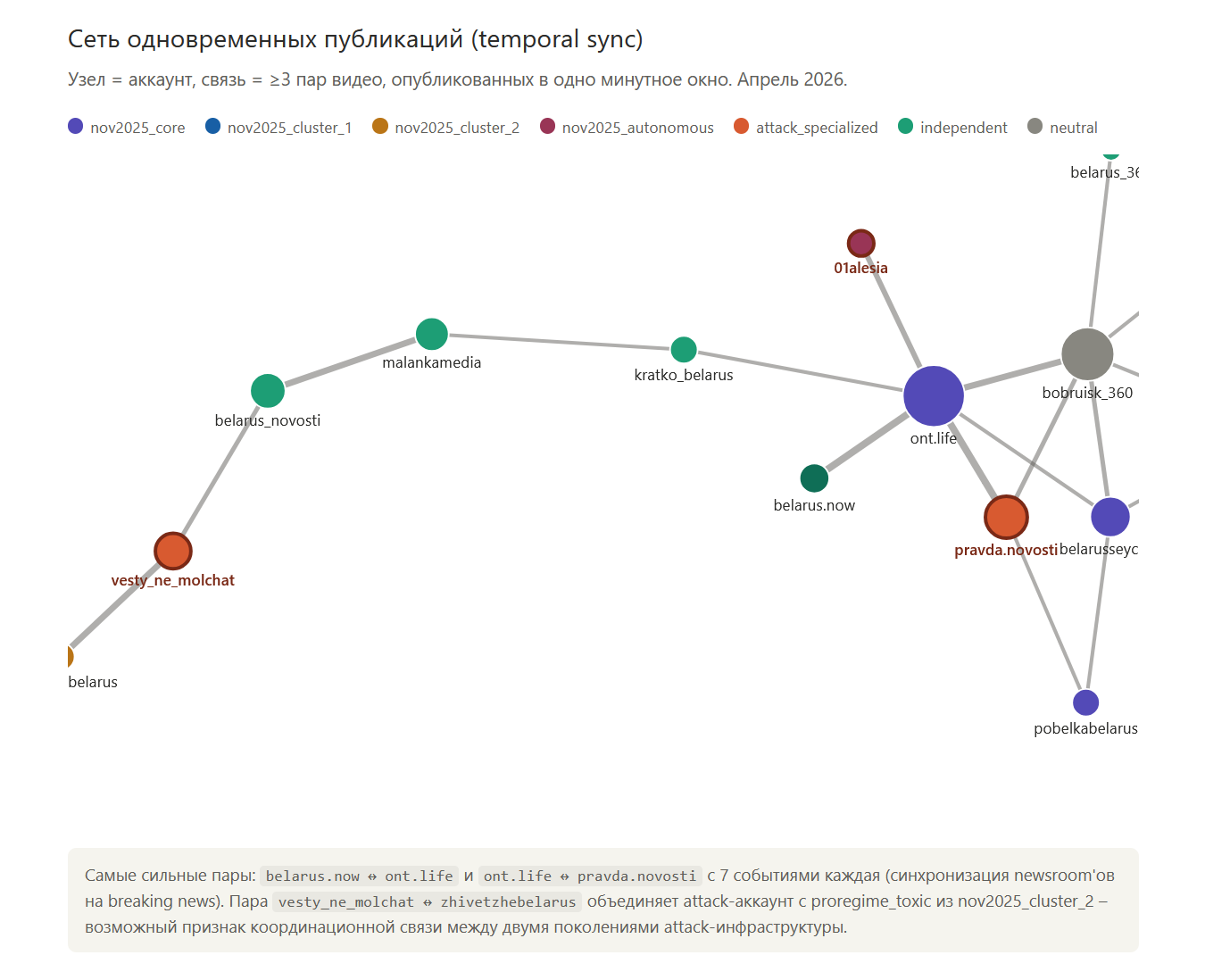
This synchronicity shouldn’t be understood as coordination in the sense of collusion, but rather as a response to the same breaking news events: both outlets publish videos on TikTok almost simultaneously during breaking news. This is typical editorial synchronization on a fast-paced video platform.
In this network, the second most powerful hostile connection is particularly revealing:vesty_ne_molchat↔zhivetzhebelarus(6 joint publications).zhivetzhebelarus– this is the proregime_toxic account from the nov2025_cluster_2 November publication, and the compatibility of its publications with the new hostile infrastructurevesty_ne_molchatThis indicates a probable operational link between the November pro-government segment and the new hostile cohort. This structural connection between the “old” and “new” generations of hostile accounts is not discernible in composite metrics, but is visible in the network analysis of post co-occurrence.
What does this typology add to the November methodology?
The differentiated picture of the embeddedness of hostile accounts within the overall network significantly enhances the interpretation of the composite coordination indicator. The high composite indicator value for the hostile cohort as a whole (85.7) conceals significant diversity in individual positions.pravda.novostiIt is integrated into the state core and serves a predominantly Belarusian audience in conjunction with state media.01alesiaIt is integrated into the state core in its Belarusian part, but its main audience is outside of Belarus.ai.real999isolated in a narrow pro-government bubble.belvestnik And golaya_za_kadromhave too small an audience to have any significant crossover.
A detailed methodological analysis of what this differentiation means for future research is provided in Section 6.
Section 5. Platform repression of independent media: the case of Zerkalo
In October 2025, at the time of data collection for the November publication, the @zerkalo.io account was one of the largest Belarusian TikTok accounts with an independent editorial policy. According to monitoring data, at its peak, it had 274,300 subscribers and 2,200 videos with a combined reach of 806.8 million views. The editorial team also had a parallel account, @zerkalo.io2, with 74,300 subscribers, 1,100 videos, and 282.6 million views. The combined reach of the two accounts was approximately 1.09 billion views.
By the time of the data recollection in April 2026, both accounts had been deleted by the platform. Zerkalo’s editorial team migrated to a new account, belarus_novosti (branded as “Belarus | No Filters”), which had already existed as a companion project and now became the editorial team’s primary TikTok presence. The deletion of two flagship accounts of one of the leading independent Belarusian media outlets represents the first documented case in our expanded corpus of a named independent media outlet being subject to platform moderation, resulting in the destruction of a combined reach of over a billion views. This section documents the findings and discusses the methodological and analytical implications.
What we observe and what we cannot observe
TikTok account deletion is an opaque process for outside observers. The platform doesn’t publish justifications for specific moderation actions or notify third parties of the reasons for deletions. This means we can observe the deletion and its consequences, but we can’t directly document the mechanism that led to the decision.
Possible account deletion mechanisms generally include: an automated decision by moderation algorithms based on complaints, made without the involvement of a human moderator; a decision by a human moderator based on incoming complaints; or a decision made as part of compliance with government requests, which in the case of Belarus and the Russian jurisdiction is not a zero-sum probabilty. It is impossible to distinguish between these three scenarios based on the data available to us. However, the very fact of deleting 1.09 billion views from an organization engaged in independent journalism and registered in exile is a significant event for the study of the Belarusian media platform ecosystem.
The zerkalo_podrobno subcohort, the third Zerkalo account for which we have retained data over the entire monitoring period, shows an interesting pattern. In November 2025, there were 55 videos, in December – 83, in January – 20, in February – 19, in March – 0, and in April – 0. Activity decreased towards the end of winter and ceased completely by March. Without direct information from Zerkalo’s editorial team, we cannot determine whether this is a technical consequence of the deletion of the flagship accounts, an editorial decision to consolidate its presence, or the result of additional platform actions regarding the subaccount. In any case, by April 2026, Zerkalo has a single functioning TikTok account, down from the three or more that previously existed.
Contrast with the stability of the state network
A comparison of the trajectories of Zerkalo and the state-owned TikTok network for the period October 2025 – April 2026 illustrates the asymmetry of platform risks. The state-owned central core did not suffer significant losses from platform moderation during this same period. Of the 21 accounts in the November sample, only two were removed by the TikTok platform (priestblrwith 5 videos anduser1358171015688with 406 videos in October), and both deletions occurred between October and November 2025, before the start of our study period. After November 2025, the state core did not lose any accounts as a result of platform moderation.
In other words, the state-run network was subjected to a significantly lesser degree of moderation than the independent media in our corpus. Priestblr’s account was deleted by the platform, which had a minimal audience (five videos per month)—a loss that was incomparable to the loss of 274,300 subscribers to Zerkalo’s main account.user1358171015688A content factory with 406 videos per month without an identifiable editorial brand was removed—a case that is significantly different from the removal of a media organization’s flagship account.
Thus, during the study period, the only documented case of a significant audience being destroyed through platform moderation occurred in an independent media outlet, not in a state-run propaganda network. This empirical observation does not prove a systematic bias in TikTok’s moderation practices, but it does document an asymmetrical outcome of moderation decisions in our sample.
The context of other deletions and the nature of the risk
In addition to the Zerkalo accounts, our corpus contains four anonymous accounts deleted by the platform at an earlier time (recorded in historical data): three accounts with reach between 12.9 and 25.5 million views and one with reach of 0.78 million views. Based on available characteristics (volume, production pattern, lack of an identifiable editorial profile), the three high-reach accounts show signs of specialized content farm activity, while the low-reach account shows signs of a bot farm. These deletions occurred before our detailed monitoring began and did not preserve metadata that would allow us to determine editorial focus.
The Zerkalo case, unlike anonymous deletions, has an identifiable editorial actor and a documentable context. Zerkalo is the successor to one of the largest Belarusian independent media outlets and has been operating in exile since being forced to cease operations in Belarus in 2021-2022. The deletion of Zerkalo’s flagship TikTok account in this context is not an isolated platform event, but part of a broader pattern of pressure on Belarusian independent media through platform mechanisms.
It should be clearly noted that we have no empirical basis to assert that Zerkalo’s removal was the result of a coordinated complaint campaign by certain actors or the result of off-platform pressure. These hypotheses are plausible in the context of the pressure on Belarusian independent media in general, but require separate evidence that goes beyond the observations of the TikTok corpus.
Platform risk as a factor in independent media strategies
The Zerkalo case has implications for understanding independent media’s survival strategies on TikTok. If the platform can wipe out a billion views of a single editorial organization with a single decision, without explaining the reasons, this creates a fundamentally different operating environment compared to, say, a dedicated website or email newsletter. Concentrating an entire audience on a single TikTok account proves to be a vulnerable strategy.
Our corpus demonstrates a diversity of independent media presence strategies. Some editorial offices maintain a single, directly branded account: Belsat, Euroradio, and gazeta.by operate through TikTok accounts of the same name. Some editorial offices have two accounts, one main and one secondary: Malanka maintains malankamedia and malanka_news. Other editorial offices use generic, camouflaged names without direct branding: belarus_360, kratko_belarus, 365bel, zhaloby.by. Differences between these strategies may reflect varying levels of awareness of platform risk, different editorial preferences for media branding, or a combination of factors. Using the available data, we cannot quantitatively assess which strategy is more resilient to platform moderation, as the number of independent media removals in our corpus is too small to draw statistical conclusions.
However, the qualitative observation is as follows. The mirror operated by concentrating its core audience on a single flagship account, and the platform’s decision regarding this account instantly destroyed its main asset. After the account’s deletion, the editorial team was forced to restore its audience throughbelarus_novosti, starting from a much smaller base. This case illustrates the vulnerability of a single-account strategy to platform-based solutions and raises questions about the choice of TikTok presence strategies for media organizations whose operational security is critical.
Methodological implications for monitoring
The Zerkalo case also has methodological implications for research monitoring of Belarusian TikTok. If significant audience assets can be destroyed by the platform between data collection points, this means any monitoring must consider the risk of the observed object disappearing. Snapshots taken at one point in time may contain accounts that are missing from the next snapshot, and this is not a data error, but a documented phenomenon of the platform itself.
For the current study, this means that observations made on the expanded April 2026 corpus refer to the sample of accounts that survived platform moderation between October 2025 and April 2026. Accounts deleted during this period were excluded from our final sample not by our methodological decision, but by the platform’s decision. This survivorship bias must be taken into account when interpreting the trajectories: the apparent stability of the independent ecosystem in April may partly reflect the fact that less resilient accounts are no longer observed. A similar consideration applies to the state network, although there were significantly fewer deletions in this subcohort.
For future monitoring, we plan to preserve metadata for accounts that disappear from public view, based on the most recently available snapshots. This will at least allow us to record the disappearance and approximate the parameters of the lost audiences, even if it is no longer possible to analyze the content of such accounts.
Section 6. Methodological comments
This section collects methodological observations and refinements accumulated during the course of the expanded analysis and is intended for researchers working with coordinated campaigns on TikTok and similar platforms.
Composite Coordination Measure: Limitations of Interpretation
The canonical formula from the November publication is constructed as a weighted sum of four components with fixed maximums: the comment component (0–30), the user component (0–30), the hashtag component (0–20), and the time component (0–20). On the April 2026 corpus, consisting of 40 accounts and 21,000 videos, three of the four formula components for most subcohorts reach their maximums. This means that in our dataset, the formula discriminates subcohorts primarily based on one component—the hashtag component—while the others reach their maximums.
This limitation is not a methodological error in the November publication, but a consequence of the fact that the comment, user, and time components were calibrated on a relatively compact sample of 21 accounts, where saturation occurred at higher relative values. On a larger corpus, saturation occurs more quickly. For future work, we recommend recalibrating the formula’s weights and maximums based on the corpus size, or using non-saturating versions of the components (e.g., logarithmic compression after a certain threshold instead of a hard cap).
This also means that a single formula is insufficient for distinguishing subcohorts by coordination type in the modern, expanded corpus. We’ve supplemented it with account-based signatures and network analysis, allowing us to distinguish states that are indistinguishable by a single composite metric.
Account-based signatures as a diagnostic tool
Four-dimensional signatures consist of the following components:
- The share of commentators active simultaneously on two or more cohort accounts, as a percentage of the account’s total audience. Low values indicate a specific audience that isn’t shared across other cohort accounts, which could indicate either an organic, narrow niche or a geographically dispersed audience outside the corpus being studied.
- An increase in video production volume relative to the baseline period. A sharp increase in a short window indicates an editorial decision to escalate production, rather than organic growth.
- Flag for the “birth” of an account after the baseline period. An account that did not exist in October and appeared in March is methodologically separated from accounts that existed since the baseline period.
- The proportion of comments with verbatim duplicate text on other accounts in the cohort. High values indicate coordinated commenting activity that goes beyond the random coincidence of short reactionary phrases.
Combining these four features provides a qualitative diagnosis of the type of coordination, which is not discernible in a single composite metric. Specific examples of classifying hostile cohort accounts using this scheme are provided in Section 4.
Network analysis of audience overlap and publication simultaneity
In parallel with coordination intensity metrics, we recommend using network analysis to determine the position of accounts within the overall information environment. Paired audience intersection networks, constructed at a significance threshold (in our case, 150 or 20 common commentators, depending on data density), allow us to distinguish between accounts deeply embedded in the overall network and those isolated in narrow bubbles.
Simultaneous publishing networks based on pairs of videos published within a single minute window allow us to further distinguish between the coordination of content releases and the natural parallelism of editorial responses to breaking news. In our corpus, a prime example of the latter is the pairbelarus.now↔ont.lifeWith seven joint publications in April 2026, this connection between independent media within Belarus and the state-owned ONT does not constitute coordination in the sense of collusion, but rather reflects a shared response to the same events in Belarus. Without network analysis, this coherence could be mistakenly interpreted as a strong signal of coordination.
Recommendation for future work: When constructing networks of simultaneous publications, include a control check through comparison with pairs of “independent media – state media,” which serve as a natural reference sample for editorial synchronization. Only connections significantly exceeding this reference sample should be interpreted as a signal of coordination.
Bin-aware Jaccard and the role of neutral reference sampling
Coordination metrics based on hashtag or commenter overlap are sensitive to the overall level of activity on the platform. When the platform is generally more active, any two accounts will have more overlap simply due to statistics, not due to actual coordination. Without normalizing for this background level, comparing coordination metrics between periods of different intensity leads to biased conclusions.
In the November publication, normalization was performed using a single neutral account with a limited amount of data, which reduced the reliability of the reference sample. In the current study, we use seven Belarusian neutral regional portals with a combined volume of over 3,000 videos and 13,000 unique commentators. This reference sample is statistically rich and allows us to apply the bin-aware Jaccard normalization previously developed for the Bulgarian FactCheck.LT case study (analysis of TikTok campaigns for the 2026 elections). Although the current publication primarily uses unnormalized values for direct comparability with the November methodology, the presence of a reliable reference sample paves the way for normalized analyses in future studies.
Survivorship bias and hull dynamics
Accounts deleted by the platform between two observation points are excluded from the sample not by the researcher’s methodological decision, but by the platform’s decision. This creates survivorship bias in any analysis limited to the last observation point: the visible sample is a sample of those who survived platform moderation, and the characteristics of this sample may systematically differ from those of the original population.
In our corpus, survivorship bias is documented in three cases. Six accounts from the original 21-account sample from the November publication had become inactive by April 2026 (two were deleted by the platform, four self-deactivated). Two flagship Zerkalo accounts were deleted by the platform, with a combined loss of over 1 billion views. Four anonymous accounts in the historical data were deleted by the platform even earlier. In each of these cases, the account ceased to be observable, but the event of its disappearance is itself a significant phenomenon for the platform ecosystem.
For research purposes, we recommend preserving the metadata of disappearing accounts based on the latest available snapshots (volume, reach, production patterns), even if meaningful analysis becomes impossible. This allows us to at least quantitatively document the scale of platform changes and avoid dismissing disappeared accounts as data noise.
Data limitations for the October 2025 period for the hostile cohort
Collecting comments for the hostile cohort (except01alesia And belarusfakty) began in April 2026 and does not cover October 2025. This means that the coordination score for the proregime_attack_specialized subcohort for October 2025 is not comparable to the same score for March and April 2026: comment-based metrics are underestimated for October due to missing data, not due to a real lack of coordination.
For the analysis in Section 4, we relied not on the dynamics of the composite coordination indicator (which is methodologically inconsistent in this case), but on two independent factors: the emergence of specific accounts in March 2026, as recorded using video production data (available for the entire period), and a significant acceleration in production for existing accounts in March. These two factors were recorded independently of any comment data and are not subject to the limitations of the October data collection.
Missing geolocation and multi-country platform
We have confirmed data on the geographic distribution of the audience for only one account in the corpus –01alesiawith a distribution of 33 percent Belarus, 33 percent Ukraine, and 33 percent Kazakhstan, according to third-party analytics services. For the remaining accounts, direct geographic data is unavailable, and we can only indirectly interpret their audience characteristics through cross-account intersections. A low proportion of commenters on multiple accounts, despite a high comment volume,pravda.novosti(15-17 percent with a volume of about 2,800 comments) is consistent with the hypothesis of multi-country audience distribution, but does not prove it with the available data.
This gap is a general limitation of TikTok ecosystem research, as the platform does not publish the geographic distribution of commenters on individual videos to external researchers. Using third-party analytics services provides a partial picture, but comes with its own methodological caveats regarding the representativeness of their samples and evaluation algorithms.
Section 7. Conclusion and directions for further work
An expanded analysis of Belarusian TikTok for October 2025–April 2026 reveals that the coordinating structure of state-sponsored TikTok propaganda identified in the November publication has not collapsed over the past six months, but has evolved in several directions simultaneously. This evolution cannot be described by a single aggregate number or a single linear metric. It represents simultaneous change along several independent axes, visible only through the use of additional analytical layers—per-account signatures and audience network analysis.
The central core of the November publication remained virtually unchanged: seven active accounts, a six-month coordination score of 85+, and an organically integrated audience with no signs of artificial formation. This confirms the correctness of the November methodological decision to identify these eight accounts as the central core – the identified structure proved to be a stable phenomenon, not a momentary clustering artifact.
At the same time, a partial erosion of the November sample’s periphery occurred: six out of 21 accounts were either deleted by the platform or self-deactivated by April 2026. The degradation is concentrated in the nov2025_autonomous and nov2025_cluster_2 subcohorts and does not affect the central core. This asymmetric erosion is an important characteristic of the platform resilience of different types of government accounts: institutional government accounts with high production volumes are resilient, while individual pro-government blogger accounts are subject to both platform moderation and editorial suspension decisions.
Parallel to these processes, a new, specialized hostile infrastructure emerged in the first quarter of 2026. Seven accounts not included in the November sample demonstrated coordination at the central core by April. The timing of this emergence (with a peak in acceleration in March 2026) coincides with other signs of platform hedging by the state media infrastructure—the creation of the backup YouTube channel CTVplus in early February and preceding the deletion of flagship YouTube channels in early April. We interpret this chronology as rational institutional hedging of platform risks, initiated early and implemented in parallel across multiple fronts.
Network analysis of the audience revealed that within the new hostile cohort, accounts have significantly different levels of integration into the overall Belarusian TikTok network.pravda.novostiDeeply embedded in the state core through commentators. 01alesia is connected to the state core in its Belarusian section, with its primary audience outside of Belarus.ai.real999isolated in a narrow pro-government bubble with an 85 percent share of commentators on multiple accounts and a 58 percent share of duplicate comments – this is a structure with a ready-made, coordinated audience.vesty_ne_molchatdistributedly embedded into pro-government, independent and neutral segments simultaneously.belvestnikand golaya_za_kadrom have such a small audience that their connections with other accounts don’t reach a significant threshold. The composite coordination score of 85.7 for the hostile cohort as a whole conceals this significant diversity of individual positions.
An important finding of the network analysis of simultaneous publications was a pairvesty_ne_molchat↔zhivetzhebelaruswith six joint publications in a one-minute window for April 2026.zhivetzhebelarusbelongs to the nov2025_cluster_2 subcohort of the November publication, while vesty_ne_molchat belongs to the new hostile infrastructure. This connection suggests a probable operational continuity between the November pro-government segment and the new hostile cohort. What we initially described as the “emergence of new infrastructure” turns out, upon closer inspection, to be partly a continuation of old editorial connections in new forms. This clarifies the picture: the resumption of hostile production in Q1 2026 does not occur out of nowhere, but through a combination of new accounts and operationally linked accounts from the existing pro-government network.
At the same time, the state-owned TikTok network’s audience continues to dilute. Average comment frequency has declined by 17 percent over six months and hasn’t reversed by April. The selective nature of this decline, specifically for the state-owned network, while the independent and neutral ecosystem remains stable, is consistent with the hypothesis of an influx of new passive audiences—presumably migrating from deactivated YouTube channels.
A network analysis of audience overlap across 28 of the most active accounts revealed that Belarusian TikTok as a platform represents a unified information space. The strongest network connections connect government and independent accounts, rather than accounts within the same editorial segment.ont.life And belarus.now, the state-owned ONT and independent media within Belarus, has 1,838 total commentators in April 2026; audiencebelarusfakty And ont.life– 1,969 total. This structurally distinguishes TikTok from Telegram and Facebook, where the Belarusian political audience is typically much more divided between camps. On TikTok, algorithmic recommendations based on interest rather than subscriptions significantly reduce the barriers between editorial camps for the average user.
During this same period, the first documented case in our corpus of the destruction of a significant independent media outlet’s audience through platform moderation occurred. The deletion of two flagship Zerkalo accounts resulted in the immediate loss of over 1 billion views and forced the editorial team to rebuild its TikTok presence from scratch using an alternative account. During the study period, the state-owned network did not suffer significant losses from platform moderation, demonstrating the asymmetric nature of moderation decisions in our sample.
Main methodological conclusions
Coordination on contemporary Belarusian TikTok is a multidimensional phenomenon. The current composite coordination score is an informative metric of coordination intensity, but it doesn’t distinguish its nature, doesn’t localize it within the overall network, and doesn’t separate it from the natural synchronization of editorial teams in response to breaking news events. Accounts with the same composite score can belong to structurally different types, as we see in a direct comparison between the central core of the November post (85.4 in April, a stable institutional structure with an organically accumulated audience actively circulating throughout the Belarusian TikTok landscape) and the new hostile cohort (85.7 in April, a heterogeneous infrastructure with a ready-made, audience-coordinated component, a multi-country component, and elements of a small, isolated audience).
For further research into coordinated campaigns on TikTok, we recommend supplementing the composite coordination metric with the following analytical layers. The first is account-specific signatures with indicators of origin, volume dynamics, multi-account audience overlap, and duplicate commentary activity, which allows for a qualitative classification of accounts by coordination type. The second is the normalization of the bin-aware Jaccard model against a reliably constructed neutral reference sample, which allows for the separation of actual coordination from the platform’s background statistics. The third is a network analysis of accounts’ positions within the overall audience overlap network, which allows for the identification of distinct clusters and accounts with artificially generated audiences. The fourth is an analysis of joint publications separately from audience analysis, which allows for the distinction between content coordination and shared reactions to breaking news. The fifth is explicit documentation of survivorship bias through monitoring disappearing accounts.
The combined use of these layers on the expanded corpus of Belarusian TikTok made it possible to capture processes indistinguishable from a single composite metric: the stability of the central core of the November publication, the degradation of its periphery, the emergence of a new hostile infrastructure with an internally heterogeneous structure, operational continuity between the old pro-government segment and the new cohort, and a unified information field on Belarusian TikTok with active audience circulation between editorial camps.
Directions for further work
The current analysis leaves several open questions that require separate future research.
Multi-country hostile platforms: An example01alesiaWe have documented the existence of TikTok accounts in the Belarusian pro-government segment that simultaneously target audiences in Belarus, Ukraine, and Kazakhstan. A similar pattern may also apply topravda.novostiA systematic study of the multi-country aspect of Belarusian propaganda accounts requires access to commentators’ geodata and is beyond the scope of this errata. We are considering this aspect as material for a separate publication.
Textual analysis of narratives. In this errata, we analyzed the structural characteristics of accounts and audiences, but not the content itself. Parallel textual analysis – which specific narratives are promoted?pravda.novosti And ai.real999, how they relate to the narratives of the silencedazarenok_napryamu And marthasbelievskyWhether there is a migration of themes or their new formation can clarify the picture of the restructuring of the propaganda infrastructure. This is work for the next analytical cycle.
Pair vesty_ne_molchat↔zhivetzhebelarusThe observed simultaneous publications between the new hostile infrastructure and the old proregime_toxic account from the November post require further investigation. If this connection is operational (shared editorial staff, shared management, shared content flow), this changes the interpretation of the hostile cohort’s formation from “new infrastructure” to “the continuation of an existing infrastructure under new names.” Distinguishing these scenarios requires additional content analysis and, if possible, investigative journalism.
Resilience Strategies for Independent Media. A comparative analysis of the operational strategies of various independent media outlets on TikTok in terms of their resilience to platform risks is a separate research task with practical implications for editorial recommendations.
The structure of the unified Belarusian TikTok field. The observation that state and independent media share a significant portion of the TikTok audience significantly distinguishes this platform from Telegram and Facebook in the Belarusian context. A systematic comparison of the structure of audience overlap between different platforms could clarify the role of algorithmic recommendations in the formation or destruction of echo chambers. This is a methodologically important question for the entire field of platform communication research, not just for the Belarusian case.
The November publication provided the basis for the current extended analysis. The current errata provides the basis for several subsequent research cycles, in which we plan to consistently address the remaining open questions.
Data collected using TikTok’s analytics platform –Exolyte.