
TL;DRA few days before the parliamentary elections in Armenia, we looked at how Belarusian state media is covering the vote. It’s not the aggression that’s surprising. What’s surprising is the disguise.
On June 7, Armenia will hold its first regular parliamentary elections since 2017. The vote will determine whether the country continues to distance itself from Moscow’s orbit. Such elections attract foreign media manipulation, and several international observers have already warned of this.
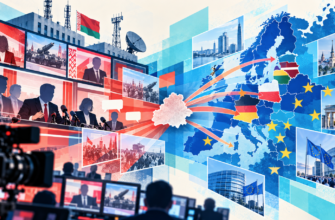
Belarus may seem like an unexpected vantage point for the Armenian elections, but Minsk is keeping a close eye on Yerevan. For the Kremlin’s closest ally, Armenia is a test case: a test of Russia’s ability to keep its partners in its orbit. Therefore, Belarusian state coverage of Armenia is worth reading carefully.
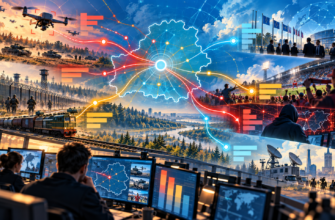
To do this at scale, we analyzed a research corpus of over two million documents, identifying 5,461 genuine mentions of Armenia on Belarusian pro-government websites and Telegram channels, as well as 41 Armenian YouTube channels: approximately 14,000 political videos and 165 million views in April and May 2026. This article is both about what we found and how we did it.
One system, two registers
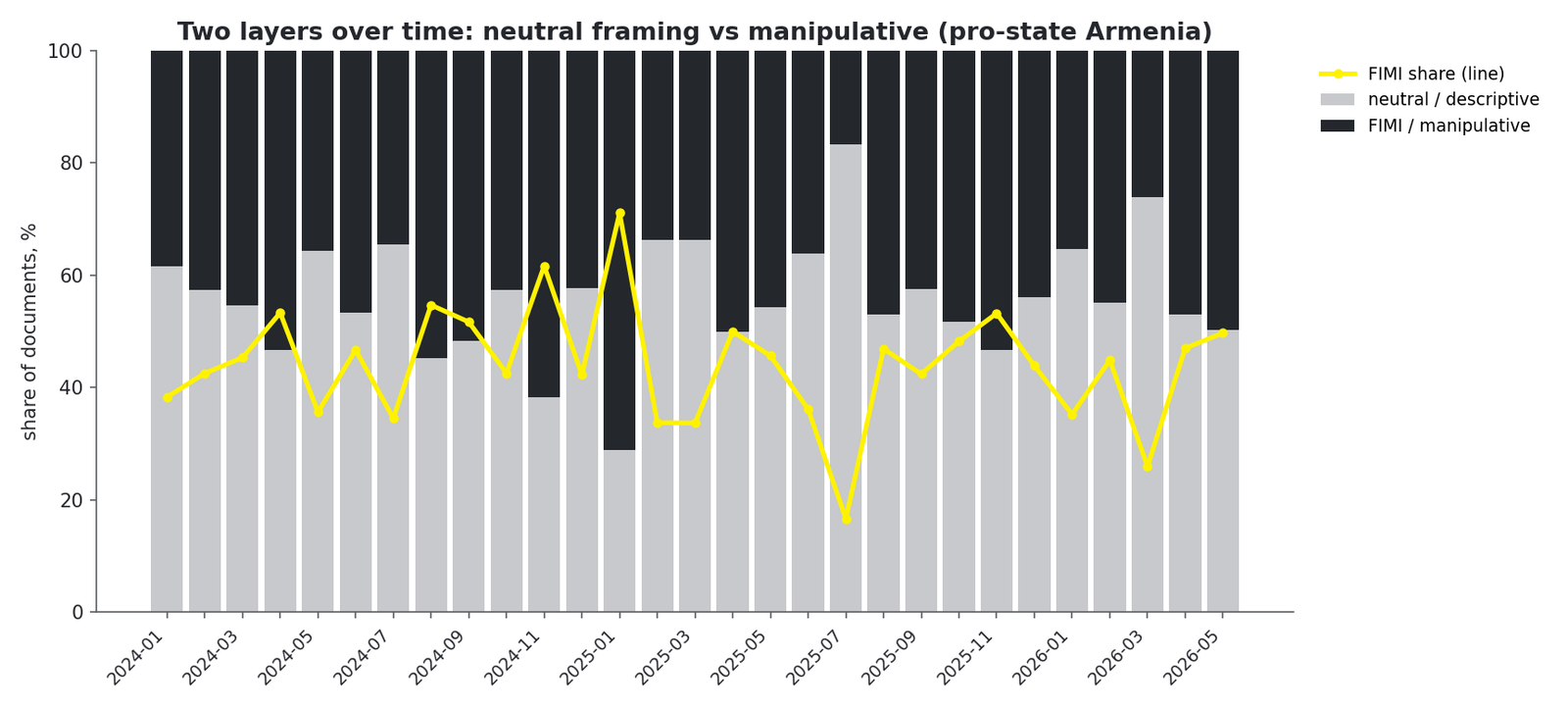
Belarusian state media speaks about Armenia in two voices simultaneously. On the official websites of state-owned media outlets, the tone is calm:About 72% of headlines are read as neutralThe same system in videos and on Telegram becomes harsher and more emotional. The public face is reserved, and the message underneath is nonexistent.
This manipulative message has a measurable form. The most common technique is an appeal to authority: it appears in more than half of the manipulative materials, followed by intimidation, emotionally charged language, and a selective presentation of facts. The format is recognizable: one expert, no alternative viewpoints, a predetermined conclusion. The same trace is visible in transcripts, video covers, and comments.
Mostly neutral, and that is what hides the toxic layerThis is our main finding, and it contradicts the intuition that state propaganda is loud and obvious. When we evaluated the full text of pro-government coverage using our codebook, the dominant frame was partnership, cooperation, and integration. Armenia is presented primarily as a regional partner, not an enemy. On the surface, this appears neutral, even friendly.
But beneath this neutral surface lies a manipulative layer, present in approximately 45% of the materials throughout the entire period. It doesn’t scream. It sits beneath a cooperative frame that makes it invisible. This neutral presentation is camouflage.
The toxic layer is surfacing at a crucial moment. On May 31, a week before the vote, Alexander Lukashenko advised Armenians to“very careful so as not to repeat what happened in Ukraine”, directly linking the warning to Armenia’s choice between the EU and the Eurasian Economic Union. The statement was disseminated by the state news agency BelTA, clearly linking it to the elections. The threatening frame was present in the data all along, and at the crucial moment, it came to the fore.
Where Toxicity Is Increasing: Telegram
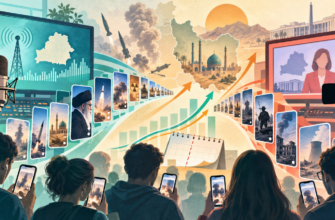
The two registers behave differently over time, and this difference is the story. Government websites remained relatively stable. The pro-government segment of Telegram did not. From January to May 2026, its reach increased almost sevenfold, and the number of posts about Armenia almost quadrupled. Actual mentions of Armenia on pro-government Telegram rose from approximately 80 per month at the beginning of the year to around 300 in May: a surge specific to Telegram, while websites remained stable.
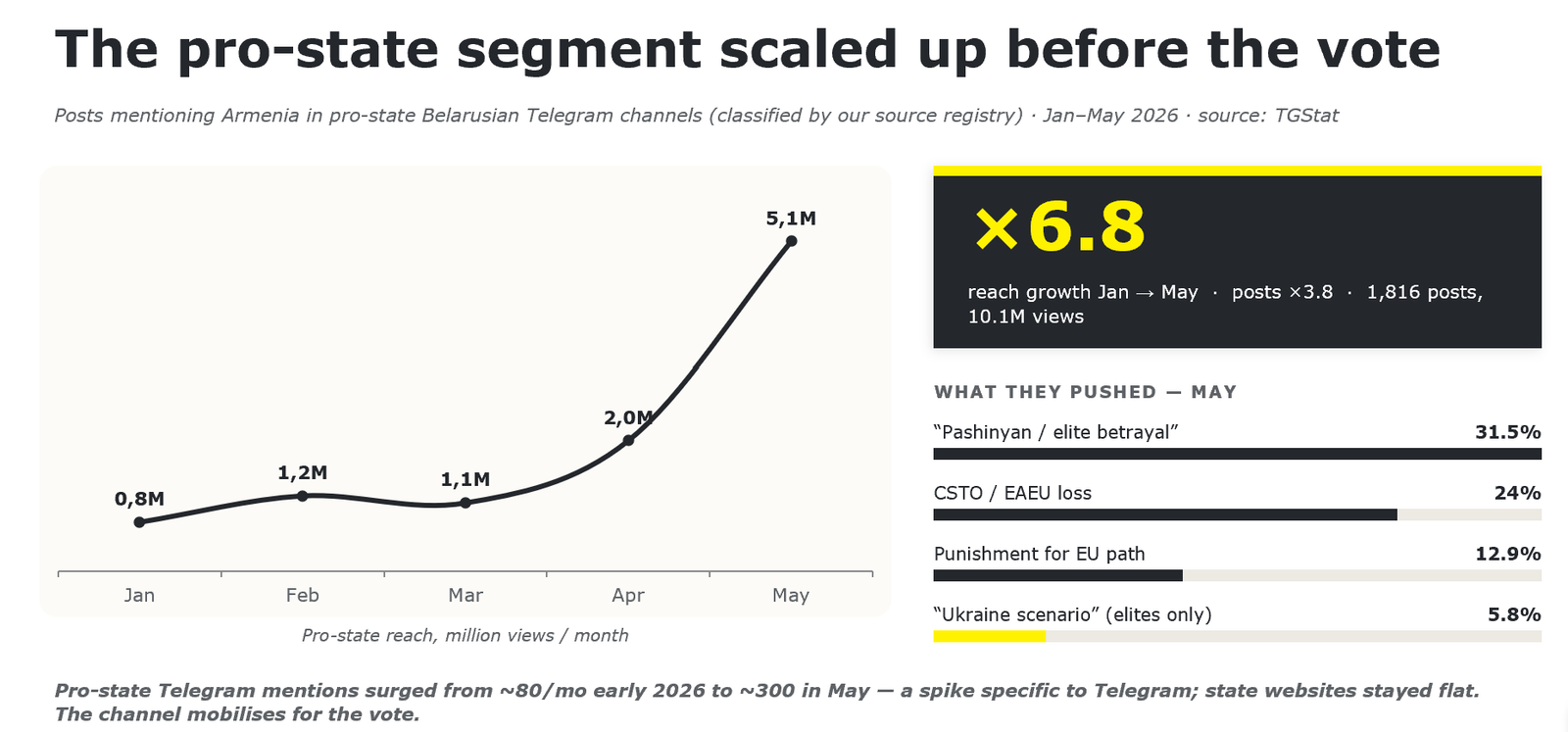
The division of labor is obvious: the site maintains a calm public face, while Telegram is mobilizing. Narratives about betrayal by Prime Minister Pashinyan, the loss of ties with the CSTO and the EAEU, and the “Ukrainian scenario” gained the most traction in May. Separately tracking the two tracks makes this clear: if combined into a single number, Telegram’s surge would dissolve into a flat average.
Inside Armenia: a fragmented field tilted to one side
We also monitored the Armenian side: 41 YouTube channels, nearly 14,000 political videos over two months, and approximately 165 million views. The field is fragmented among numerous platforms, but fragmentation does not mean balance. The most viewed political content is skewed toward Russian-language and geopolitical topics.
And although the field is fragmented, manipulative content is concentrated. In our in-depth analysis for the first quarter, one channel, Noyan Tapan, carried approximately 90% of one major narrative (about Turkey) and over 80% of another (about “punishment by the West”). Three independent methods: transcript evaluation, cover image analysis, and comment patterns, all pointed to the same channel.
What the machine marked and what was real
Here, the method is more important than a flashy number. We ran a semantic screen on a graphics processing unit (GPU) through the comments, looking for coordination. It flagged about one in ten accounts as potentially coordinated. If taken at face value, the figure looks dramatic. And if taken at face value, it’s wrong.
We read the flagged clusters manually. Most weren’t a network. Sixty-eight accounts simply wrote “absolutely correct.” A cluster with a similarity coefficient of 1.00 turned out to be four laughing emojis. Others were flag emojis and short slogans like “Prime Minister Nikol” or “Shame on you.” Short, emotional comments naturally cluster together because people actually write similarly: this is human behavior, not a botnet.
The real signal was different and much smaller: over 100 accounts with a single, long, identical text about former President Kocharyan. A long verbatim copy across multiple accounts is a coordination worth investigating. The lesson is simple, and that’s why we’re cautious with our own numbers:Detection without human verification is not a product. Verification is the work..
Narrative and reality
Manipulation works best where opinion has already shifted. The narrative that “Russia is the only guarantor” contradicts polls, which show a sharp decline in trust in Russia as a partner while support for rapprochement with the EU is growing. The gap between the message and the measured sentiment is the target. Therefore, independent monitoring is important: in April 2026, the International Democracy Support Mission explicitly recommended that government institutions and civil society coordinate to identify foreign information manipulation. This is precisely what our pipeline is designed for.
From detection to product
None of this requires a government agency. The pipeline operates on a civilian budget: collect, analyze, store, and produce. A full codebook assessment of over 5,400 documents cost $8-$14 with batch processing. A more complex analysis of comments is performed on a single laptop GPU. What’s needed isn’t scale, but method and consistency.
The result is intended for use, not just reading. Along with this analysis, we are conducting aFIMI practical glossary on Armenia: eight propaganda techniques and five recurring narratives, each with a definition, typical wording, and counterargument. We view it as a living reference: editors and fact-checkers can use it to recognize the technique, preempt the narrative before it spreads, and adapt it to their country. It is open and free for reuse with attribution.
Civil society doesn’t wait to react. It produces analysis, tools, and shared knowledge that others can build on.
Methodology
Data was taken from the FORESIGHT research corpus (over 2 million documents) on June 2, 2026. Mentions of Armenia are highlighted with multilingual markers and a density filter that removes navigation and “read also” text before counting. The pro-government web track and Telegram track are presented separately. Full-text evaluation was performed using the Structured Propaganda Codebook (v3.1) via batch processing; the figures presented are based on documents assessed at the time of writing; re-evaluation is ongoing. Coordination in comments was screened using multilingual sentence embeddings and clustering, then manually verified. We do not assert intent; we measure the trace: framing, techniques, and coordination in text, video, and comments.