

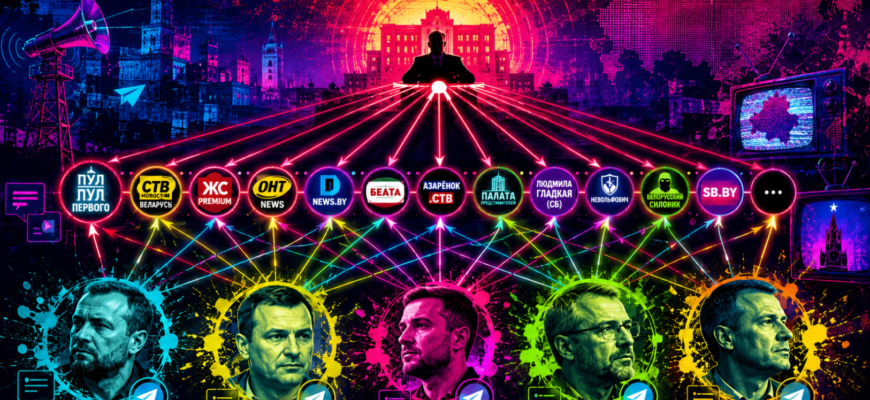
TL;DRThe five most prominent pro-government commentators in Belarus—Grigory Azarenok, Igor Tur, Alexey Dzermant, Alexander Shpakovsky, and Vadim Gigin—publicly present themselves as independent authors, analysts, and ideologists. Each has their own distinct voice, recognizable style, and audience on Telegram.
We decided to test the extent to which this independence was supported by data. The analysis was based not on subjective impressions of their rhetoric, but on the technical metadata of the channels: who exactly they rebroadcast, how often they do so, and how the sources of borrowed content are distributed.
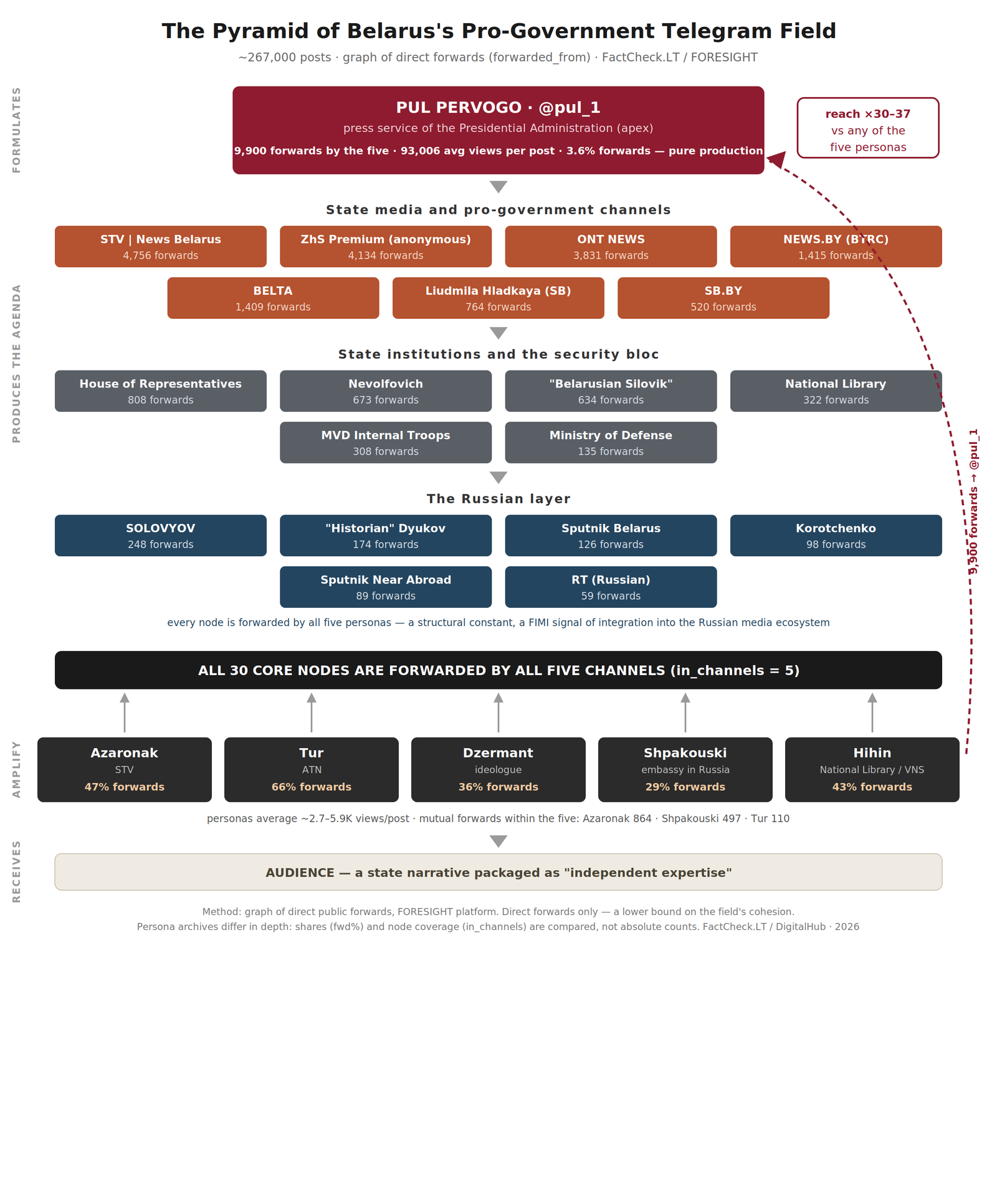
The results were more convincing and robust than our initial hypothesis. We’re not dealing with five independent authors who occasionally cite state media, but with a tightly interconnected information dissemination system. All five channels systematically amplify the same network of approximately thirty Belarusian state and Russian sources. At the top of this information pyramid is not an abstract “state media outlet,” but the official Telegram channel of the Presidential Administration’s press service.
Method
The analysis was conducted using a narrative monitoring system. The corpus consists of approximately 267,000 posts from seven Telegram channels: five personal channels of the aforementioned commentators, plus two institutional sources: NEWS.BY (a channel of the Belarusian Television and Radio Company, 169,000 posts) and “Pul Pervogo” (@pul_1, a channel of the presidential administration’s press service, ~18,000 posts).
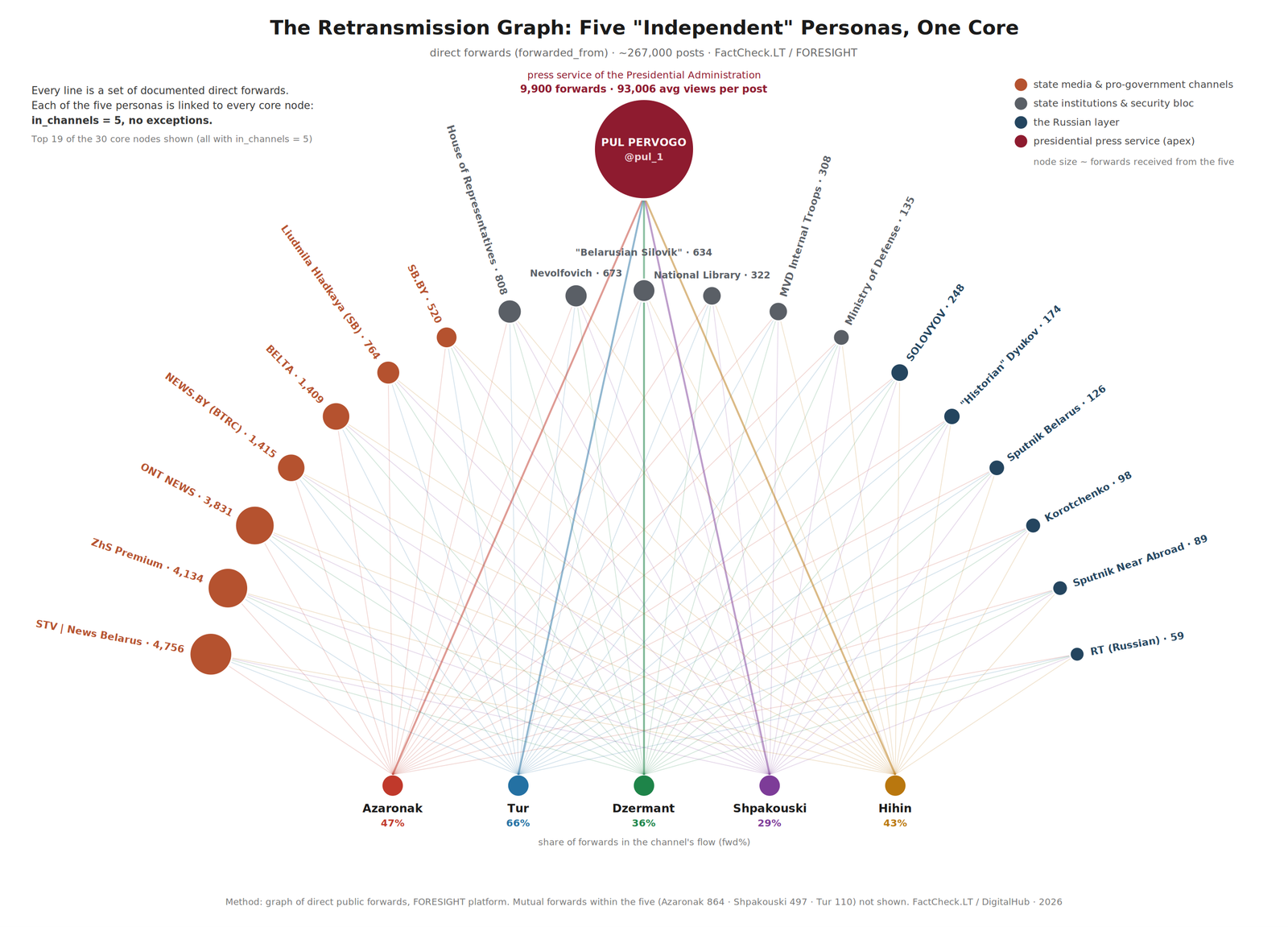
The method is transparent and reproducible: each forward in Telegram contains a machine-readable mark of the original channel (forwarded_from). We constructed a relay graph—who forwards whom—and calculated for each source node how many of the five personal channels it was reinforced by.
An important caveat right away: the graph only recordsdirect public forwardsHidden influence, copy-paste without attribution, and thematic coordination are not measured—these are separate issues. What we demonstrate below is the lower, documentably demonstrable boundary of field connectivity.
Find 1. Total pyramid
Key metric –in_channels: How many of the five personal channels forwarded this source? We expected to see a gradation: each commentator has their own circle of citations, with overlapping results on major government resources.
There is no gradation. All top 30 core nodes have in_channels = 5. Each of the five “independent” commentators systematically relays each of these nodes.
Not “the majority strengthens the main channels,” but “everyone strengthens everything.” Core map (total forwards from all five players):
| Knot | Forwards | Layer |
|---|---|---|
| Pool of the First (@pul_1) | 9,900 | Press Service of the Presidential Administration —vertex |
| STV | Belarus News | 4,756 | state TV |
| ZhS Premium | 4 134 | pro-government anonymous |
| ONT NEWS | 3,831 | state TV |
| NEWS.BY | 1,415 | state media |
| BELTA | 1,409 | state agency |
| Azarenok. STV | 864 | intercitation within the five |
| House of Representatives | 808 | state institution |
| Lyudmila Gladkaya (SB) | 764 | state journalist |
| Nevol’fovich | 673 | power unit |
| Belarusian security officer | 634 | power unit |
| SB.BY | 520 | state media |
| Shpakovsky. In essence | 497 | intercitation |
| National Library | 322 | state institution |
| Internal Troops of the Ministry of Internal Affairs | 308 | power unit |
| SOLOVYOV | 248 | Russia |
| “Historian” Dyukov | 174 | Russia |
| Ministry of Defense of the Republic of Belarus | 135 | power unit |
| Sputnik Belarus | 126 | Russia |
| Korotchenko | 98 | Russia |
| Sputnik Near Abroad | 89 | Russia |
| RT in Russian | 59 | Russia |
Finding 2. The apex is the apparatus of power itself, and it dominates all axes.
The most forward-oriented network on the field is “Pool Pervogo,” the official channel of the Presidential Administration’s press service (operating since November 2019). 9,900 forwards from the top five are more than any state television channel.
We’ve compiled this channel in its entirety: ~18,000 posts, 97% of which contain meaningful text. The share of forwards in it is 3.6%: this is almost pureproduction, the original source in the literal sense – direct quotes from Lukashenko, the structure of the meetings, the wording of the instructions.
And the key figure is reach. The average Pool One post gets93,000 views(maximum—2.99 million). This is 30–37 times more than any of the five commentators (average views per person are approximately 2.7–5.9 thousand) and than NEWS.BY (~2.5 thousand).
This upends the naive idea that “pro-government bloggers shape public opinion.” Real direct reach is concentrated in the press service’s channel. These individuals are second-tier amplifiers with a much smaller audience of their own. Their function isn’t reach. Their function is to lend the state narrative the appearance of independent expertise.
Finding 3. The Russian layer is not an episode, but a constant
In the core, in_channels = 5 – that is, among the sources that forwardall fivecommentators, the Russian layer is consistently present: Solovyov, the “historian” Dyukov, two Sputnik channels, Korotchenko, RT.
This is a structural characteristic of the field, not a random intersection: every Belarusian pro-government commentator systematically amplifies Moscow-based sources. In terms of FIMI (Foreign Information Manipulation and Interference) analysis, this is a direct, measurable metric of the integration of the Belarusian pro-government media field into the Russian propaganda ecosystem.
Finding 4. The “production → amplification” spectrum
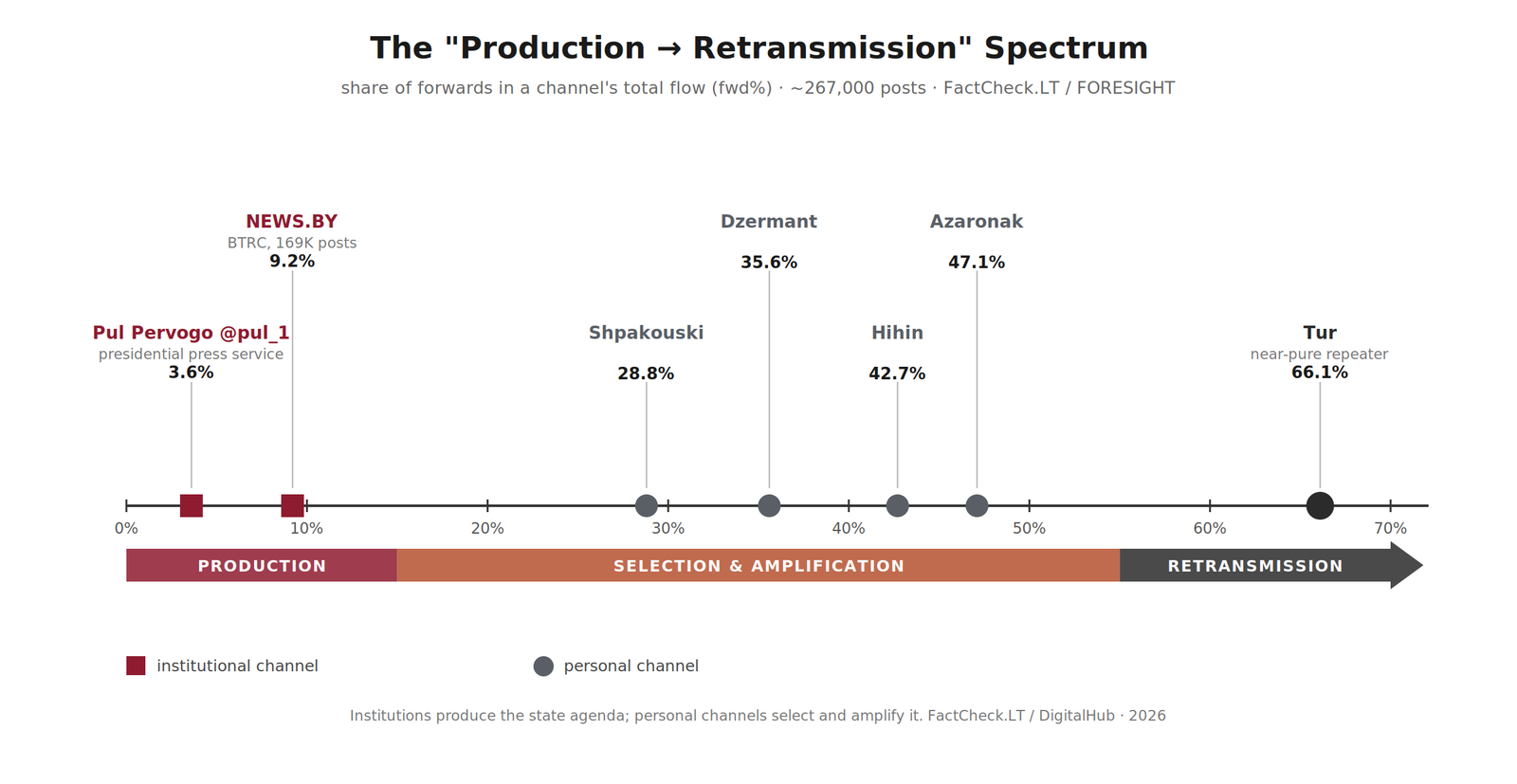
The share of forwards in the total channel flow (fwd%) lines up all channels in a layer into a continuous axis:
- @pul_1 — 3.6%: press service, clean production;
- NEWS.BY — 9.2%: state media factory, generates agenda;
- Shpakovsky – 29% / Dzermant – 36% / Gigin – 43% / Azarenok – 47%: selection and strengthening;
- Tour – 66%: almost a pure retransmitter of other people’s content.
Since the corpus includes both the producing side (169 thousand NEWS.BY posts, ~18 thousand press service posts) and the amplifying side, it is possible to trace verbatim which specific formulations from the state center are being circulated through “independent” commentators.
Finding 5: The network inflates its own weight
Personal channels also forward each other: Azarenka’s channel is rebroadcast by the others 864 times, Shpakovsky’s 497 times, and Tura’s 110 times, and in each case by all members of the five. This cross-citation creates the effect of multiple voices within the field where the source is single.
Finding 6. Infrastructure – before the crisis, mediators – under the events
The chronology of the canal launches shows the model of field construction:
- Bothinstitutionswere opened in 2019 — NEWS.BY in August, “Pool of the First” in November —toThe 2020 protests. Meanwhile, NEWS.BY was practically “sleeping”: in 2019, it had about a thousand posts with an average of ~260 views. During the protests of 2020, the channel exploded: 12,000 posts, a tenfold increase in views. The infrastructure had been built in advance and activated by the crisis.
- PersonsThey joined in waves based on events: Dzermant – 2018 (an early ideologist), Shpakovsky – November 2020 (immediately after the protests), Tur – 2021, Azarenok – September 2022, Gigin – February 2024 (nomination as a public leader).
Model: infrastructure in advance, mediators as needed.
Conclusion
The data leaves no room for interpretation by the “five independent authors.” The Belarusian pro-government Telegram community is a single, controlled pyramid, with the official channel of the Presidential Administration’s press service at the apex: it formulates, state media produces, and personal channels rebroadcast it indiscriminately—including the systematic amplification of Russian propaganda sources. The declared independence of the commentators is neither an exaggeration nor a stylistic license. Based on the structure of the rebroadcast, it is a fiction, measurable in the graph.
Within the FIMI framework, this field should be read as an integrated segment of the Russian-Belarusian manipulative media ecosystem, and the “expert voices” within it as a functional layer of legitimization of the state narrative.
Limitations of the method
- The graph records direct public forwards, not hidden influence or unattributed copy-paste (textual matches are the subject of a separate study).
- Telegram views are a snapshot at the time of collection; reach conclusions should be read as ordinal rather than definitive.
- The absolute numbers of forwards are not directly compared between personal channels: the archives are of different depths (Gigin – since 2024, Tur – since ~2023). The shares (fwd%) and the in_channels metric are comparable.
- Tour’s channel is a rebroadcaster of other people’s content (verification: forwards from a dozen different government sources, no self-promotion detected); this is recorded as is.
- All subjects are publicly employed propagandists; the study describes the structure of the media landscape and does not address private individuals.