
How Belarusian state media and pro-regime Telegram channels described storm Priska in Lithuania and Latvia
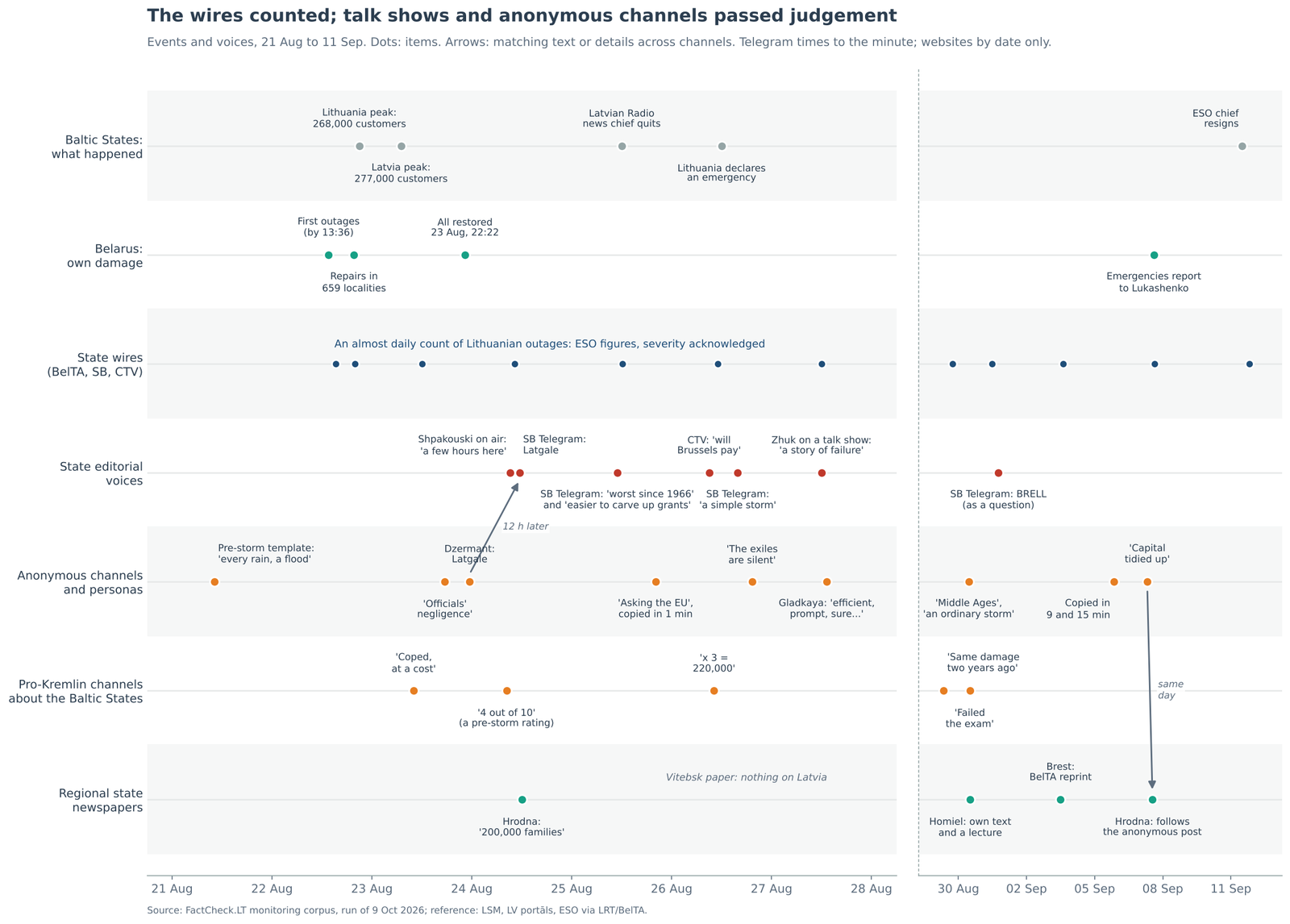
On Saturday 22 August and overnight into 23 August, cyclone Priska passed across Poland, Belarus, Lithuania and Latvia. At the peaks of the outages, more than half a million customers in Lithuania and Latvia combined were left without electricity, and two people died. In Belarus, power cuts over the two days affected more than 889 settlements.
We checked how Belarusian state media and pro-regime Telegram channels wrote about it between 22 August and 15 September. A search of the FactCheck.LT monitoring corpus using a storm vocabulary returned 567 items. Of these, 129 items from state websites, state Telegram channels and regional newspapers, and 83 posts from personal, anonymous and pro-Kremlin channels were about the storm in the neighbouring countries. We read them by hand.
The state news wires reported the storm in the neighbouring countries mostly accurately and acknowledged its severity. The judgements “they couldn’t cope”, “they’re asking the EU for money” and “an ordinary storm” appeared elsewhere: on the talk show Budni, in the write-up of that broadcast on the SB. Belarus Segodnya website, in closing lines added to posts on SB’s Telegram channel, in anonymous pro-regime channels and in pro-Kremlin channels about the Baltic States. The dividing line runs even through a single channel. In the news part of posts on SB’s Telegram channel, the neighbours’ storm is “destructive”, while in a closing line on 26 August it has already become a “simple” storm.
Key findings
- News items by BelTA, SB and CTV mostly reported the Lithuanian and Latvian operators’ figures correctly. CTV wrote of a “catastrophic” situation, BelTA of a storm “a third more intense” than a couple of years ago. A frequent error in the wires: “people” instead of “customers”.
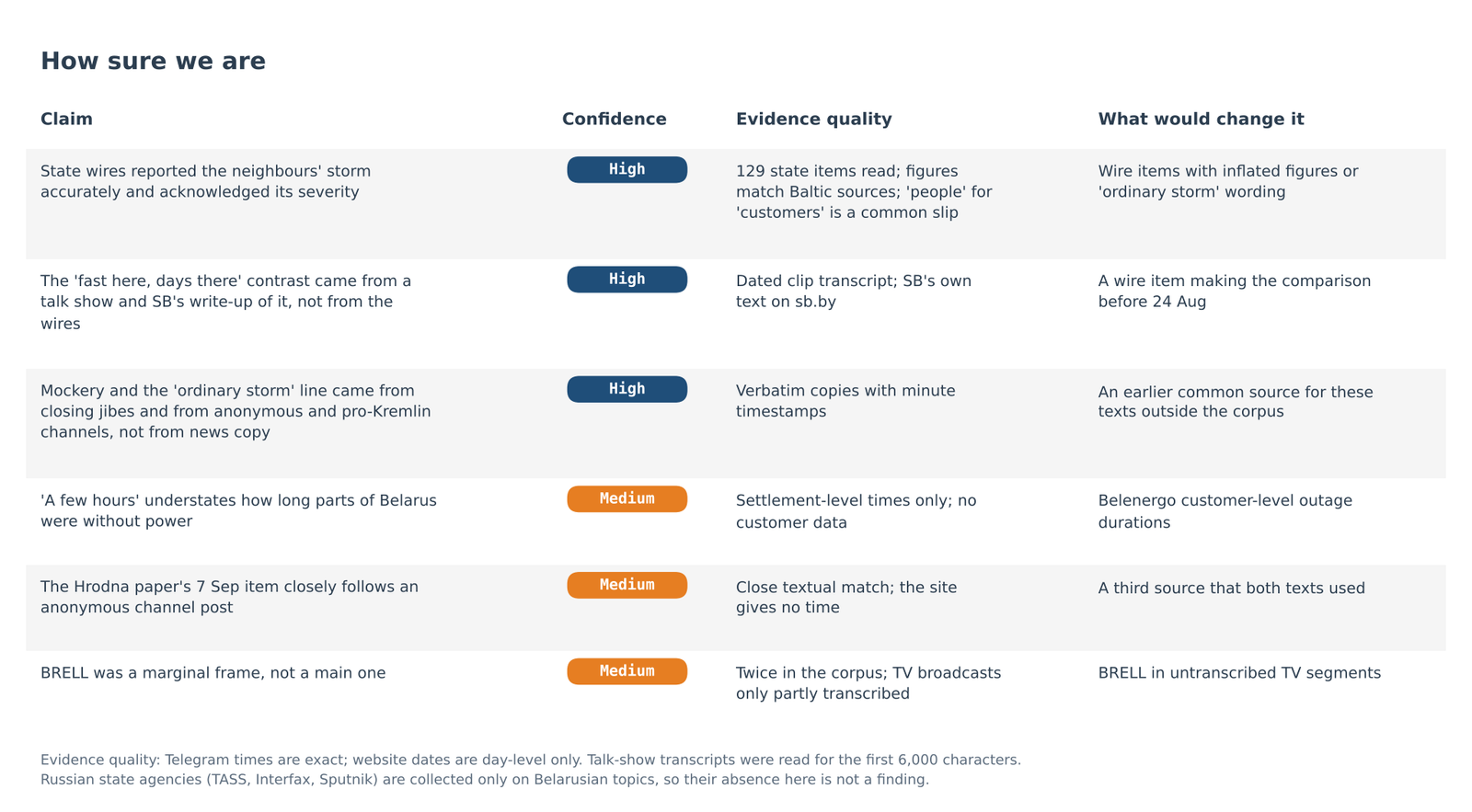
- The comparison “a few hours for us, days on end for them” was first made on the talk show Budni on 24 August. It came from Aliaksandr Shpakouski, a member of the House of Representatives. Belarus did restore power faster, but almost 33 hours passed between the first outages and the restoration of power to all settlements, and Belarus did not publish customer figures.
- The mockery was started by anonymous channels on 23 August. Propagandists’ personal channels repeated their posts 1–15 minutes later. Pro-Kremlin channels about the Baltic States and Belarusian anonymous channels shared texts with each other.
- The regional paper Grodnenskaya Pravda published two harsh texts about the neighbours with no sources. The second of them closely repeats a post by an anonymous channel published that same morning.
- Most of the “failures” that propaganda traded in were taken from genuine self-criticism by Lithuanian and Latvian officials. It was reworked using four techniques: removing caveats, shifting things in time, inflating figures and imputing malice.
What actually happened
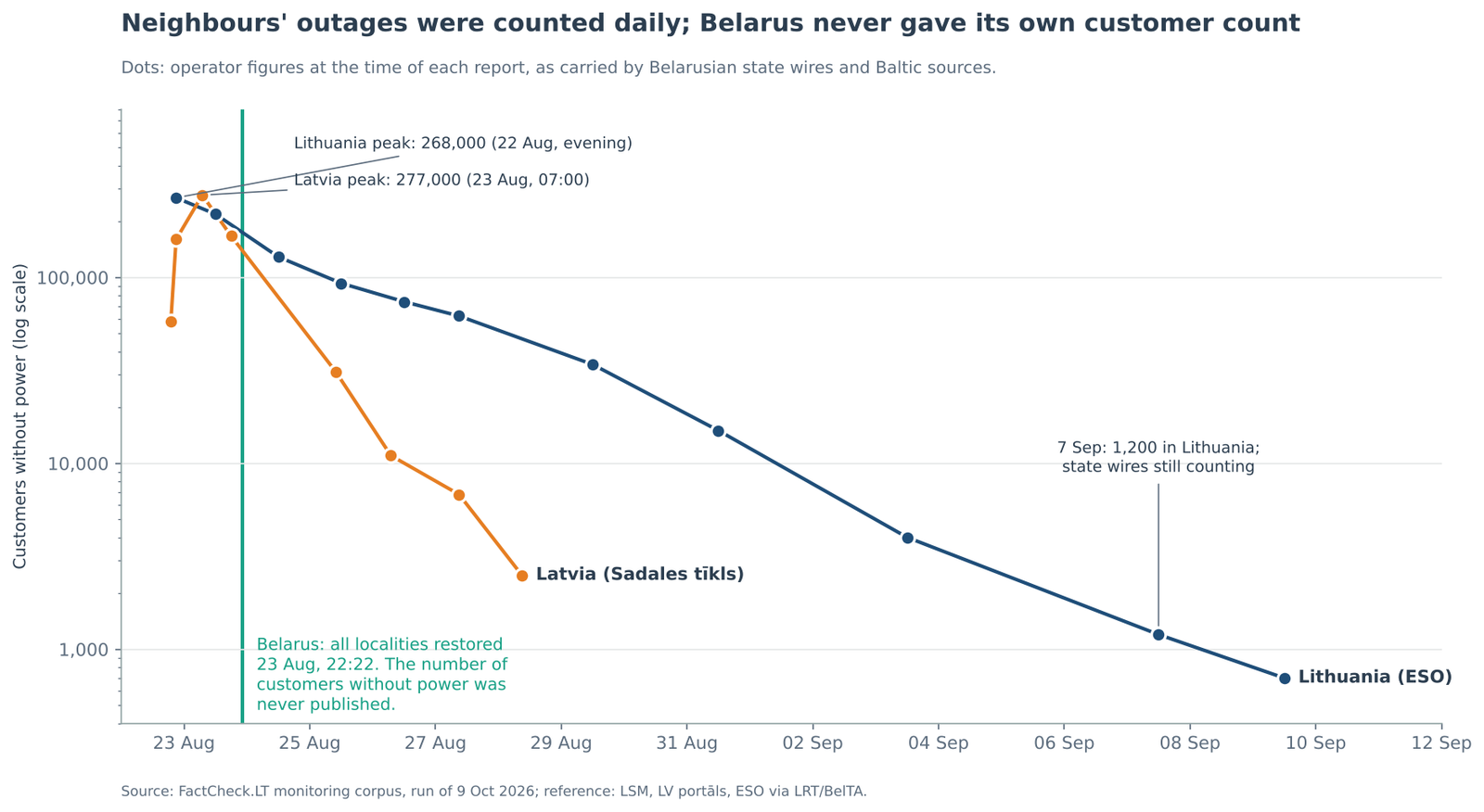
The Belarusian state wires themselves provide the baseline. On 24 August BelTA wrote that on the evening of 22 August electricity was cut off for 268,000 customers in Lithuania, while in Latvia the storm caused the most extensive power supply disruptions of the past 20 years: at 07:00 on 23 August about 277,000 customers were without power. One person died in Lithuania and one in Latvia.
After that, the count ran in days. According to data from the Lithuanian operator ESO, relayed by the same BelTA, 129,000 customers were still without power on 24 August, about 74,000 on 26 August and about 1,200 on 7 September. In Latvia, restoration went faster: on the morning of 26 August about 11,000 customers were still without power (LSM).
On 26 August the Lithuanian government declared a nationwide state of emergency (BelTA), and the army was brought in to help with the work. On 11 September the head of ESO resigned. In Latvia, on 25 August, the head of Latvian Radio’s news service stepped down over the coverage of the storm (LSM).
In north-eastern Poland, almost 150,000 households were left without electricity (BelTA on Telegram, 23 August).
Trouble at home: how state media described the damage in Belarus
The first outages in Belarus began in the afternoon of 22 August. At 13:36 Vitebskie Vesti reported seven 10 kV lines down in the Pastavy, Hlybokaye, Verkhnyadzvinsk and Polatsk districts. This is the earliest time-stamped report we found. In the evening the Ministry of Energy wrote about restoration work in 659 settlements: as of 19:00, 1,876 transformer substations, 179 lines of 10 kV, 12 lines of 35 kV and 7 lines of 110 kV were disconnected, and 31 farms and 16 boiler houses were without power.
As of 22:22 on 23 August, the Ministry of Energy reported that all settlements had electricity. The same report said that during the bad weather the outages had affected more than 889 settlements, that two diesel generator sets were still running and that 41 customer requests on the 0.4 kV network were still outstanding. Almost 33 hours passed between the first time-stamped report and this one.
Belarus reported how many settlements and substations were left without power. The Ministry of Energy reports we found give neither the number of customers without power nor the duration of the outages. What the neighbours published was precisely the number of customers. This difference will matter when we come to the comparisons.
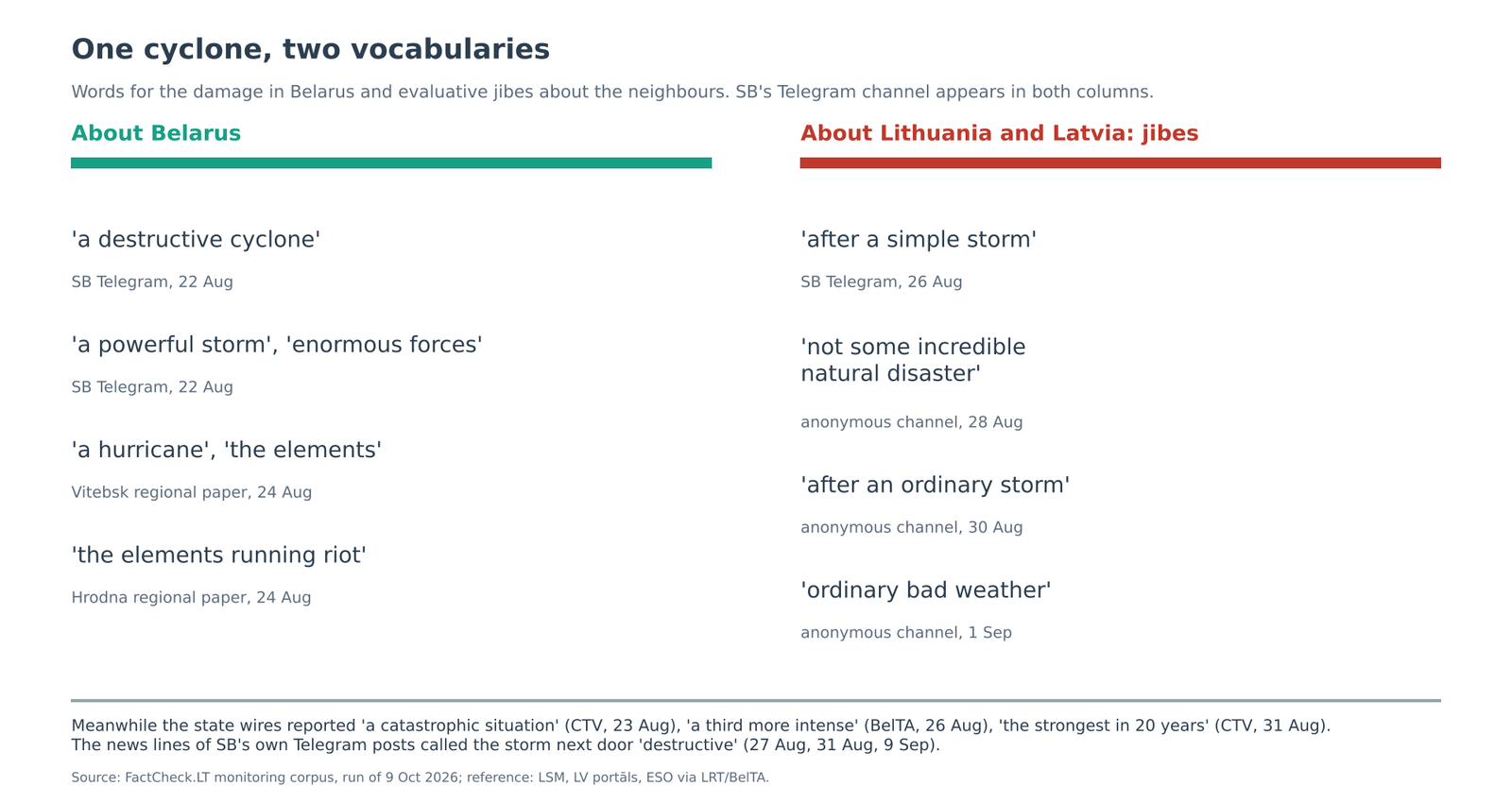
State media did not play down the disaster at home. On 22 August SB’s Telegram channel wrote of a “destructive cyclone”, a “powerful storm” and “colossal forces” deployed on restoration. On 24 August Vitebskie Vesti wrote of a “hurricane” and “the elements”, including in the Verkhnyadzvinsk and Braslau districts on the border with Latvia. The same day Grodnenskaya Pravda recalled “the rampage of the elements”.
Four voices of one state
In the coverage of the storm in the neighbouring countries we distinguished four voices. They spoke at the same time, but they said different things.
| Voice | What it did | Example |
|---|---|---|
| The news wires of BelTA, SB, CTV and their Telegram channels | An almost daily chronicle citing ESO, LRT and other sources from 22 August to 11 September. The severity of the storm is acknowledged | CTV, 23 August: the operator calls the situation catastrophic; there has been no damage like it for several decades |
| The editorial layer of state media | The “us and them” comparison, “a story of failure”, “a simple storm”, EU money, BRELL | The talk show Budni on 24 and 27 August, a CTV report on 26 August, closing lines on posts by SB’s Telegram channel |
| Anonymous pro-regime channels and named individuals | Mockery, “an ordinary storm”, “the runaways are silent”, “the Middle Ages”. Personal channels mostly copy; Liudmila Gladkaya and Aliaksei Dzermant write their own material | Zheltye Slivy, Nevolfovich, BelVestnik; Gladkaya, Dzermant, Ryhor Azaronak |
| Pro-Kremlin channels about the Baltic States (country of origin not established) | Accurate figures next to self-criticism taken out of context, and threats. Exchange of posts with Belarusian channels | Teni Pribaltiki, Baltiysky Most, Aleksei Stefanov’s channel |
The news wires stuck to the facts. On 26 August BelTA relayed ESO’s statement that the storm had been “more than a third more intense than a couple of years ago”. On 31 August CTV called it “the strongest in 20 years”, and on 3 September SB wrote that it had been “one of the biggest in recent decades”. On 4 September CTV mentioned that specialists from Latvia and Poland were helping Lithuania.
The wires made mistakes too. The most frequent was “people” instead of “customers”: BelTA (25 August) and SB (26 August) both wrote it this way. A CTV item on 23 August said that “more than 270 families” in Latvia were without electricity, although the figure in question was 277,000 customers. In one post, SB’s Telegram channel mixed up the Lithuanian and Latvian operators. These errors did not change the overall picture and added no judgements.
Judgement was added alongside. At 09:12 on 24 August, a clip from the talk show Budni featuring Aliaksandr Shpakouski appeared on YouTube. “Some of our compatriots were a little irritated, unhappy that they had to spend a few hours without electricity. Now our neighbours in Lithuania, 155,000 people, for days on end they cannot overcome this problem. Do you understand? That’s the difference in approaches”, he said.
On 27 August Information Minister Dzmitry Zhuk appeared on the same Budni. His exact words: “Of course, this is a story of failure. Not with regard to Latvia and Lithuania, but with regard to the authorities of Latvia and Lithuania”, “they were hooked on EU subsidies as if on a needle”, and Belarusians can rely on their authorities, whereas “our neighbours in Latvia and Lithuania, alas, do not have that luxury”. The write-up on the SB website added lines of its own: “Latvia and Lithuania failed the exam the elements set them”, “in Belarus the aftermath of the elements is dealt with far more promptly”, “unfortunately, the people of Lithuania and Latvia have grown used to the authorities’ inaction”. The SB write-up contains not a single figure about Belarus.
SB’s Telegram channel worked the same way: facts first, then a closing line. On 25 August a post about Latvia reported that the storm was being called the strongest since 1966, and ended with the words “Easier to carve up grants”. On 27 August the channel quoted the head of Latvia’s Central Election Commission as saying that the elections would go ahead even by candlelight, and added that this “vividly highlights the real ‘effectiveness’ of the local emergency services”.
CTV’s report of 26 August, “In the Baltics they cannot cope with the aftermath of the bad weather”, brought almost the whole frame together in one text: Brussels, which is supposed to “cross their palm with silver”, defence spending, the border fence and “200 euros to every Lithuanian”.
The anonymous channels started before anyone else. On 21 August, the day before the storm, Zheltye Slivy published a template about a downpour in Lithuania: “As soon as it rains, there’s a flood… Well, that’s in Lithuania, zmagar”. At 17:32 on 23 August the same channel wrote that Latvia had been left without power by “the hurricane and the officials’ sloppiness”. Teni Pribaltiki’s first evaluative post, on the morning of 23 August, acknowledged that “the services coped, but the price is high”. It ended with a hint: this had been a “natural storm” that “came from the south and went away”, whereas the one that “the Balts have already earned from the east has a habit of coming back every night. Think about it”.
Double standard
On 22 August SB’s Telegram channel wrote of a “destructive cyclone” over Belarus. In the news part of its posts it wrote about the neighbours in similar terms, calling their storm “destructive” (27 August, 31 August, 9 September). But on 26 August the closing line on a post about Lithuania’s telecoms problems read: “If things are this bad in Lithuania after a simple storm, it’s not very clear how they intend to fight a war”. The word “simple” appears where the judgement begins.
The anonymous channels did the same thing more bluntly. On 28 August BelVestnik opened a post with “the strongest storm in recent years” and closed it by saying that this was “not some incredible natural cataclysm. Just a strong storm”. On 30 August an anonymous Hrodna channel wrote of “the Middle Ages” in Lithuania “after an ordinary storm”. On 1 September Nevolfovich called the storm “ordinary bad weather”. In an interview with BelTA on 4 September, an expert called it a “little hurricane”.
All these formulations are contradicted by the state media’s own reports quoted above: “a catastrophic situation”, “a third more intense”, “the strongest in 20 years”, “one of the biggest in decades”.
How texts moved between channels
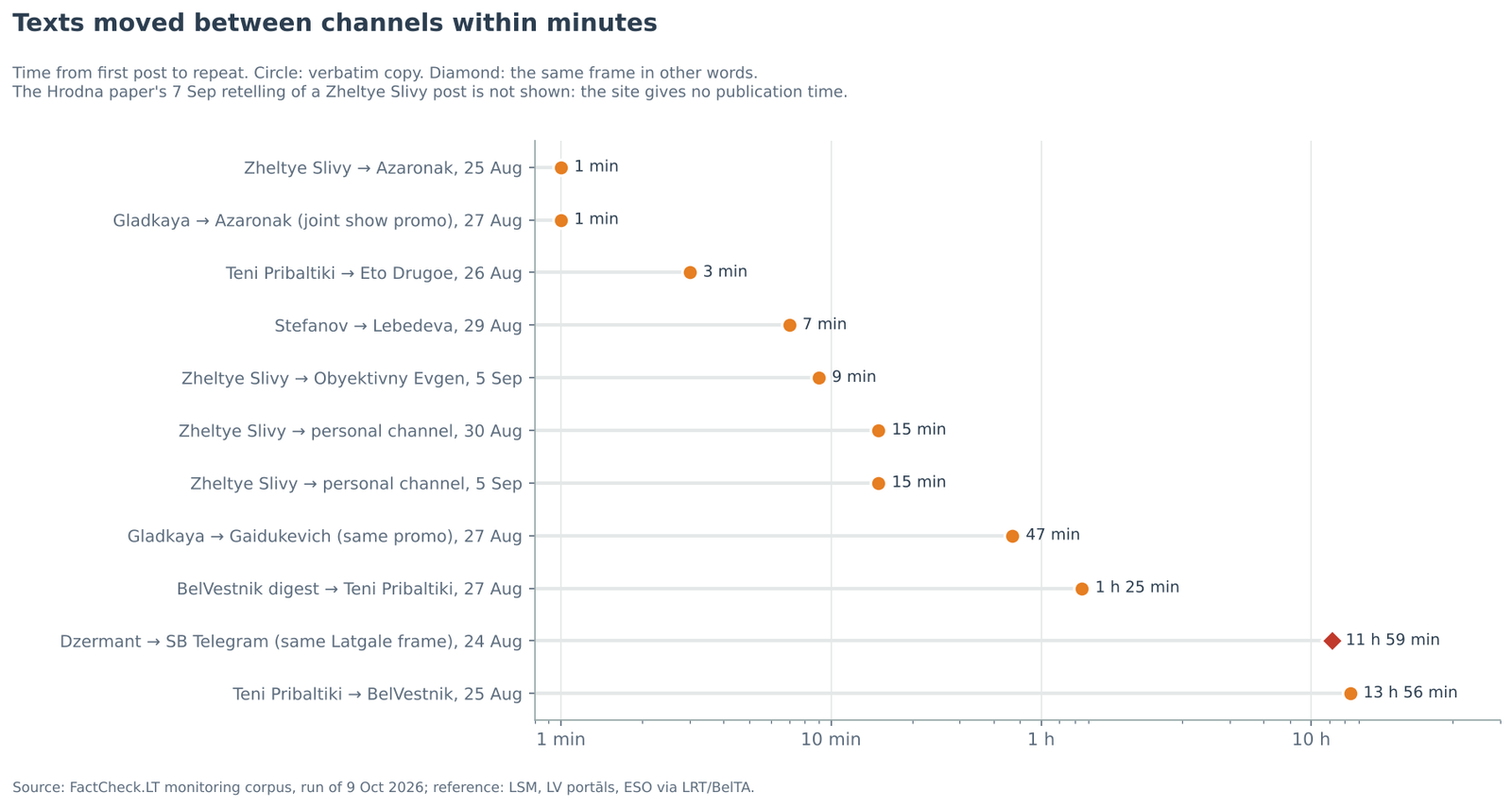
Telegram posts carry a publication time accurate to the minute, so copies are visible. We found the following chains.
Anonymous channel → personal channels, verbatim. A Zheltye Slivy post saying that Latvia would ask the European Union for money (“Is this the bottom, or already rock bottom”) went out at 20:09 on 25 August. At 20:10 Ryhor Azaronak repeated it. A post by the same channel at 13:14 on 30 August was repeated by a personal pro-regime channel at 13:29. A post of 5 September, published at 20:13, was repeated by Obyektivny Evgen at 20:22 and by the same personal channel at 20:28.
Liudmila Gladkaya. Among the personal channels, Liudmila Gladkaya (SB) wrote about the storm in the neighbouring countries more often than the others. On 27 August she retold the news that Lithuania and Latvia had spent almost a week dealing with the aftermath of the storm, adding the closing line “Effective, prompt, yeah…” and a quote from the head of Latvia’s Central Election Commission (post). On 29 August she wrote that Lithuanian officials “have no time for that” because they were discussing the castration of paedophiles, and suggested “starting with the Lithuanian top brass” (post). A trailer for the Letuchka broadcast with the line “Lithuania without power…”, featuring Gladkaya, Yauhen Gorin and Azaronak (post), was repeated by Azaronak a minute later and by Aleh Gaidukevich 47 minutes later. For a trailer of a joint broadcast, this is ordinary cross-promotion. Azaronak himself wrote no text of his own about the storm in the neighbouring countries.
Pro-Kremlin channels about the Baltic States and Belarusian anonymous channels. A Teni Pribaltiki post about a “staff shortage” in Lithuania went out at 22:01 on 24 August, and BelVestnik repeated it at 11:57 the next day. Aleksei Stefanov’s “Baltic week in review” went out at 08:26 on 29 August; seven minutes later Ksenia Lebedeva repeated it, and the post then spread to five more channels. BelVestnik’s digest of 27 August at 15:37 (post) is put together from sections signed “Aleksei Stefanov”, “Teni Pribaltiki”, “Baltiysky Most” and Baltnews. The same evening it appeared on Teni Pribaltiki, Stefanov’s channel and Baltiysky Most. Who compiles these digests cannot be seen from the data.
Named individual → state channel. At 23:29 on 23 August Aliaksei Dzermant wrote that in Latgale “the Latvian state has simply dumped people to their fate” and people “are taking drinking water from the river”. Twelve hours later SB’s Telegram channel wrote: “The authorities simply abandoned people to their fate”, people are stocking up on water, “scooping it from the river”. Neither names a specific source: SB refers to “videos” on social media.
Anonymous channel → regional newspaper. More on this below.
What this network did not include. The channel Pul Pervogo, which is close to the press service of the head of the regime, did not write about the storm in the neighbouring countries. Russian agencies (TASS, Interfax, Sputnik) do not appear in the corpus with material on the storm in the neighbouring countries, but we collect them only on Belarus-related topics, so we draw no conclusions from this.
Regional newspapers
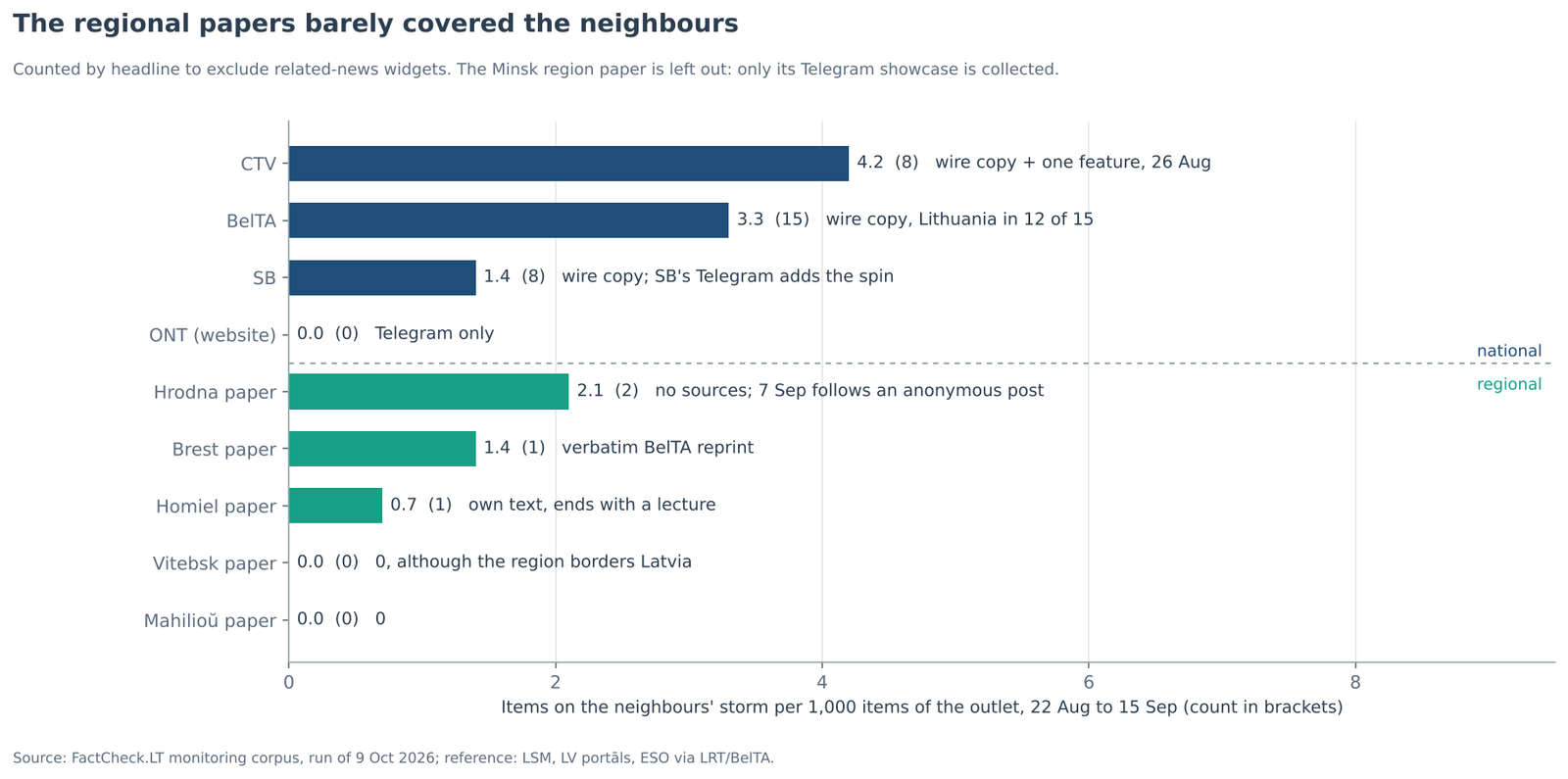
We compared national state media with the regional newspapers. There is a difference, but not the one you might expect: the regional papers barely wrote about the neighbours.
| Outlet | Items on the storm in the neighbouring countries (by headline) | Per 1,000 items by the outlet | Origin and tone |
|---|---|---|---|
| BelTA | 15 | 3.3 | chronicle citing sources, Lithuania in 12 of 15 |
| CTV | 8 | 4.2 | chronicle plus one editorial report on 26 August |
| SB | 8 | 1.4 | chronicle; judgement is added by SB’s Telegram channel |
| ONT (website) | 0 | 0 | Telegram only |
| Grodnenskaya Pravda | 2 | 2.1 | no sources, written like a social media post; on 7 September a close retelling of an anonymous channel |
| Zarya (Brest) | 1 | 1.4 | verbatim reprint of BelTA |
| Gomelskaya Pravda | 1 | 0.7 | own text: facts, with a moralising ending about defence spending |
| Vitebskie Vesti | 0 | 0 | wrote about their own “hurricane”, nothing about Latvia |
| Mogilevskie Vedomosti | 0 | 0 |
Vitebskie Vesti wrote nothing about Latvia, even though the storm also passed through the border districts of Vitebsk region itself. Zarya reprinted BelTA. On 30 August Gomelskaya Pravda wrote its own piece about Lithuania: on agriculture, compensation and “268,000 people” without power (in fact, customers). It ended with a moral lecture: “dear neighbours, perhaps you should think about your priorities?”, and the storm “doesn’t care how much the country spent on fences, defence or strengthening its borders”.
Grodnenskaya Pravda published two texts that differ sharply from the wires. 24 August: “A week without power or help”. 7 September: “Riga shines while the provinces lie in ruins”. Both are without links, and both end with the call “Write in the comments!”. The second text closely repeats a post by Zheltye Slivy published at 07:40 the same day: the same “sprucing-up” in the capital, the same “a few more weeks”, a retelling of the same quote from the Latvian authorities about safety, and even the ending about people in the Baltic States who were “given” power or had it “returned”. The newspaper’s website shows no publication time, and we did not find a common third-party source. We did not find the source of the first text either.
Checking the claims
1. “Some of our compatriots… to spend a few hours without electricity. Now our neighbours in Lithuania, 155,000 people, for days on end” (Aliaksandr Shpakouski, the talk show Budni, clip of 24 August).
Belarus did restore power faster than its neighbours, if measured by settlements. But between the first time-stamped report of outages (13:36 on 22 August) and the Ministry of Energy’s report that all settlements had electricity (22:22 on 23 August), almost 33 hours passed, and even then 41 customer requests were still outstanding. The Ministry of Energy did not report how many hours each home spent without power, so for some residents “a few hours” may have been true, and for others not. The figure of 155,000 for Lithuania comes from reports on the evening of 22 August. On the day the clip came out, BelTA reported 129,000 customers.
Verdict: half-true.
2. “Unfortunately, the people of Lithuania and Latvia have grown used to the authorities’ inaction” (SB website, write-up of the broadcast with the information minister, 27 August).
Two days earlier BelTA reported that the army had been brought in to help with the work in Lithuania and that a state of emergency had been declared in the Anykščiai and Kazlų Rūda districts. On 26 August SB itself wrote about 400 ESO crews, municipal crews and the military.
Verdict: false, contradicted by the state media’s own reports.
3. “After a simple storm” (SB’s Telegram channel, 26 August), “not some incredible natural cataclysm” (BelVestnik, 28 August), “after an ordinary storm” (anonymous channel, 30 August).
The state wires wrote about the same storm: “a catastrophic situation” (CTV, 23 August), “more than a third more intense than a couple of years ago” (BelTA citing ESO, 26 August), “the strongest in 20 years” (CTV, 31 August), “one of the biggest in recent decades” (SB, 3 September). SB’s Telegram channel itself, in the news part of its posts, called the neighbours’ storm “destructive”, and BelVestnik opened its own post with “the strongest storm in recent years”.
Verdict: false.
4. “While more than 200,000 families remain in the dark… rescuers and utility workers simply don’t turn up when called” (Grodnenskaya Pravda, 24 August, headline “A week without power or help”).
The figure is out of date, and its unit has been changed. BelTA reported about 219,000 customers without power on 23 August; on 24 August 129,000 remained, and these are customers, not families. The “week” in the headline is taken from ESO’s forecast that repairs could take about a week (in the same BelTA item) and presented as an accomplished fact. The claims about “the authorities’ inaction” and that rescuers and utility workers “simply don’t turn up when called” are not backed by anything.
Verdict: distortion, claims without evidence.
5. “Riga shines while the provinces lie in ruins” (Grodnenskaya Pravda, 7 September).
The text, which gives no link, closely repeats a Zheltye Slivy post from the same morning. It is about clearing fallen trees, not about electricity: the paper itself writes that “power has finally been returned to homes”. Two days later SB’s Telegram channel wrote that “Latvia has already fully recovered from the blow dealt by the elements”.
Verdict: manipulation.
6. “74,000 households. If there are 3 people in each on average, that is more than 220,000 people” (Teni Pribaltiki, 26 August; repeated in BelVestnik’s digest of 27 August).
In Lithuania there are on average two people per household (Statistics Lithuania, 2022 data). Moreover, the 74,000 in ESO’s report are customers, which include businesses, summer cottages and outbuildings, not only residential households. The channel repeated the “×3” multiplier on 3 September as well: “4,000 households. That is roughly 12,000 people”.
Verdict: manipulation, inflated figures.
7. “The head of the Crisis Management Centre, Colonel Arvis Zīle, rated Latvia’s real readiness for emergencies at 4 points out of 10. According to him, the storm clearly demonstrated…” (Teni Pribaltiki, 24 August).
Zīle gave the “four out of ten” rating on 13 August on Latvian Radio, nine days before the storm (LSM). The post presents it as a conclusion drawn from the storm. We did not find any statement by Zīle after 22 August that the storm had shown this.
Verdict: out of context.
8. “Just two years ago bad weather caused roughly the same damage” (Aleksei Stefanov’s channel, 29 August; spread to six more channels).
A similar storm did occur a couple of years ago. But on 26 August BelTA, citing ESO, reported that this one was more than a third more intense.
Verdict: distortion.
9. “Latvia has turned to the European Commission for financial assistance” (BelVestnik, 26 August); “In Latvia the damage has exceeded 30 million euros. Riga has said it cannot cope on its own” (NEWS.BY’s Telegram channel, 25 August).
Latvian minister Edgars Tavars said that the damage “could reach tens of millions of euros” and that Latvia would “possibly” have to turn to the European Commission. That is exactly how BelTA reported it. A day later “possibly” had become “has turned“, while NEWS.BY on the same day, 25 August, came up with “has exceeded 30 million” and “has said it cannot cope”. We did not find a source for these formulations. The EU’s post-disaster assistance mechanism itself is a standard one, and Lithuania was planning to use it for its farmers: BelTA reported this too.
Verdict: distortion, caveats removed.
10. “The promised 200 euros to every Lithuanian still sitting by candlelight” (CTV, 26 August).
The payment was not promised to everyone, and it was not a fixed sum. On 30 August Gomelskaya Pravda summarised it as follows: those whose electricity was not restored within 72 hours get on average about 68 euros, plus an additional payment of up to 200 euros. According to Lithuania’s Ministry of Finance as of 3 September, ESO calculates compensation for an outage longer than 72 hours for each customer, based on their consumption and the length of the outage. The same customers can apply for simplified compensation of justified direct losses: up to 220 euros per property. “200 euros to every Lithuanian” turns a payment of “up to” a limit and “per property” into a fixed sum per person. On 7 September BelTA described the procedure correctly.
Verdict: distortion.
11. “Ordinary bad weather and strong winds brought down 124 sections of fence on the Latvian-Belarusian border” (Nevolfovich, 1 September).
Latvia’s border guard service reported 124 cases of the fence being damaged by falling trees (LSM). On 26 August CTV reported this close to the source: “124 cases of trees falling”. In the anonymous channel, cases of damage became sections brought down.
Verdict: distortion.
12. “We tried to find what our runaways are writing about it. Silence. Absolute” (Nevolfovich, 26 August).
Taken literally, this is false: Charter 97 wrote about the storm in the neighbouring countries on 23 August. In substance, the claim is partly true: the corpus contains no other items by independent Belarusian media about the storm in Lithuania and Latvia for 22–26 August.
Verdict: false, with a caveat.
The raw material was real
Most of the “failures” that propaganda wrote about were taken from real statements by Lithuanian and Latvian officials. Lithuania’s prime minister acknowledged a shortage of electricians (according to a quote in a Teni Pribaltiki post; we did not check the original source). Lithuania’s Energy Minister Lukas Savickas said that the mistakes made were obvious, as SB reported. The head of ESO resigned. Latvian minister Tavars admitted that the authorities had not anticipated the scale of the problems. The head of the telecoms operator Tet said he would like the Crisis Management Centre to take over coordination (LSM). The head of the Jēkabpils municipal council said there had been no generators (LSM).
This self-criticism was reworked using four techniques:
- removing caveats: “will possibly turn to” became “has turned to”;
- shifting things in time: the “4 out of 10” rating, given before the storm, was presented as a conclusion drawn from it;
- inflating figures: “×3” per household, “sections” instead of cases of damage, “200 euros to everyone”;
- imputing malice or indifference: “have grown used to the authorities’ inaction”, “easier to carve up grants”.
What was missing
Some topics one might have expected barely appeared.
- BRELL. Lithuania’s disconnection from the BRELL power ring was mentioned twice, and late: as a question on SB’s Telegram channel on 31 August and in the words of an expert in a BelTA interview on 4 September. As early as 24 August, the anonymous channel BelVestnik quipped that “Lithuania is once again teaching Europe energy independence”.
- Latgale. The topic came up twice: from Dzermant and, 12 hours later, on SB’s Telegram channel.
- The resignation at Latvian Radio and the disciplinary measures at LSM did not make it into state media.
- Help from Belarus was neither offered nor discussed by anyone. Help to Lithuania from its neighbours (specialists from Latvia and Poland) was mentioned once in state media, in CTV’s chronicle of 4 September.
- Poland, where almost 150,000 households were left without power, got one separate item on BelTA’s Telegram channel and mentions in general round-ups.
What was confirmed and what we could not verify
Some of the propaganda’s claims turned out to be true. On 24 August Teni Pribaltiki wrote that Latvia’s prime minister Andris Kulbergs, “abandoning the management of the clean-up of the gravest consequences of a powerful hurricane”, had “rushed off to Kyiv”. The trip did take place: Kulbergs was on a visit to Ukraine on 23–24 August and held meetings in Kyiv on 24 August (UNN, LV portāls). “Abandoning the management” remains the channel’s own judgement. These sources say nothing about the “gathering of the coalition of the willing” that the post mentions.
Not confirmed or not found:
- The claims about a “month-long training placement” for Latvian emergency services in Ukraine (CTV, 26 August; the channel Shkvarka, 29 August). The government statement on the visit speaks of using Ukraine’s experience in cybersecurity and civil protection; it says nothing about a training placement for emergency services.
- “61 holes in the eastern rampart” and “half the country without electricity” in a Zheltye Slivy post of 2 September. According to a summary of Latvian media reports, roughly a third of households were without power (FrontPages, citing the Latvian magazine IR, a secondary source).
Preliminary DISARM mapping
| Technique | What is seen in this case |
|---|---|
| T0068 Respond to Breaking News Event or Active Crisis | The storm in the neighbouring countries was used as a pretext for the “they couldn’t cope” and “they’re asking the EU for money” frames |
| T0003 Leverage Existing Narratives | Old storylines: “living on EU subsidies”, “spending on defence instead of people”, “the runaways” |
| T0118 Amplify Existing Narrative | Real Baltic self-criticism amplified and generalised |
| T0023.001 Reframe Context | Caveats removed, the “4 out of 10” rating shifted in time, “×3”, “sections” instead of cases of damage |
| T0119.001 Post across Groups | Verbatim copies between anonymous, personal and pro-Kremlin channels, from one minute to several hours apart |
The mapping is preliminary and describes observed behaviour, not the authors’ intentions.
Methodology and limitations
Window: 15 August – 15 September 2026. Source: the FactCheck.LT monitoring corpus (state websites, state Telegram channels, regional newspapers, YouTube channels of state TV, personal and anonymous pro-regime channels, pro-Kremlin channels about the Baltic States, independent Belarusian media). Selection by storm vocabulary with manual checking. National and regional outlets were compared on items with the storm in the headline, so as not to count “see also” blocks.
Limitations:
- Most websites give only the publication date, while Telegram posts and YouTube videos usually give the time to the minute. Copy chains are therefore proven only for Telegram.
- Talk show transcripts were read for their first 6,000 characters. Mentions of BRELL or Latgale in the untranscribed parts of the broadcasts are possible.
- The split between personal and anonymous channels follows the FactCheck.LT list. We did not establish the country of origin of the pro-Kremlin channels about the Baltic States.
- How many customers in Belarus were without power, and for how long, cannot be checked from open data.
- Russian agencies are collected in the corpus only on Belarus-related topics.
Links to all the materials, including Telegram posts, are collected in an evidence table, which we are ready to share with researchers on request.