
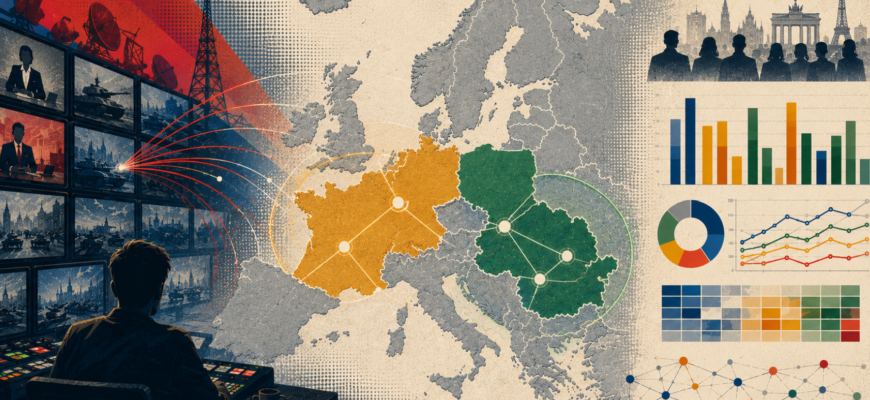
Monitoring of 9 EU countries in three clusters: the Baltic States, the Weimar Triangle and the Visegrad Group.
TL;DR: From the Baltics and Weimar to the Visegrad GroupThis monthly monitoring issue continues to monitor how Belarusian state media cover European Union countries, but for the first time expands the analytical framework to include the Visegrad Group (V4): Poland, the Czech Republic, Hungary, and Slovakia. The occasion was the GLOBSEC 2026 conference and the shift in the center of gravity of Central European policy, which Belarusian state propaganda could not ignore.
Poland is analyzed in two cluster contexts simultaneously. It remains a pivot point of the Weimar Triangle, along with Germany and France, and is also a member of the Visegrad Four. This is not double counting, but rather two analytical lenses: the same materials about Poland are read differently depending on whether they are viewed alongside Western European partners or alongside Central European neighbors.
The analysis is based on 3,843 unique materials from ten state sources for April 2026, of which 1,433 were subjected to in-depth analysis using a language model. Opposition media and media in exile were excluded from the sample, as their content is contradictory and, if combined, would distort the picture of state propaganda.
Key findings
France remains the most frequently mentioned country by volume (1,223 materials), followed by Germany (1,044) and Poland (802). However, the volume of mentions and the intensity of propaganda are two different things.
The main result of the month was the dominance of the narrative of the European Union’s internal division. This framework, in which individual countries are presented as “voices of reason” against the “Brussels dictate,” turned out to be the second-largest category in the entire dataset (211 materials) and the most prevalent in the Visegrad cluster. Of the 1,433 materials analyzed, 592 (41.3 percent) were classified as high risk.
Emotional tonality of the array:483 articles were negative, 464 were openly hostile, and only 102 were positive. TASS was cited in 87 articles, remaining the primary conduit for relaying Russian state narratives.
Three clusters, three different strategies
A comparison of the three clusters reveals not a difference in intensity, but a difference in the very logic of the attack. The Baltic states are subjected to a monotonous military attack. The Weimar Triangle is facing a diversified attack without a single dominant narrative. The Visegrad Group is being attacked in a fundamentally different way: here, the narrative of internal EU division is unconditionally dominant.
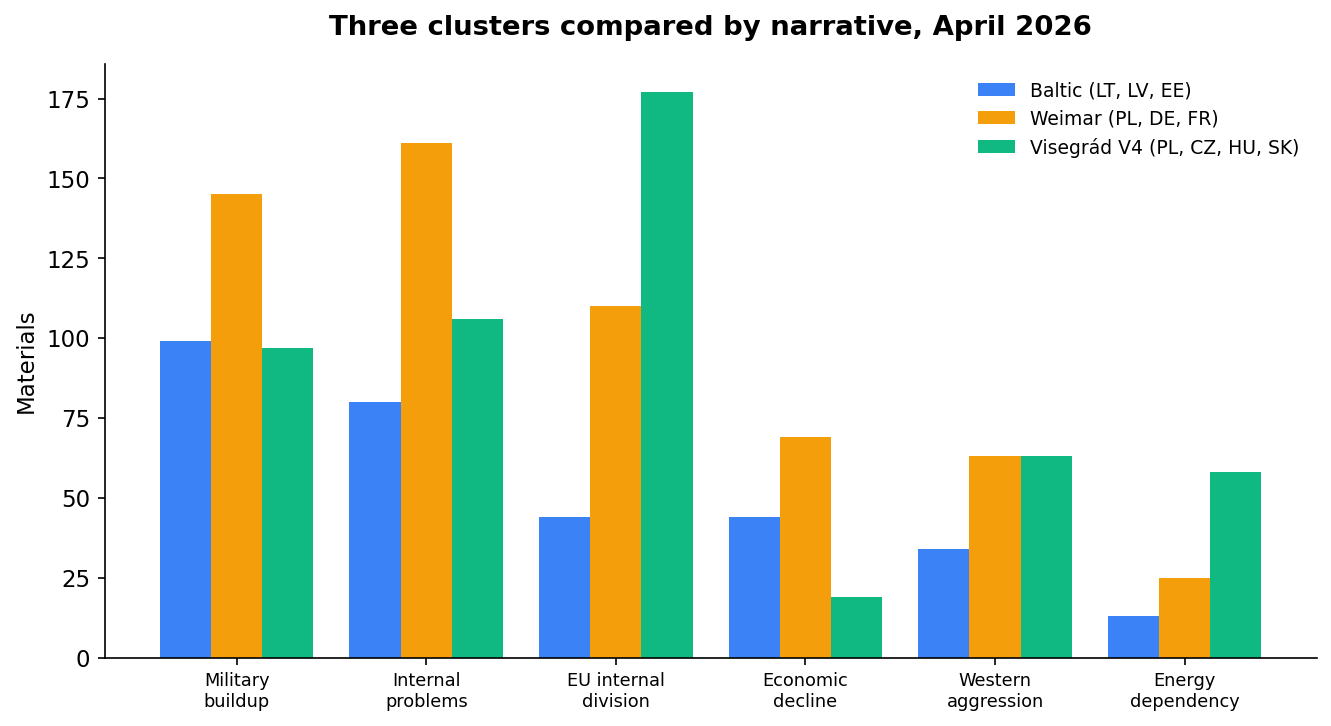
The Visegrad Group is attacked through the narrative of the EU’s internal division (177 materials), far outpacing militarization (97). Instead of portraying its neighbors as a hostile military bloc, propaganda uses them to demonstrate that the European Union is divided from within. Hungary and Slovakia play the role of “sensible” states in this construction.
Narrative profiles of the Visegrad countries
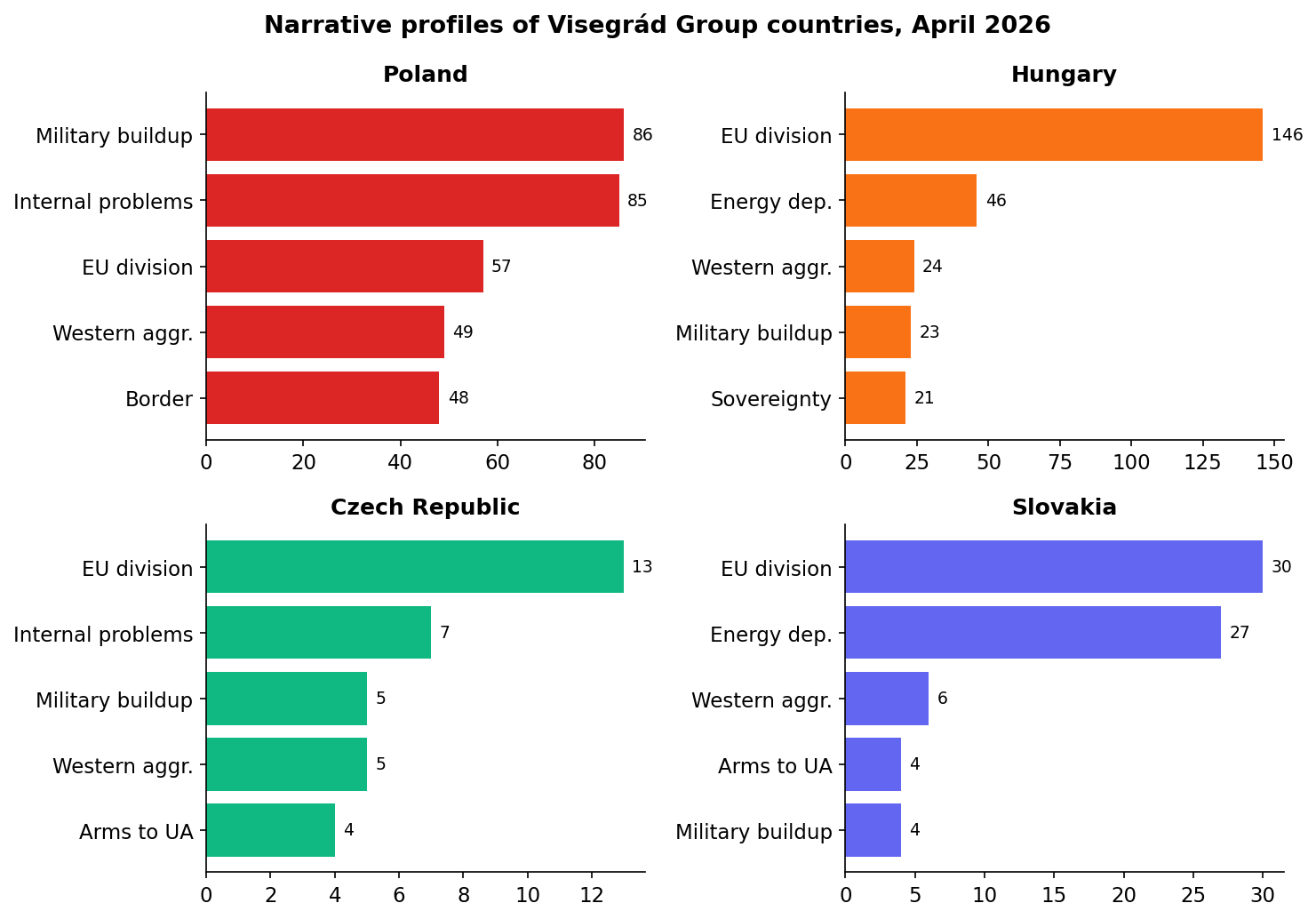
Each V4 country has its own profile. Poland is the most balanced, with no dominant narrative. Hungary is sharply tilted toward EU division. Slovakia is focused on energy. The Czech Republic received the least attention.
Hungary: Recalibrating Propaganda After April Elections
Hungary emerged as the most analytically significant case of the month. After Viktor Orbán lost the April 12 election to Péter Magyar’s Tisza party, Belarusian state media faced a problem: their long-standing “pragmatic ally” had disappeared from the political scene.
The April data reveals a propaganda machine in the midst of a recalibration. The narrative of internal EU divisions regarding Hungary is overwhelmingly dominant: 146 out of 344 stories (42 percent). The propaganda doesn’t attack the new prime minister head-on, but rather constructs a framework of conditional acceptance while simultaneously constructing an image of internal conflict.
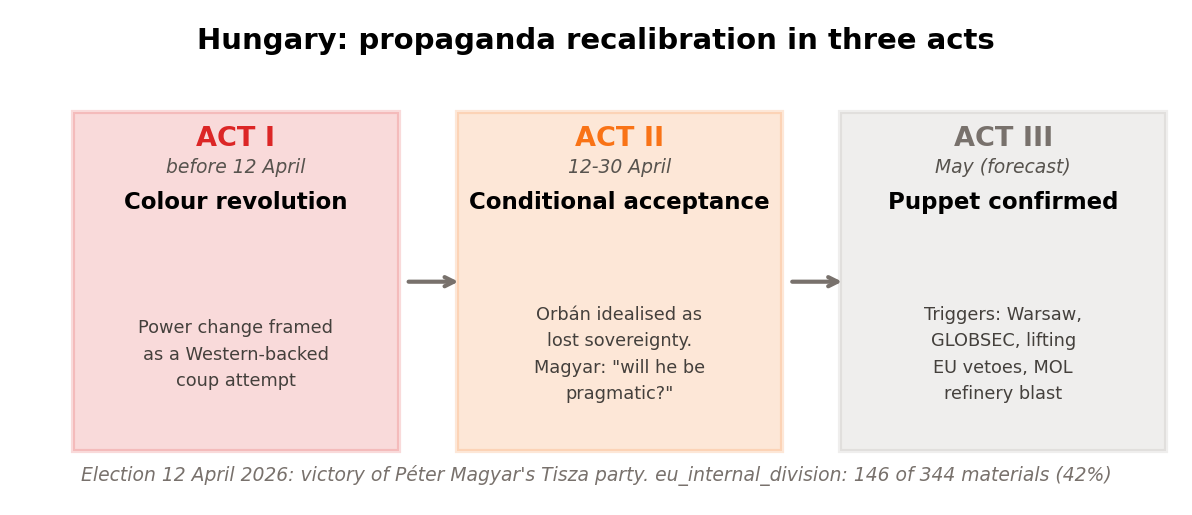
This analytically illustrates a fundamental characteristic of state propaganda: it doesn’t describe reality, but rather serves a geopolitical agenda. The same country can produce diametrically opposed narratives depending on how convenient the new government is for Moscow.
Anatomy of a campaign: Hungarian elections day by day
To demonstrate how coordination works, let’s examine one campaign in detail. The Hungarian elections of April 12 provided a rare opportunity to trace a complete narrative plot with clear checkpoints. In April, the system recorded 57 coordination events; the Hungarian line stands out for its dramatic structure.
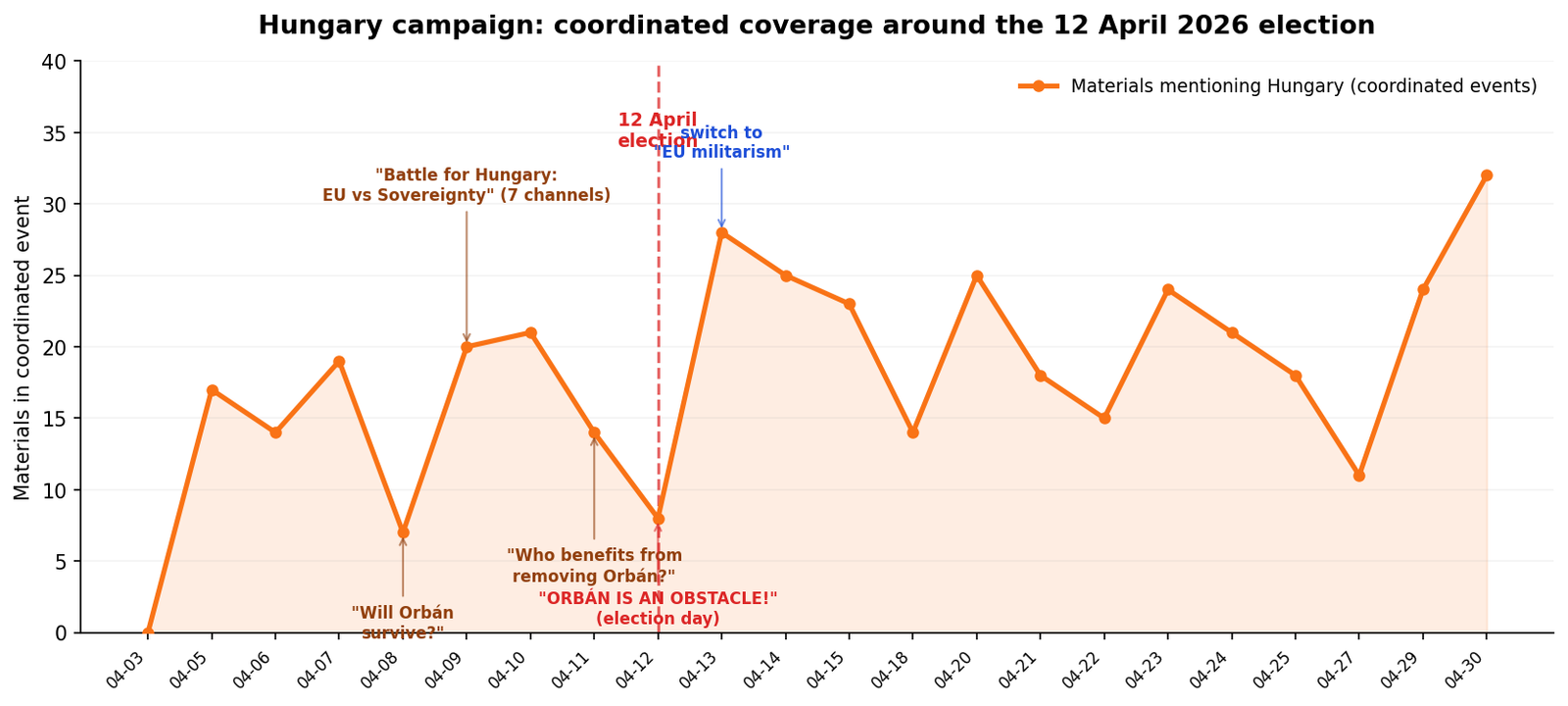
Phase 1, Preparation (April 8–11)A few days before the vote, state media hyped the topic. April 8: “Elections in Hungary: Will Orban Survive?” April 9: The first peak of synchronization, with seven channels simultaneously broadcasting “The Fight for Hungary: The EU vs. Sovereignty.” On April 11, NEWS.BY sharpened its focus: “Who Benefits from Removing Orban?” At this stage, Orban is still a hero, a sovereign leader under pressure from “globalists.”
Phase 2, Election Day (April 12)Belarus News publishes the article “ORBAN IS A HURDLE! INCONVENIENT FOR THE EU!” The volume of Hungarian coverage drops to a minimum (8), and the system awaits the outcome.
Phase 3, Reversal (from April 13)After Orbán’s defeat, there’s a sharp shift: the Hungarian topic returns at its peak (28 stories, 8 channels), but the frame shifts to “How Hungary will respond to EU militarism.” The topic doesn’t disappear; it reconnects to the persistent narrative of militarization.
This arc, the buildup before the event, the synchronized peak, and the shift in frame after an unfavorable outcome—this is the clear anatomy of what, in aggregate figures, appears simply as “the dominance of the EU split.” The coordination here isn’t verbatim copying: the channels synchronously maintain the topic and coordinately change the framing according to the political moment. This is editorial coordination of the agenda, not copy-paste.
Slovakia, the Czech Republic, and Poland in two contexts
SlovakiaDespite its modest size (86 articles), it displays one of the clearest profiles: the EU’s division (35%) and energy dependence (31%) together account for two-thirds of the submissions. “Slovakia defends its right to purchase Russian gas” is an image of energy pragmatism in defiance of Brussels.
Czech RepublicLeast attention among the V4 (64 materials). Not integrated into the energy pragmatism narrative, the pro-Ukrainian position is weakly reflected. Propaganda ignores those who firmly adhere to the Western consensus.
Poland. In the Weimar reading, it is attacked as a NATO outpost (militarization 86); in the Vysehrad reading, as a participant in Central European bargaining (EU split 57, borders 48). One data set, two strategic constructs.
What does this mean?
April 2026 demonstrated that Belarusian state propaganda, when applied to the EU, operates not as a unified stream, but as a set of differentiated strategies. The Baltics remain the target of military intimidation. The Western European core is presented as a system in crisis. Central Europe is used as a tool to demonstrate the union’s internal divisions.
The Hungarian case provides clear evidence of the instrumental nature of this entire machine. The ability of propaganda to begin a reassessment of a country that until recently served as a model of “sovereign pragmatism” in a matter of weeks demonstrates that it is based not on a description of reality, but on serving foreign policy objectives.
Methodology: The analysis is based on 3,843 unique materials from ten state and pro-government sources for April 1–30, 2026. A comprehensive analysis of 1,433 materials was performed using a large language model; visual analysis of cover images was performed using a multimodal model. A navigational filter was applied. Opposition media were excluded from the sample.